
The Unworn Bandana: Storing Accessories After Your Labrador Passes
The duct tape makes that harsh, tearing sound that echoes too loudly off the concrete walls. You’re standing there in the half-light of the garage, holding a slobber-encrusted Chuckit! launcher in one hand and a half-empty bag of glucosamine treats in the other. The cardboard box in front of you is marked "DOG" in sharpie, but you haven't been able to seal it for twenty minutes. It’s just stuff—plastic, fabric, rubber—but putting it in the dark corner behind the holiday decorations feels like a betrayal. It feels like you're packing away the last physical proof that your Labrador, with his tail that cleared coffee tables and his snore that shook the floorboards, actually existed.
Quick Takeaways:
- The "Sanctuary Box": You don't have to donate or display everything immediately. Creating a designated storage box buys you emotional time.
- Scent Preservation: If you want to keep your dog's unique scent on a blanket or bandana, seal it in a vacuum bag or airtight Ziploc immediately; open air dissipates the smell within weeks.
- The "Rule of Three": When you're ready to curate, try to narrow keepsakes down to three categories: one thing to touch, one thing to look at (like a custom pet figurine), and one thing to keep safe.
- Guilt is Normal: Putting away the water bowl doesn't mean you're erasing them. It means you're protecting yourself from the constant visual trigger of their absence.
The "Radioactive" Phase: Why You Can't Touch the Bed Yet
There is a strange phenomenon that happens in the first week after a loss. The objects your dog left behind—the leash hanging by the door, the XL orthopedic bed in the corner, the half-chewed Nylabone under the sofa—suddenly feel "radioactive."
You can't move them because that makes the house feel empty. But you can't look at them because they remind you of the emptiness.
We’ve worked with thousands of pet families, and here is the counterintuitive truth that most grief guides skip over: Leaving everything exactly as it was is often a form of self-torture.
There is a distinct difference between "honoring" and "haunting." When you trip over the water bowl for the tenth time and burst into tears, that object isn't serving a memorial purpose anymore. It’s just hurting you.
The most helpful first step isn't to decide what to keep forever. It's simply to change the location. Move the bed to a spare room. Put the bowls in a cupboard. You aren't throwing them away; you are simply deactivating the triggers so you can navigate your own home without flinching.
The Science of Scent: Preserving the "Fritos Paws" Smell
Labrador owners know the smell. It’s that earthy, slightly oily, corn-chip scent that gathers around their paws and ears. It is perhaps the most visceral trigger of memory we have.
Here is a practical reality: Scent fades much faster than fabric deteriorates.
If you have a bandana your Lab wore on their last day, or a favorite fleece blanket they slept on, leaving it out on the back of the couch will cause that scent to neutralize within 2–4 weeks. Air circulation and sunlight are the enemies here.
- Do not wash the item. This seems obvious, but habit is strong.
- Fold it inward. Keep the surface that touched the dog's skin on the inside.
- Use an airtight container. A vacuum-seal bag is best, but a double-bagged heavy-duty Ziploc works too.
- Store in a cool, dark place. Heat breaks down the organic compounds that create the scent.
We’ve had customers tell us they keep a "scent jar"—a small airtight container with a piece of their dog’s bedding—that they only open on anniversaries or particularly hard days. It’s a powerful, private way to reconnect.
The Guilt of Relief (And the urge to clean)
Let’s talk about the emotion almost no one admits to: the relief of a clean floor.
Labs are messy. They shed tumbleweeds of hair, they drip water across the kitchen, and they track mud with professional efficiency. When they pass, especially after a long illness involving incontinence or mobility issues, your house suddenly stays clean.
You might find yourself vacuuming the living room and feeling a wave of satisfaction, followed immediately by a crushing weight of guilt. How can I be happy the floor is clean? Do I care more about my rug than my dog?
This is the nuance of grief that we see constantly. You aren't relieved they are gone. You are relieved that the chaos of caretaking has paused.
Cleaning up the physical accessories—the ramps, the diapers, the pills, the endless towels—is a way of processing the trauma of the end-of-life phase. It is okay to want your home to feel orderly again. It doesn't mean you loved them less. It means you are trying to regain control of an environment that has felt out of control for a long time.
The "Not Yet" Box vs. The "Never" Box
So, back to that box in the garage.
One of the biggest mistakes grieving pet owners make is forcing a binary decision: Keep or Trash.
There is a third option: The Purgatory Box.
Get a large plastic tote (cardboard attracts moisture and pests, which can ruin keepsakes). Put everything in it. The collars, the extra leashes, the sweaters, the winter booties they hated, the brush full of fur.
Seal it. Label it "Not Yet."
Put it in the garage, the attic, or the back of a closet. Set a reminder in your phone for six months from now.
When that alarm goes off, you will likely find that your relationship to these objects has changed.
- The Leash: In the first week, it looks like a dead snake. In six months, it looks like the adventures you took together.
- The Food: In the first week, it represents the meals you can't give them. In six months, it’s just expiring kibble that could have helped a shelter dog.
Time transforms these objects from painful triggers into potential treasures (or just clutter). You cannot know which is which right now.
Curating the Shrine: The Rule of Three
Eventually, you may want to bring some things back out. But a house full of scattered dog toys when there is no dog can feel heavy.
Many of the families we work with at PawSculpt eventually transition to a curated memorial space. Instead of leaving the dog’s things everywhere, they create a specific focal point.
We recommend the Rule of Three for display:
1. Something to Touch (Texture)
This is usually the collar, a tag, or a small favorite toy. Labs are tactile creatures; you need something that feels like them. The worn leather of a collar or the specific heft of their favorite dummy bumper connects you to the physical memory of handling them.2. Something to See (Representation)
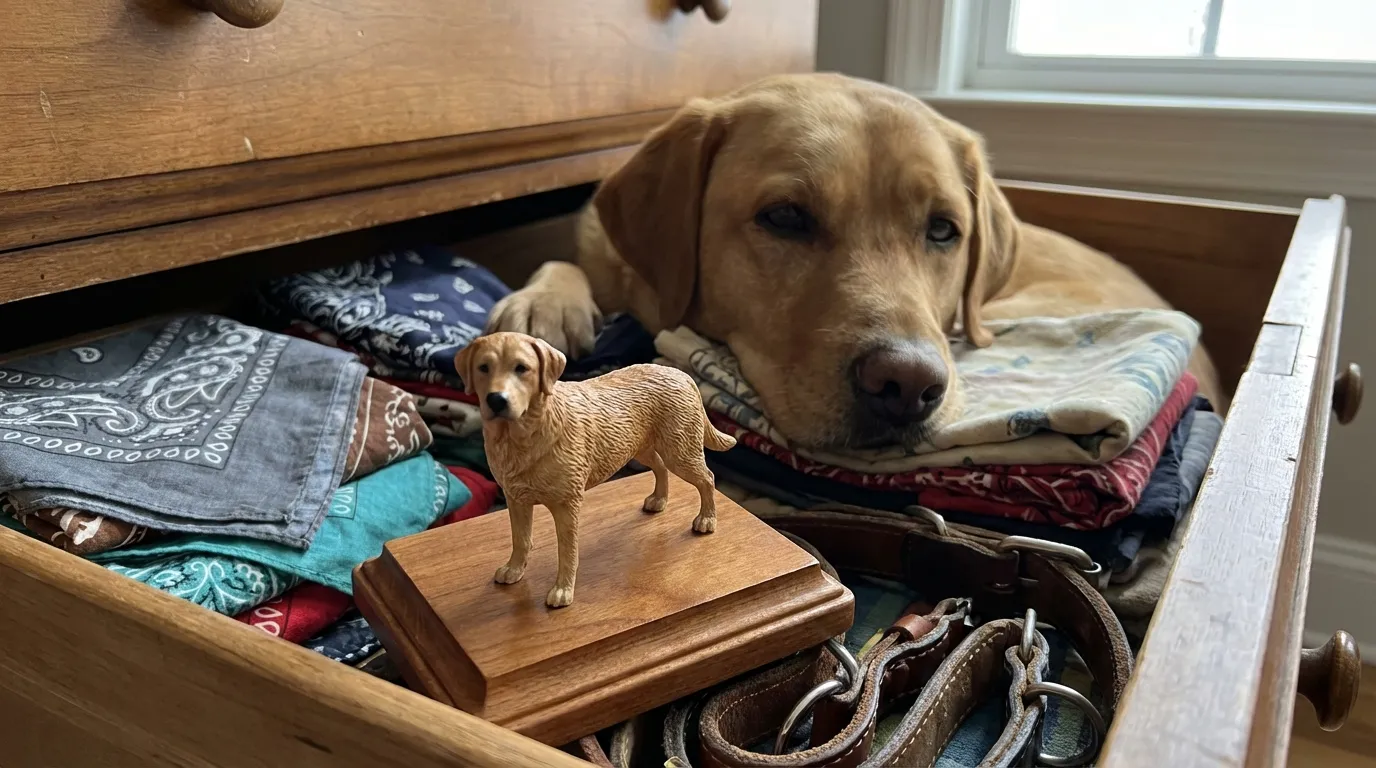
Photos are wonderful, but they are flat. This is where three-dimensional tributes bridge the gap. We’ve seen a massive shift toward tangible art. A photo captures a split second, but a custom figurine captures the posture—the way your Lab sat with one hip rolled under, or the specific tilt of their head when you said "walk." Having a physical representation of them in the room, watching over the space, can be incredibly grounding.3. Something to Contain (Remains or Earth)
If you have ashes, a customized urn fits here. If not, many people keep a small jar of earth from their favorite hiking trail or a lock of fur.By grouping these three elements on a shelf or mantle, you create a space you can visit when you need to grieve, but you also reclaim the rest of your home for living.
What to Do with the "Practical" Stuff
The hardest items are often the expensive ones. The $200 orthopedic bed. The crate. The ramp for the SUV.
There is a specific kind of pain in looking at a high-quality dog bed that is gathering dust. You might feel that selling it is mercenary, but throwing it away is wasteful.
The "Legacy Donation"
Contact your local breed-specific rescue (e.g., a Labrador Retriever Rescue). Ask if they have a foster family taking in a senior dog.Donating your items specifically to another senior dog feels different than dropping them at a Goodwill. It feels like a bequest. Your dog’s comfort items are now providing comfort to a dog that might never have known a soft bed.
Pro-Tip: Don't do this until you are ready. And if you do it, ask a friend to do the drop-off for you. Walking into a shelter or rescue center filled with barking dogs when your grief is fresh can be overwhelming.
A Note on the "Gross" Toys
Every Lab owner has that one toy. The disgusting, saliva-hardened, half-destructed stuffed pheasant or hedgehog that smells like a swamp.
Spouses or well-meaning friends might try to throw this away while you’re at work, thinking they are helping you clean up.
Do not let them.
That gross toy is often the most valuable artifact you have. It holds the evidence of your dog’s joy. The teeth marks are their signature.
If you can't stand the smell or the sight of it right now, wrap it in tissue paper and put it in a shoebox. But do not throw it away in a fit of cleaning. You can buy a new leash. You can frame a new photo. You cannot replicate the specific wear pattern on a toy your dog worked on for five years.
Closing: The Bandana in the Drawer
Six months from now, or maybe two years from now, you’ll be looking for a screwdriver in the garage. You’ll see that box.
You might open it. You might pull out that bandana.
The sharp pain you feel today will likely have softened into a dull, heavy ache—a bruise rather than an open wound. You might hold the fabric to your face and realize the scent is gone, replaced by the smell of the garage.
And surprisingly, you’ll be okay.
Because by then, you’ll realize that your memory of them isn't stored in the fabric. It isn't stored in the leash or the bowl or the crate. Those were just the accessories to the life you shared. The love is stored in you. The accessories can stay in the box, or be given away, or sit on a shelf. You don't need the object to keep the dog.
But for tonight? Tape the box shut. Put it in the corner. Turn off the garage light. It’s okay to let them rest.
Frequently Asked Questions
How soon should I pack away my dog's things?
There is no medical or psychological "correct" timeline. We see some families pack everything away within hours because the sight of an empty bed is too traumatic. Others leave the water bowl out for months. If you are unsure, use the "Not Yet" box method: pack items away so they aren't daily triggers, but keep the box accessible so you haven't made a permanent decision.Does washing my dog's blanket remove the scent?
Yes, and usually permanently. The unique scent of your dog (often described by Lab owners as "corn chips" or "earthy") comes from organic compounds and oils in their fur. Detergents break these down immediately. If you want to keep the scent, do not wash the item. Seal it in an airtight bag and store it in a cool, dark place.Is it normal to feel guilty about cleaning my house after pet loss?
Absolutely. This is one of the most common "silent" struggles of pet grief. You might feel that vacuuming up the last of their fur is an act of erasure. It is important to reframe this: you are not erasing their memory; you are maintaining your home. Your dog wanted you to be happy and comfortable, not living in a shrine of dust bunnies.What should I do with expensive pet medications?
Please do not flush them or throw them in the regular trash. Many veterinary clinics have donation bins for unexpired medications, which they can use for rescue animals or families in financial need. Alternatively, ask your local shelter if they can accept them. This is a wonderful way to let your dog's legacy help another animal heal.How do I choose which keepsakes to display?
If you keep everything, your home can feel like a museum of loss. We recommend selecting a few high-quality items that represent different aspects of your dog. A beautiful custom figurine can capture their physical likeness, while a shadow box can hold their collar and tags. Curating a small, specific space often feels more peaceful than having reminders scattered in every room.Honor Their Memory Forever
Your pet's story deserves to be preserved in a way that captures their unique spirit. A custom PawSculpt figurine transforms your cherished memories into a timeless keepsake—every whisker, every marking, every detail that made them irreplaceable.
Free instant AI preview • 3D artist preview within 7 days • 5 free revisions