
Creating a Memory Box for Your Husky: 13 Meaningful Items to Include and 4 That May Stall Your Healing
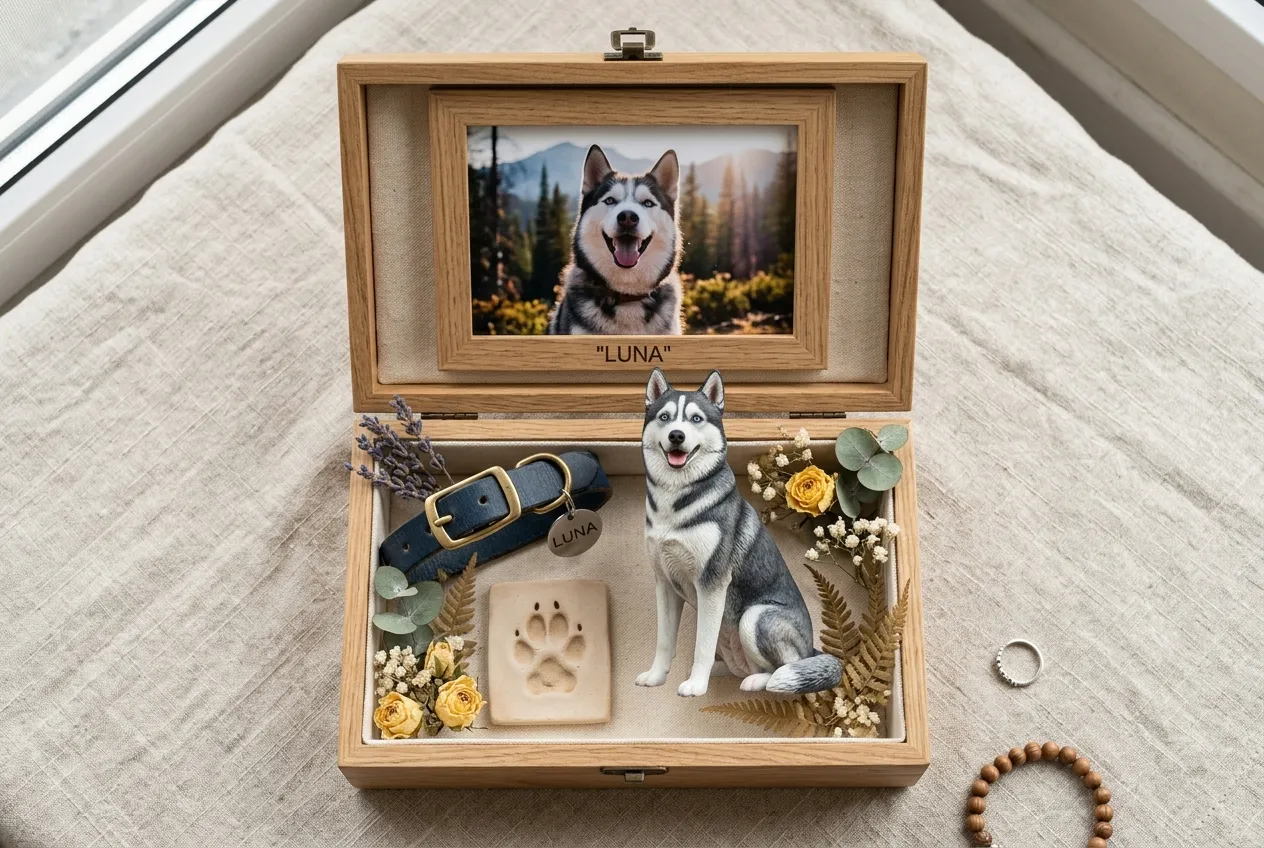
You're sorting through boxes in the basement when your hand closes around the worn tennis ball—the one with teeth marks so deep you can still feel where your Husky's canines gripped during every game of fetch.
Quick Takeaways
- Memory boxes work best when they trigger multiple senses—not just visual reminders, but textures and scents that recreate specific moments with your Husky
- Avoid items that freeze you in acute grief—certain keepsakes can anchor you to trauma rather than celebration, and recognizing the difference is crucial for healing
- The "fear of forgetting" drives most memory box choices—understanding this anxiety helps you curate items that genuinely comfort rather than items you think you should keep
- Physical keepsakes like custom 3D-printed figurines capture your Husky's unique markings—offering a tangible connection that photographs alone can't provide
- Your memory box should evolve—what comforts you at three weeks post-loss may differ dramatically from what you need at three months
The Neuroscience Behind Why Physical Memory Boxes Actually Help
Here's what grief counselors rarely explain: your brain processes tangible objects differently than digital memories. When you hold something your Husky touched, wore, or played with, your somatosensory cortex activates—the same neural pathways that fired when your dog was alive. This isn't mystical thinking. It's basic neurobiology.
Research on attachment theory shows that physical transitional objects help us maintain psychological bonds after loss. For children, it's a blanket. For grieving pet parents, it's often a collar, a favorite toy, or a tuft of fur. These items serve as what psychologists call "continuing bonds"—they don't keep you stuck in grief, they help you carry love forward.
But here's the counterintuitive part: not all physical reminders support healthy grieving. Some items can trap you in the worst moment—the final vet visit, the decision you second-guess at 3 AM, the guilt that follows relief when suffering finally ended. We'll address those later.
"The objects we keep aren't just souvenirs. They're anchors that let us revisit joy without drowning in loss."
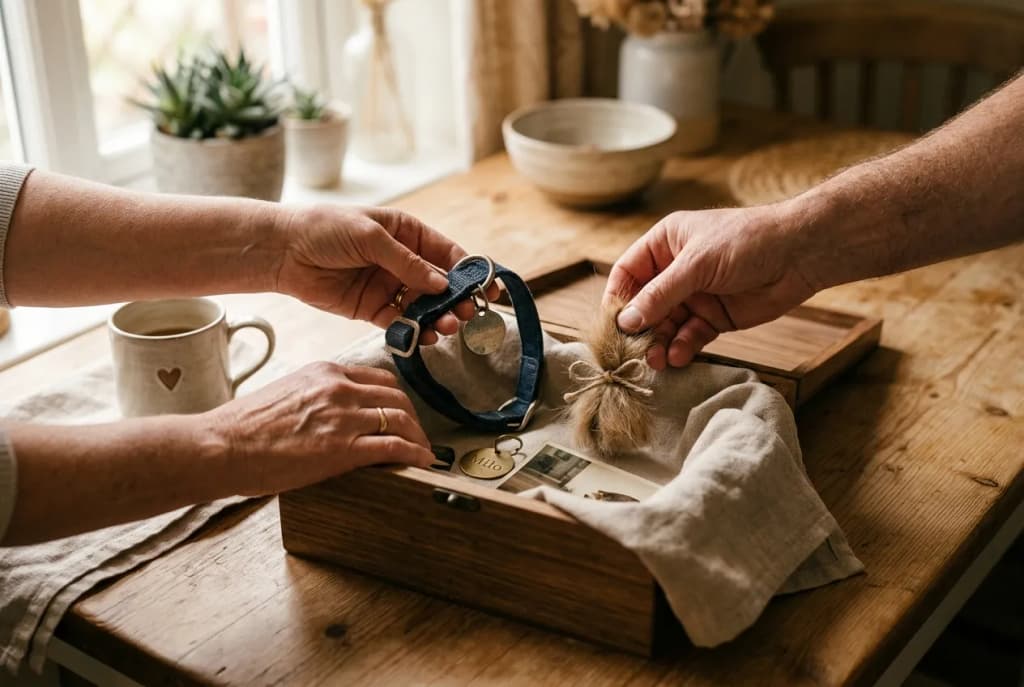
13 Items That Transform a Box Into a Healing Ritual
1. The Collar (But Remove the Tags First)
Your Husky's collar carries scent molecules that can persist for months, even years. Scent is processed through the olfactory bulb, which has direct connections to the amygdala and hippocampus—your emotion and memory centers. This is why a single whiff can transport you back to a specific moment with startling clarity.
Pro tip: Remove the ID tags and store them separately. The jingling sound can trigger acute grief responses in the early weeks. You can add them back later when you're ready for auditory memories.
2. A Paw Print Impression (Taken Correctly)
Most commercial paw print kits produce disappointing results—too shallow, smudged edges, or they crack within months. If you're creating one posthumously, use air-dry clay rather than plaster (it captures finer detail and won't crumble). Press firmly enough to get the webbing between toes—that's where your Husky's unique architecture lives.
One family we worked with took prints of all four paws and arranged them in walking formation inside their memory box. They said it felt like their dog was still moving through their lives, not frozen in stillness.
3. Fur Clippings in a Glass Vial
Huskies shed enough to knit a second dog, so you likely have plenty of fur. But here's what matters: where you collect it from. Fur from behind the ears or the chest ruff often carries more scent than the undercoat. Store it in a small glass vial with a cork stopper—plastic bags create static and degrade the texture.
Some pet parents worry this is morbid. It's not. It's tactile memory preservation. You're not trying to reconstruct your dog; you're keeping a piece of their physical presence.
4. Their Favorite Toy (Even If It's Disgusting)
That shredded rope toy with the stuffing hanging out? The squeaky ball that no longer squeaks? Keep it. Don't wash it. The bacteria that worried you when your dog was alive won't harm you now, and the scent profile is irreplaceable.
We've heard from customers who initially felt embarrassed about keeping "trash" in their memory boxes. Then they opened the box six months later, held that destroyed toy, and felt their Husky's joy in every torn seam. That's not trash. That's evidence of a life fully lived.
5. A Custom 3D-Printed Figurine That Captures Their Exact Markings
Photographs flatten three-dimensional beings into two-dimensional representations. Your brain knows something's missing. This is where full-color 3D printing technology offers something different—a physical sculpture that reproduces your Husky's unique facial markings, eye color variations, and even the specific way their ears stood.
At PawSculpt, our team digitally sculpts each figurine based on your photos, then uses advanced resin printing to create a piece where the color is embedded in the material itself—not painted on top. The result has the authentic texture of a 3D print (fine layer lines that catch light naturally) protected by a clear coat. It's not trying to be a stuffed animal or a photograph. It's its own category of remembrance.
Why this matters for Huskies specifically: Their facial masks, eye colors (often heterochromatic), and distinctive markings make them particularly well-suited to this technology. Generic memorial items can't capture the difference between your Husky and every other Husky. This does.
6. A Handwritten Letter You'll Never Send
Grief therapists call this "continuing the conversation." Write to your Husky—tell them what you wish you'd said, what you're grateful for, what you're struggling with now that they're gone. Don't edit yourself. This isn't for anyone else.
Fold it, seal it in an envelope, and place it in your memory box. You might never read it again. That's fine. The act of writing it serves a purpose: it externalizes the internal dialogue that can otherwise loop endlessly in your mind.
7. A Bag of Their Favorite Treats (Unopened)
This one surprises people, but it's remarkably effective. An unopened bag of treats represents potential—all the moments you would have shared. It's a different kind of memory than the used items. It acknowledges the future you lost, not just the past you had.
One customer told us she keeps a bag of salmon training treats in her memory box. "Every time I see it, I remember how food-motivated he was, how smart, how willing to work for a tiny piece of fish. It makes me smile instead of cry."
8. Photos Printed on Archival Paper (Not Just Digital)
Digital photos live on devices that will eventually fail, in cloud services that might not exist in twenty years, in formats that could become obsolete. Print your favorites on acid-free, archival-quality paper. Choose images that show your Husky's personality, not just their appearance.
The best memorial photos aren't always the most technically perfect ones. They're the ones where you can see your dog's soul—mid-zoomie, post-swim shake, the concentrated focus before a treat. Those are the images worth preserving in physical form.
| Photo Type | Why It Matters | What to Capture |
|---|---|---|
| Action Shot | Shows personality and energy | Mid-run, playing, working |
| Close-up Portrait | Captures unique facial features | Eye color, markings, expression |
| Environmental | Preserves context and favorite places | In their bed, favorite trail, backyard |
| Candid Moment | Reveals authentic behavior | Sleeping positions, quirky habits |
9. A Piece of Their Bedding (Small Swatch)
You don't need to keep the entire dog bed—a 6-inch square is enough. Cut it from the spot where your Husky's head rested. This fabric holds scent, yes, but it also holds shape memory—the indentation from their body, the wear pattern from months or years of use.
Seal it in a ziplock bag initially. You can open it when you need that olfactory connection, then reseal it to preserve the scent longer.
10. Your Veterinarian's Condolence Card
This might seem odd, but hear us out. That card represents professional validation of your grief. In a world where people still say "it's just a dog," having a medical professional acknowledge your loss matters. It's evidence that your grief is legitimate, witnessed, real.
Keep it even if you never look at it again. Its presence in your memory box serves a purpose.
11. A Map Marking Your Favorite Walking Routes
Print a local map and trace the routes you walked together. Mark the spots where your Husky always stopped to sniff, where they met their dog friends, where they once chased a squirrel up a tree. Geography holds memory. This map becomes a record of shared territory.
Some pet parents take this further—they frame the map and hang it. Others fold it into their memory box. Either way, it transforms abstract loss into concrete geography. Your Husky existed in physical space. This proves it.
12. A Recording of Their Vocalizations
Huskies are famously talkative. If you have video of your dog's howls, grumbles, or "talking," extract the audio and save it to a small USB drive in your memory box. Sound is the most emotionally evocative sense after smell. Hearing your Husky's voice can be painful initially, but many people find it becomes a comfort later.
Label the USB drive clearly. Future you will appreciate knowing what's on it without having to plug it in and be surprised.
13. Something That Represents Their Personality (Not Just Their Species)
This is the wild card item—the one that's specific to your individual dog. Was your Husky obsessed with a particular stick? Did they have a weird thing about cardboard boxes? Did they steal socks?
One family kept a single sock (clean, thankfully) because their Husky had stolen dozens over the years. It wasn't about the sock. It was about the mischief, the personality, the specific quirk that made their dog their dog and not just a dog.
"Memory boxes fail when they try to memorialize the idea of a pet. They succeed when they capture the irreplaceable individual."
4 Items That May Anchor You in Trauma Rather Than Love
Now for the harder conversation—the one most memory box guides skip entirely. Not every keepsake supports healing. Some items can trap you in the worst moments, triggering what psychologists call "complicated grief" where you can't move from acute pain to integrated loss.
1. The Final Vet Bill or Euthanasia Paperwork
This is the most common mistake we see. People include these documents thinking they need "complete records." What they actually create is a grief trigger disguised as documentation. Every time you open your memory box, you're forced to relive the worst day.
If you need these documents for practical reasons (pet insurance, records), file them separately. They don't belong in a space meant for healing.
The exception: If your Husky died naturally at home, peacefully, and you have a condolence card from a home euthanasia vet that focuses on the peaceful passing, that's different. Context matters.
2. Photos from the Final Days (When They Were Visibly Suffering)
We understand the impulse—you want to remember every moment. But photographs of your Husky in obvious decline, emaciated, or in pain don't honor their memory. They override your brain's earlier, healthier memories.
Neuroscience shows that the most recent memories often dominate. If the last images you see are of suffering, those become the default mental picture. This is why many grief counselors recommend focusing on photos from when your pet was healthy and happy.
What to do instead: If you feel compelled to keep these photos, store them in a separate envelope, sealed, labeled "Final Days—Open Only If Needed." This gives you access without making them the first thing you see.
3. Items That Trigger Guilt About Decisions You Made
Did you choose to euthanize? Did you wait too long? Not long enough? The guilt-relief-guilt cycle is one of pet loss grief's cruelest features. You feel relief when suffering ends, then guilt about feeling relief, then guilt about the timing of your decision.
Items that trigger this specific loop—like the appointment card from the euthanasia visit, or a toy you bought the week before they died—don't belong in your memory box. They keep you stuck in second-guessing rather than remembering.
The psychological reality: You made the best decision you could with the information you had. A memory box should reinforce love, not interrogate choices.
4. Anything You're Keeping Because You Think You "Should"
This is subtle but important. Some items end up in memory boxes because of external pressure—what you think other pet parents do, what seems "normal," what you'd be judged for not keeping.
If an item doesn't genuinely comfort you or connect you to positive memories, you don't owe it space in your box. This isn't a museum exhibit. It's a personal healing tool.
One customer told us she initially included her Husky's medical records because she thought she "should" document everything. Six months later, she removed them. "I don't need paperwork to prove he existed. I need things that make me feel his presence."
The "What We Wish We Knew Sooner" Sidebar
From the PawSculpt Team:
- Wait at least two weeks before finalizing your memory box. What comforts you in acute grief may differ from what helps long-term. We've seen people add and remove items multiple times before finding the right combination.
- Scent fades faster than you think. If scent preservation matters to you, seal items in airtight containers within the first month. We learned this the hard way with our own pets.
- Digital backups of physical items matter. Photograph everything in your memory box. If something gets damaged or lost, you'll have a record. This sounds paranoid until it happens.
- Your memory box can include items for your next dog. Some people add a small note or token representing their readiness to love again. It's not betrayal. It's honoring the capacity for love your Husky taught you.
- The box itself matters. Choose something beautiful, sturdy, and appropriately sized. A shoebox feels temporary. A wooden box with a latch feels intentional. The container communicates how you value what's inside.
When to Open Your Memory Box (And When to Leave It Closed)
This is the part no one tells you: a memory box isn't meant to be opened daily. It's not a photo album. It's more like a time capsule you access intentionally, when you need that specific kind of connection.
Good Times to Open It:
- Your Husky's birthday or adoption anniversary—these dates will always carry weight; the memory box gives you a ritual for marking them
- When you're ready to share stories with someone new—showing your memory box to a partner, friend, or future pet can be a way of introducing them to your Husky
- When you notice you're starting to forget details—the texture of their fur, the exact pattern of their markings, the sound of their collar jingling
- When you need to cry and can't access the feeling—sometimes grief gets stuck; physical items can unlock it
Times to Leave It Closed:
- When you're already in acute emotional distress—don't pile on; the memory box isn't for deepening pain, it's for processing it
- When you're using it to avoid moving forward—if you're opening it multiple times daily, it may have become a form of rumination rather than remembrance
- When someone else pressures you to "move on"—don't open it to prove your grief is valid; you don't owe anyone access to your healing process
"Grief isn't linear. Some days you'll need the box. Some months you won't. Both are normal."
The Sensory Architecture of Memory: Why Huskies Need Multi-Modal Keepsakes
Huskies engage the world through multiple sensory channels simultaneously. They're visual hunters (those striking eyes aren't just for show), they're scent-driven, they're vocal, they're tactile. A memory box that only addresses one sense—usually visual through photos—misses the full dimensionality of who they were.
This is why the most effective memory boxes include:
- Visual: Photos, figurines, collar
- Tactile: Fur, bedding, toys
- Olfactory: Unwashed items, treat bags
- Auditory: Recorded vocalizations (stored digitally but accessed through the box)
When you engage multiple senses, you're activating broader neural networks—creating a more complete memory reconstruction. This isn't about perfectly recreating your Husky's presence. It's about honoring the full sensory experience of loving them.
| Sense | Memory Type | Best Keepsake Options | Why It Works |
|---|---|---|---|
| Visual | Facial recognition, color, movement | Photos, figurines, collar | Activates visual cortex and recognition centers |
| Tactile | Texture, weight, temperature | Fur, toys, bedding swatch | Engages somatosensory cortex |
| Olfactory | Scent memory (strongest) | Unwashed collar, bedding, toys | Direct pathway to amygdala and hippocampus |
| Auditory | Vocalizations, environmental sounds | Recorded howls, collar jingle | Temporal lobe processing, emotional memory |
How to Curate Your Memory Box When You Have Multiple Pets
If you've lost more than one Husky—or if you have other pets still living—the memory box becomes more complex. You're not just preserving one relationship; you're honoring multiple bonds while acknowledging that each was unique.
The mistake: Creating a generic "pet memorial" box where everything blurs together. This dilutes the individual significance of each animal.
The better approach: Separate boxes for each pet, or clearly divided sections within one larger box. Each Husky gets their own space, their own items, their own story.
One family we worked with created a shelf system—each pet had their own box, arranged chronologically. They said it helped them remember each dog as an individual, not as a collective "the dogs we've loved."
For living pets: Some people include a small item representing their current dog—a photo, a note about what they're learning from this pet. It acknowledges that love continues, that your capacity to bond wasn't buried with your Husky.
The Evolution of Your Memory Box: What Changes Over Time
Here's what we've observed from hundreds of pet families: your memory box will change, and that's healthy. What you need at three weeks post-loss differs dramatically from what you need at three years.
Months 1-3: The Acute Phase
Your memory box might be opened frequently. You're still in the stage where you need constant reassurance that your Husky existed, that your grief is real, that the love was worth this pain. Items that provide sensory immediacy—scent, texture, sound—matter most now.
Months 4-12: The Integration Phase
You're beginning to carry your Husky's memory without needing constant physical reminders. The memory box gets opened less frequently, but when you do open it, you're looking for different things—stories, personality, joy rather than just presence.
This is when people often add new items: a photo they found on an old phone, a story they wrote down, a drawing a child made.
Year 2+: The Continuing Bond Phase
The memory box becomes something you access intentionally, often on anniversaries or when you want to share your Husky's story with someone new. You might add items that represent how they changed you—a photo from a hiking trip you only took because your Husky taught you to love the outdoors, a certificate from a volunteer program you joined in their honor.
The psychological term for this is "meaning-making"—transforming loss into purpose, pain into growth. Your memory box can document this evolution.
Addressing the Fear of Forgetting: Why Physical Items Matter More Than You Think
Let's talk about the anxiety that drives most memory box creation: the terror of forgetting. Not just forgetting what your Husky looked like—photos handle that—but forgetting the specific details that made them them.
The way they tilted their head when confused. The exact pitch of their howl. The weight of their head on your lap. The smell of their fur after a walk in the rain.
These sensory-specific memories fade faster than visual memories. This is normal neurobiology—your brain prioritizes recent sensory input over old data. But it feels like betrayal. It feels like losing them twice.
Physical items in a memory box serve as memory anchors. They don't perfectly preserve the past, but they provide enough sensory input to help your brain reconstruct more complete memories. The collar's weight reminds you of how it felt to clip on the leash. The fur's texture brings back the sensation of petting them. The toy's shape recalls the specific way they carried it.
This is also why custom figurines work differently than photos. A photo is flat, backlit, mediated through a screen. A figurine is three-dimensional, tactile, present in physical space. You can hold it, turn it, see how light falls across the features. Your brain processes it more like a memory of your actual dog than like a representation of your dog.
What to Do When Well-Meaning People Don't Understand Your Memory Box
You'll encounter people who think memory boxes are "too much" or "unhealthy" or "preventing you from moving on." These people mean well. They're also wrong.
The research is clear: maintaining continuing bonds with deceased loved ones (including pets) is psychologically healthy. It's not denial. It's integration. You're not pretending your Husky is still alive; you're acknowledging that the relationship continues to shape who you are.
When someone questions your memory box:
- You don't owe them an explanation. "This helps me" is a complete sentence.
- Redirect to education: "Research on grief shows that physical keepsakes support healthy processing."
- Set boundaries: "I appreciate your concern, but I'm comfortable with how I'm handling this."
One customer told us her mother-in-law said keeping her Husky's collar was "morbid." She responded: "I kept my grandmother's wedding ring. This is the same thing." That ended the conversation.
The truth: People who haven't experienced profound pet loss often don't understand the depth of the bond. That's their limitation, not yours.
The Practical Details: Choosing and Maintaining Your Memory Box
Let's get tactical. The container itself matters more than you might think.
Material Options:
- Wood: Feels permanent, ages well, can be engraved with your Husky's name
- Metal: Airtight options available, good for scent preservation, can feel cold
- Fabric-covered: Softer aesthetic, less protective, better for items that don't need sealing
- Acrylic/Glass: Lets you see contents without opening, can feel too display-oriented
Our recommendation: A wooden box with a hinged lid and a latch. It feels intentional. It protects contents. It can be personalized.
Size Considerations:
Don't go too large—you'll feel pressure to fill it. Don't go too small—you'll have to make painful choices about what to exclude. A box roughly 12" x 8" x 6" works for most people. That's enough space for 10-15 meaningful items without becoming a storage unit.
Maintenance:
- Check it annually for any degradation—moisture, pests, material breakdown
- Replace any ziplock bags that have lost their seal
- Consider silica gel packets if you live in a humid climate
- Keep it in a climate-controlled space—not the garage, not the attic
Personalization:
Many people engrave their Husky's name and dates on the box. Others add a photo to the lid. Some keep it unmarked—the contents are personal enough. There's no wrong choice here.
When You're Ready: Adding Items That Represent Moving Forward
This is the part that feels like betrayal but isn't: eventually, your memory box might include items that represent life after loss.
A photo of your new dog (if you get one) with a note about what your Husky taught you about love. A trail map from a hike you took while grieving. A journal entry about the moment you realized you could remember them without crying.
These items don't diminish your Husky's significance. They document the continuing impact of having loved them. They show that grief transformed into something else—not forgetting, but integrating.
One customer added a small stone from a beach she visited six months after her Husky died. She wrote: "This is where I first felt joy again. He would have loved this beach. I'm grateful he taught me to notice beauty."
That's not moving on. That's carrying love forward.
The Intersection of Physical and Digital: Creating a Hybrid Memory System
We live in a digital age, but grief is analog. The most effective memorial systems combine both.
Your memory box holds the physical items—the things you can touch, smell, hold. But you should also maintain:
- A digital photo album (cloud-stored with multiple backups) of your Husky
- A document with written memories—stories, quirks, favorite things
- Video clips of typical behaviors, vocalizations, movements
- A playlist of songs that remind you of them or that you played during your time together
The physical memory box is for sensory connection. The digital archive is for comprehensive documentation. You need both.
Some people create a private Instagram account or a password-protected blog where they post memories. Others use note-taking apps. The platform doesn't matter—the act of recording does.
Why this matters: Your memory will fade. That's not failure; it's neurobiology. External memory systems (physical and digital) compensate for this inevitable process.
Creating Your Memory Box: A Step-by-Step Timeline
If you're reading this in the immediate aftermath of loss, you might feel paralyzed about where to start. Here's a realistic timeline:
Week 1: Gather, Don't Curate
Collect anything that might matter. Don't make decisions yet about what stays or goes. Put everything in a temporary container—a cardboard box, a bag, whatever. You're not ready to curate. You're just preserving options.
Weeks 2-4: Begin Selection
Now you can start making choices. Hold each item. Does it comfort you or distress you? Does it remind you of joy or pain? Keep the former, set aside the latter.
This is when you might order a custom figurine if you're considering one—the process takes time, and having it arrive a few weeks into your grief can provide a new touchpoint when the acute shock has worn off but the ache remains.
Months 2-3: Finalize and Organize
Choose your permanent container. Arrange items intentionally. Add any written components (letters, stories, notes). Seal items that need preservation.
Month 6+: First Review
Open your memory box and assess. Are there items you want to add? Remove? Change? This isn't set in stone. It's a living document of your grief and healing.
The Role of Ritual: How to Use Your Memory Box Intentionally
A memory box isn't just a container. It's a ritual object. How you interact with it matters.
Some people light a candle before opening it. Others play specific music. Some take it to a meaningful location—the park where they walked, the backyard where their Husky played.
The ritual creates a boundary—it signals to your brain that you're entering a specific emotional space. This is important because it prevents the memory box from becoming either too casual (opened mindlessly) or too fraught (avoided entirely).
One family we worked with opens their Husky's memory box together once a month, on the date he died. They each share a memory. They look at photos. They hold his collar. Then they close the box and go do something he loved—usually a hike. The ritual has a beginning, middle, and end.
This is healthy grief: contained, intentional, integrated into ongoing life rather than consuming it.
Frequently Asked Questions
How soon after pet loss should I create a memory box?
There's no perfect timeline, but most grief counselors recommend waiting at least one to two weeks before you start making permanent decisions about what to include. In the immediate aftermath, you're in shock—your judgment about what will comfort you long-term isn't reliable yet.
Gather items in those first weeks, but don't finalize your memory box until you're two to three months out. By then, you'll have a better sense of what genuinely helps versus what keeps you stuck in acute pain.
Is it normal to feel guilty about which items to include or exclude?
Completely normal. The fear of forgetting makes every choice feel impossibly weighted. You worry that excluding an item means erasing a part of your Husky's existence.
Here's the truth: you're not creating a comprehensive archive. You're curating what helps you heal. Your memory box doesn't have to prove your love was real or document every moment. It just has to serve your grief process. Give yourself permission to be selective.
Should I include items from my Husky's final days or euthanasia appointment?
In most cases, no. Items from when your pet was visibly suffering or from the euthanasia appointment itself tend to trigger complicated grief—they anchor you in trauma rather than love. The exception is if your Husky died peacefully at home and you have gentle, comforting associations with those final moments.
Focus on keepsakes from when your dog was healthy, happy, and fully themselves. That's the version you want to remember most vividly.
How do I preserve my Husky's scent in the memory box?
Scent fades faster than most people realize—often within weeks if items aren't properly stored. If scent preservation matters to you, seal unwashed items (collar, bedding, toys) in airtight ziplock bags or glass containers within the first month.
Fur from behind the ears or the chest ruff typically holds scent longer than undercoat fur. Store it in a small glass vial with a cork stopper rather than plastic, which can create static and degrade the texture.
Can I add items to my memory box over time, or should it stay the same?
Your memory box should absolutely evolve. Many people add items months or even years after the initial loss—a photo they discovered on an old device, a story they wrote down, a drawing their child made, or something that represents how their Husky changed them.
The memory box isn't a time capsule sealed at the moment of death. It's a living document of your continuing relationship with your pet's memory.
What if opening my memory box makes me cry every time?
That's completely normal, especially in the first six to twelve months. Crying is how your body processes grief—it's not a sign that something's wrong. The memory box is working exactly as intended if it helps you access and release emotion.
However, if opening the box triggers panic attacks, prevents you from functioning in daily life, or keeps you trapped in acute grief beyond the first year, consider working with a pet loss grief counselor. There's a difference between healthy crying and complicated grief that needs professional support.
Ready to Preserve Your Husky's Memory?
The items you choose for your memory box tell a story—not just of loss, but of a unique bond that shaped both of you. Whether you're gathering your Husky's collar and favorite toy or considering a custom figurine that captures their distinctive markings and soulful eyes, each piece serves as a tangible anchor to the love you shared.
Visit pawsculpt.com to see how full-color 3D printing technology can create a lasting tribute to your Husky's one-of-a-kind personality
Your memory box isn't about preventing grief. It's about giving grief a place to live—contained, intentional, honored—so it doesn't have to consume your entire life. The collar you're holding in the basement right now, the one with teeth marks worn smooth from years of play, deserves a home that acknowledges both the joy it represents and the ache of its stillness.
You're not trying to bring your Husky back. You're making sure you never have to say goodbye completely. That's not denial. That's love continuing in the only form still available to you.
And that's worth preserving with care.