
Thank You Gifts for Pet Sitters: 9 Ways to Honor the Person Who Loved Your Scottish Fold
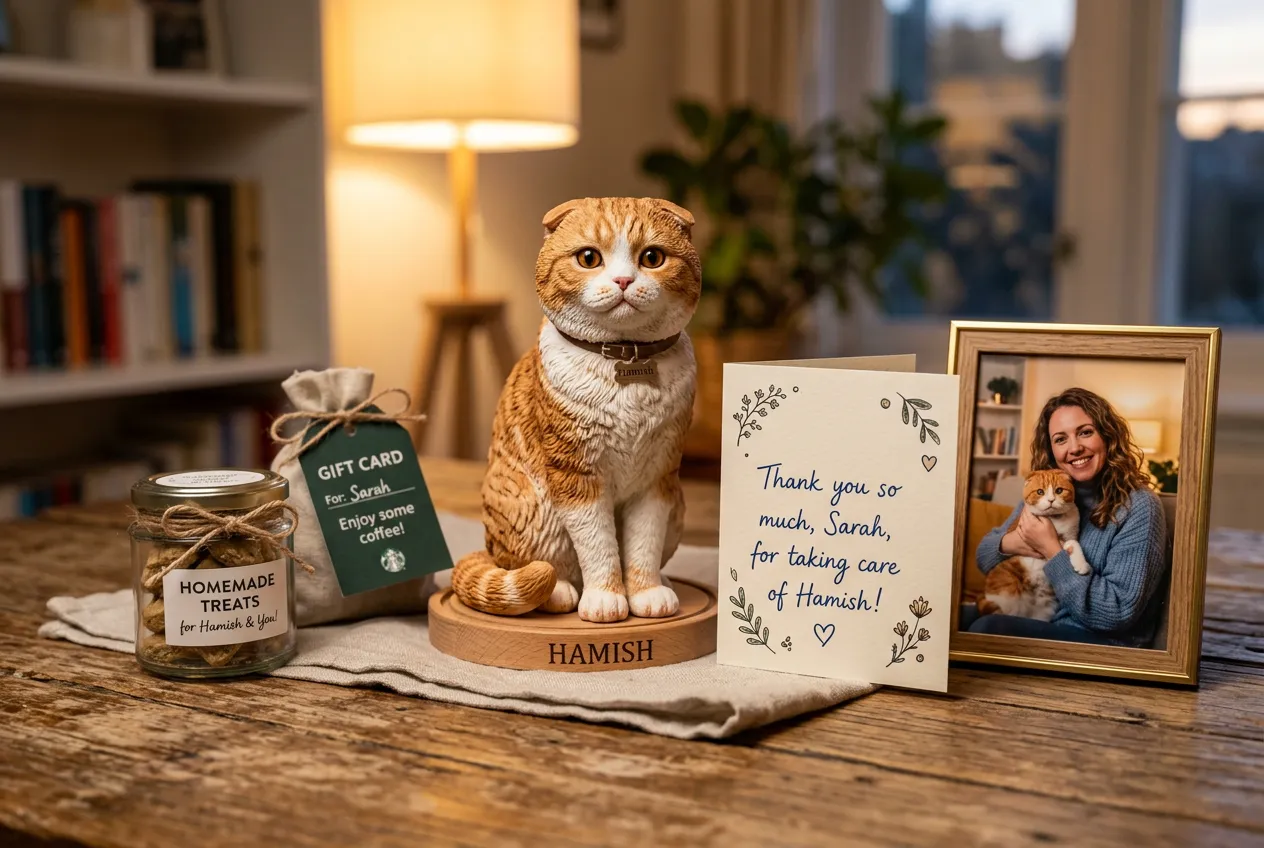
She was halfway down the hallway, dragging her suitcase toward the front door, when she heard it—the unmistakable chirp of her Scottish Fold, followed by her pet sitter's voice, soft and low, saying "I know, buddy, I'll miss you too." She stopped. And right there, standing between the coat rack and the shoe bench, she realized she had no idea how to thank someone for that kind of love. If you've ever searched for the right pet sitter thank you gifts, you already know: the gratitude is easy. The expression of it is the hard part.
Quick Takeaways
- Match the gift to the bond, not the budget — a $15 gift chosen with precision beats a generic $50 one every time
- Gifts that reference YOUR specific pet hit harder emotionally — they prove you noticed the sitter noticing your cat
- Timing matters more than you think — deliver within 48 hours of your return for maximum psychological impact
- A custom keepsake like a 3D-printed pet figurine turns a thank-you into a lasting tribute — especially for long-term or live-in sitters
- Pair a physical gift with a handwritten note — the combination triggers deeper gratitude recognition in the brain than either one alone
Why Most Pet Sitter Gifts Miss the Mark (And What Psychology Says Actually Lands)
Here's the counterintuitive thing nobody talks about in those "top 10 gift ideas" roundups: most thank-you gifts for pet sitters fail because they thank the wrong thing.
They thank the task. The feeding. The litter box scooping. The twice-daily medication routine.
But that's not what kept your Scottish Fold calm while you were 2,000 miles away. What kept your cat calm was the sound of someone else's breathing in the room at 2 a.m. The specific way your sitter learned that your Fold prefers the crinkle toy over the feather wand. The patience it took to earn that first slow blink.
Attachment theory—the framework psychologists use to understand bonding—doesn't just apply to parent-child relationships or romantic partners. Research from institutions like the Human Animal Bond Research Institute confirms that the bonds between humans and companion animals activate the same neurological pathways. Oxytocin floods the brain. Cortisol drops. The bond is biochemically real.
Your pet sitter stepped into that bond temporarily. They became a surrogate attachment figure for an animal that doesn't understand calendar apps or return flights. That's not a task. That's an emotional labor of the highest order.
So the gift that actually resonates? It acknowledges the relationship, not the résumé.
"The best thank-you gifts we've seen aren't about the sitter's job—they're about the sitter's heart."
Let's get specific.
The 9 Best Thank-You Gifts for Your Scottish Fold's Caregiver
Before we walk through each gift, here's a quick comparison to help you scan based on your situation:
| Gift | Best For | Budget Range | Emotional Impact | Effort Level |
|---|---|---|---|---|
| Custom Pet Figurine | Long-term/live-in sitters | $$-$$$ | ⭐⭐⭐⭐⭐ | Low (you upload photos) |
| Handwritten Letter + Café Card | Any sitter, any duration | $ | ⭐⭐⭐⭐ | Medium |
| Pet-Themed Jewelry | Close friend/family sitter | $$-$$$ | ⭐⭐⭐⭐ | Medium |
| "Their Favorite Thing" Basket | Sitters you know well | $$-$$ | ⭐⭐⭐⭐ | High |
| Photo Book of the Sit | Tech-savvy sitters | $-$$ | ⭐⭐⭐⭐⭐ | High |
| Donation in Their Name | Ethically-minded sitters | $-$$ | ⭐⭐⭐ | Low |
| Experience Gift | Professional sitters | $$-$$$ | ⭐⭐⭐ | Medium |
| Premium Pet Care Tools | Professional sitters building a kit | $$-$$$ | ⭐⭐⭐ | Low |
| The "Open When" Letter Set | Recurring sitters | $ | ⭐⭐⭐⭐⭐ | High |
Now let's dig in.
1. A Custom 3D-Printed Figurine of Your Scottish Fold
Who it's for: The sitter who fell in love with your cat. The one who sends you unsolicited photos. The one who cried a little at pickup.
Budget: $$–$$$ (visit pawsculpt.com for current options)
This is the gift that makes people gasp. And here's why it works on a psychological level most people don't consider: object permanence isn't just for babies. When your pet sitter goes home, there's a real—if mild—grief response. The house is quieter. No one chirps at them from the windowsill. A physical, tangible representation of that animal they bonded with gives the brain something to anchor the memory to.
PawSculpt creates these using full-color 3D printing technology, where master digital sculptors model your Scottish Fold's exact features—those signature folded ears, the particular tilt of the head, that copper-and-cream tabby pattern—and then print it in full-color resin. The color isn't painted on. It's embedded directly into the material, voxel by voxel, which means every stripe and whisker marking is part of the figurine itself. A clear protective coat gets applied afterward for durability and sheen.
Why it stands out: Most Scottish Fold gifts are generic cartoon cats with folded ears. This is their Scottish Fold. The one who drooled on their lap. That specificity is what transforms a gift from "nice" to "I can't believe you did this."
Pro tip: Upload a photo where your cat's personality is showing—mid-yawn, perched on a weird surface, doing that owl-head thing Folds do. The sculptors work from photos, so the more character, the better the result.
2. A Handwritten Letter Paired with a Café Gift Card
Who it's for: Literally anyone. This is the universal solvent of gratitude.
Budget: $10–$25
Here's something that will change how you think about thank-you notes: a study published in Psychological Science found that people systematically underestimate how much recipients value expressions of gratitude. The senders felt awkward. The receivers felt moved. The gap was enormous.
You don't need to write a novel. You need to write three sentences that are brutally specific.
Not: "Thanks for watching Mochi! You're the best!"
But: "You figured out that Mochi only drinks from the bathroom faucet. That took patience I'm not sure I would've had with someone else's cat. Thank you for being the kind of person who pays attention."
Pair that with a $15 card to their favorite coffee shop, and you've created a gift that costs almost nothing but activates the brain's reward circuitry in a way a $100 generic gift basket never could. Specificity is the mechanism. It proves you were paying attention to them paying attention.
Pro tip: Mail it. Don't hand it over. The anticipation and surprise of receiving physical mail amplifies the emotional response—that's basic behavioral psychology, and it works every time.
3. Pet-Themed Jewelry Featuring Scottish Fold Details
Who it's for: A close friend or family member who sat for you—someone whose taste you know well enough to buy wearable items.
Budget: $20–$75
The market for Scottish Fold gifts has expanded wildly in the past few years. You can find delicate sterling silver necklaces with folded-ear cat silhouettes, minimalist bracelets with paw-print charms, even custom-engraved pieces where your cat's actual ear shape is replicated from a photo.
Why it stands out: Jewelry is inherently personal. It travels with the wearer. Every time they touch that necklace at their desk, their brain fires a micro-burst of the positive association—your cat's purr, the warm weight on their chest during movie night. That's not sentimentality. That's classical conditioning, and it's powerful.
Avoid: Cheap costume pieces that turn green. If you're going jewelry, go small but real. A tiny sterling silver Fold-ear pendant from an Etsy artisan beats a chunky plated charm bracelet from a big-box retailer. Always.
Pro tip: Check if the sitter has pierced ears before buying earrings. Sounds obvious. You'd be surprised how many people skip this step.
4. The "Their Favorite Thing" Basket
Who it's for: A sitter you know personally—a neighbor, a friend, a family member whose preferences you've cataloged.
Budget: $25–$60
This is the gift that says: "I see you as a whole person, not just the person who feeds my cat."
The concept is simple. You build a small basket around something they love. Not cat-themed. Not pet-adjacent. Theirs.
- Your sitter is a runner? A new pair of moisture-wicking socks, a gift card to their favorite smoothie spot, a mini foam roller.
- They're a reader? A bookshop gift card, a scented candle, a packet of fancy hot chocolate.
- They're a plant person? A propagation station, a rare cutting, a ceramic pot.
"A thank-you gift that has nothing to do with your pet can say more about gratitude than one that does."
The psychology here is identity affirmation. You're telling the sitter: I recognize that you have a life beyond my cat, and I value that life. In a world where pet sitters—especially informal ones—often feel invisible, this kind of recognition activates what psychologists call self-determination theory: the deep human need to feel seen, competent, and connected.
Pro tip: Throw one tiny cat-related item in there anyway. A Scottish Fold sticker. A mini card with your cat's face. It bridges both worlds.
5. A Photo Book Documenting the Sit
Who it's for: Sitters who sent you daily photo updates (and the ones who deserved to have someone do the same for them).
Budget: $15–$40
Most sitters take photos for you. But when was the last time someone made a photo book for them?
This flips the script entirely. You curate a small photo book—services like Chatbooks, Shutterfly, or Artifact Uprising make this painfully easy—that documents the relationship between your sitter and your Scottish Fold. Include the goofy selfies they sent. The blurry action shots. The one where your cat is asleep on their laptop keyboard.
Why it stands out: This gift has what behavioral economists call high "story value." It's not just an object. It's a narrative artifact. When the sitter shows it to someone, they don't say "look what I got." They say "look at this cat I took care of" and then proceed to tell six stories. The gift becomes a vehicle for social bonding, which extends its emotional lifespan far beyond the moment of opening.
Pro tip: Add captions. Even short ones. "Day 3: Mochi finally sat on your lap" hits different than just the photo alone.
6. A Charitable Donation in Their Name
Who it's for: The sitter who volunteers at shelters, fosters kittens, or has a "rescue" bumper sticker. You know the type.
Budget: $15–$50
Choose an organization that aligns with their values. The ASPCA is a safe bet, but local cat rescues or breed-specific organizations often hit closer to home. Some organizations send a physical card to the honoree, which adds a tangible element.
Why it stands out: This gift activates what psychologists call "warm glow giving"—the neurological reward we get from prosocial behavior. But here's the twist: the warm glow hits twice. Once for you (the giver) and once for the sitter (the honoree). It's a doubled dopamine loop. Efficient.
The honest counter-point: Not everyone loves donation gifts. Some people—especially younger sitters or those in tight financial situations—might prefer something they can actually use. Read the room. If you're not sure, pair a small donation with a physical gift.
Pro tip: If your Scottish Fold is a rescue, donate to the organization you adopted from and mention that in the card. The circularity of that gesture is profound.
7. An Experience Gift
Who it's for: Professional pet sitters who already own every pet-related gadget, or sitters who value experiences over objects.
Budget: $30–$100
Think: a movie ticket pair, a cooking class voucher, a massage gift card, tickets to a local event. The key is choosing something they wouldn't buy for themselves.
| Experience Type | Price Range | Why It Works | Best For |
|---|---|---|---|
| Movie tickets (pair) | $25–$35 | Low commitment, universal appeal | Casual/new sitters |
| Cooking or pottery class | $40–$80 | Memorable, shareable story | Creative-minded sitters |
| Spa or massage voucher | $50–$100 | Addresses caregiver burnout directly | Live-in/long-term sitters |
| Local event tickets | $30–$75 | Creates anticipation (future-focused) | Sitters who love going out |
| Subscription box (1-3 months) | $30–$90 | Gift that keeps arriving | Recurring sitters |
Why it stands out: Object gifts sit on shelves. Experience gifts become memories, and memories integrate into identity. A year from now, your sitter won't remember the candle. But they'll remember the pottery class where they made a lopsided mug and laughed until their sides ached. That's the difference between a gift and a gift.
Pro tip: For professional sitters especially, self-care experiences acknowledge the physical and emotional toll of caregiving. Taking care of animals—particularly ones with medical needs or separation anxiety—elevates cortisol levels. A massage isn't indulgent. It's therapeutic.
8. Premium Pet Care Tools
Who it's for: Professional sitters who are building their toolkit, or friends who also have pets of their own.
Budget: $20–$75
This is the practical gift—and sometimes practical is exactly right.
Think high-quality lint rollers (the reusable silicone kind), a premium treat pouch, a top-rated pet first aid kit, or a sleek pet hair remover for furniture. If your sitter has their own pets, a Lick Mat or puzzle feeder they haven't tried yet is gold.
Why it stands out: Professional sitters notice quality. They've used the cheap lint rollers. They've dealt with the flimsy treat bags that spill. Giving them the good version of something they use daily is a quiet act of respect for their craft.
Avoid: Don't gift cleaning supplies unless they're genuinely premium and fun (a fancy enzyme cleaner in nice packaging, yes; a bulk jug of floor cleaner, no). The line between "thoughtful tool" and "here's something to clean up after my cat" is thin. Stay on the right side.
Pro tip: If they sat for your Scottish Fold specifically, include a small card explaining that Folds are prone to joint issues (due to the cartilage mutation that gives them those signature ears), so any gentle-play toys or orthopedic pet beds you've found helpful could be a useful recommendation they can apply to future sits.
9. The "Open When" Letter Set
Who it's for: Recurring sitters. The person who watches your Scottish Fold every time you travel. The one who's become part of your cat's life in a real, ongoing way.
Budget: $5–$15 (mostly your time and emotional honesty)
This is the sleeper hit. The gift that costs almost nothing and delivers the highest emotional ROI on this entire list.
You write 3–5 short letters, each sealed in its own envelope, each labeled with a prompt:
- "Open when you're having a rough day"
- "Open when you miss Mochi"
- "Open when you need to laugh"
- "Open when you forget how much you matter"
- "Open the next time you sit for us"
Inside each: a short note, maybe a photo, maybe a memory from a previous sit. One could contain a gift card. Another might hold a printed screenshot of a text they sent you that made you laugh.
"The most unforgettable gifts aren't the most expensive. They're the most specific."
Why it stands out: This leverages what psychologists call anticipated savoring—the pleasure we get from knowing a future positive experience awaits. Each unopened envelope is a tiny deposit of joy the sitter can cash in whenever they need it. The gift keeps giving long after you've handed it over.
Pro tip: Use nice envelopes. Wax seal optional but extremely effective. The tactile experience of opening a real, sealed letter in 2025 is almost shockingly emotional. We've lost that ritual, and reclaiming it—even in miniature—packs a punch.
"The best gifts don't just sit on a shelf—they start conversations and spark memories that outlast the wrapping paper."
— The PawSculpt Team
The Counter-Point: When a Gift Isn't What Your Sitter Actually Needs
We'll be real. There are situations where a gift—any gift—misses the point.
If your sitter is a professional and you underpaid them, the best thank-you is paying them fairly next time. A handwritten letter doesn't offset below-market rates. A figurine doesn't replace the $20/day you saved by "finding a deal." If you used a platform that takes a significant cut, consider supplementing with a direct cash tip. The going rate for professional cat sitting varies by region, but the standard gratuity for excellent pet sitting is 15–20% of the total fee, and most sitters will tell you (privately, over wine) that cash tips matter more than gifts.
If your sitter set a boundary you didn't love—they didn't send enough photos, they didn't follow your feeding schedule to the letter, they let your Fold sleep on the bed when you said not to—resist the urge to "gift" your way past the conversation. Address it directly, kindly, and then decide if a gift still feels right. Cognitive dissonance is real: gifting someone you're frustrated with creates internal tension that often leaks out as passive-aggression in the card.
If your sitter is a close family member who'd be insulted by payment, a gift might feel transactional in a different way. Sometimes the best thank-you for Grandma who watched your Scottish Fold for two weeks is simply calling her the next day, asking about her life (not the cat), and listening for 45 minutes. Presence over presents.
The point is: gifts are powerful when they're genuine. They're hollow when they're compensatory.
Timing Your Gift: The 48-Hour Window That Matters
Here's a detail that almost no gift guide mentions, and it's backed by basic neuroscience.
The impact of a thank-you gift drops sharply after 48 hours. Not because gratitude expires, but because of how episodic memory works. In the first 48 hours after an event, the brain is actively consolidating the experience—deciding what to file in long-term storage and what to let fade. A gift that arrives during this window gets encoded as part of the pet-sitting experience itself. It becomes fused with the memory of your cat, your home, the whole emotional arc.
After 48 hours? The sit becomes a closed chapter. The gift arrives as a separate event. Still nice. But neurologically disconnected from the emotional peak.
So here's the move: have the gift ready before you leave. Buy it, wrap it, hide it. When you get home and your sitter hands over the keys, you hand over the gift. The simultaneity of the exchange—keys for gratitude, ending for beginning—creates what memory researchers call a "flashbulb moment." It sticks.
If you can't manage that, mail it the next day with a note: "I wanted to get this to you while the fur was still on your sweater."
How to Choose the Right Gift: A Decision Framework
Not sure which of the nine to pick? Here's a simple framework:
Ask yourself three questions:
- How long was the sit? A weekend warrants a card and café gift card. Two weeks calls for something more substantial—a figurine, an experience, a curated basket.
- How personal is the relationship? Acquaintance or app-based sitter → professional gifts (tools, experience, tip). Close friend or family → personal gifts (letters, photo book, jewelry). Deep bond → keepsakes (custom figurine, "Open When" set).
- What did they sacrifice? Did they rearrange their schedule? Sleep at your house? Miss an event? The gift should acknowledge the specific cost, not just the general service.
| Sit Duration | Relationship Level | Recommended Gifts | Budget Guide |
|---|---|---|---|
| 1–3 days | Professional/acquaintance | Handwritten note + tip + café card | $15–$30 |
| 1–3 days | Close friend/family | Handwritten note + "Favorite Thing" basket | $25–$50 |
| 4–7 days | Professional/acquaintance | Experience gift or premium tools + tip | $40–$75 |
| 4–7 days | Close friend/family | Photo book or pet jewelry + letter | $30–$60 |
| 8+ days | Any relationship | Custom figurine, "Open When" set, or combination gift | $50–$150+ |
The Sound They Won't Forget: Scottish Folds and the Sitters Who Love Them
There's something specific about sitting for a Scottish Fold that sitters mention again and again, and it's not the ears.
It's the sounds.
Scottish Folds are famously quiet cats. They don't yowl. They don't demand. They chirp. They trill. They make these soft, almost conversational noises that sound like a question being asked in a language you almost understand. One of our customers described her Fold's voice as "a door creaking open in a fairy tale."
For a pet sitter, those sounds become the soundtrack of the sit. The trill when they open a can of food. The tiny chirp from the hallway when the sitter comes home. The absolute absence of sound at 3 a.m. that somehow feels louder than any bark—because it means a small, warm creature is sleeping peacefully in the next room, trusting them completely.
When you choose a gift that honors the sitter's experience with your specific cat—not "a cat," but this cat, with these sounds and this particular habit of sitting like a tiny furry buddha—you're telling them that the soundtrack mattered. That the quiet moments counted.
That's why a custom pet figurine resonates so deeply as a caregiver appreciation gift. It's not a generic cat statue. It's a three-dimensional echo of the specific animal whose chirp became part of someone's daily rhythm. PawSculpt's digital sculptors work from your photos to capture the exact posture, markings, and expression of your Scottish Fold, then print it in full-color resin where every detail—from the copper rings in a tabby coat to the particular fold angle of those cartilage-soft ears—is embedded directly in the material.
It sits on a shelf. And sometimes, on a quiet Tuesday evening, your sitter glances at it and hears the chirp again.
Wrapping It All Together: The Gift Is Never Really About the Object
You stood in that hallway with your suitcase, listening to your pet sitter whisper goodbye to your Scottish Fold, and something shifted. The gratitude you felt wasn't for the clean litter box or the refilled water bowl. It was for the tenderness. The willingness to love a small creature that wasn't theirs, fully and temporarily, knowing the goodbye was built into the deal from the start.
The best pet sitter thank you gifts honor that tenderness. They say: I heard you talking to my cat when you thought no one was listening. I noticed. And I wanted you to know it mattered.
Whether that message comes through a handwritten letter, a charity donation, an experience they'd never buy themselves, or a full-color 3D-printed figurine that captures every detail of the animal who changed their Tuesday evenings—the vehicle matters less than the intention behind it.
Choose the gift that tells the truest story. The one your sitter will keep not because it's beautiful, but because it means something only the two of you—and one small, folded-eared cat—would understand.
Some gifts sit on shelves. The best ones sit in memory, right next to the sound of a Scottish Fold chirping hello from the end of a hallway.
Frequently Asked Questions
How much should I spend on a thank-you gift for a pet sitter?
It depends on the length and complexity of the sit. For a quick weekend stay, $15–$30 is generous and appropriate. For a week-long sit, $40–$75 reflects the real investment of time and energy. For extended care—two weeks or more, especially involving medication or special needs—$50–$150+ is warranted. The key isn't the dollar amount but the thoughtfulness behind the choice.
Should I tip my pet sitter in addition to giving a gift?
For professional sitters, yes. The standard gratuity is 15–20% of the total fee, and most sitters appreciate cash or digital payment (Venmo, Zelle) over a gift alone. A gift should supplement fair pay, not replace it. For informal sitters like friends or family who refused payment, a gift carries even more weight.
When is the best time to give a pet sitter their thank-you gift?
Within 48 hours of your return. Neuroscience tells us that the brain actively consolidates episodic memories during this window. A gift delivered during pickup or mailed the next day gets encoded as part of the emotional experience, making it significantly more impactful than one that arrives a week later.
What are the most meaningful personalized gifts for a cat sitter?
Custom pet figurines, handwritten letters with specific memories from the sit, photo books documenting the sitter's time with your cat, and "Open When" letter sets consistently rank highest for emotional resonance. The common thread is specificity—gifts that reference the unique bond between your sitter and your particular cat.
Is it appropriate to give a thank-you gift to a professional pet sitter I found through an app?
Absolutely. Even sitters booked through platforms appreciate recognition beyond the transaction. A cash tip (added in-app or given directly) paired with a small gesture—a café gift card and a handwritten note—goes a long way. Professionalism doesn't negate the emotional labor of caring for someone else's animal.
What makes Scottish Fold gifts different from generic cat gifts?
Scottish Folds have signature folded ears, a tendency to sit in distinctive "buddha" poses, and soft chirping vocalizations that set them apart from other breeds. The best Scottish Fold gifts reference these specific traits—a figurine capturing the exact ear fold, jewelry with the breed's silhouette—rather than defaulting to generic cat imagery.
Ready to Thank the Person Who Loved Your Scottish Fold?
Some people watch your pet. Others care for them—learning their quirks, earning their trust, whispering goodbyes in hallways. A custom PawSculpt figurine captures the exact animal your sitter fell in love with, from the fold of those distinctive ears to the last stripe on their tail, printed in full-color resin that preserves every detail.
Visit pawsculpt.com to see how it works, explore options, and start your order