
Thanksgiving Memories: Setting a Plate for Your Late Beagle
"Grief is not a disorder, a disease or a sign of weakness. It is an emotional, physical and spiritual necessity, the price you pay for love." – Earl Grollman
The fluorescent lights of the exam room always hum with a specific, low-frequency anxiety, but on that Tuesday, the sound seemed to drill right into the drywall. You walked in with a leash taut against the weight of a warm, breathing body. You walked out holding that same leash, but it was light, limp, and coiled in your pocket. The drive home wasn't silent—the world was too loud, the traffic too aggressive—but the passenger seat was empty. And now, Thanksgiving is approaching. The holiday dedicated to gratitude, family, and food is colliding with the first raw season of your loss.
Quick Takeaways:
- The "Beagle Factor": Beagles are food-obsessed; their absence is felt most acutely during food-centric holidays like Thanksgiving.
- The "Relief" Trap: It is normal to feel a split-second of relief that you don't have to guard the turkey, followed immediately by guilt. This doesn't mean you loved them less.
- Tangible Anchors: Physical memorials, like custom pet figurines or photo books, give your grief a place to land during family gatherings.
- New Rituals: Instead of ignoring the empty spot, create a "Ghost Plate" tradition or a donation drive in their honor.
The Kitchen Floor Phenomenon: Why Beagle Grief Hits Different
We need to talk about the specific, sensory nature of losing a Beagle, because general pet loss advice often misses the mark here. If you lost a cat, you might miss the weight on your lap. If you lost a Shepherd, you might miss the protection. But when you lose a Beagle, you lose a presence that was roughly 90% appetite and 10% ears.
For years, your kitchen floor was not just a floor; it was a patrol zone. You couldn't open a cheese wrapper three rooms away without hearing the click-click-slide of nails on hardwood.
This Thanksgiving, you will likely drop a piece of turkey. It’s inevitable. In years past, that scrap of meat wouldn't have lasted three seconds. You had a built-in vacuum cleaner with a wet nose. But this year, when that piece of turkey hits the floor, it will just... stay there.
That moment—staring at a piece of food on the tile that isn't being snatched up—is often the trigger that breaks people. It’s a violation of the natural order of your household. The silence of the kitchen floor is louder than any conversation at the dinner table.
The Counterintuitive Insight: Don't rush to clean it up. It sounds strange, but that reflex to shout "Leave it!" or to dive for the food before the dog gets it is muscle memory. When you drop that food and no one comes, take a breath. Acknowledge the absurdity of it. It’s okay to cry over a piece of dropped stuffing. It’s not about the food; it’s about the missing rhythm of your life.
The Guilt of the Unguarded Trash Can
Here is something few pet owners admit, but we hear it constantly in our work with grieving families: The guilt of relief.
Beagles are notorious counter-surfers and trash-raiders. Thanksgiving used to be a tactical operation. You had to push the chairs in. You had to weigh down the lid of the garbage can. You had to tell Aunt Linda three times not to feed the dog onions.
This year, you don't have to do any of that. You can leave a plate on the coffee table and go to the bathroom, and it will be there when you get back.
You might feel a sudden, involuntary wave of relaxation. I don't have to worry about the trash.
And then, almost instantly, you will feel like a monster.
How can I be relieved? I would give anything to have him tip over the trash can one more time.
Please hear us on this: That feeling of relief is not a betrayal. It is simply your nervous system recognizing a drop in threat level. Caregiving, especially for high-energy or food-motivated breeds, requires constant vigilance. When that vigilance is no longer needed, the body exhales. It doesn't mean you don't miss them. It doesn't mean you wouldn't trade all the peace and quiet in the world to have them back. It just means you are human.
A Micro-Story:
We remember a customer, Sarah, who told us she burst into tears because she left a stick of butter on the counter. She realized she’d left it there for an hour, unguarded. "I felt so guilty that I was enjoying the convenience of not hiding the butter," she said. "It felt like I was erasing him." Sarah wasn't erasing him; she was just navigating a new, unwanted reality.
Creating Space: The "Ghost Plate" and Other Rituals
Ignoring the loss usually backfires. The "elephant in the room" is actually the Beagle not in the room. Instead of pretending everything is normal, try leaning into the memory with specific rituals.
The "Ghost Plate"
In many cultures, setting a place for ancestors is a revered tradition. You can adapt this for your Beagle.- The Concept: Prepare a small plate of dog-safe Thanksgiving favorites (plain turkey, sweet potato, green beans).
The Action: Don't just throw it away. If you live near woods and it's safe for local wildlife, leave it out for nature. Or, simply set it on the porch for a moment of silence before disposing of it respectfully. It’s the act of serving* them that matters. It satisfies the urge to nurture that you’re struggling to suppress.
The Donation Run
If the idea of wasting food feels wrong, convert that energy. Calculate what you would have spent on your Beagle’s treats and food for the holiday week. Take that exact amount—or buy that amount in high-value wet food—and drop it at a shelter on Thanksgiving morning.- Why it helps: Grief is love with nowhere to go. this gives it a destination.
Visual Anchoring
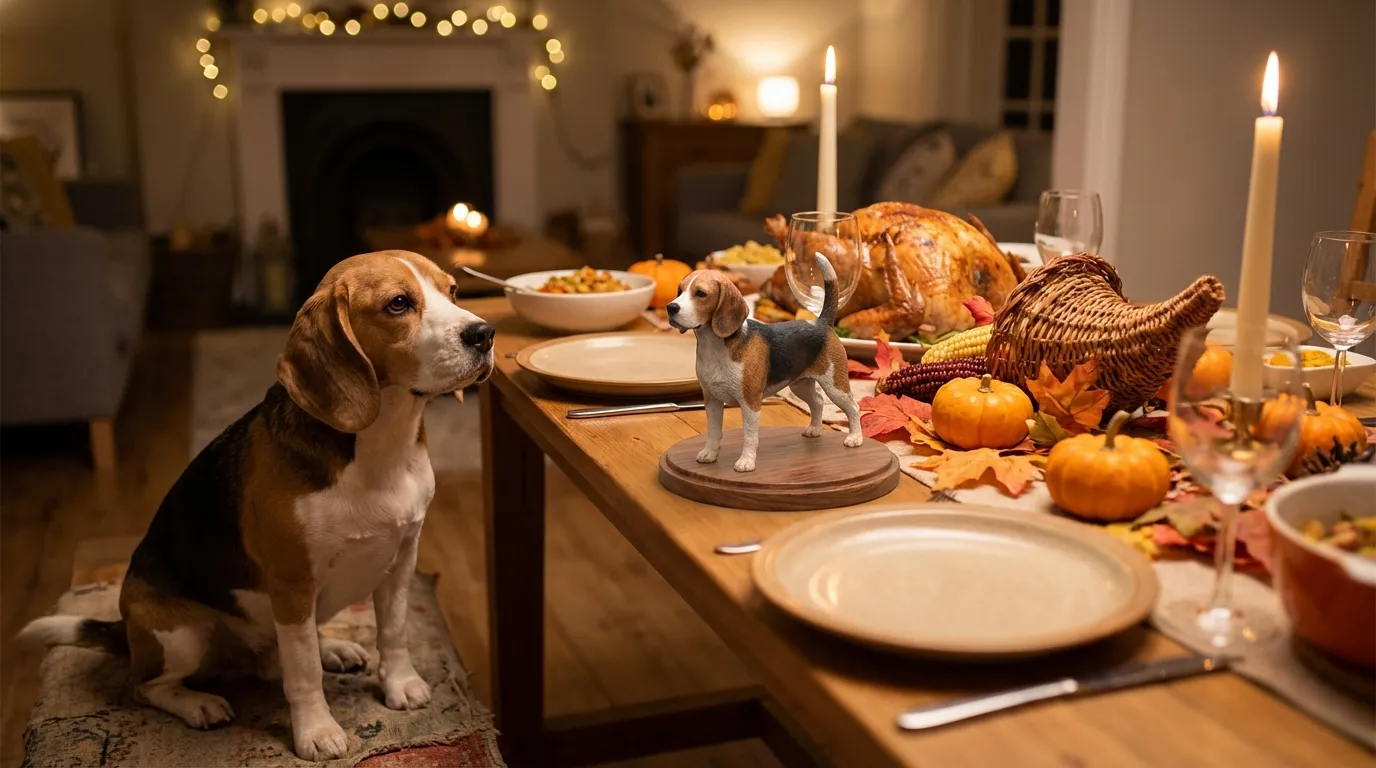
Sometimes, you just need to see them. Photos are great, but they are flat. They live on screens or in frames on the wall. They don't occupy space.This is where three-dimensional tributes can bridge the gap. We’ve seen a significant shift toward families commissioning custom pet figurines to place on the holiday table. Unlike a photo, a figurine has a presence. It casts a shadow.
If you go this route, specificity is key. A generic "Beagle statue" from a home goods store rarely helps—in fact, it can feel uncanny and wrong. It needs to look like your dog. The way their left ear was always slightly cocked. The specific pattern of ticking on their legs.
At PawSculpt, our artists work from your photos to capture those micro-details. We’ve had families place their custom figurine near the centerpiece during dinner. It’s a quiet way of saying, "You are still part of this circle." It gives your eyes a place to rest when the conversation gets overwhelming.
Navigating Family and "The Comments"
"At least you don't have to walk him in the cold anymore."
"Are you going to get another one?"
"It's been three months, aren't you over it?"
Family members, often with good intentions, can say devastatingly stupid things. They are trying to fix your pain, not witness it.
You need a strategy for this before you walk in the door.
The "Pass the Bean Dip" Strategy:
When someone asks a question that hurts or minimizes your grief, you are not obligated to educate them or defend your feelings.
Them:* "So, when are you getting a new puppy?"
You:* "I'm not there yet. But I'd love some of those mashed potatoes, could you pass them?"
The Escape Hatch:
If you are hosting, this is harder. But if you are a guest, drive your own car. Give yourself permission to leave early. Grief is physically exhausting. The effort of "masking"—pretending to be happy for the sake of the group—burns calories like a marathon. If you hit a wall at 6:00 PM, it is okay to say, "I'm feeling a bit wiped out, I'm going to head home." You don't need to explain that you're going home to cry into a dog bed.
The Timeline of "Firsts"
Psychologists often talk about the "Year of Firsts." The first Christmas, the first birthday, the first vet reminder card that arrives by mistake. Thanksgiving kicks off the hardest gauntlet of the year.
The anticipation of the holiday is almost always worse than the day itself. You spend weeks dreading the absence. You replay the memories of them begging for scraps. You worry about breaking down in front of your in-laws.
Usually, when the day arrives, you find moments of grace. You might laugh at a memory. You might feel that phantom weight of a head resting on your foot under the table.
A Critical Reminder:
If you don't cry this Thanksgiving, that is also okay.
Some people feel guilty for having a good time. They think, If I laugh, it means I've forgotten him.
You haven't. Joy and grief can coexist in the same room. In fact, they usually do. Your Beagle was a creature of joy. They didn't dwell on the past; they lived entirely in the present moment (usually searching for a crumb). Enjoying a slice of pie, laughing at a joke, or feeling the warmth of the fire is not a betrayal of their memory. It’s honoring the life they helped you build.
Closing Thoughts
There is a particular spot on the couch where the cushion is still depressed, just slightly, from years of naps. There are smudge marks on the bottom of the back door glass that you haven't had the heart to Windex away.
This Thanksgiving, set the plate. Or don't. cry in the bathroom. Or don't. Buy the custom figurine that looks exactly like them, or donate to the shelter. There is no rulebook for this.
But do not let anyone tell you "it was just a dog."
It was a heartbeat that synced with yours. It was a witness to your life. And this holiday, it is okay to miss them with every fiber of your being, even while you are thankful for the time you had.
Frequently Asked Questions
How do I handle family members who minimize my pet loss?
Family gatherings can be minefields for grieving pet owners. If someone says, "It's just a dog," or asks when you're getting a "replacement," you don't need to engage in a debate. We recommend setting a boundary or changing the subject. A simple, "I'm still missing him a lot, and I'd rather not talk about it right now," is usually enough to shut down the conversation without causing a scene.Is it normal to feel relief after a pet dies?
Absolutely, though few people talk about it. If your Beagle was elderly, sick, or required high-maintenance care (like guarding food constantly), your body has been in a state of high alert. When that stressor is removed, you will feel relief. This is a physiological response, not an emotional judgment on your love for your dog. Be gentle with yourself; the guilt that follows this relief is a common part of the grieving process.What are good memorial gift ideas for a grieving pet owner?
The best gifts acknowledge the specific bond. Generic "rainbow bridge" cards can sometimes feel impersonal. We find that custom figurines or portraits that are created from actual photos of the pet land much softer. They show you took the time to see their dog, not just a dog. Alternatively, making a donation to a Beagle rescue in their dog's name is a beautiful gesture that honors the breed they loved.How long does the intense grief last after losing a dog?
Grief is not linear. You might feel fine one week and be devastated the next. However, the first year is typically the hardest because you are navigating the "firsts"—the first Thanksgiving, the first snowfall, the first spring. Most people find the sharp edges of grief begin to soften after the first year, though the love remains. If you find yourself unable to function or care for yourself, please seek support from a counselor who specializes in pet loss.Honor Their Memory Forever
Your pet's story deserves to be preserved in a way that captures their unique spirit. A custom PawSculpt figurine transforms your cherished memories into a timeless keepsake—every whisker, every marking, every detail that made them irreplaceable.
Free instant AI preview • 3D artist preview within 7 days • 5 free revisions