
The Rainbow Bridge: Understanding the Comfort Behind the Poem
The Rainbow Bridge: Understanding the Comfort Behind the Poem
The silence in the house is the first thing you notice. The click-clack of nails on hardwood is gone. The gentle jingle of a collar, the rhythmic thumping of a happy tail against the couch, the soft weight at the foot of your bed—all replaced by a quiet that feels heavy and unfamiliar.
Grief is the price we pay for love, and nowhere is this more poignant than in the loss of a beloved pet. They are not just animals; they are our confidants, our shadows, our sources of unconditional love. When they leave us, the void is immense. In the midst of this sorrow, millions of pet owners around the world have found solace in a simple, anonymous prose poem known as "The Rainbow Bridge."
But why does this specific imagery resonate so deeply? Is it merely a comforting story, or does it speak to a profound psychological need for closure and hope? In this comprehensive guide, we will explore the origins, the meaning, and the enduring power of the Rainbow Bridge poem, offering comfort for pet loss to those navigating the difficult journey of saying goodbye.
Part 1: The Legend of the Rainbow Bridge
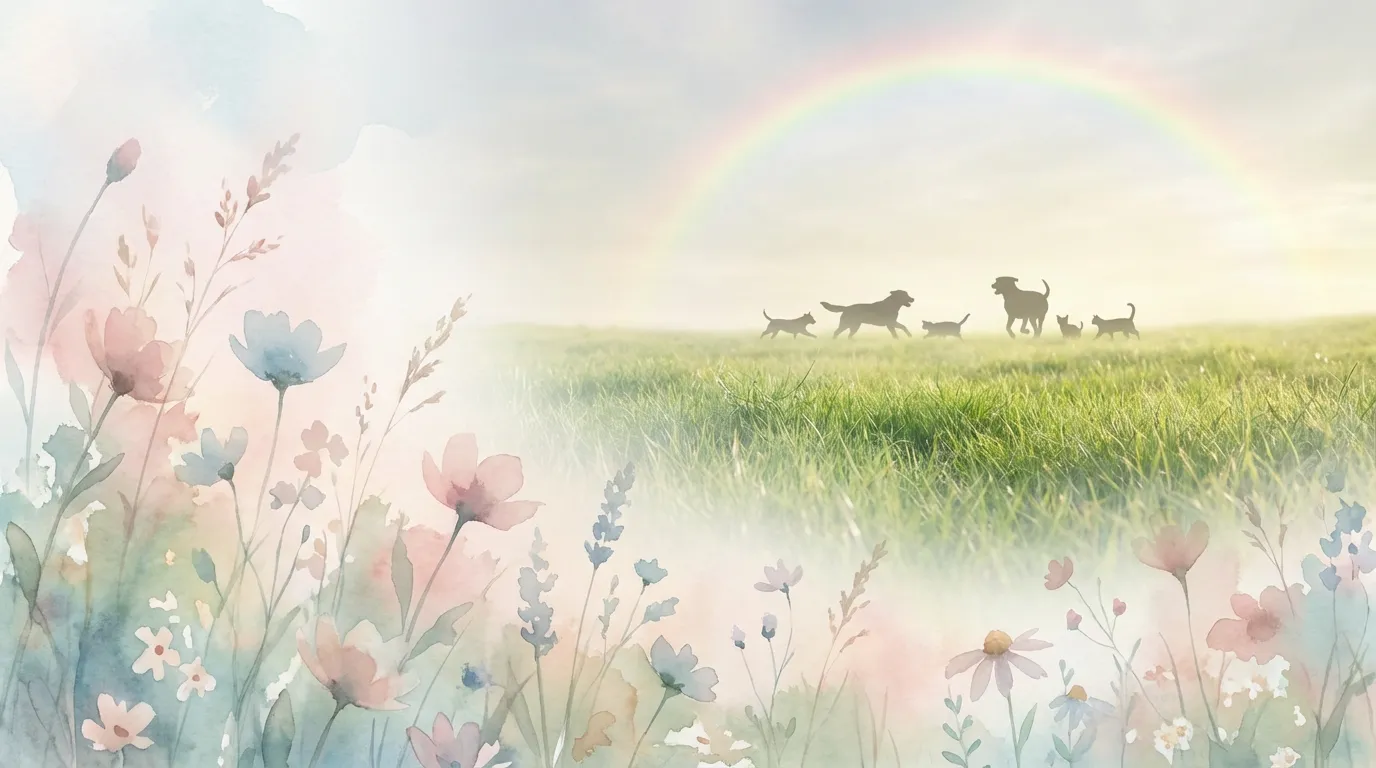
If you have ever received a sympathy card after the passing of a dog or cat, you have likely read the words. The imagery is vivid and specific: a lush, green meadow located "just this side of heaven," bathed in perpetual sunlight.
The Story We Tell Our Hearts
The poem describes a place where our pets go after they die. It is a land of restoration. The old and frail are made young again. The maimed are made whole. They play all day, running through the grass, free from pain and suffering. There is plenty of food, water, and sunshine. They are happy and content, except for one small thing: they each miss someone very special to them, who had to be left behind.
The climax of the poem is a reunion. One day, while playing, a pet stops and looks into the distance. Their bright eyes are intent; their eager body quivers. Suddenly, they begin to run from the group, flying over the green grass, their legs carrying them faster and faster.
They have seen you.
And when you and your special friend finally meet, you cling together in joyous reunion, never to be parted again. The happy kisses rain upon your face; your hands again caress the beloved head, and you look once more into the trusting eyes of your pet, so long gone from your life but never absent from your heart.
Then, you cross the Rainbow Bridge together.
The Origins of the Mystery
For decades, the authorship of this powerful piece of prose was a mystery, attributed simply to "Author Unknown." This anonymity perhaps added to its mystique—it felt like a universal truth rather than one person's creation.
Recently, however, historians and sleuths have traced the likely origins to a few potential sources from the mid-20th century. While Edna Clyne-Rekhy, a Scottish woman who wrote a poem for her dog Major in 1959, is widely considered a primary claimant, the concept of an afterlife specifically designed for the bond between human and animal has roots that go back much further.
Regardless of who first penned the specific words, the Rainbow Bridge poem has become a cultural phenomenon. It bridges the gap between religious dogma and secular grief. It doesn't require a specific theology to believe in; it only requires love. It validates the idea that the bond we share with our pets is eternal, transcending the physical limitations of life and death.
Part 2: Why We Need the Rainbow Bridge
Grieving a pet is a unique form of sorrow. psychologists often refer to it as "disenfranchised grief." Unlike the loss of a human relative, society doesn't always provide a structured way to mourn a pet. There are rarely funerals, bereavement leave from work is uncommon, and well-meaning friends might say hurtful things like, "It was just a dog," or "You can get another cat."
This lack of social validation makes the pet afterlife narrative crucial for healing.
1. Validation of the Bond
The poem elevates the animal soul. It suggests that animals are not just biological entities that cease to exist, but spiritual beings worthy of a "heaven." By placing them in a paradise where they wait specifically for us, the poem validates the depth of the relationship. It confirms what every pet owner knows in their gut: this relationship was significant, life-changing, and worthy of an eternity.2. The Promise of Restoration
Watching a pet decline is traumatic. Whether it was a long battle with cancer, the slow decline of old age, or a sudden tragic accident, the final images we have of our pets are often marred by their suffering. We remember the limp, the clouded eyes, the labored breathing.The Rainbow Bridge offers a counter-narrative. It replaces those traumatic memories with images of vitality. It tells us that Buddy isn't arthritic anymore; he is running. It tells us that Luna isn't sick; she is whole. This visualization is a powerful tool for cognitive reframing, allowing grieving owners to replace images of pain with images of joy.
3. The Hope of Reunion
The finality of death is the hardest pill to swallow. The idea that we will never again see the creature that greeted us at the door every day is devastating. The core promise of the poem is not just that the pet is okay, but that we will be together again. This hope serves as an anchor. It transforms "goodbye" into "see you later."Part 3: Navigating the Stages of Grief with Your Pet
Understanding the poem is one thing; living through the grief is another. The stages of grief—denial, anger, bargaining, depression, and acceptance—are not linear. You may bounce between them for months. Here is how to navigate this terrain while honoring the memory of your companion.
The Shock and the Silence
In the immediate aftermath, the routine is your enemy. You will instinctively reach for a leash that isn't needed or listen for a meow that won't come.- Actionable Advice: Don't rush to put everything away. Leave the bed where it is for a few days. Let yourself cry. The sheer physical absence is a shock to your nervous system.
Guilt and the "What Ifs"
"Did I wait too long?" "Did I make the decision too soon?" "Should I have tried that experimental treatment?" Guilt is the constant companion of pet loss, especially when euthanasia is involved.- Actionable Advice: Remind yourself that you made decisions out of love. Animals live in the present. They do not fear death; they fear pain. By taking their pain onto yourself in the form of grief, you gave them the ultimate gift of peace.
Finding a New Normal
Eventually, the sharp edges of grief begin to soften. You can talk about them without sobbing. You can look at photos and smile. This is where memorialization becomes a vital part of healing.Many pet owners find great comfort for pet loss by creating a physical representation of their love. This is where we at PawSculpt have been privileged to play a small role in so many stories. We have seen firsthand how holding a tangible reminder can ground a grieving heart. While a photo captures a moment, a custom figurine captures a presence. It serves as a placeholder for the physical weight we miss so dearly, standing as a quiet sentinel on a mantle or desk, reminding us that the love remains.
Part 4: Rituals of Remembrance
Creating rituals can help bridge the gap between the physical presence of your pet and their memory. Here are several ways to honor your pet’s journey to the Rainbow Bridge.
1. The Memorial Shelf
Dedicate a small space in your home to your pet. This could include their collar, a favorite toy, a framed photo, and perhaps a candle you light on anniversaries. This designates a physical space for your grief and your love.2. Writing a Letter
Write a letter to your pet. Tell them everything you loved about them, apologize for any regrets you’re holding onto, and thank them for the time you had. Burn the letter and scatter the ashes, or bury it in their favorite spot in the yard. This act of externalizing your feelings can be incredibly cathartic.3. Commissioning Art
Art heals. Whether it is a watercolor portrait, a paw print cast in clay, or a 3D tribute, art captures the spirit. At PawSculpt, we often hear from customers who tell us that unboxing their custom figurine was the first time they felt a sense of peace since their loss. Seeing the specific curve of the ears, the unique pattern of the fur, or the familiar posture can trigger a release of emotion that is necessary for healing. It is not about replacing the pet—nothing can do that—but about honoring their unique footprint in the world.4. Living Tributes
Plant a tree or a flowering bush in your garden. As the plant grows, it serves as a living testament to life continuing. Alternatively, make a donation to a local animal shelter or rescue organization in your pet’s name. Turning your pain into purpose helps the healing process.Part 5: Helping Children Understand the Rainbow Bridge
For many children, the death of a family pet is their first encounter with mortality. It is a foundational moment that shapes how they process loss for the rest of their lives. The Rainbow Bridge poem is an exceptionally useful tool for parents.
Keep it Simple and Honest
Avoid euphemisms like "put to sleep," which can cause children to fear bedtime. Use the words "died" and "death," but pair them with the comforting imagery of the poem.- Explain: "Buddy’s body was very old and it stopped working. He couldn't stay in it anymore. But the part of Buddy that loved us—his spirit—went to a beautiful place called the Rainbow Bridge."
Encourage Expression
Children grieve in bursts. They may be crying one minute and playing the next. This is normal. Encourage them to draw pictures of what they think the Rainbow Bridge looks like. Ask them what their pet is doing there right now. Is he chasing butterflies? Is she napping in a sunbeam?Create a Family Ceremony
Let the children lead a small memorial service. They can choose a song to play, read a drawing, or place a flower on the grave or urn. Giving them a role empowers them and validates their feelings.Part 6: When the Grief Doesn't Lift
It is important to acknowledge that for some, the Rainbow Bridge poem isn't enough. Grief can sometimes evolve into depression. If you find yourself unable to function, unable to sleep, or overwhelmed by guilt months after the loss, it may be time to seek professional help.
There are therapists who specialize in pet loss bereavement. There are also support groups—both online and in-person—where you can speak with others who understand exactly what you are going through. You are not "crazy" for grieving a dog or cat this deeply. You are simply a human being who loved deeply.
The Science of Pet Grief
Studies have shown that the loss of a companion animal can be just as devastating as the loss of a significant human figure. Our brains produce oxytocin (the bonding hormone) when we interact with our pets, similar to the bond between a parent and child. When that feedback loop is broken, our neurochemistry goes into withdrawal. Acknowledging the biological reality of your grief can help you be kinder to yourself.Part 7: The Evolving Concept of the Afterlife
As society changes, so do our views on the pet afterlife. In the past, theological debates often centered on whether animals had souls. Today, for the modern pet owner, the question is moot. The soul is self-evident in the animal's behavior, empathy, and loyalty.
The Rainbow Bridge has evolved from a niche poem into a secular theology of sorts. It respects the spiritual without demanding religion. It creates a shared language among pet owners. When someone says, "My dog crossed the bridge today," no further explanation is needed. We immediately understand the magnitude of the loss and the hope for the future.
This shared language creates community. In the comments sections of social media posts, in forums, and in dog parks, strangers offer support to one another using this imagery. It reminds us that we are not alone in our sorrow.
Part 8: Moving Forward, Not Moving On
There is a distinct difference between "moving on" and "moving forward." Moving on implies leaving the memory behind. Moving forward means carrying the memory with you as you continue your life.
Your heart expands to accommodate the grief, rather than shrinking around it.
Eventually, the thought of your pet will bring a smile to your face before it brings a tear to your eye. You will remember the funny way they sneezed, or how they stole socks, or the specific sound of their purr. These memories are the true legacy.
Is it Time for a New Pet?
This is a deeply personal question. Some people need the house to be full again immediately to cope with the silence. Others feel that getting a new pet too soon is a betrayal. There is no right answer.However, if you do decide to bring a new love into your life, remember the lesson of the Rainbow Bridge: Love is not a finite resource. Loving a new animal does not diminish the love you held for the one who passed. It is a testament to them. It says, "This relationship was so wonderful, so life-affirming, that I am willing to risk this heartbreak all over again to experience it."
Part 9: A Final Thought on Eternity
Whether you view the Rainbow Bridge as a literal destination, a metaphorical state of peace, or simply a comforting story, its power remains undiminished. It provides a framework for the unmanageable emotions of loss.
We hold onto our pets in many ways. We hold them in our memories, in the stories we tell, in the photos on our walls, and in the tributes we keep close. At PawSculpt, we are humbled every day by the stories you share with us. When we craft a figurine, we know we aren't just shaping clay; we are honoring a soul that touched a human life. We are helping to keep a small piece of that love tangible in a world that often feels ephemeral.
To those of you currently walking through the valley of shadow, looking toward that Rainbow Bridge: know that your grief is valid. Your loss is real. But so is the love. The love does not die. It stays here, with you, woven into the fabric of your life, forever.
As the poem concludes, “Then you cross Rainbow Bridge together...”
Until that day, may you find peace in the memories, comfort in the hope, and healing in the knowledge that you gave your best friend a life filled with love.
*
Frequently Asked Questions About Pet Loss
Q: Is it normal to grieve a pet more than a human relative?
A: Yes, it is very common. Our relationships with pets are often uncomplicated and free of the conflict that characterizes human relationships. Their love is unconditional, which can make the loss feel sharper and more profound.
Q: How can I help a friend who lost a pet?
A: Listen more than you speak. Validate their pain. Send a card or a small memorial gift. Avoid offering advice on getting a new pet. Simply being present and acknowledging that their loss is significant is the best support you can offer.
Q: Where can I find the full text of the Rainbow Bridge poem?
A: The poem is widely available online and is often included in sympathy cards from veterinary clinics. A quick search will provide several variations, all carrying the same beautiful message.
Q: How long does pet grief last?
A: There is no timeline. Acute grief may last months, while a duller sense of loss can last years. Be patient with yourself. Healing is a marathon, not a sprint.
*
If you are looking for a way to honor your beloved companion, visit PawSculpt to learn more about how we can help you preserve their memory with a custom, handcrafted tribute.
Honor Their Memory Forever
Your pet's story deserves to be preserved in a way that captures their unique spirit. A custom PawSculpt figurine transforms your cherished memories into a timeless keepsake—every whisker, every marking, every detail that made them irreplaceable.
Free instant AI preview • 3D artist preview within 7 days • 5 free revisions