
Missing the Caretaking: The Void After Nursing a Sick Senior Pug
The receptionist’s keyboard clacking sounded like gunfire in the small waiting room. It was the only sound in the world because the heavy, rhythmic wheezing that had been the soundtrack of your life for the last two years had suddenly stopped. You handed over the credit card—a mundane, robotic motion—while your other hand kept reaching down to check a carrier that was no longer there. The weight of the empty leash in your pocket felt heavier than the twenty pounds of struggling, coughing Pug you had carried in just an hour ago.
Walking out into the sunlight felt like a betrayal. How could the world continue to spin, how could cars continue to drive by, when your entire universe had just shifted axis? But the hardest part wasn't the immediate shock of that afternoon. It was what happened when you got home. You reached for the pill organizer on the counter before you even took off your coat.
Quick Takeaways:
- Caregiver Grief is Distinct: You aren't just mourning a pet; you are mourning a job, a purpose, and a rigid schedule that defined your daily existence.
- The "Phantom Limb" of Routine: Your body will continue to wake up at 3 AM for potty breaks and reach for medication bottles long after they are necessary.
- Relief is Not Betrayal: Feeling relief that the suffering (and the work) is over is a normal biological response, not a lack of love.
- Memorialize the Healthy Version: When creating tributes, such as a custom figurine or photo wall, focus on their prime years, not their sick years, to help overwrite the medical trauma.
The Deafening Silence of a Medical Routine
We talk a lot about the emotional bond with our pets, but we rarely discuss the sheer logistics of loving a senior dog, especially a breed as high-maintenance as a Pug. By the end, you weren't just a pet parent. You were a nurse, a pharmacist, a physical therapist, and a janitor.
For the last few months (or years), your life was likely governed by a strict clock. 7:00 AM: Eye drops. 7:15 AM: Carry them down the stairs because their hips gave out. 12:00 PM: Pain meds. 3:00 AM: The "I can't breathe" panic or the "I need to go out now" bark.
When that stops, it doesn't feel like freedom. It feels like unemployment.
We’ve seen this countless times with the families we work with. The silence in the house isn't peaceful; it’s vacant. You find yourself staring at the clock at 4:55 PM, feeling a rising anxiety that you’re forgetting something crucial, only to remember there is no insulin shot to give, no dinner to mash up with warm water.
This is what experts call "Caregiver Grief." It’s a specific type of hollowness that comes from the loss of being needed. Your identity shifted from "person who has a dog" to "person who keeps this fragile creature alive." When the creature is gone, the identity crumbles, leaving you standing in the kitchen holding a half-empty bag of prescription kibble, wondering who you are now.
The Taboo Emotion: Relief (and the Guilt That Follows)
Let’s say the quiet part out loud. There is a moment, perhaps a few days or weeks in, where you sleep through the night for the first time in a year. You wake up rested. You drink a coffee while it’s still hot. You realize you can leave the house for more than two hours without arranging a specialized sitter.
And then, immediately after that realization, you feel sick to your stomach.
Guilt is the constant companion of the grieving caregiver. You might catch yourself thinking, “It’s nice not to have to clean up accidents every morning,” and then mentally punish yourself for having such a selfish thought.
Here is the counterintuitive truth that most people won’t tell you: Relief is a form of love.
The relief you feel isn't because you wanted them gone. It’s because you were hyper-vigilant for so long. Your cortisol levels have been spiked for months. You were living in a state of "anticipatory grief," watching them decline day by day, waiting for the other shoe to drop. The relief is simply your nervous system finally getting permission to stand down.
It means you loved them enough to carry the burden of their care until you physically couldn't anymore. It means you loved them enough to prioritize their comfort over your own sleep, your own social life, and your own bank account. The relief is just your body acknowledging that the marathon is over. It doesn't mean you didn't love the runner.
The "Senior Pug" Specifics: Why This Silence is Louder
While every pet loss is devastating, losing a senior Pug hits a specific sensory note. Pugs are not subtle creatures. They are auditory and tactile presences in a home.
If you’ve loved a Pug, you know the sounds: the snorting, the clicking of nails (which they hate having trimmed), the heavy breathing that sounds like a coffee percolator, the "scream" when they want attention. They are "Velcro dogs" to the extreme. A senior Pug doesn't just sit near you; they sit on you, or right behind your heels, tripping you up in the kitchen.
When a Pug passes, the sensory deprivation is extreme.
- The Air Feels Empty: You’re used to checking the room temperature constantly because they overheat so easily. Now, the thermostat is just a number.
- The Floor is Too Clear: You spent years navigating around ramps, steps, and pee pads. Now you can walk in a straight line, and it feels wrong.
- The Shadow is Gone: You turn around to tell them to stop begging, but the spot by the fridge is empty.
One of our team members lost her 15-year-old Pug, Barnaby, last year. She told us that for weeks, she would instinctively step over a specific spot on the rug where he used to sleep, even though the rug was empty. The muscle memory of caretaking is powerful. It takes weeks for your brain to stop mapping the room based on where the dog is.
Reclaiming Your Home from the "Hospital" Vibe
In the final stages of a sick pet's life, your home often transforms into a hospice. The living room is dominated by a playpen or a orthopedic bed. The counters are lined with pill bottles (Gabapentin, Galliprant, eye lubes). The smell of enzymatic cleaner becomes your signature home fragrance.
After they pass, there is a frantic urge to either purge everything immediately or keep everything exactly as it is. Both are trauma responses.
We recommend a middle ground: The Deliberate Dismantling.
- Donate the Meds: Many vet clinics accept donations of unexpired medication for families who can't afford them. Doing this gives the leftover pills a purpose.
- Clean the Floors: Hire a professional cleaner if you can. Get the "sick" smell out of the house. It doesn't erase your dog; it erases the illness.
- Create a "Healthy" Shrine: This is crucial. During the sickness, your most recent memories are of them frail, cloudy-eyed, and struggling. You need to overwrite that image.
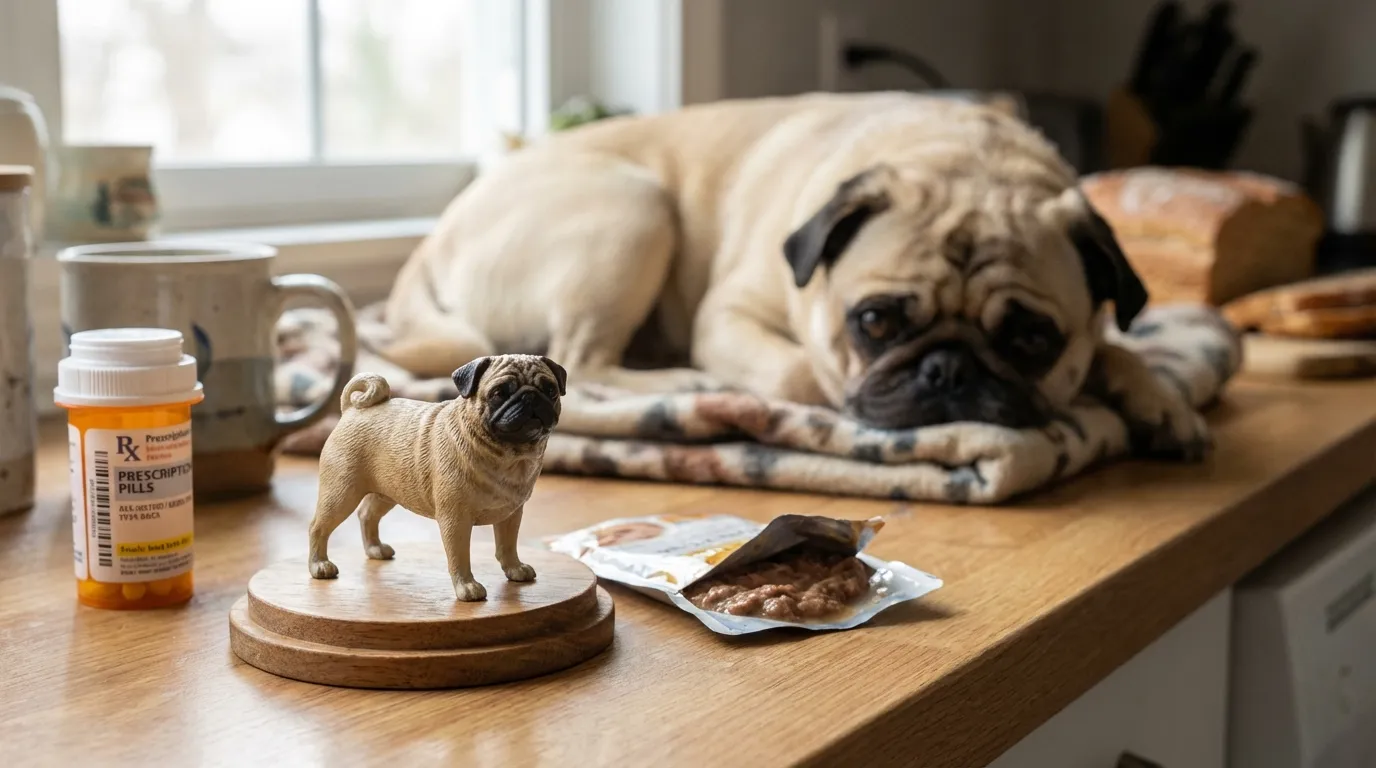
This is where we often step in with families. When we design a memorial, we always ask for photos from the "glory days." We want to capture the Pug head-tilt, the curly tail, the bright eyes—the way they looked before the illness took over. Placing a tangible object, like a custom figurine, in the spot where their medicine used to sit changes the energy of the space. It shifts the focus from "here is where I treated their pain" to "here is where I honor their life."
The "What Now?" of Daily Life
So, what do you do with the time? You have an extra two hours a day that used to be filled with caretaking.
The mistake most people make is trying to fill that time with "distractions." They binge-watch TV or throw themselves into work. But the void is physical, so the remedy must be physical.
Use the "Walk" Time:
If you used to walk them at 8 AM (or carry them outside in a stroller), still go outside at 8 AM. Walk the route. Yes, you will cry. Yes, neighbors might look at you. But you need to reclaim that route as yours. You need to see the trees and the sidewalk without the anxiety of "is he walking too slow?" or "is it too hot for him?"
Retrain Your Hands:
Your hands are used to being busy—massaging hips, cleaning folds, administering drops. When you sit on the couch, your hands will feel restless. Take up something tactile. Knitting, pottery, gardening—anything that requires fine motor skills. It sounds trivial, but it helps soothe the somatic urge to fix something.
When the "Second-Guessing" Starts
About two weeks after the loss, the adrenaline fades and the "bargaining" stage of grief sets in. This is dangerous territory for a caregiver.
You will start to replay the last week.
Did we wait too long?*
Did we do it too soon?*
Should I have tried that experimental therapy the specialist mentioned?*
Did he know I was there at the very end?*
This is your brain trying to regain control over an uncontrollable situation. As the "medical director" of your dog's life, you are used to solving problems. Death is the one problem you couldn't solve, so your brain looks for errors in your data.
Here is the reality we have learned from thousands of pet owners: There is no perfect time. There is only a decision made with love, usually made a day too early or a day too late, but always made to prevent suffering.
If you are haunting yourself with the "what ifs" of their medical care, stop. You are looking at the past with the clarity of the present. You made the best decisions you could with the information and resources you had at the time. The fact that you agonized over it proves you were a good caretaker.
Moving From "Nurse" Back to "Parent"
The transition from nursing a sick animal to mourning a deceased one is a rocky path. You have to learn to relate to your pet in the past tense, which feels like a betrayal.
But remember this: The illness was just a chapter. It was likely a long, hard chapter at the end, but it was not the whole book.
Your Pug was not "the dog with the bad hips." He was the dog who stole pizza crusts. He was the dog who snored so loud he woke the neighbors. He was the dog who zoomed around the living room after a bath.
Your job now is no longer to protect his body. You did that job. You did it perfectly. You carried him when he couldn't walk. You breathed for him when he couldn't breathe. You took on his pain so he didn't have to feel it.
Your new job is to protect his memory.
And unlike the caretaking, which was exhausting, messy, and filled with anxiety, this new job is gentle. It allows you to rest. It allows you to look at a photo or a keepsake and smile, not check for symptoms.
The silence in the house will eventually stop sounding like emptiness and start sounding like peace. The phantom weight of the leash in your hand will fade, leaving you with just the warmth of the memory of the walk.
You can rest now, caretaker. You’re off the clock.
Frequently Asked Questions
Is it normal to feel relief after a sick pet dies?
Yes, absolutely. This is one of the most common, yet least discussed, emotions surrounding pet loss. The relief you feel is usually twofold: relief that your beloved pet is no longer in pain, and relief that the exhausting, high-stress demands of caregiving have ended. This is a biological response to your nervous system finally being allowed to rest; it does not mean you didn't love your pet deeply.How long does "caregiver grief" last?
While general grief has no timeline, the specific "phantom routine" aspect of caregiver grief typically remains acute for 3 to 6 weeks. This is roughly the time it takes for the brain to break a habit loop. You may stop waking up at 3 AM or reaching for the medicine bottle within a month, though the emotional sadness will likely ebb and flow for much longer.What should I do with my deceased pet's medication and supplies?
Please do not flush medications down the toilet. Many animal shelters and veterinary clinics have donation programs for unexpired medications and supplies (like diapers, ramps, or prescription food) to help families in financial need. Calling your local shelter to donate these items can be a healing act, turning your leftover supplies into a gift for another dog.Why do I keep hearing my deceased dog in the house?
This is a very common phenomenon known as a "grief hallucination." Your brain is a prediction machine; for years, it has predicted the sound of nails on the floor or heavy breathing in the next room. When the sound stops, your brain sometimes "fills in the blank" out of habit. It is not a sign of mental illness; it is simply your mind adjusting to a new reality.Honor Their Memory Forever
Your pet's story deserves to be preserved in a way that captures their unique spirit. A custom PawSculpt figurine transforms your cherished memories into a timeless keepsake—every whisker, every marking, every detail that made them irreplaceable.
Free instant AI preview • 3D artist preview within 7 days • 5 free revisions