
Why a Custom Figurine is the Ultimate Healing Memorial Gift
The silence in the house wasn’t just quiet; it was heavy. It pressed against your eardrums at 6:00 AM when the click-clack of nails on hardwood should have been your alarm clock. It lingered in the kitchen, right near the refrigerator door where a cold nose usually nudged your calf, begging for a sliver of cheese. It’s been three weeks, but yesterday, you still automatically stepped over the spot on the rug where she used to nap in a sunbeam. That muscle memory—the physical habit of loving something that is no longer there—is the cruelest part of grief. It’s not just an emotional void; it’s a sensory deprivation tank. Your hands literally don’t know what to do with themselves anymore.
We talk about grief in stages, cleanly categorized like a checklist, but anyone who has lost a soul dog or a heart cat knows it’s actually a messy, non-linear spiral. One day you’re functioning; the next, you’re weeping in the pet food aisle because they changed the packaging of their favorite kibble. And while friends send flowers that wilt and cards that get tucked into drawers, there is a desperate, unspoken need for something else. Something permanent. Something you can touch.
This is why we need to talk about tangible grief anchors. Specifically, why a three-dimensional representation of your pet—a custom figurine—does something for the healing brain that a photograph simply cannot achieve.
The Neuroscience of "Touch Hunger" in Grief
Here is the thing most sympathy guides won’t tell you: your grief is physical. We often treat pet loss as a purely emotional event, a sadness of the heart. But your brain has spent years mapping the specific texture of your dog’s fur, the weight of your cat on your chest, the exact resistance of the leash in your hand.
When that physical feedback loop is suddenly severed, psychologists call it "skin hunger" or "touch hunger." Your nervous system is essentially going through withdrawal.
I remember a conversation with a customer named Sarah last year. She had lost her Great Dane, Barnaby. She told me, "I have a thousand photos of him on my phone. I scroll through them every night. But looking at a flat screen makes me feel further away from him, not closer. I can’t feel the size of him."
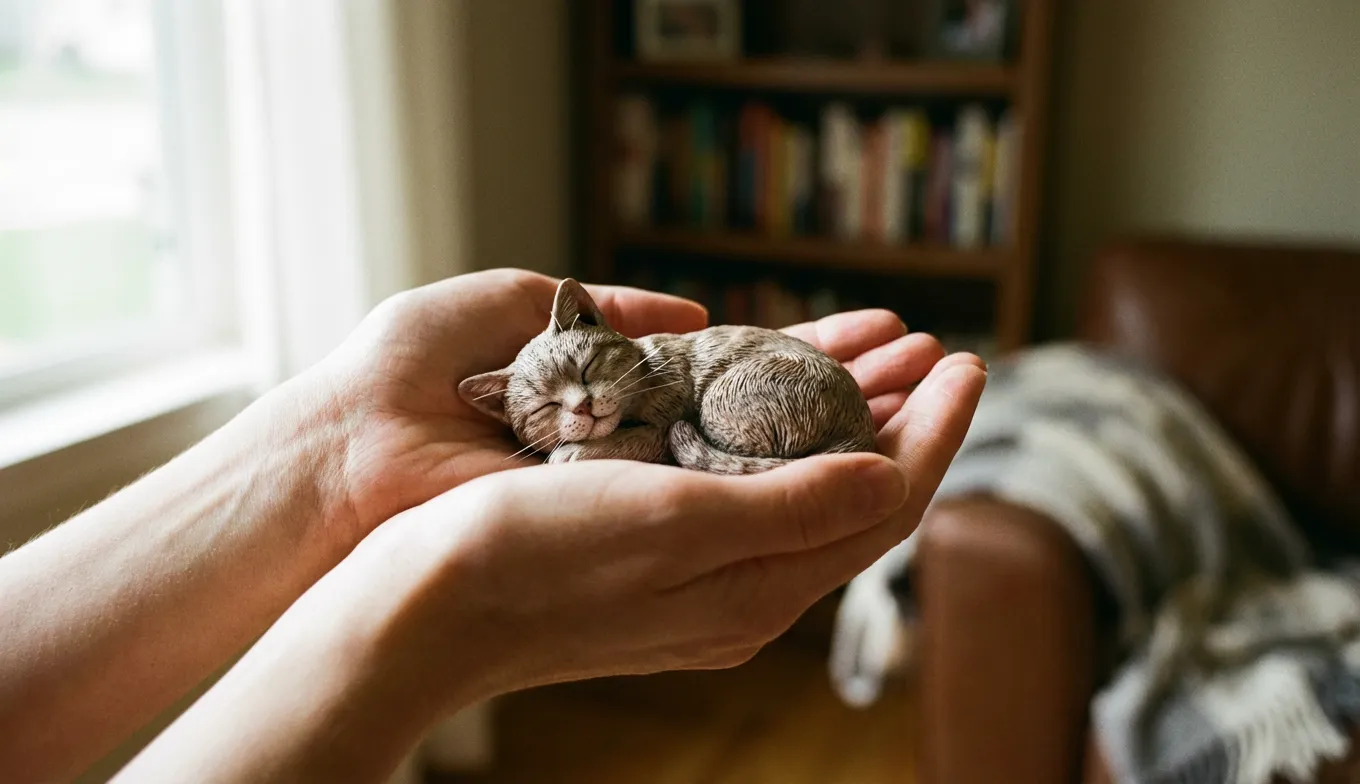
This is the limitation of 2D memories. A photo engages the visual cortex, which is powerful, yes. But a custom figurine engages our spatial awareness and tactile memory. When you hold a miniature replica, your brain registers the contours—the way the ears perk up, the specific curve of the tail. It’s a sensory bridge.
It’s not about replacing the pet. That’s impossible. It’s about giving your hands a place to rest their love. We’ve seen incredible breakthroughs in healing when a grieving owner can physically place a representation of their pet on a desk or a mantle. It transforms the memory from a digital file on a cloud server into a physical presence in the room. It validates that they existed in space, not just in pixels.
Why "Rainbow Bridge" Platitudes Often Fail
Let’s be honest for a second. When you lose a pet, the well-meaning deluge of "They’re running free at the Rainbow Bridge" messages can sometimes feel… hollow. Don’t get me wrong, the sentiment is beautiful. But for the person left behind, standing in a quiet hallway holding a useless leash, the idea of a metaphysical meadow doesn’t solve the immediate pain of absence.
The problem with generic pet memorial gifts is that they are often one-size-fits-all solutions for a highly specific relationship. A stone that says "Always in our Hearts" could apply to any dog, anywhere. But your grief isn’t generic, because your dog wasn’t generic.
Your dog had a specific snaggletooth on the left side. Your cat had a white patch on her chest that looked exactly like the state of Texas. Your rabbit had one ear that flopped only when he was tired.
These "imperfections" are actually the anchors of your bond. When we try to heal using generic symbols, we often feel a disconnect. We feel like the world doesn’t understand what we actually lost. We didn’t lose "a dog." We lost that dog.
This is where the psychology of hyper-specificity comes in. Healing accelerates when the memorial acknowledges the unique quirks of the animal. A custom figurine that captures the specific graying of the muzzle or the exact way they sat with one hip kicked out validates the individual life. It says: "I saw you. I knew you. And I remember you exactly as you were."
In my time working with grieving families at PawSculpt, I’ve learned that the details are where the love lives. I’ve had clients ask if we can replicate a tiny scar on a nose or the specific mismatched color of paw pads. When they receive the figurine and see that tiny detail—that secret code only they knew—the release of emotion is profound. It’s usually the first time they cry "good tears"—tears of recognition rather than just despair.
The "Shrine" Phenomenon: Reclaiming a Space
There is a strange phenomenon that happens about two weeks after a pet passes. You feel the urge to clean up, to put away the bowls and the beds, because seeing them empty is painful. But the moment you put them away, you feel an immense guilt, as if you are erasing them from the household.
This is the "Erasure Trap." You’re stuck between the pain of seeing their things and the pain of hiding them.
The solution isn’t to leave the dirty food bowl out forever, nor is it to scrub the house sterile. The solution is the creation of a dedicated memorial space—a secular shrine.
Anthropologists tell us that humans have been creating small altars for the dead for thousands of years. It’s a way of compartmentalizing grief. Instead of the whole house being a minefield of sad memories, you create one specific spot where the memories are honored and contained.
A custom figurine often becomes the centerpiece of this space.
Here is a practical framework for creating a healing space that actually works, rather than just collecting dust:
1. Choose a "High-Traffic" but "Low-Stress" Location:
Don’t put the memorial in the dark corner of a spare bedroom. Put it on a bookshelf in the living room or a corner of your work desk. You want to see it during your daily flow, but not in a place where it dominates every conversation.
2. The Trinity of Memory:
An effective memorial usually needs three elements:
- The Image: A photo or, even better, a 3D figurine to anchor the visual/spatial memory.
- The Artifact: A physical item they used—a collar, a tag, or a small favorite toy.
- The Living Element: A small succulent, a candle, or a fresh flower. This symbolizes that love is still a living, growing thing, even if the life has ended.
3. Interaction is Key:
The mistake most people make is setting up a shelf and never touching it again. It becomes a museum exhibit. True healing comes from interaction. Dust the figurine. Light the candle on Fridays. Speak to it.
I know a woman who keeps her custom figurine of her beagle, Lou, on her kitchen windowsill. Every morning while her coffee brews, she taps the figurine on the head. Just a tap. It takes one second. But that micro-ritual keeps Lou as part of her morning routine. It acknowledges him without derailing her day. That is what healthy integration looks like.
Navigating the Guilt of "Moving On"
Let’s talk about the elephant in the room: Guilt.
It is the dirty secret of pet loss. The guilt that you didn’t catch the illness sooner. The guilt that you made the decision to euthanize too early—or too late. And eventually, the guilt that you are starting to feel okay again.
About three to six months post-loss, you might find yourself laughing at a movie, or enjoying a walk without crying. And immediately, a voice in your head says: How dare you? If you love them, you should still be miserable.
This is a cognitive distortion. Grief is not the price you pay for love. Grief is just love with nowhere to go.
A tangible memorial gift serves as a permission slip to move forward. It acts as a container for the memory, so you don’t have to carry the heavy weight of it on your shoulders every single second.
When you have a permanent tribute, like a handcrafted statue that captures their spirit, you are externalizing the memory. You are putting it into a physical object that is safe and permanent. This allows your brain to relax. You don’t have to constantly ruminate to "keep them alive" in your mind, because their likeness is right there on the shelf. They aren’t going anywhere.
I’ve seen this shift happen with clients. Once they have the figurine, they often tell me they feel a sense of relief. They say, "He’s home now." That phrase—he’s home—signals a psychological shift from active, panicked grieving to passive, peaceful remembering. It frees them up to consider getting another pet eventually, or just to breathe a little easier, knowing they haven’t abandoned the memory of their friend.
The Art of the Gift: When Words Fail
If you are reading this not as the grieving owner, but as the friend trying to support one, you are in a tough spot. The "dog sympathy gift" market is flooded with generic trinkets. Wind chimes. Keychains. Things that eventually end up in a Goodwill donation box because the recipient feels guilty throwing them away but doesn't actually want them.
Here is the hard truth about gifting during grief: Timing is everything, and patience is the ultimate luxury.
Most people send flowers immediately. The flowers die in a week, right around the time the shock wears off and the real depression sets in. That’s when the support creates a vacuum.
The most impactful gifts often arrive a month or two later.
Ordering a custom figurine takes time. It requires photos. It requires artistry. It isn’t an Amazon Prime overnight delivery. And that is actually a benefit.
Imagine this: It’s been two months. The condolences have stopped. The world expects your friend to be "over it." Then, a package arrives. Inside is not a generic angel statue, but a hyper-realistic sculpture of their dog, capturing that goofy way his ear flipped inside out.
It sends a powerful message: I haven’t forgotten that you are hurting. I haven’t forgotten how special he was. And I know you are still missing him.
If you don’t have access to their photos to commission a piece secretly (and honestly, you usually need the owner's input to get the details right), a gift card for a custom piece is surprisingly intimate. It gives them a project. It gives them a reason to go through old photos with a purpose—not just to be sad, but to select the perfect pose for an artist to recreate. It turns the passive act of grieving into an active act of creation.
The "Unseen" Pets: Grief Beyond Dogs and Cats
We need to take a moment to validate the grief that society often ignores. If you lose a Golden Retriever, your boss understands why you need a day off. If you lose a rat, a lizard, or a guinea pig, you often get confused stares.
“It was just a hamster,” they say.
But love is not measured in pounds or lifespan. I have worked with customers who were absolutely shattered by the loss of a bearded dragon or a parakeet. These animals are often cage-bound, meaning the owner’s interaction with them was intensely focused and intimate.
The market for memorial goods is 99% dog and cat focused. Try finding a high-quality memorial stone for a ferret. It’s nearly impossible.
This is where custom artistry becomes an act of defiance against a culture that ranks grief. Commissioning a custom figurine of a "nontraditional" pet is a radical act of validation. It says: This life mattered.
I recall a project for a client named David who lost his African Grey parrot, Merlin. Merlin had been with him for 25 years—longer than his marriage. When David received the figurine, complete with the specific feather variegation on Merlin’s wings, he wrote to us saying, "Finally, something that matches the size of the hole in my life."
If you are grieving a small or exotic pet, know that your grief is valid. And know that seeing your small friend immortalized in a substantial, artistic way can be incredibly grounding. It gives weight to a small life.
Beyond the Mantel: Creative Ways to Integrate a Figurine
So, you have this beautiful, custom likeness of your pet. Most people put it on a shelf. But I want to challenge you to think about how this object can be part of your life in a more dynamic way.
The Travel Companion
I’ve seen a growing trend where people take their smaller custom figurines on travels. It sounds eccentric to some, but it’s deeply healing for others. Did your dog love the beach? Take the figurine to the shore. Snap a photo of the figurine looking out at the waves. It’s a way of bringing their spirit along for the ride, honoring the adventures you didn’t get to finish together.
The Holiday Proxy
Holidays are brutal after a loss. The empty spot under the Christmas tree or the lack of a beggar at the Thanksgiving table is glaring. Incorporate the figurine into the decor. Place it amidst the holiday village. Put a tiny ribbon on it. It acknowledges their presence in the family gathering without bringing down the mood. It’s a quiet nod to the family member who is there in spirit.
The Garden Guardian
While many custom figurines are indoor art pieces, some can be treated or placed in protected outdoor areas (always check the material specs first!). Placing the likeness of your cat in the flowerbed she used to stalk bugs in connects the memory to the earth. It creates a peaceful spot for you to sit and reflect outside, surrounded by life.
The Difference Between "Letting Go" and "Carrying Forward"
There is a terrible phrase we use in grief counseling: "Closure."
Closure is a myth. You don’t close the door on a being you loved. You don’t finish the chapter and burn the book.
The goal is not closure; the goal is integration.
Integration means you accept that the loss is now part of your life story, just like their presence was. You are not the same person you were before you had them, and you aren’t the same person you were before you lost them.
A custom figurine is a tool for integration. It physically integrates their memory into your current environment. It allows you to look at their face—frozen in a moment of joy, not illness—and smile.
In the first few days, looking at it might hurt. That’s okay. Turn it around if you need to. Put it in a drawer for a week. But eventually, the pain sharpens into something else. It becomes a bittersweet gratitude.
You look at the figurine and you don't just see the dog that died. You see the dog that lived. You see the muddy paws, the stolen pizza crusts, the greeting at the door that made you feel like the most important person on Earth.
A Note on the Artist’s Hand
There is something spiritual about handmade items. In a world of 3D printed mass production and AI-generated imagery, having a human artist sculpt or paint the likeness of your pet adds a layer of intention to the memorial.
When an artist at PawSculpt works on a piece, they are staring at your photos for hours. They are studying the way your dog’s eyebrow arched. They are investing time and care into recreating a life they never met.
That energy transfers. When you unwrap the package, you aren’t just holding resin or clay. You are holding time, attention, and respect. You are holding a collaborative effort between your memories and an artist’s hands.
This matters because grief can feel very lonely. Knowing that a stranger took the time to get the eyes just right makes you feel less alone. It feels like the community is helping you shoulder the burden of the memory.
When to Start the Process
One of the most common questions I get is: "Is it too soon?" or "Is it too late?"
It is never too late. We have clients commissioning pieces for dogs that passed away twenty years ago. The grief has softened, but the love remains, and they finally want a physical representation of that era of their life.
"Too soon" is trickier.
If you are in the raw, sobbing-on-the-floor stage of the first 48 hours, don’t make any big purchases. Your brain is in survival mode. You might pick a photo that reflects your sadness rather than their joy.
Wait until the fog lifts just a little. Wait until you can look at photos of them and smile at least once. That is the sweet spot. That is when you can approach the process of creating a custom figurine not as a desperate attempt to clutch onto them, but as a celebration of who they were.
However, if you are a friend buying for someone else, start the process earlier than you think. Since custom work takes time, getting the ball rolling allows you to deliver the gift right when the initial support network fades away—that critical 2-to-3-month window I mentioned earlier.
The Legacy of a Good Dog (or Cat, or Horse...)
Ultimately, the reason we grieve so hard is because we loved so hard. The pain is the receipt for the joy.
We live in a culture that encourages us to move on quickly, to replace, to upgrade. But a custom figurine is a stake in the ground that refuses to bow to that pressure. It is a permanent declaration that this animal was important.
It allows you to tell their story without saying a word. When a guest comes over and sees the figurine on your shelf, they might ask, "Who is that?"
And just like that, you get to say their name again. You get to tell the story of the time they ate the Thanksgiving turkey, or how they saved you during your hardest year.
The figurine isn’t just a statue. It’s a conversation starter. It’s a memory keeper. It’s the ultimate healing gift because it doesn’t try to fix the grief. It simply gives the grief a beautiful place to live, transforming it slowly, day by day, back into love.
Because they never really leave us. Not as long as we remember the exact shape of their ears, the color of their eyes, and the way they looked at us like we were the only thing that mattered in the universe. A custom figurine just helps us keep that vision sharp, tangible, and close enough to touch.
Honor Their Memory Forever
Your pet's story deserves to be preserved in a way that captures their unique spirit. A custom PawSculpt figurine transforms your cherished memories into a timeless keepsake—every whisker, every marking, every detail that made them irreplaceable.
Free instant AI preview • 3D artist preview within 7 days • 5 free revisions