
Reading the Medical File One More Time: Anticipatory Grief and Your First Cavalier Spaniel
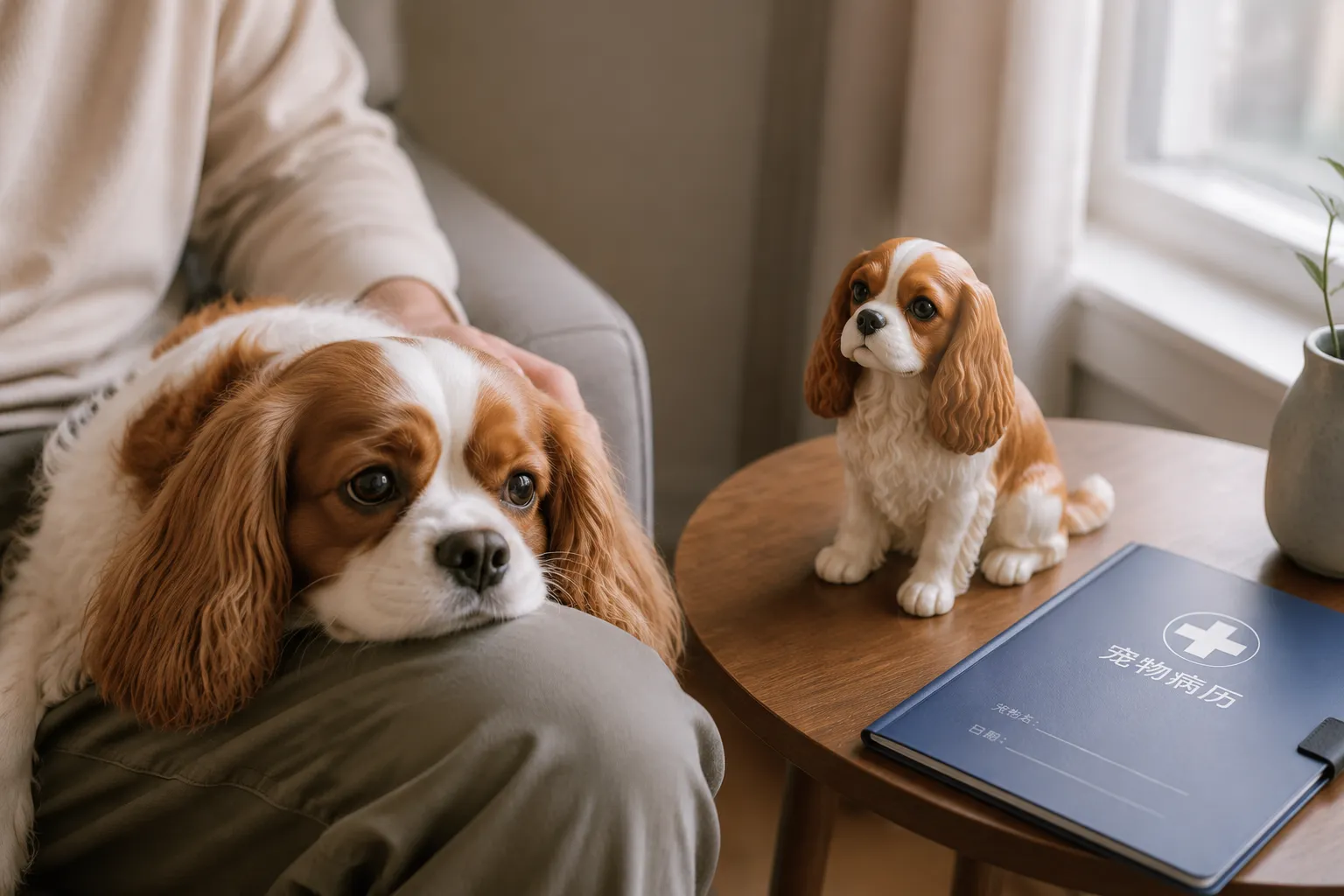
The vet's hallway smells like antiseptic and wet dog, and you're standing there gripping a manila folder you've already read four times. That folder — that diagnosis — is where anticipatory grief starts for most first-time pet owners, long before there's any goodbye to give.
Quick Takeaways
- Grieving before the loss is real — anticipatory grief is a normal response to a terminal pet diagnosis, not disloyalty.
- First pet loss hits harder — your brain formed attachment patterns it's never had to un-form before.
- Cavaliers face predictable illnesses — mitral valve disease affects most by age ten, so information beats denial.
- Capture details now, not later — photos of markings, paws, and expressions become the raw material for custom pet figurines and other keepsakes while your dog is still here.
- Presence outperforms perfection — fifteen minutes of undistracted floor time matters more than any grand gesture.
The Grief That Arrives Before the Goodbye
Here's the thing nobody tells you at the appointment. You can start mourning a dog who is currently lying on your kitchen floor, tail thumping, very much alive.
That's anticipatory grief, and it's one of the most disorienting parts of a serious pet diagnosis. You're not grieving a memory. You're grieving a future you can suddenly see the edges of.
We've talked to a lot of pet families over the years, and this one comes up constantly. A customer we'll call Dana reached out to us not long after her Cavalier King Charles Spaniel, Winnie, was diagnosed with early mitral valve disease at seven. Winnie was fine that week. Playing. Eating. Doing that Cavalier thing where they lean their whole body weight against your shin like a small warm sandbag.
And Dana was already crying in the car.
She felt insane about it. Her dog was right there. Why was she grieving?
Because her mind had done the math. The diagnosis handed her a rough timeline, and her heart refused to wait for permission to feel the ending.
"Anticipatory grief isn't rehearsing the loss. It's love realizing it has a deadline."
If you're in that hallway right now, mentally rereading a file you've memorized, understand this: what you're feeling has a name, it's documented, and it does not mean you're broken. The Association for Pet Loss and Bereavement recognizes pre-loss grief as one of the most under-supported experiences pet owners go through. Most people around you won't get it. That doesn't make it less legitimate.
The counterintuitive part
Most articles about pet grief treat the sadness as the enemy — something to manage, delay, or minimize.
We'd push back on that. The problem usually isn't the grief. It's what the grief does to your attention.
Anticipatory grief has a nasty habit of pulling you out of the present. You're on the floor with your dog, and instead of being there, you're already at the vet's office six months from now, imagining the worst day. You lose the actual dog to the imagined one.
The skill worth building isn't suppressing the grief. It's catching yourself time-traveling and coming back. More on how to do that below.
Why Your First Pet Loss Rewrites You
There's a specific cruelty to your first one.
The psychology of pet attachment tells us something a lot of people find surprising: our bonds with dogs activate many of the same neural and hormonal systems as our bonds with people. Oxytocin loops. Caregiving circuits. The whole architecture we built for family, applied to a creature who greets you like you've returned from war every time you take out the trash.
With a first pet, none of that machinery has ever been tested by loss.
You've grieved before, maybe — grandparents, friends. But you've never grieved this specific shape of relationship. The one with no words. The one built almost entirely on routine, touch, and smell.
That last one matters more than people realize.
Grief lives in the nose
Ask anyone who's lost a dog what undid them, and a shocking number will say it was a smell.
The particular warm-cracker scent of paw pads. The slightly corn-chip funk of Cavalier ears (if you know, you know). The blanket that still holds them weeks later. Rain on the back porch where you two used to sit while they lifted their nose to read the whole neighborhood.
Smell bypasses the thinking brain and lands directly in memory and emotion. It's why a stranger's dog can walk past you at a park two years later and level you in half a second.
"The body remembers a dog through scent long after the mind has made its peace."
Here's the practical, slightly counterintuitive takeaway: if your dog is still with you, don't wait to notice these things. Most first-time owners spend the healthy years half-present, scrolling, distracted. Then they'd give anything for one more deliberate lungful of that ear-smell.
Dana told us she started pressing her face into Winnie's fur on purpose after the diagnosis. Not morbid. Just awake. She said it was the first time she'd really smelled her dog in years.
Living Inside a Cavalier Diagnosis
Let's get specific, because vague comfort helps nobody.
If you have a Cavalier King Charles Spaniel, you're loving a breed with two well-documented health realities. We're not vets — please take medical questions to yours — but knowing the landscape reduces the panic of the unknown.
The two big ones, per the American Kennel Club's breed information and standard veterinary literature:
- Mitral valve disease (MVD) — a progressive heart condition. It's extremely common in the breed, often appearing earlier than in other dogs. Many Cavaliers develop a heart murmur by middle age.
- Syringomyelia (SM) — a neurological condition related to skull shape, which can cause pain and sensitivity.
The hard truth: these are common enough that a diagnosis, while devastating, is not a fluke or a failure on your part. You didn't cause it. You almost certainly couldn't have prevented it.
What the illness actually asks of you
A murmur diagnosis doesn't mean tomorrow. It often means years, especially when managed well with a good cardiologist. This is where anticipatory grief plays its dirtiest trick.
You can lose two good years to dreading a bad day.
Here's a framework we've watched work for families managing a long diagnosis window. Think of it as sorting your energy:
| What you're spending energy on | Is it in your control? | Better use of that energy |
|---|---|---|
| Rereading the medical file at 2 a.m. | No | Write down your actual vet questions for the next visit |
| Imagining the final day | No | Book the next cardiology check so you have data, not dread |
| Guilt over "not doing enough" | Partial | Set up the meds routine and monitoring the vet recommended |
| Watching their breathing obsessively | Partial | Learn the resting respiratory rate count — one concrete tool |
| Being present on the floor | Yes | Do more of this. This is the whole point. |
The resting respiratory rate point is worth pulling out. For heart patients, counting breaths per minute while your dog sleeps is one of the few genuinely useful things you can do. It converts helpless watching into actual monitoring your vet can use. Ask your cardiologist for the target number. It gives your anxious energy a job.
So what? Because anticipatory grief thrives on helplessness. Every concrete task you take on starves it a little.
The Feelings Nobody Warns You About
This is the section people need most and articles skip most.
The emotions of a long diagnosis are messier than "sad." Let's name the ones you're probably too embarrassed to say out loud.
The guilt of a normal Tuesday
You'll have a good day. You'll laugh at something, forget the diagnosis for three hours, enjoy a completely ordinary afternoon.
And then you'll feel guilty for it. Like joy is a betrayal of the seriousness of the situation.
It isn't. Living well alongside a sick dog is not disrespect — it's the entire gift you're giving them. Your dog reads your body. A tense, weepy owner makes for an anxious dog. The normal Tuesday is medicine.
The second-guessing that hasn't even happened yet
Many owners of terminally diagnosed dogs start pre-litigating the euthanasia decision months in advance. How will I know? What if I do it too early? Too late? What if I get it wrong?
This is one of the most common and least-discussed forms of anticipatory grief. You're grieving a decision you haven't had to make.
Here's what actually helps more than mentally rehearsing it: ask your vet, now, to define the specific quality-of-life markers for your dog's condition. Appetite. Breathing effort. Interest in favorite things. Number of good days versus bad. When it's time, you'll be reading signs, not guessing. That clarity is a mercy you can arrange in advance.
"You will not have to be a mind reader on the worst day. You'll have a checklist made in a calmer moment."
The fear of forgetting
This one sneaks up on people. Underneath the grief is a quiet terror: what if I forget the exact weight of him on my lap? The specific brown of her eyes? The sound of those nails on the hardwood?
Fear of forgetting is grief protecting the thing it loves. And unlike most grief feelings, this one you can actually act on while your dog is alive.
Record the sounds. The little grumble-sigh when they settle. Take video, not just photos — video keeps the movement, the personality, the way they cock their head. Get close-ups of the specific markings, the exact blaze on a Blenheim Cavalier's forehead, the freckle on a nose.
These details aren't just for memory. As we'll get to, they're the raw material for anything physical you might want made later — and the families who capture them early are always, always glad they did.
"We've learned that the details people fear forgetting are exactly the ones that bring the most comfort held in your hands later."
— The PawSculpt Team
The isolation
Your coworker will say "it's just a dog." Someone will ask if you've thought about getting another one. You'll feel, suddenly, very alone with something enormous.
That isolation is real and it's rough. Find the people who get it — online Cavalier communities, pet loss support lines, the one friend who cried when their own dog got sick. You don't have to justify the size of this to people committed to misunderstanding it.
How to Spend the Time You Actually Have
Okay. Editorial hat on. We've watched a lot of families navigate the runway between diagnosis and goodbye, and some approaches genuinely land better than others. Here's our honest ranking of what's worth your limited energy.
Do this first: the ordinary, repeated
Skip the bucket list, at least at the start.
The internet loves a "100 things to do with your dying dog" list — beach trips, steak dinners, road trips. Some of that is lovely. But our standout advice, the thing families thank us for later, is smaller: protect the ordinary rituals.
The evening walk. The specific spot on the couch. The morning ear-scratch. These are what your dog actually loves, and they're what your muscle memory will ache for later. A dramatic beach day is for you. The Tuesday routine is for both of you.
Worth it: the sensory archive
Build a deliberate record while there's still something to record.
- Video with sound — captures movement and voice, not just a frozen pose.
- The scent items — set aside a blanket or toy, unwashed, in a sealed bag. Sounds strange. Grieving owners treasure these.
- Reference photos — clear, well-lit shots from multiple angles (more on this below).
- The paw print — ink or clay kits are cheap and take five minutes.
The one that surprises people: a physical likeness
Here's where families are often caught off guard by their own reaction.
A photo lives on a screen and gets buried under ten thousand others. But a physical object — something with weight and dimension that sits on a shelf where the dog used to sleep — engages the grief differently. You can hold it. It occupies the room.
Some families plant a memorial garden. Some make a photo book. And a growing number choose a tangible likeness like a custom pet figurine created from their favorite photos. At PawSculpt, these are digitally sculpted by our 3D artists and then produced through full-color resin 3D printing, where your dog's actual markings and colors are printed directly into the material rather than added on top. The natural fine texture of the print, sealed under a protective clear coat, tends to read as real and warm rather than glossy-plastic.
The reason we mention it in this article specifically: the quality of the result depends entirely on the reference photos. Which is exactly why capturing them while your Cavalier is healthy and photogenic beats scrambling for a blurry shot later.
Here's how those three memory-keeping paths compare in practice:
| Memory approach | Effort now | Best captured while pet is alive? | What it gives you later |
|---|---|---|---|
| Photo book | Low–medium | Yes | A flip-through narrative of their life |
| Memorial garden | Medium | After | A living, seasonal place to visit |
| Paw print / clay kit | Very low | Must be while alive | A literal impression of their body |
| Custom 3D-printed figurine | Low (just need photos) | Photos are far better while alive | A dimensional likeness you can hold |
So what? Two of the four options on that list are meaningfully better if you act while your dog is still here. That's not a sales point. It's just true, and it's the kind of thing people wish they'd known.
Capturing What You're Afraid to Lose
Since photo quality is doing so much heavy lifting, let's make it concrete. Whether you're saving images for yourself, a photo book, or a future keepsake, the same principles apply.
We've reviewed thousands of customer-submitted photos, and the difference between a usable reference and a frustrating one comes down to a few repeatable things.
| Photo factor | What works | What to avoid |
|---|---|---|
| Lighting | Soft daylight near a window; overcast outdoors | Harsh flash, deep shadows, backlighting |
| Angle | Eye level with your dog, a few clear angles | Shooting down from standing height |
| Focus | Sharp on the eyes and face | Motion blur, low-res screenshots |
| Markings | Close-ups of unique spots, blaze, ear color | Only far-away full-body shots |
| Expression | Their signature look — the head tilt, the soft eyes | Stiff, unnatural "posed" shots |
A few field notes from experience:
- Get low. Almost every phone photo of a dog is taken from human standing height, looking down. Kneel. Shoot at their level. It transforms the character instantly.
- Chase the personality, not the pose. For a Cavalier, that melting, slightly-too-emotional gaze is the breed. Capture that and you've captured them.
- Take way more than you think you need. Storage is free. Regret isn't.
Dana sent us photos of Winnie taken over the course of a single golden afternoon on her porch — the light going amber, Winnie's Blenheim chestnut patches practically glowing. She didn't know yet what she'd use them for. She just wanted them.
Months later, when she was ready, those were the images that made the likeness possible. She told us the day it arrived, she set it on the windowsill in the exact patch of sun where Winnie used to bake herself warm. She said the color caught the afternoon light the same way the real chestnut fur had.
That's the whole idea behind a good keepsake. Not to replace the dog. To hold the light a little longer.
"A keepsake doesn't bring them back. It gives your hands somewhere to put the love."
If a physical likeness is something you're considering, you can explore how the process works and see examples of these 3D-printed pet sculptures — but honestly, the more urgent action for today is simpler: go take the photos.
Coming Back to the Hallway
Return, for a second, to that hallway. The folder. The four re-reads.
Here's what we'd tell you if we were standing there with you. That file is a map of a road, not a countdown clock. It tells you what's ahead so you can pack for the trip — the meds, the questions, the respiratory counts, the quality-of-life markers you'll define together with your vet.
But it doesn't tell you how to spend the drive.
That part is yours. And the families who navigate a first pet loss with the fewest regrets aren't the ones who grieved perfectly or the ones who never cried in the car. They're the ones who kept coming back from the imagined bad day to the real good one. Who pressed their face into the fur while it was still warm and there. Who took the photos, saved the blanket, counted the breaths, and then got down on the floor.
Your dog doesn't know what's in the file. Your dog knows whether you're here.
So close the folder. Learn the one respiratory number your vet gives you. Take the photos this week, in good light, at their eye level. And then go sit in that patch of sun with your Cavalier and be, fully, in the ordinary Tuesday you still have.
The anticipatory grief will still be there. But it doesn't get to drive.
Frequently Asked Questions
Is it normal to grieve my pet before they've even died?
Completely. Anticipatory grief is a well-documented experience, and it's especially common with first-time owners facing a terminal or progressive diagnosis. You're mourning a future you can suddenly see. That's not morbid or disloyal — it's love reckoning with time. The goal isn't to shut it off, but to keep it from stealing the good days you still have.
How long can a Cavalier King Charles Spaniel live with mitral valve disease?
It really depends on the individual dog, the stage at diagnosis, and how well it's managed with a veterinary cardiologist. Many Cavaliers live years after a heart murmur is first heard. We're not vets, so please get a prognosis specific to your dog — but know that a diagnosis often means "monitor closely," not "goodbye tomorrow."
How will I know when it's the right time to let go?
The most helpful thing you can do is ask your vet, well in advance, to define concrete quality-of-life markers for your dog's condition — appetite, breathing effort, mobility, interest in favorite things, the ratio of good days to bad. When the time comes, you'll be reading signs you agreed on in a calm moment, not making a decision from scratch in a panic.
What photos should I take now for a future keepsake?
Sharp, well-lit shots taken at your dog's eye level, focused on the face and eyes, plus close-ups of unique markings like a Blenheim blaze or a nose freckle. Take far more than you think you need. Capturing these while your dog is healthy and expressive gives you the richest reference material later.
Why does losing a first pet feel so much bigger than I expected?
Because the attachment systems involved are the same ones we use for close family, and they've never had to process this particular kind of loss before. There are no words in the relationship, so much of it lives in touch, routine, and smell — which is exactly why it can floor you unexpectedly months later.
Ready to Celebrate Your Pet?
Every pet has a story worth preserving. Whether you're honoring a beloved companion who's crossed the rainbow bridge or facing the anticipatory grief that comes with a first pet's serious diagnosis, a custom PawSculpt figurine captures the details — the markings, the expression, the personality — that make your Cavalier one-of-a-kind.
Visit pawsculpt.com to learn more about our full-color 3D printing process, preview turnaround, revisions, and quality guarantee.