
Two People, One Border Collie's Paw Print, and the Late-Night Walks That Helped Us Grieve
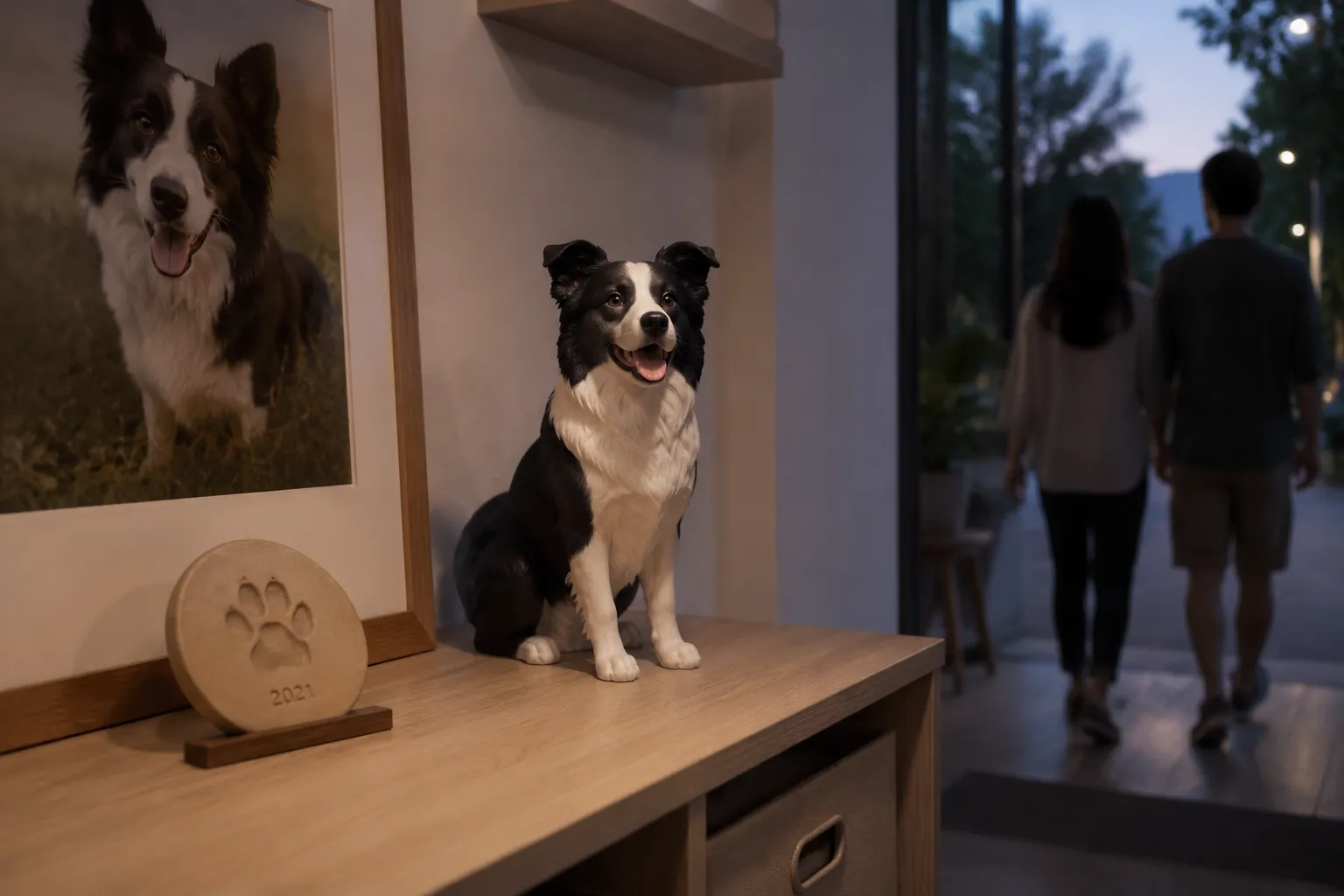
Grief counselors have a name for what happens to couples after a loss: incongruent grieving. Partners rarely sync up, and couples grieving differently turns out to be the rule, not the exception. In the garage, one hand pressed flat against a cold plaster cast—a border collie's paw print, edges still rough, the pad's grooves just deep enough to catch a fingernail.
Quick Takeaways
- Incongruent grief is normal — partners process loss on different timelines, and that gap isn't a sign of trouble.
- The "less upset" partner is often hiding delayed grief — silence rarely means someone cared less.
- Build a shared ritual, not a shared schedule — a nightly walk works better than forcing the same emotions.
- A tangible anchor helps grief settle — many families find comfort in a custom pet figurine that holds their pet's exact shape and markings.
- Talk about the dog, not the grief — naming specific memories reconnects partners faster than discussing feelings in the abstract.
When One of You Breaks and the Other Builds a Shelf
Here's the thing nobody warns you about. You lose your dog, and somewhere around day three, you look across the kitchen at the person you love most and feel a flicker of something ugly. Resentment. Why aren't you crying? Did she mean less to you?
We've talked to thousands of pet families over the years, and this moment—this exact, quiet betrayal—comes up more than almost anything else. One partner is dissolving. The other is organizing the vet paperwork, researching cremation options, building a literal shelf in the garage for the urn. And each one secretly suspects the other is doing grief wrong.
They're not. They're just running on different wiring.
Attachment theory gives us the first clue. The way each of us bonded with the dog—and the way we bond with loss itself—was shaped long before the border collie ever trotted into the house. Some people are wired to approach pain. They move toward it, talk about it, sit in it until it loosens. Others are wired to manage it. They cope by doing, fixing, solving. Neither is healthier. They just look nothing alike from the outside.
"The partner building the shelf is grieving too. They're just pouring it into their hands instead of their tears."
Psychologists studying bereavement describe two coping styles that map onto this almost perfectly: loss-oriented and restoration-oriented grieving. Loss-oriented people face the emptiness directly—they cry, they reminisce, they pull out the old photos. Restoration-oriented people focus on adjusting to the new reality—handling logistics, returning to routines, keeping the household moving. The American Psychological Association's work on grief notes that most healthy mourners actually oscillate between both, but couples often get stuck in opposite corners.
And that's where the trouble starts. The loss-oriented partner sees the restoration-oriented one and thinks, cold. The restoration-oriented partner sees the crying and thinks, I have to hold it together for both of us, so I can't fall apart too.
Both are exhausted. Neither feels understood.
The cortisol gap nobody mentions
There's a biological layer underneath all this. Grief floods the body with cortisol, the stress hormone, and it doesn't release on the same schedule for everyone. For some people, the spike hits within hours. For others, the body holds the line for weeks—staying functional, staying useful—before the dam gives.
So when you watch your partner pay the vet bill with steady hands, you might be watching someone whose cortisol hasn't crested yet. Not someone who doesn't care. Someone whose flood is still upstream.
We mention this because understanding the why changes the whole conversation. It's a lot harder to resent a person's tear ducts once you realize their stress hormones simply haven't peaked. The gap between you isn't a measure of love. It's a measure of timing.

The Border Collie Problem: When the Dog Was the Whole Household's Glue
Border collies aren't just dogs. Anyone who's lived with one knows this. They're a presence—a fourth person at the dinner table, a project manager who herds the family toward the door at exactly 6 p.m. because it is walk o'clock and there will be no negotiation.
According to the American Kennel Club's breed profile, border collies are among the most intelligent and energetic breeds, bred for relentless focus and constant engagement. That intelligence is exactly why losing one cracks a household open in a specific way. A border collie doesn't just occupy space. They run the schedule. They notice when you're sad before you do. They build the rhythm everyone unconsciously moves to.
So when they're gone, it isn't only the dog that vanishes. It's the structure.
One family we worked with put it perfectly. The wife said the house didn't feel empty—it felt unemployed. Nobody was checking the windows for squirrels. Nobody nudged a cold nose under an elbow at 5:55. The border collie had been the metronome of their marriage, and without that steady tick, both partners suddenly noticed how quiet they'd let themselves become with each other.
"We didn't realize the dog had been translating us to each other until she was gone."
This is the border collie problem in a nutshell. The smarter and more involved the dog, the bigger the hole in the household's operating system. And couples often grieve that structural loss on completely different frequencies—one mourning the companion, the other mourning the routine, each barely recognizing the other's version of the same dog.
What the herding instinct leaves behind
Border collies herd. It's in the muscle, the eye, the crouch. And a lot of them quietly herd their humans—steering you back together when you drift to opposite ends of the couch, planting themselves between you during an argument like a furry United Nations.
When that mediator disappears, couples sometimes find their old friction returning with nothing to absorb it. The dog had been doing emotional labor for the entire family, and no one had it on the chore chart.
If this is you, name it out loud. "She used to break up our standoffs" is a real sentence worth saying. Acknowledging the role the dog played isn't sentimental nonsense—it's an honest accounting of what you actually lost, which is the first step toward redistributing that load between the two of you.
Delayed Grief in Pet Loss: The Wave That Arrives in Month Three
Let's talk about the partner who didn't cry.
Maybe it was you. You handled everything. You were the steady one. And for weeks, friends praised how well you were doing, and some small honest part of you wondered if something was broken inside you, because you felt mostly numb.
Then one ordinary Tuesday—maybe you're putting away groceries, maybe you find a clump of black-and-white fur stuck behind the dryer—and the whole thing comes down on you at once, ten weeks late, with the force of a collapsing wall.
That's delayed grief, and in pet loss it is wildly common and almost never talked about.
Here's the science. The brain is a prediction machine, and neuroplasticity means it physically rewires around the patterns we live with daily. Your border collie was woven into hundreds of micro-routines—the jingle of tags, the click of nails on hardwood, the weight against your feet at the desk. Your brain built neural shortcuts expecting all of it. Grief, in part, is the slow, painful process of those circuits updating to a world where the dog no longer exists.
For the restoration-oriented partner, that updating gets postponed. You stay busy. You stay useful. You keep the predictions running on the surface. And then one day the deeper layers finally catch up, and the bill comes due all at once.
Personal Aside: We'll be real with you—this is the order that haunts our team the most. The ones who reach out months after the loss, voice cracking, embarrassed, saying "I thought I was fine." You were never fine. You were just patient. And the grief was patient too.
Why the delay can damage a relationship
Here's the part that catches couples off guard. By the time the delayed-grief partner finally breaks, the other one may have already moved through the worst of it. They've done their crying. They're starting to feel daylight again.
So now the timelines are completely flipped. The one who needs to fall apart is finally falling apart—right as the other is ready to heal. And if you don't see it coming, it can feel like you're trapped in an endless relay where someone is always down.
The fix isn't to grieve faster or slower. The fix is to expect the wave. If you're the steady partner, tell your spouse: "I haven't really felt it yet. It's probably coming. When it does, I'll need you." That single sentence can save you both weeks of confusion later.
Here's a rough map of how incongruent grief tends to unfold in couples. Yours won't match exactly—nobody's does—but the shape is worth knowing.
| Timeframe | Loss-Oriented Partner | Restoration-Oriented Partner | What Helps Both |
|---|---|---|---|
| Week 1 | Intense crying, can't function | Handles logistics, feels numb | Divide tasks without keeping score |
| Weeks 2–4 | Begins to stabilize | Stays busy, "fine" on the surface | Name the difference out loud |
| Weeks 5–10 | Finding small good days | Cracks may start to appear | Watch for the delayed wave |
| Months 3–6 | Healing, occasional pangs | Delayed grief often peaks here | Switch roles—now they lean on you |
| Month 6+ | Integration, fond memory | Integration, fond memory | Build a shared ritual together |
The Late-Night Walks That Became Our Ritual
We want to tell you about a habit that, again and again, we've seen pull couples back from opposite corners of the house.
The walk.
One couple we worked with—both grieving their border collie, both completely out of sync—stumbled into it by accident. He couldn't sleep. She couldn't sit still. So around 10 p.m., without really planning it, they started walking the same loop they'd walked with the dog for nine years. No leash. No dog. Just two people and the cold air and the route their feet already knew.
They didn't talk about feelings. That was the genius of it. They talked about her—the dog. The time she herded the neighbor's kids into the garage during a thunderstorm. The way she refused to walk past the blue mailbox for reasons no one ever understood. The smell of her paws, which, inexplicably, was corn chips.
And somewhere in those walks, in the dark where neither of them had to make eye contact, the grief gap started to close.
Why walking works when talking doesn't
There's real science here. Bilateral movement—the rhythmic left-right of walking—has a documented calming effect on the nervous system. It's part of why therapists use walk-and-talk sessions. Motion lowers the stakes. Side-by-side is less confrontational than face-to-face, which is exactly why hard conversations happen so naturally in cars and on trails.
For couples grieving differently, this matters enormously. Sitting across a table and being asked "how are you feeling" can shut down the restoration-oriented partner completely. But walking the old route, in the dark, with no pressure to perform an emotion? The words come on their own.
"Grief doesn't always want to be discussed. Sometimes it just wants to be walked."
Here's our specific, concrete suggestion. Take a 20-minute walk together, after dark, three nights a week, along a route your dog actually knew. Don't make it a grief session. Don't assign it homework. Just move, and let the dog come up naturally. The structure does the work.
If walking isn't possible, the principle still holds: find a side-by-side activity with gentle rhythm. Washing dishes together. A slow drive. Folding laundry. The body relaxes, the guard drops, and the partner who couldn't say a word at the kitchen table suddenly can.
The night-walk anchor
There's something about night specifically. The day's tasks are done, the to-do list can't intrude, and the darkness offers a kind of privacy even between two people who know everything about each other. Many couples tell us the night walk became the one time of day grief felt manageable instead of ambushing—because they'd given it a container.
That's the real lesson. Grief that has nowhere to go leaks into everything—dinner, work, the bedroom, the small irritations that become big fights. Grief that has an appointment tends to stay in its appointment. The walk became their container. It can become yours.
A Paw Print Keepsake and the Weight of Holding On
At some point, every grieving pet family confronts the same quiet question: what do we keep?
The collar still in the drawer. The half-bag of food no one can throw away. And for many, the paw print keepsake—that small impression in clay or plaster the vet pressed before saying goodbye.
There's a reason these objects matter so much, and it's not sentimentality. It's psychology. Grief researchers talk about continuing bonds—the now-accepted understanding that healthy mourning doesn't mean cutting ties with the deceased. It means transforming the relationship into something you can carry. A physical object gives that transformed bond a home. Somewhere for the love to live now that the dog can't hold it.
This is where the texture matters. There's a specific comfort in pressing your thumb into the cool groove of a paw print—the slightly rough surface of the plaster, the unmistakable shape of those four toes and the pad. Touch bypasses the thinking brain. It speaks directly to the part of us that bonded with the warm weight of a dog leaning against our legs.
"We've seen families heal by holding something solid. Grief needs an anchor, and the hands need somewhere to land."
— The PawSculpt Team
When a flat print isn't enough
Here's something we've learned that surprises people. For a lot of grieving families, the paw print eventually feels incomplete—not because it isn't precious, but because a border collie was never flat. They were motion and dimension and that intense, head-tilted stare. A two-dimensional impression captures the paw, but not the dog.
That's part of why families increasingly look for something with more presence—a three-dimensional keepsake that holds the actual posture, the markings, the lopsided ear. This is what our team does at PawSculpt: we digitally sculpt your pet from your photos, then bring that model to life through full-color resin 3D printing that captures the real shape and coloring of your dog, down to the split-face markings and the white blaze a border collie so often wears.
The color isn't applied on top. It's printed into the resin itself, voxel by voxel, so a figurine carries your dog's actual fur pattern in the material—then it's sealed with a clear protective coat for sheen and durability. When it arrives, it has a real weight in your palm. Cool resin, smooth finish, with the faint natural grain of the print that reminds you it was made for one specific dog and no other.
Couples especially tell us this helps bridge the grief gap. Both partners can hold the same object. The one who needed to cry has something to cry over; the one who needed to do has something tangible to care for. A shared anchor for two people who'd been drifting toward separate shores.
Here's how the common memorial options tend to compare, in our experience working with families.
| Memorial Option | Cost Range | Effort | Emotional Impact | Best For |
|---|---|---|---|---|
| Paw print (clay/plaster) | Low | Minimal | High, but flat | Immediate, raw early days |
| Photo book | Low–Medium | Moderate | Story-driven | Families who process visually |
| Memorial garden | Medium | High, ongoing | Living, seasonal | Those who cope by tending |
| Cremation urn | Medium | Minimal | Solemn, central | A defined place to "visit" |
| Custom 3D figurine | Medium–Higher | Low (we do the work) | Lifelike presence | Capturing the dog's whole self |
A quick, honest note: the "right" memorial is the one that fits how you grieve, not the most expensive one. Some people need a living garden to tend. Some need a book to turn the pages of. If a simple paw print on the mantel is everything you need, that's a complete and beautiful answer. We'd never tell you otherwise. For details on our own process, materials, and guarantees, it's best to visit pawsculpt.com and see what feels right for your family.
The guilt of the keepsake
Let's name something hard. Some people feel guilty about wanting a keepsake at all—as if buying something turns love into a transaction, or as if "moving the grief onto a shelf" means moving on too soon.
It doesn't. This is one of grief's cruelest tricks: convincing you that the things that comfort you are somehow a betrayal of the one you lost. They're not. Creating a place for your dog to live in your home isn't letting go. It's the opposite. It's deciding they get to stay.
And if you and your partner disagree about a keepsake—one wants the figurine, the other finds it too painful to look at—that disagreement is just incongruent grief showing up again. Compromise on placement. The bedroom for one, a quiet shelf for the other. The object can wait until you're both ready to see it every day.
Finding Your Way Back to Each Other
Most advice for grieving couples tells you to "communicate more." We think that's backwards, and here's the counterintuitive part: talking directly about your grief, head-on, is often the fastest way to make a grieving couple fight.
When you ask a hurting person "what are you feeling," you're asking them to translate something raw into words while it's still bleeding. Most people can't. So they say "I'm fine" or "I don't know," and the asking partner hears a wall.
What actually works is sideways. Talk about the dog, not the grief. Specific memories, not abstract emotions.
- Instead of "are you okay?" try "remember when she stole the entire Thanksgiving turkey off the counter?"
- Instead of "we need to talk about how we're coping," try "want to do the loop tonight?"
- Instead of "you seem distant," try "I found her tennis ball under the couch today."
Each of these opens a door without demanding someone walk through it. Specific memories reactivate the shared bond. Abstract grief questions just trigger the defenses.
When the gap feels too wide
Sometimes the distance between two grieving partners stretches far enough that it scares you. One of you wants another dog within a month; the other can't imagine ever again. One visits the urn daily; the other can't be in the room with it.
This is where you have to remember the timing principle. You are very likely not at the same point on the curve. The partner who wants a new dog isn't being callous—they may be restoration-oriented, healing through forward motion. The one who can't bear the thought isn't being dramatic—they may still be loss-oriented, mid-flood.
Neither of you is wrong. You're just at different mile markers on the same road. If the gap genuinely frightens you, talking to a grief counselor—the Association for Pet Loss and Bereavement maintains resources and support specifically for pet loss—can give you a neutral third presence. Sort of the role your border collie used to play, stepping between you to keep the peace.
A few specific things that help
We're not therapists, and for clinical depression or grief that isn't lifting at all, please see a professional. But these are concrete moves we've watched help real couples:
- Schedule the wave. If one partner hasn't grieved yet, agree out loud that it's coming and plan to switch support roles when it does.
- Keep one shared ritual. The night walk, a Sunday morning coffee where the dog comes up, anything repeated and side-by-side.
- Divide the keepsakes by readiness, not by fairness. Whoever needs the figurine in view gets it in view. The other gets a quieter spot.
- Tell specific stories. Ban "how are you feeling." Replace it with "remember when."
- Touch something solid together. Hold the paw print, the collar, the figurine—in the same room, at the same time. Shared physical grief beats parallel silent grief every time.
"You're not on different roads. You're just at different mile markers on the same one."
Where the Two Roads Meet Again
Back to that garage. The plaster paw print on the workbench, cold under one hand and growing slowly warm where the skin held it.
That's the whole thing, really. Two people, standing in the same room, touching the same small shape that's all that's left of the dog who used to run the house. One of you got here weeks ago. One of you just arrived. And for a long time it felt like you were grieving two completely different dogs in two completely different houses.
But you're not. You're grieving the same border collie—the one who herded you back together for years, and who, even now, is doing it one last time through the cold groove of a single paw print and the dark loop of a late-night walk.
So tonight, do the loop. Don't talk about feelings. Talk about the turkey she stole, the mailbox she feared, the corn-chip smell of her paws. Let the rhythm of walking do what words can't.
And when you're ready—not before—give your dog a place to stay. Whether that's a paw print on the mantel, a garden out back, or a keepsake that holds her actual shape in your hand, the goal is the same. Not to let go. To decide she stays.
The gap between you and your partner will close. It always does, once you stop measuring grief and start sharing it. The dog would have wanted you walking together anyway. She always did insist.
Frequently Asked Questions
Why are my partner and I grieving our border collie so differently?
Because you're likely running on different coping styles. One of you faces grief head-on—crying, reminiscing, sitting in it—while the other copes by handling logistics and staying functional. Attachment theory and stress-hormone timing both play a role, and your cortisol simply may not peak on the same schedule. Neither approach is wrong; they just look nothing alike from the outside.
Is delayed grief after pet loss actually a real thing?
Very much so, and it's far more common than people realize. The "steady" partner often stays numb or busy for weeks, then gets ambushed by grief months later, frequently triggered by something small like finding fur behind the dryer. The brain postpones the emotional flood while it keeps the household running, and the bill eventually comes due all at once.
How do we grieve together when we're on completely different timelines?
Stop trying to sync your emotions and build a shared ritual instead. A 20-minute night walk along your dog's old route, three times a week, works beautifully because side-by-side motion lowers everyone's guard. Talk about specific memories rather than asking "how are you feeling," and agree out loud that the delayed wave is coming so you can switch support roles when it hits.
Is it normal to feel guilty about wanting a memorial keepsake?
Yes, and it's one of grief's cruelest tricks. Wanting something tangible doesn't turn love into a transaction or mean you're moving on too soon. A keepsake gives your continuing bond a physical home—it's not letting go, it's deciding your pet gets to stay in the house with you.
What should we keep, and what kind of memorial is "right"?
The right memorial is the one that fits how you grieve, not the most elaborate option. Some people need a garden to tend, some a photo book, some a paw print on the mantel. Others want a three-dimensional keepsake that captures their dog's whole posture and markings. For couples, a shared object both partners can hold often helps bridge the grief gap.
Should we get another pet, and how soon?
There's no universal timeline, and partners often disagree here—usually because they're at different points on the grief curve. The one ready for a new dog may be healing through forward motion; the one who can't imagine it may still be mid-flood. Neither is wrong. Wait until you're closer to the same mile marker, and talk to a pet loss counselor if the gap feels frightening.
Ready to Celebrate Your Pet?
Every pet has a story worth preserving. Whether you're honoring a border collie who's crossed the rainbow bridge or finding a way for couples grieving differently to hold onto the same shared memory, a custom PawSculpt figurine captures the exact markings, posture, and personality that made your dog one-of-a-kind—printed in full color, right into the resin.
Visit pawsculpt.com to learn more about our process, fast previews, flexible revisions, and quality guarantee