
I Still Can't Move the Food Bowl: One Month Alone After Saying Goodbye to My Russian Blue
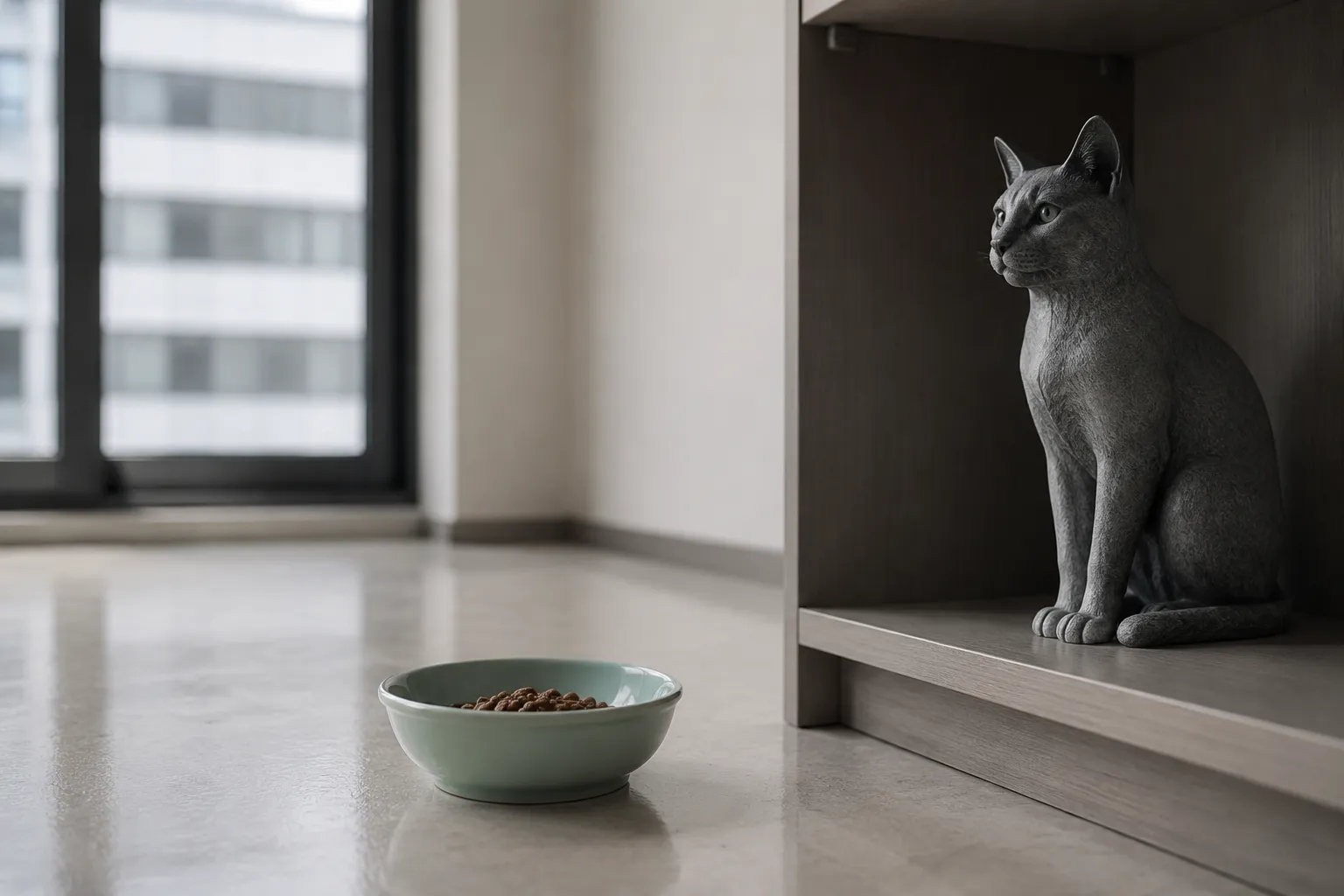
You crouch by the water dish at 6 a.m., hand already curled around the ceramic rim, and your fingers stop cold against the smooth edge. Empty. Still. This is what solo owner pet grief feels like in the first month alone—the muscle memory of care with nowhere to land.
Quick Takeaways
- Muscle memory grieves too — leave the food bowl if moving it feels impossible right now.
- Second-guessing euthanasia timing is universal — the "too early or too late" loop is grief, not failure.
- Solo owners carry a unique weight — no one shared the routine, so no one shares the silence.
- A tangible anchor helps the bond stay present — some pet parents choose custom pet figurines to hold something real when memory feels slippery.
- Rituals beat resolutions — small daily acts of remembrance outperform "moving on" every time.
Why the Food Bowl Is the Hardest Object in the House
We've talked with thousands of pet families over the years, and one detail comes up more than almost any other. It's never the big stuff that breaks them. Not the vet bill. Not the collar in the drawer.
It's the bowl.
Here's the thing about a food bowl. It's the one object your pet interacted with every single day, multiple times a day, in a ritual you both performed together. You scooped. They waited. The kibble hit the ceramic with that specific rattle. Your Russian Blue wound between your ankles, that dense plush coat brushing your shin—cool on top, warm underneath, like petting a cloud with a furnace inside.
That sound. That texture. Gone in one appointment.
Most grief guides tell you to pack up your pet's things quickly. "Clean break," they say. We think that advice is, honestly, a little reckless. Because the food bowl isn't clutter. It's an altar.
"Some objects aren't clutter. They're the last physical proof that a daily ritual once existed."
When you're a solo owner, the bowl carries even more weight. There was no partner on the other side of the couch who also fed them. No kid who split the morning duty. The russian blue memorial you're building in your mind is built alone, because the caretaking was yours alone. Every scoop, every refill, every "okay, okay, I'm getting it" at 5:45 a.m.—that whole liturgy belonged to you and one small gray soul.
So no, you don't have to move the bowl. Not today. Maybe not this month.
The counterintuitive truth about "moving on" objects
The standout insight from families who healed well isn't that they cleared everything fast. It's the opposite. They gave certain objects a new role instead of an exit.
The bowl stays. But it becomes a place for a candle. Or a small plant. Or nothing at all—just a marked spot on the floor where love used to happen.
So what? Because forcing yourself to erase the evidence doesn't accelerate healing. It just teaches your nervous system that the ritual was shameful. It wasn't. It was sacred.

The Solo Owner's Silence Nobody Warns You About
Let's be real about something the grief pamphlets skip.
When you live alone with a pet, that animal isn't just a companion. They're your witness. The one who saw you cry after a bad day. The one who heard you talk to yourself in the kitchen. The presence that made a one-bedroom apartment feel occupied instead of empty.
Russian Blues are especially good at this. They're famously bonded to one person—velcro cats with a quiet, watchful loyalty. According to the American Kennel Club's overview of feline companionship, single-person households often report deeper one-on-one attachment, and Russian Blues are the poster cat for it. Your grief isn't dramatic. It's structural. You lost your daily witness.
A day in the life, one month out
The alarm goes off. For a half-second, before your eyes open, your body braces for the weight of a small cat landing on your chest. Nothing lands. You lie there feeling the cool sheet where a warm gray body used to press. Then you make coffee for one, and the apartment stays quiet in a way that has texture—thick, heavy, pooling in the corners.
That specific quiet is the first month pet loss experience for solo owners. It's not sadness on a schedule. It's the absence of an entire soundtrack.
"Living alone with a pet means they were your witness. Grief for a witness is its own kind of lonely."
Here's what actually helps more than "staying busy" (which everyone recommends and which mostly just delays the crash): give the silence a job. Play the same podcast every morning. Keep a radio on the station you'd never let bother your cat's sensitive ears. Fill the auditory space intentionally, not frantically.
So what? Because your grief lives in your senses—sound, touch, the specific weight of a body. You can't outrun sensory memory, but you can gently redirect it.
The Euthanasia Decision Loop: Reading Your Own Mind at 3 a.m.
We need to talk about the thing you're probably not saying out loud.
If your goodbye involved a euthanasia decision, you are almost certainly running the tape backward. Was it too soon? Did I steal weeks we could've had? Or the opposite—did I wait too long, did they suffer while I hesitated, was that last week about them or about me?
This is euthanasia decision grief, and it is one of the cruelest features of loving a pet through their final chapter.
Let us name it plainly: the second-guessing is not evidence that you made the wrong choice. The second-guessing is evidence that you loved a creature who couldn't tell you when they were ready. You made an impossible call with incomplete information, out of mercy. That's not a mistake. That's the final act of care.
"You didn't choose between right and wrong. You chose between two kinds of heartbreak, out of love."
One customer told us she replayed her cat's last morning for weeks—had he purred because he was comfortable, or because cats purr when they're in pain too? She couldn't know. That not-knowing is the wound. And the truth is, it doesn't fully close. It softens. It scars over. But the loop quiets when you stop treating it as a case to solve and start treating it as grief to hold.
What actually breaks the 3 a.m. loop
Most advice says "focus on the good memories." Fine, but useless at 3 a.m. when your brain is a prosecutor.
Try this instead. Write down—physically, on paper—the specific signs that told you it was time. The refusing food. The hiding. The way they stopped grooming that once-immaculate blue coat. Keep the list somewhere you can reach.
Then, when the loop starts, you don't argue with your brain. You read the list. Evidence, not emotion.
So what? Because guilt thrives on vagueness. It hates specifics. When you can point to concrete reasons, the accusation loses its grip. This is one of the most practical tools we've heard from families who found peace with a hard decision.
If you're stuck in a spiral that won't lift after several weeks, the Association for Pet Loss and Bereavement offers grief support specifically for this—including the euthanasia guilt so many owners carry in silence.
The Emotions You're Not Supposed to Admit
Grief is messy, and the tidy versions people share online leave out the parts that make you feel like a monster. So let's go there.
Relief mixed with sadness. When the caretaking is over—the medications, the 3 a.m. checks, the watching-for-suffering—there's often a flood of relief. And then immediate horror at feeling relieved. Listen: relief doesn't cancel love. It means you carried a heavy thing for a long time, and your body noticed the weight lift. That's human. That's not betrayal.
Anger. At the vet. At yourself. At the universe. At the cat, even, for leaving. Anger is grief with nowhere to go. It's normal, and it usually burns off if you let it move through instead of judging yourself for having it.
The fear of forgetting. This one keeps solo owners up at night. What if I forget the exact sound of their meow? The specific weight of them on my lap? The way that dense double coat felt different in summer versus winter? This fear is why so many people reach for something tangible—because memory is slippery, and the mind panics at the thought of losing the last of them.
Here's a table we put together from patterns we've seen across many families. It's not a prescription—everyone's timeline differs—but it helps to know you're not broken.
| Emotion | When It Often Peaks | What Actually Helps |
|---|---|---|
| Shock / numbness | Days 1–7 | Don't make big decisions; keep basic routines |
| Relief + guilt | Week 1–3 | Name it out loud; relief is not betrayal |
| Euthanasia second-guessing | Week 2–6 | Keep a written "signs it was time" list |
| Fear of forgetting | Week 3–8 | Create a tangible anchor (photos, keepsakes) |
| Quiet reorganizing | Month 2–4 | Give objects new roles instead of removing them |
Notice there's no "acceptance = done" row. Because grief isn't a staircase you climb and finish. It's a room you learn to live in, and eventually the furniture stops surprising you in the dark.
Building a Sacred Space Instead of a Shrine
There's a difference between a shrine and a sacred space, and it matters.
A shrine can become a place you visit to feel bad—a static monument to loss. A sacred space is alive. It's where you go to feel the ongoing presence of the bond, not just the absence.
For solo owners especially, creating this space is powerful because you're the sole keeper of the flame. No one else is going to build it. That's heavy, yes. But it's also a gift—you get to design the exact space that honors the exact relationship only you fully knew.
How to build one that actually helps
Pick a spot with texture and light. A windowsill where afternoon sun used to pool for a napping cat. A shelf you pass daily. The energy of the space matters more than the size.
Then layer in a few elements:
- Something they touched — the food bowl, a favorite blanket with fur still woven into the fibers, the collar.
- Something that holds their image — a printed photo (not just a phone screen you'll scroll past).
- Something you can hold — this is the piece most people skip, and it's the one that matters most for the fear of forgetting.
That third element is why tangible keepsakes have become such a meaningful part of memorial rituals. When the mind starts to lose the details, your hands remember. The weight in your palm. The cool smooth surface. The specific shape of a body you knew better than your own.
Some families plant a tree. Some commission a portrait. And increasingly, pet parents choose 3D pet sculptures that reproduce their companion's exact markings and posture—something with real presence you can pick up, not just look at.
"We've watched grief find its footing the moment someone holds a likeness of the one they lost. The hands remember what the mind fears losing."
— The PawSculpt Team
Why a Physical Likeness Anchors the Bond
Let's talk about why holding something matters, from a slightly more practical angle.
Grief researchers and the human-animal bond studies referenced by organizations like the NIH point to a concept called "continuing bonds"—the healthy, healing practice of maintaining a connection with a loved one after they're gone, rather than severing it. The old model said healthy grief means letting go. The current understanding says the opposite: you don't have to detach to heal. You transform the relationship.
A physical object is one of the most effective continuing-bond tools because it lives in three dimensions, in your actual space, with weight and presence.
What we've learned about capturing a Russian Blue
Russian Blues are, honestly, one of the trickier subjects—and one of the most rewarding. That coat isn't just gray. It's a specific silvery-blue with silver-tipped guard hairs that catch light, giving them an almost shimmering quality. Get the color flat and it looks like any gray cat. Get it right and their owner gasps.
At PawSculpt, we digitally sculpt each pet by hand using master 3D artists, then bring them to life through full-color resin 3D printing. The color isn't a coating applied on top—it's printed into the material itself, voxel by voxel, so those subtle silver-tipped tones and the plush density of a Russian Blue's double coat come through in the resin directly. The only manual finishing step is a protective clear coat that gives the piece its sheen and guards the color for years.
The result has an authentic, tactile quality—vibrant full color with the fine natural grain of a quality 3D print, not a glossy plastic toy. When you pick it up, it has real heft. That weight is the point.
Here's a quick comparison of common memorial keepsake options, based on what we've seen resonate with families over the years:
| Keepsake Type | Tactile Presence | Captures Likeness | Best For |
|---|---|---|---|
| Framed photo | Low | High (2D only) | Everyday visual reminder |
| Paw print clay mold | Medium | Low (abstract) | Immediate, before goodbye |
| Custom figurine | High | Very high (3D) | Fear of forgetting; daily holding |
| Memorial jewelry | Medium | Low | Carrying them with you |
| Fur/ash keepsake | Medium | None | Intimate, private ritual |
Notice we're not saying a figurine is the only answer. If a paw print mold is what comforts you, that's the right choice. The best keepsake is the one you'll actually reach for. For a lot of solo owners, though, the thing that helps most on the hard nights is something they can literally hold—which is why a custom pet figurine ends up on so many nightstands.
Pro tip for photos: the best source image for a figurine is a well-lit shot at your pet's eye level, showing their natural posture and clear markings. For a Russian Blue, daylight near a window beats flash every time—flash flattens that gorgeous silver shimmer. You can see examples of what works on the PawSculpt gallery.
The Rituals That Rebuild a Routine
The cruelest part of the first month isn't any single moment. It's the collapse of structure. Your day was scaffolded around another creature's needs, and now the scaffolding is gone.
You don't rebuild that by "keeping busy." You rebuild it with intentional ritual.
Morning ritual
Instead of the feeding routine, create a 90-second replacement. Light the candle by the bowl. Say good morning to them out loud—yes, out loud. Touch the keepsake if you have one. Then start your day. It sounds small. It's not. You're teaching your nervous system that the morning still has a shape.
Evening ritual
Russian Blues are dusk creatures—that's often when they'd get playful, pupils wide, tearing across the room. That's the hour many solo owners feel the absence hardest.
Fill it. Fifteen minutes of something that honors them—looking through photos, writing one memory in a notebook, sitting in their sunny spot. Not scrolling. Not numbing. A real, chosen act of remembrance.
"You're not keeping a routine for a cat who's gone. You're keeping a promise to the love that stays."
So what? Because the structure your pet gave your day was real, and its collapse is a genuine second loss on top of the first. Rebuilding ritual gives your hours their shape back—on your terms, in their honor.
A note on the fear of getting another pet
Some of you are already feeling the pull toward another cat, and feeling guilty about it. Others can't imagine it and feel guilty about that. Both are normal.
Getting another pet is not replacing. Loving again is not forgetting. And there's no correct timeline—some people are ready in weeks, some in years, some never, and all of those are legitimate. The presence of one soul in your life doesn't erase another. Love isn't a fixed quantity you use up. It's a space that keeps expanding.
When Grief Feels Bigger Than It "Should"
We hear this one a lot, usually whispered: "It was just a cat. Why am I this destroyed?"
Stop. First, we're not vets or therapists, so if grief is affecting your ability to function for an extended time, please reach out to a professional—the APLB grief resources are a good starting point, and they get it.
But here's the reframe. The intensity of your grief is a direct measure of the depth of the bond. You're not overreacting. You lost a daily relationship, a witness, a source of touch and warmth and routine and unconditional presence. For a solo owner, that cat may have been your most consistent relationship, full stop.
Grief that big isn't a malfunction. It's a receipt. It's proof of how much was real.
"The size of your grief is the size of your love, measured honestly. Don't apologize for the total."
And the people who make you feel judged for it—the "just get another one" crowd—simply never had a bond like yours to lose. Their inability to understand is not a verdict on your grief. It's a gap in their experience.
What to Expect If You Choose a Tangible Memorial
If you're considering a physical keepsake, here's an honest walk-through of the general process, without the fine print (which changes, so check the site for specifics).
- You choose your favorite photos. Clear, well-lit, showing markings and personality. Multiple angles help our artists most.
- Master 3D sculptors model your pet digitally. This is where the likeness is built—posture, proportions, that particular tilt of the head.
- You review a preview. Good services show you the digital model before production so you can request adjustments.
- Full-color 3D printing brings it to life in resin. Color printed into the material, then sealed with a protective clear coat.
- It arrives, and you hold it. That first moment—the weight, the recognition—is what families tell us stays with them.
For turnaround times, revision options, and guarantees, we'd point you to pawsculpt.com directly, since those details are best confirmed live rather than quoted from a blog.
Care note: keep your figurine out of prolonged direct sunlight to preserve the color over the long haul, and dust it gently with a soft dry cloth. The clear coat is protective, but resin appreciates a stable spot away from heat.
One thing worth noting from experience: the families who order sooner rather than later often say the same thing—having something to look forward to during the rawest weeks gave the grief a small, forward-facing shape. Not a fix. A foothold.
The Bowl, Revisited
Go back to that morning. Your hand on the empty water dish, fingers stopped against the cool ceramic.
Here's what we've learned from walking beside so many people through exactly this moment: you don't have to move the bowl until the bowl stops being a wound and starts being a memory. That shift can't be forced. It arrives on its own, usually somewhere in the second or third month, when you realize you walked past it without your chest caving in.
When that day comes, you might not put the bowl away at all. You might set a small candle beside it. Or place a figurine of your Russian Blue right there, in the exact spot where the ritual of your love played out twice a day for years—so the space that held their body now holds their presence.
The first month pet loss feeling never fully disappears, and it isn't supposed to. It becomes something you can carry instead of something that carries you. Your cat isn't in the bowl. They're in the reaching—the reflex of care that outlived them, which is just love that hasn't figured out where to go yet.
Give it somewhere to go. Light the candle. Keep the promise. Hold what you can hold.
That's not moving on. That's moving with.
Frequently Asked Questions
Is it normal to feel guilty after choosing euthanasia for my pet?
Completely normal, and more common than almost any other grief response we hear about. Euthanasia decision grief loops on "too soon or too late" because you made a merciful call for a creature who couldn't tell you they were ready. Try keeping a written list of the specific signs that told you it was time—when the guilt spiral starts, you read the evidence instead of arguing with your brain.
How long does grief last after losing a pet, especially living alone?
There's no universal timeline, and anyone who gives you an exact number is guessing. Acute grief often begins to soften over a few months, but solo owner pet grief can run longer because your pet was your daily witness and the scaffolding of your routine. Waves that return months later—triggered by a sound, a season, an empty sunny spot—are normal, not regression.
Why can't I bring myself to move the food bowl?
Because the bowl is the object tied to your most repeated shared ritual, layered with sound, texture, and muscle memory. It's not clutter to clear—it's an emotional anchor. You don't have to move it. Many people give it a new role instead, setting a candle or a keepsake beside it until the object shifts from wound to memory.
Is it too soon to order a memorial figurine during the first month?
Not at all. Some families wait, and that's fine, but many tell us that having a tangible keepsake in progress gave the rawest weeks a small, forward-facing focus. A physical likeness helps with the fear of forgetting the details—the exact posture, the specific markings—because your hands remember what the mind worries it will lose.
What photo works best for a custom Russian Blue figurine?
A well-lit, eye-level shot taken in natural daylight, showing your cat's natural posture and clear markings. For Russian Blues specifically, skip the flash—it flattens that silver-tipped shimmer that makes the breed distinctive. Multiple angles give the 3D artists the most to work with. You can see examples of ideal reference photos on the PawSculpt site.
Is it wrong to feel relieved after my pet passed?
No. If you spent weeks or months caregiving, medicating, or watching for suffering, relief when it ends is your body registering that a heavy weight lifted. That relief doesn't erase or diminish your love. Relief and grief frequently arrive together, and feeling both at once doesn't make you cold—it makes you human.
Ready to Celebrate Your Pet?
Every pet has a story worth preserving. Whether you're navigating the raw first month pet loss brings or honoring a companion who's crossed the rainbow bridge, a custom PawSculpt figurine captures the exact markings, posture, and presence that made your pet one-of-a-kind—something real you can hold when solo owner pet grief makes memory feel slippery.
Visit pawsculpt.com to explore our full-color 3D printing process, preview options, revisions, and quality guarantee.