The Bearded Dragon Keeper's Guide: 5 Ways to Immortalize Scales (And Why Photos Fail)
"Nature does not hurry, yet everything is accomplished." — Lao Tzu. You are sitting in the garden, staring at a patch of sun-warmed stone where your bearded dragon used to flatten himself into a solar panel. The absence of that rough, prehistoric texture against your hand is a specific emptiness that a standard reptile memorial simply cannot fill.
Quick Takeaways
- Photos flatten texture — 2D images cannot capture the tactile "spikiness" of a beardie's scales.
- Taxidermy is difficult — Reptile skin loses vibrant color quickly after death, making preservation tricky.
- Validation is necessary — "Reptile grief" is often dismissed by others; acknowledge your right to mourn.
- Precision matters — Custom figurines use full-color 3D printing to replicate exact scale patterns and morph colors.
- Plan ahead — If your pet is aging, take high-resolution reference photos of their unique markings now.
The Silent Struggle of Reptile Grief
Let's be blunt about something most people won't say to your face: the world doesn't understand why you are crying over a lizard.
When a dog dies, neighbors bring casseroles. When a bearded dragon dies, those same neighbors might say, "It was just a reptile," or ask if you're going to get a "real pet" next. This creates a phenomenon known as disenfranchised grief—sorrow that society refuses to acknowledge.
But we know the truth. We know the specific routine of chopping mustard greens at 7:00 AM. We know the sound of claws scrabbling against glass when they want out. We know the distinct personality behind that judgmental side-eye.
"Grief for a reptile is often silent because the world refuses to listen, but the bond was never quiet."
The isolation is real. You aren't just missing a pet; you are missing a daily rhythm of heat lamps, humidity gauges, and live feeders. The silence of a cricket bin that no longer needs filling is a sound only a reptile keeper understands.
Why Photography Fails the "Pancake" Test
Most pet owners rely on photos for memories. For mammals, this works reasonably well. Fur absorbs light, creating soft edges that cameras handle nicely.
Bearded dragons are different. They are architectural.
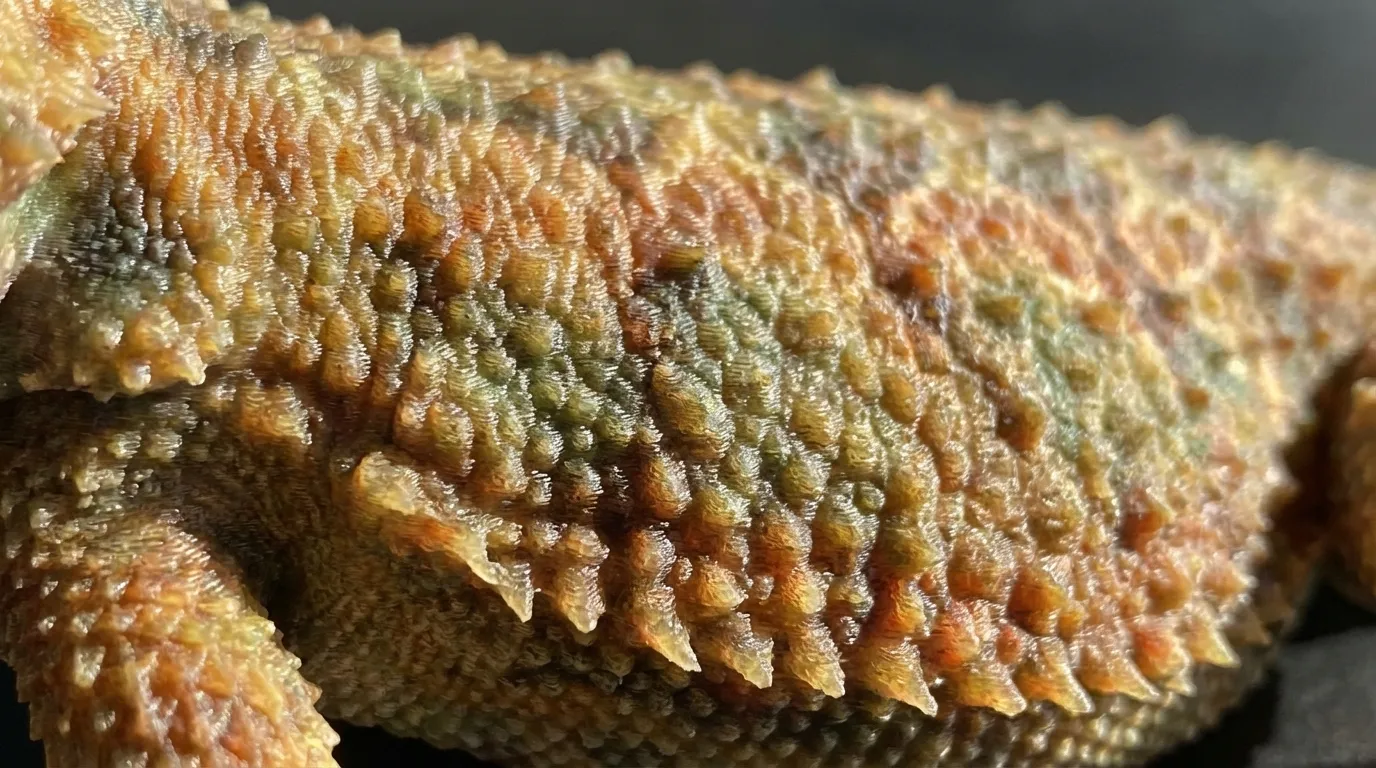
Their beauty lies in topography—the ridges of the head, the spikes along the beard (gular pouch), and the rough texture of the back. When you take a photo of a bearded dragon, especially with a flash, you flatten that topography. The light bounces off the scales, creating glare rather than depth.
The Texture Gap
A photo cannot replicate the sensation of holding a "spiky pancake." You miss: 1. The Temperature: The warmth they absorbed from their basking spot. 2. The Friction: The way their scales grip your shirt. 3. The Volume: The physical weight of them resting on your chest.To truly immortalize a reptile, you need three dimensions. You need to capture the geometry of the animal, not just the image.
Method 1: Skeletal Articulation (The Scientific Approach)
If you appreciate the biology of your dragon as much as their personality, skeletal articulation is a compelling, albeit stark, option.
What it is: A professional taxidermist cleans the bones (often using dermestid beetles) and reassembles the skeleton in a lifelike pose.
The Reality:
- Pros: It is visually striking and lasts forever. It honors the incredible anatomy of the creature.
- Cons: It removes the "face" of your pet. You lose the color, the eyes, and the expression. It can feel clinical rather than comforting.
- Cost/Time: High cost ($300-$800+), long wait lists (6-12 months).
Who this is for: The keeper who views their dragon with scientific fascination and wants a museum-quality display.
Method 2: Custom Full-Color 3D Replicas
This is where modern technology bridges the gap between a flat photo and a taxidermy mount. At PawSculpt, we utilize full-color 3D printing technology to recreate the physical presence of your pet.
Unlike traditional sculpture which relies on an artist's interpretation of paint, our process uses voxel-level color control. The color is not painted on the surface; the color is part of the resin itself.
Why this works for scales:
- Digital Sculpting: Our 3D artists digitally model every spike and scale based on your photos. We don't guess; we trace the geometry.
- Morph Accuracy: Whether you had a standard wild-type, a vibrant red, or a hypomelanistic morph, the printer replicates those exact gradients.
- Durability: The result is a solid, UV-resistant resin figure that holds the weight and shape of your dragon.
"Reptiles are all about geometry. A photo flattens them, but a 3D print captures the way the light hits every single scale."
— The PawSculpt Team
The Process: You upload clear photos (top, side, and face). We create a 3D digital model. You review it. Once approved, we print it in full color. The only post-processing is a clear coat to protect the finish and mimic the natural sheen of scales.
Method 3: Wet Specimens (The Preservationist Route)
This is not for the faint of heart, but it is a traditional method of zoological preservation.
What it is: The dragon's body is injected with formalin to halt decomposition and then stored in a sealed jar of alcohol.
The Reality:
- Pros: It is literally your pet's body. Nothing is simulated.
- Cons: Color fades significantly over time (greens turn brown, reds dull). The eyes cloud over. It looks like a specimen in a laboratory jar, which can be distressing for some owners to look at daily.
Warning: Do not attempt this yourself. Improper fixation leads to decomposition inside* the jar.
Method 4: Scale Jewelry & Resin Casting
If you want something you can keep close to you, utilizing shed skin (if you saved any) or cremation ashes is a subtle way to maintain a connection.
The Strategy:
Many artists can encapsulate a piece of shed skin or a small amount of ash into resin jewelry.
The "Shed" Problem: Shed skin is transparent and ghostly. It doesn't look like the dragon did when alive. However, it does capture the pattern* of the scales perfectly.
- The Solution: Look for artists who back the shed skin with a dark background to make the scale pattern pop, or who mix ashes with a pigment that matches your dragon's original color.
Pro Tip: If you use shed skin, ensure it is fully dried and free of any moisture before sending it to an artist, otherwise it will rot inside the resin.
Comparison: Which Memorial Fits Your Grief?
To help you decide, here is a breakdown of the practical trade-offs for each method.
| Memorial Type | Visual Accuracy | Tactile Feel | Long-Term Durability | "Cuddle Factor" |
|---|---|---|---|---|
| Photos/Canvas | Medium (lacks depth) | None | High | Low |
| Skeletal Articulation | Low (no skin/color) | High (fragile) | Very High | None |
| Wet Specimen | High (initially) | None (in glass) | Medium (color fades) | None |
| PawSculpt Figurine | High (shape & color) | High (solid weight) | Very High | Medium (holdable) |
| Scale Jewelry | Low (abstract) | Medium (smooth resin) | High | High (wearable) |
The "Guilt" Factor in Reptile Loss
We need to address the elephant in the room: Husbandry Guilt.
Because reptiles have such specific environmental needs (UVB percentages, temperature gradients, calcium ratios), their death almost always triggers a forensic investigation in the owner's mind.
- "Did I let the tank get too cold last winter?"
- "Was the humidity too high?"
- "Did I feed him a bad hornworm?"
Stop.
Reptiles are masters of hiding illness. By the time they show symptoms, they have often been sick for weeks. According to veterinary data from the Association of Reptilian and Amphibian Veterinarians, reptiles metabolize drugs and recover from illness much slower than mammals, making treatment windows incredibly narrow.
You did the best you could with the information you had. Memorializing them is a way to forgive yourself and focus on the life they lived, not the clinical details of how it ended.
"You offered a wild creature a safe home and a warm hand. That is enough."
Practical Steps: Organizing the Legacy
Don't let grief paralyze your organization. If you have equipment left behind, you have decisions to make.
- Sanitize Immediately: If you plan to get another reptile eventually, clean everything now. Use F10SC or a bleach solution (1:10 ratio). Rinse thoroughly. Do this while you are in "task mode"—it’s harder to do months later when the smell of the tank brings back memories.
- The Bulb Check: UV bulbs degrade even if they still light up. If you store them for 6 months, they are likely useless. Mark the date on them or toss them.
- The Digital Archive: Go through your phone. Create a specific folder named "Dragon." Don't let those photos get buried in your camera roll. Back them up to a cloud service immediately.
Moving Forward
The empty tank in the living room is a heavy object. It occupies space in your house and your mind.
Some people cover it with a blanket. Others fill it with houseplants (a "memorial terrarium") using the grow lights that are already there. This can be a beautiful way to transition the space from death back to life—growing succulents or ferns in the habitat where your friend used to roam.
Whatever you choose to do, remember that your grief is valid. That spiky, cold-blooded creature warmed your life in a way a dog or cat never could.
Frequently Asked Questions
How long does it take to make a custom reptile figurine?
At PawSculpt, the process typically takes 3-5 weeks. This includes the digital sculpting phase (where you get to give feedback), your final approval, and the high-precision 3D printing and finishing process. We don't rush the sculpting because capturing the specific shape of the head spikes is critical.Can you make a figurine from just a few photos?
Yes, though more angles are better. We ideally need one clear photo of the face (for expression) and one of the back (for pattern). However, our digital artists have years of experience with reptile anatomy. If you are missing a specific angle, we can infer the details based on standard morph traits and the reference photos you do have.Do you paint the figurines by hand?
No. We use advanced full-color 3D printing technology. This is superior for reptiles because painting individual scales by hand often leads to a "clumpy" look. Our printers inject color directly into the resin voxel-by-voxel, ensuring precise reproduction of complex patterns, gradients, and markings without losing the fine texture of the digital sculpt.Is it normal to feel guilty after my reptile dies?
It is extremely normal and very common. Because reptiles require such specific husbandry (heat, light, supplements), owners often blame themselves for environmental factors. Remember that reptiles are evolutionarily designed to hide illness to avoid predation. By the time they show signs of sickness, it is often advanced.Ready to Celebrate Your Pet?
Every pet has a story worth preserving. Whether you're honoring a beloved companion who's crossed the rainbow bridge or celebrating your furry friend's unique personality, a custom PawSculpt figurine captures those details that make your pet one-of-a-kind.
Free instant AI preview • 3D artist preview within 7 days • 5 free revisions