
7 Ways to Memorialize a Golden Retriever Without Creating a 'Shrine' (And 1 Mistake to Avoid)
You’re kneeling on the rough plywood of the attic floor, dust motes dancing in the single shaft of afternoon light, when your hand brushes against a texture your fingers haven’t felt in months. It’s the distinct, fuzzy grit of a tennis ball, rolled behind a holiday storage bin and forgotten. As you squeeze it, that specific rubbery resistance brings the memory of your golden retriever memorial plans rushing back—not as a concept, but as a physical weight in your chest.
Quick Takeaways
- Curate, don't accumulate — Select 3-5 high-impact items that spark joy rather than keeping every toy.
- Integrate, don't isolate — Blend memorial pieces into your existing decor rather than dedicating a sad corner.
- Focus on light and texture — Use materials that mimic the warmth and softness of a Golden's coat.
- Create a tangible anchor — Consider a custom pet figurine to preserve their physical presence in a tasteful way.
- Honor the "Golden" energy — Choose tributes that reflect their joy and service, not just their absence.
The Art of Curated Memory: Moving Beyond the Shrine
There is a distinct tension in the artistic process of grief. You want to remember everything—the way the light caught the crimped fur behind their ears, the specific rhythm of their tail against the doorframe—but you don't want your home to feel like a museum of sorrow.
We often see pet owners fall into the trap of the "shrine." This usually happens when we are terrified of forgetting. We arrange the collar, the urn, the favorite toy, and a photo in a specific corner. Over time, this corner becomes a "dead zone" in the house—a place where the energy stops, where visitors avert their eyes, and where you feel a sharp pang of sadness rather than a warm wash of memory.
A Golden Retriever’s spirit is not static. It is kinetic, warm, and deeply integrated into the flow of family life. Therefore, a memorial for a Golden should not be a stagnant display. It should be woven into the living texture of your home.
The Nuance of Relief and the Guilt That Follows
Before we discuss the "how," we must acknowledge the "why" of the artistic choices we make. When you lose a Golden, especially after a long battle with hip dysplasia or cancer (so common in the breed), there is often a secret emotion that sits uncomfortably next to the heartbreak: relief.
You might feel relief that you no longer have to lift an eighty-pound dog into the car. Relief that the labored breathing has stopped. Relief that the medication schedule is over.
And then, almost immediately, comes the guilt.
This guilt is a liar. It tells you that because you feel relief, you didn't love them enough. This is why many people build "shrines"—as a form of penance, a way to prove their devotion. But you don't need to prove anything. The relief you felt was an act of love; it was your soul acknowledging that their suffering was too heavy a price for your desire to keep them close.
Your memorial should reflect the joy of their life, not the heaviness of your guilt.
1. The Living Palette: Botanical Tributes
Golden Retrievers are creatures of the earth. They are mud-lovers, leaf-chasers, and sun-bathers. A static object sometimes feels insufficient to capture a dog that was so synonymous with the outdoors.
Instead of a plaque, consider a living color palette.
Planting for the "Golden Hour"
Artistically, Goldens are defined by their color—that spectrum ranging from deep mahogany to pale cream. You can replicate this warmth in a garden space that changes with the seasons, just as your dog moved through the phases of their life.- The Sunflower Circle: Plant a circle of 'Teddy Bear' sunflowers. These have a fluffy, dense texture that mimics the coat of a Golden. They follow the sun, much like your dog likely followed you from room to room.
- The Ornamental Grasses: Consider planting Mexican Feather Grass or Fountain Grass. When these dry out in the autumn, they turn a beautiful, golden-straw color. When the wind hits them, they ripple and move, creating a "ghost" of the movement you used to see in the yard.
- The Perennial Return: Goldens are reliable. They are always there. Perennials like Black-Eyed Susans offer that same reliability, returning every year with a burst of gold against the green.
"Gardens are the slowest form of sculpture. They require you to wait, and in that waiting, the sharp edges of grief begin to soften."
The Counterintuitive Insight
Most people think they should bury the ashes under the plant. However, cremated remains are highly alkaline and can actually kill young plants. Do not plant directly into ashes. Instead, place the ashes in a sealed, eco-friendly vessel beneath the roots, or mix a very small amount into a large volume of soil conditioner weeks before planting.2. The Sculptural Element: Capturing Volume and Stance
Photography is two-dimensional. It captures light and shadow, but it fails to capture volume.
One of the hardest things to lose is the physical presence of a Golden Retriever. They are big dogs. They take up space. They block hallways. They rest heavy heads on knees. When they are gone, the house feels spatially empty.
This is where three-dimensional representation becomes a crucial part of the healing landscape.
The Difference Between "Toys" and "Sculpture"
In the world of art and design, the difference often lies in the materials and the intent. A plastic bobblehead is a toy; a piece that accurately reflects anatomy, texture, and individual markings is a sculpture.At PawSculpt, we utilize full-color 3D printing technology to bridge this gap. Unlike traditional bronzing or generic ceramic statues, modern 3D technology allows for the preservation of specific biological details.
- The "Feathering": A Golden's silhouette is defined by the feathering on the legs and tail. A generic statue smooths this out. Precision 3D printing captures the jagged, soft edge of the fur.
- The Graying Muzzle: The "sugar face" of a senior Golden is a badge of honor. It represents years of loyalty. A custom figurine preserves this specific gradient of color—the white creeping into the gold—which is the true map of their life with you.
- The Stance: Does your Golden sit with one hip rolled to the side (the "lazy sit")? Did they carry their tail high or low? These are the architectural details of their personality.
"We've seen families heal by holding something tangible. Grief needs an anchor, and sometimes your hands just need to feel the shape of them again."
— The PawSculpt Team
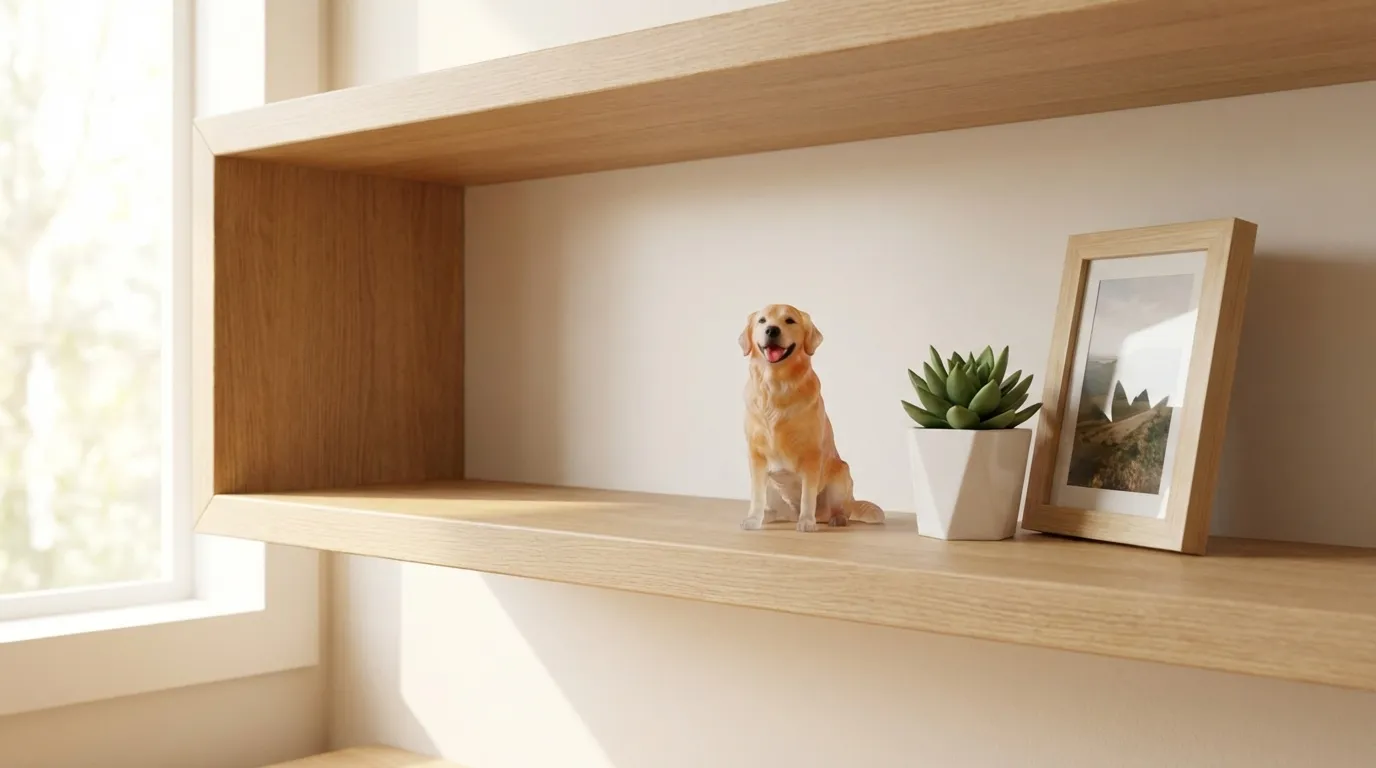
By placing a small, hyper-realistic sculpture on a bookshelf or desk, you reintegrate their physical form into your daily line of sight without it dominating the room. It becomes a quiet discovery rather than a loud declaration.
3. The Textile Narrative: Repurposing the Softness
Golden Retrievers are tactile animals. Their ears are like velvet; their undercoats are dense and soft. The loss of a Golden is largely a loss of touch.
Many owners keep the dog bed or the favorite blanket, but eventually, these items become dusty or impractical to keep on the floor. The artistic solution is repurposing.
The Shadow Box Alternative
Instead of a shadow box (which can look like a museum display), consider working with a textile artist to incorporate their belongings into functional art.- The Collar Weave: A leather worker can deconstruct a leather collar and re-stitch it into a keychain or a bracelet. This keeps the patina—the scratches, the wear, the oil from their fur—close to your skin.
- The Fur Felt: This is niche, but powerful. You can collect the soft undercoat (if you have brushes full of it saved) and have it felted into a small heart or bead. It is the ultimate preservation of material.
- The Bandana Quilt: If your Golden was a "bandana dog," sewing those fabrics into a throw pillow allows you to keep the colors in your living room in a way that looks intentional, not accidental.
4. The Auditory Landscape: Wind and Sound
We often focus on the visual, but the sound of a Golden Retriever is distinct. The heavy panting, the thumping tail, the click of nails on hardwood. When the house falls silent, the silence is deafening.
To combat the silence without playing recordings (which can be distressing), introduce kinetic sound to your environment.
The Wind Chime Theory
Choose a wind chime that is tuned to a deep, resonant key (like a tenor or alto), rather than a high-pitched tinkling sound. Goldens have deep barks and heavy footsteps. A bamboo or deep-pipe metal chime provides a comforting, low-frequency sound that fills the empty space in the air.Hang it near the door where they used to wait to be let in. When the wind blows and the chime sounds, it serves as a gentle, auditory reminder of their energy at the threshold.
5. The Golden Hour Gallery: Lighting as Medium
The mistake many make with photos is clutter. Taping forty photos to the fridge creates visual noise. To honor the beauty of the breed, treat your photos like an art curator would.
The "Golden Hour" Concept
Golden Retrievers look their best in natural light. Select one or two high-resolution images where the lighting is spectacular—backlit by the sun, or soft morning light.- The Medium Matters: Instead of glossy photo paper (which reflects glare and feels modern/cold), print on matte cotton canvas or wood.
- Printing on Wood: The grain of the wood showing through the lighter parts of the image (the white chest or face) adds a layer of organic texture that suits the breed perfectly. It feels warm and rustic, not sterile.
- Negative Space: Don't fill the frame completely. Use a large white matte with a smaller photo. This draws the eye in and creates a sense of peace and breath around the memory.
| Memorial Type | Sensory Focus | Best For | Avoid |
|---|---|---|---|
| Living Garden | Visual / Seasonal | Owners with yards; those who find peace in nature cycles. | Planting directly on fresh ashes (toxic to roots). |
| Custom Figurine | Tactile / Spatial | Preserving specific markings, "sugar faces," and unique anatomy. | Generic "store-bought" statues that lack personality. |
| Textile Art | Touch / Comfort | Keeping the physical connection close. | Leaving old beds to gather dust in corners. |
| Light/Photo | Visual / Mood | Modern homes; celebrating the dog's beauty. | Cluttered collages or low-res phone prints. |
6. The Olfactory Anchor: Scent Memory
Science tells us that the olfactory bulb is directly connected to the amygdala and hippocampus—the centers for emotion and memory. This is why a sudden whiff of rain on pavement can make you cry.
While you don't want to keep the "wet dog" smell, you can memorialize the environment you shared.
The Scent of Their Joy
Think about where your Golden was happiest.- Was it the beach? (Salt, driftwood, ozone).
- Was it the forest? (Pine, damp earth, cedar).
- Was it the backyard in October? (Dried leaves, crisp air).
Commission or buy a high-quality candle that mimics this specific landscape. Light it only on special occasions—their birthday, or the anniversary of their passing. This ritual creates a "scent bridge" to the memories of your adventures together, bypassing the logical brain and going straight to the emotional core.
7. The Legacy Action: The "Helper" Trait
Golden Retrievers are, by nature, service-oriented. They are retrievers, helpers, therapy dogs, and guides. To memorialize a Golden without a physical object, you must memorialize their function.
If your dog was a lover of people, a physical shrine in a dark room is almost the antithesis of their spirit.
The "Sponsored Vest"
Consider donating to a service dog organization (like Guide Dogs for the Blind or a local search and rescue group) specifically to sponsor a vest or equipment for a working dog.Knowing that another Golden is out in the world, wearing a vest provided by your dog's legacy, performing the work your dog loved (or would have loved), is a profound way to keep their energy moving forward in the world.
The One Mistake to Avoid: The "Museum of Sadness"
We touched on this in the introduction, but it bears repeating with specific detail. The biggest mistake is keeping items that trigger trauma rather than love.
This often includes:
- The final collar they wore (if it smells like the vet's office).
- The empty medication bottles.
- The rug they slipped on in their final days.
It is a common human impulse to hoard these items because throwing them away feels like throwing them away. But you are not. You are curating a narrative.
The Artistic Audit:
Walk through your home. Look at the items related to your pet. If an item makes your stomach clench or brings a flash of the final, difficult moments, remove it. Take a photo of it if you must, then let the physical object go.
Keep only the items that trigger the memories of the "Golden Years"—the ball from the beach trip, the bandana from the hike, the custom figurine that captures their alert, happy posture.
Frequently Asked Questions
How long does it take to stop feeling guilty after losing a Golden Retriever?
There is no set timeline. Guilt is often the last stage of grief to leave because it gives us a false sense of control ("If I had done X, they would still be here"). For most, the sharpest edges of guilt soften within 3-6 months, especially when you actively practice self-compassion and remind yourself that you advocated for their comfort.What is the best way to preserve a dog's ashes?
"Best" is subjective, but artistically, many people are moving away from the "mantle urn." Options now include hand-blown glass orbs with ash swirled inside (catching the light), pressing ashes into vinyl records, or using bio-urns to grow trees. If you choose an urn, look for wood or ceramic vessels that don't look like traditional urns, but rather like beautiful art pieces.Is it creepy to have a statue of my deceased dog?
It depends on the execution. A life-size taxidermy is often unsettling for guests and owners alike. However, a scaled-down, artistically rendered figurine acts more like a 3D photograph. It captures the essence and anatomy without trying to "replace" the living animal. It is a tribute to their form, much like a bust of a famous figure.How do I help my surviving dog grieve?
Golden Retrievers are pack animals and feel the loss of a companion deeply. You might notice them checking the other dog's sleeping spots. Keep their routine (walks, meals) rigorous. The structure provides safety. Also, allow them to sniff the deceased dog's collar or blanket once, then put it away. This helps them process the chemical cues of absence.Ready to Celebrate Your Pet?
Every pet has a story worth preserving. Whether you're honoring a beloved companion who's crossed the rainbow bridge or celebrating your furry friend's unique personality, a custom PawSculpt figurine captures those details that make your pet one-of-a-kind.
Free instant AI preview • 3D artist preview within 7 days • 5 free revisions
"Grief isn't a problem to be solved. It's a love story that continues after the last chapter."
When you are ready—and only when you are ready—finding that tennis ball in the attic won't just bring tears. It will bring a smile, a flash of golden fur in the sunlight, and the knowledge that while they are gone from the room, they are woven into the very foundation of who you are.