
The Gift That Captures Your Friend's Boxer Before the Years Change Her Face
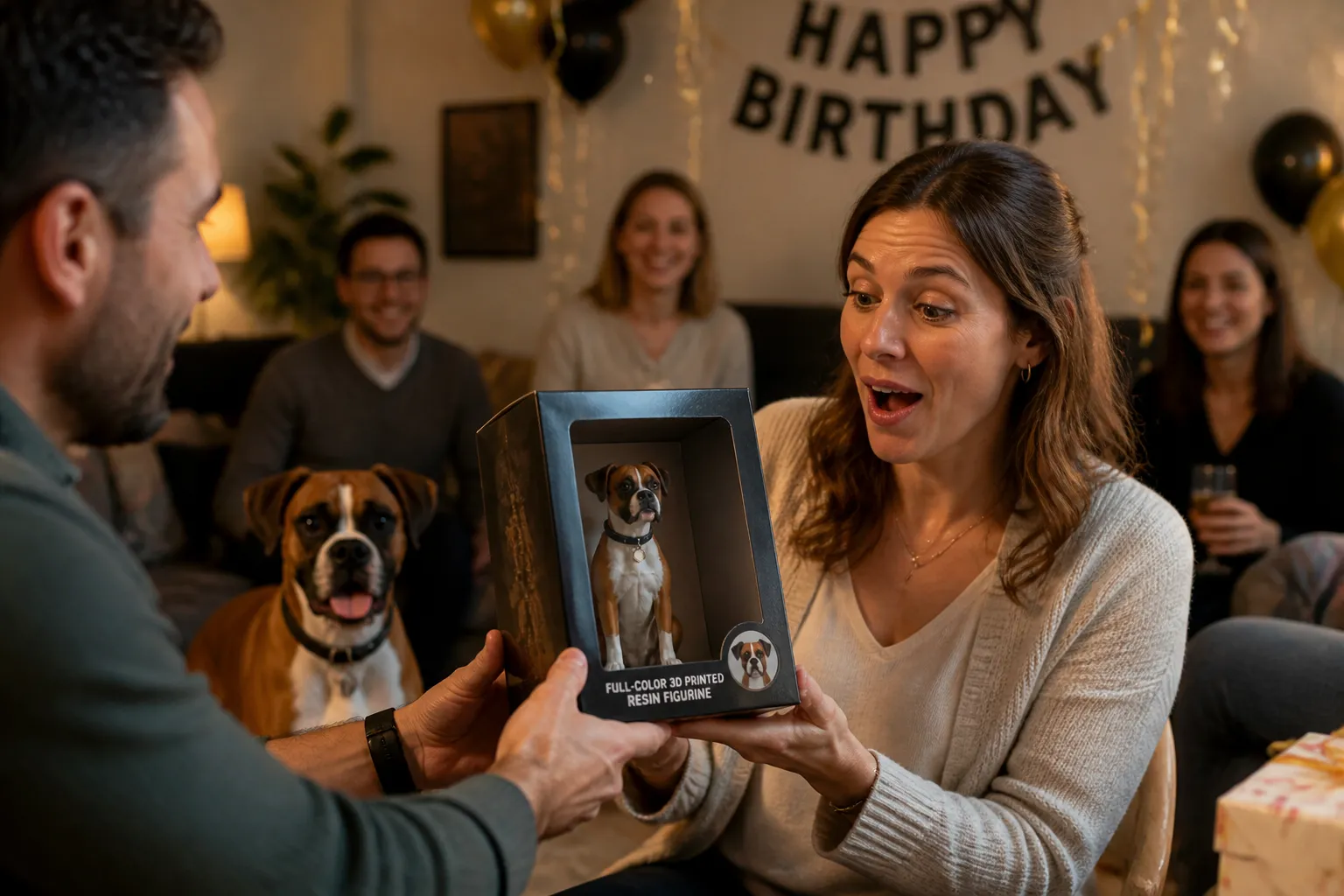
The antiseptic smell hits you the moment you walk through the vet's door — that sharp, clean scent that somehow makes everything feel more serious, more real. Your friend is sitting in the waiting room with her Boxer's big square head resting on her knee, and you're thinking: I need to find her a birthday gift for dog owner friend that actually means something this year.
Quick Takeaways
- Boxers age visibly and fast — their faces change significantly between ages 5 and 9, making timing critical for any keepsake gift
- The best gifts anticipate grief — giving something before loss arrives is more powerful than giving it after
- A photo album isn't enough — flat images can't capture the three-dimensional presence of a dog who fills a room
- Custom figurines preserve the now — a custom pet figurine from PawSculpt captures your friend's Boxer at her current age, markings, and expression before time changes her
- Emotional gifts outperform practical ones — for a friend who loves her dog like family, meaning matters more than utility
Why Boxers Are Different: The Breed That Wears Its Heart on Its Face
Here's something most gift guides won't tell you: not all dogs age the same way, and not all dogs show their age the same way. Boxers are a special case. They are, arguably, the most emotionally expressive breed on the planet — and that expressiveness is written directly into their physical features in a way that makes them uniquely vulnerable to the passage of time.
The American Kennel Club's breed profile describes the Boxer as having a "unique head" that is central to the breed's identity — that broad, blunt muzzle, the deep-set dark eyes, the wrinkled forehead that furrows when they're curious or concerned. What the breed standard doesn't tell you is how much that face changes as a Boxer moves through her years.
A Boxer at three looks almost puppyish still — tight skin, dark muzzle, eyes that are almost startlingly bright. By seven or eight, the muzzle has often gone silver or white. The skin around the jowls loosens. The eyes soften. She's still herself, completely and wholly herself, but she looks different. And if you've loved a Boxer, you know that her face is basically her entire emotional vocabulary. Every mood, every greeting, every moment of concern or joy — it's all right there in that expressive, wrinkled, magnificent face.
This is why timing matters so much when you're thinking about a Boxer dog gift idea for your friend. The window to capture a Boxer at her peak expressiveness — before the muzzle goes fully silver, before the eyes lose some of their sharpness — is narrower than most people realize.
The Muzzle Clock Is Already Running
Most Boxer owners notice the first gray hairs around the muzzle somewhere between ages four and six. It's gradual at first — a few silver threads that you might mistake for a trick of the light. Then one morning your friend looks at her dog and realizes the whole lower half of her face has gone white overnight. It didn't happen overnight, of course. It happened slowly, and then all at once.
We've worked with hundreds of Boxer families over the years, and the pattern we see most often is this: owners wait until the dog is already visibly aged before they think about capturing her likeness. By then, they're often capturing a dog who looks different from the one they fell in love with. Not worse — just different. And sometimes, they're capturing a dog who is already sick.
The gift that anticipates this — that says let's preserve her right now, while she looks exactly like this — is a fundamentally different kind of gift than anything you'd find on a generic "gifts for dog lovers" list.
| Boxer Age | Typical Muzzle Color | Energy Level | Coat Condition | Best Time for Keepsake? |
|---|---|---|---|---|
| 1–3 years | Dark / minimal gray | Very high | Tight, glossy | Good, but face still maturing |
| 4–6 years | First silver threads | High-moderate | Peak condition | Ideal window |
| 7–9 years | Significantly silver | Moderate | Slightly looser | Still meaningful, more urgent |
| 10+ years | Mostly white muzzle | Lower | Visibly aged | Capturing current reality |
That middle row — ages four through six — is the sweet spot. The Boxer is fully herself. Her face has settled into its adult character. Her markings are established. And the clock hasn't yet done its most visible work.
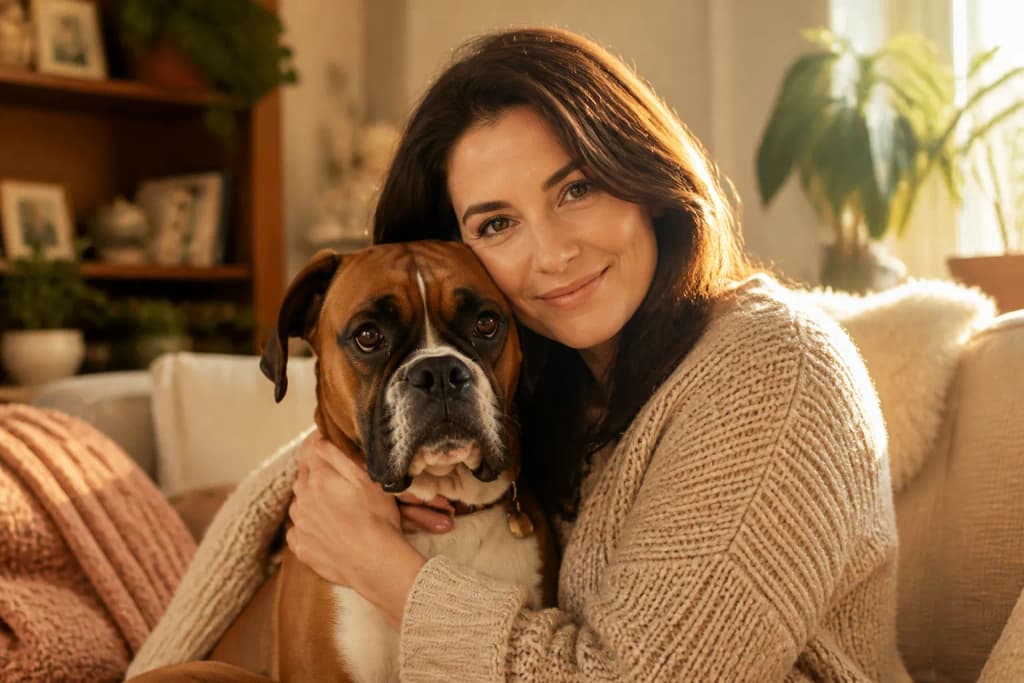
The Psychology of Giving a Gift Before the Loss
There's a concept in anticipatory grief research that doesn't get nearly enough attention in the pet world: the gift of presence. Not presence as in showing up (though that matters too), but presence as in capturing the present moment before it becomes the past.
Most memorial gifts are reactive. Someone loses a pet, and then the people who love them scramble to find something meaningful — a paw print kit, a photo book, a piece of jewelry with the dog's name engraved. These are beautiful gestures. But they're responses to absence. They're trying to fill a space that has already gone empty.
The counterintuitive insight here — the one that most gift guides completely miss — is that the most powerful keepsake gifts are given while the subject is still alive.
Think about it this way. When you give your friend a custom figurine of her Boxer now, while the dog is healthy and present and still stealing food off the counter, you're not giving her a memorial. You're giving her a celebration. You're saying: this dog is so remarkable, so irreplaceable, that she deserves to be honored right now, in this moment, while we can all still laugh about it together.
"The best gifts don't just sit on a shelf — they start conversations and spark memories every single day."
— The PawSculpt Team
And then, years later, when the time comes — and it always comes — that figurine becomes something else entirely. It becomes an anchor. It becomes the thing your friend reaches for when she walks past the corner of the living room where the dog bed used to be.
We'll be real with you: we've seen this happen. A customer ordered a figurine of her Boxer as a birthday gift to herself when the dog was six. The dog lived to eleven. When she finally passed, the figurine had been sitting on the bookshelf for five years — just a cheerful, beloved object in the house. After the loss, it became something sacred. The customer wrote to us and said she was grateful she'd captured her dog at six, not at eleven. "She looks exactly like I want to remember her," she said. "Exactly like herself."
Why Your Friend Might Not Do This for Herself
Here's the thing about people who love their dogs deeply: they often have a complicated relationship with the idea of keepsakes. There's a superstition around it — a feeling that capturing a dog's likeness is somehow tempting fate, acknowledging mortality in a way that feels dangerous. Many Boxer owners we've spoken with have said some version of: "I kept meaning to do something like that, but it felt like admitting she wasn't going to be here forever."
This is exactly why it works so well as a gift. You're removing the psychological barrier. You're making the decision for your friend, in the most loving way possible. You're saying: I see how much you love her. I'm going to help you hold onto this.
That's not a small thing. That's a profound act of friendship.
What Makes a Boxer Figurine Different from a Generic Pet Gift
Walk into any pet store or browse any gift site and you'll find Boxer-themed merchandise by the truckload. Boxer throw pillows. Boxer coffee mugs. Boxer-shaped cookie cutters. Boxer socks with little cartoon faces on them. These are fine gifts — genuinely, they're fine — but they have a fundamental limitation: they depict a Boxer, not her Boxer.
Your friend's dog has a name. She has a specific brindle pattern, or a particular flash of white on her chest, or one ear that folds differently than the other. She has a way of tilting her head when she hears a word she recognizes. She has a specific shade of brown in her eyes that you'd recognize anywhere.
A generic Boxer figurine captures none of that. It's a symbol of the breed, not a portrait of the individual.
Custom pet figurines work differently. The process starts with photographs — ideally multiple angles, good lighting, capturing the dog's actual markings and proportions. From those photos, master 3D sculptors build a digital model that reflects the specific dog: her coloring, her build, the particular way her face is shaped. Then that model is brought to life through full-color resin 3D printing, a technology that reproduces fur patterns and color gradations directly in the material itself — not as a coating on top, but as part of the resin at a voxel-by-voxel level.
The result is something that looks like her. Not a Boxer. Her.
The Technology Behind the Likeness
This is worth understanding, because it's genuinely different from what most people imagine when they think of a custom figurine. The color isn't applied afterward. There's no painting involved, no brushes, no layer of acrylic sitting on top of a white base. The advanced 3D printing technology prints color and form simultaneously — the way a photograph captures light and shadow in a single moment, rather than building them up in layers.
After printing, a clear coat is applied to protect the surface and give it a natural sheen. That's the only manual step. Everything else — every marking, every color transition, every subtle variation in fur tone — comes directly from the digital model and the printing process itself.
What this means practically is that the figurine can capture things that hand-crafted alternatives often can't: the specific brindle striping on a Boxer's flank, the dark mask that fades into the lighter muzzle, the white flash on the chest. These aren't approximations. They're reproductions.
| Feature | Generic Breed Figurine | Custom 3D-Printed Figurine |
|---|---|---|
| Likeness | Generic breed standard | Individual dog's markings |
| Color accuracy | Approximate | Voxel-level color reproduction |
| Personalization | None | Based on owner's photos |
| Emotional value | Decorative | Deeply personal |
| Longevity as keepsake | Fades with trends | Permanent portrait |
| Conversation starter | Occasionally | Almost always |
Myth vs. Reality: What People Get Wrong About Pet Keepsake Gifts
Before we go further, let's clear up a few things that come up constantly when people are considering this kind of gift.
Myth #1: "She'll think it's morbid."
Reality: This is the most common hesitation, and it's almost always wrong. The framing matters enormously. A figurine given as a birthday gift — "I wanted to celebrate how much you love her" — lands completely differently than one given after a diagnosis or in anticipation of loss. Most recipients don't experience it as morbid at all. They experience it as someone truly seeing their love for their dog and honoring it. The customers who've shared their reactions with us most often describe it as one of the most thoughtful gifts they've ever received.
Myth #2: "Photos are enough."
Reality: Photos are two-dimensional. They're flat. They live on a phone screen or in an album that gets opened twice a year. A three-dimensional object occupies space in the world — it sits on a shelf, it catches the light, it's there in the room in a way that a photo simply isn't. There's a reason we keep physical objects from people we love. The tactile, spatial presence of a thing is different from its image. Grief researchers have noted for decades that tangible objects play a specific role in mourning that images cannot replicate — they give grief somewhere to land.
Myth #3: "Custom figurines all look the same — kind of plastic and generic."
Reality: This was true of earlier generations of the technology. It's not true anymore. Full-color resin 3D printing has advanced to the point where the color reproduction is genuinely impressive — subtle, nuanced, capable of capturing the kind of color gradations that exist in a real dog's coat. The texture has a natural quality to it, not the plastic-perfect smoothness of a mass-produced toy. It looks like a portrait, not a tchotchke.
Myth #4: "It's only for after the dog is gone."
Reality: Honestly, this might be the biggest myth of all. Some of the most joyful orders we receive are for living, healthy, absolutely-not-going-anywhere dogs. A figurine of a three-year-old Boxer is a celebration. It's a way of saying: this dog is so loved, so present in our lives, that she deserves her own portrait. The memorial use case is real and meaningful — but it's not the only one, and arguably not even the primary one.
How to Actually Give This Gift: The Practical Guide
Okay, so you're convinced. You want to do this. Here's where most gift guides stop — they tell you what to give but not how to give it well. Let's fix that.
Getting the Photos Without Spoiling the Surprise
This is the trickiest part of giving a custom figurine as a surprise gift. You need good photos of the dog — multiple angles, good lighting, ideally showing her markings clearly — without tipping off your friend.
A few approaches that actually work:
- The casual visit strategy: Next time you're at your friend's house, spend some time with the dog and take photos on your phone. Frame it as "I just love her so much, I want some pictures." Your friend will think nothing of it. Most Boxer owners are delighted when someone else wants to photograph their dog.
- The social media archive: If your friend posts regularly about her dog (and most Boxer owners do), her Instagram or Facebook is a goldmine. High-quality photos, multiple angles, different lighting conditions. You can screenshot or save these without anyone knowing.
- The co-conspirator approach: If your friend has a partner, sibling, or other close friend who's in on the surprise, they can get the photos for you. This also works well if you want to make the gift a group effort.
What makes a good photo for this purpose? Clarity and lighting matter most. You want:
- Natural light whenever possible — it shows coat color most accurately
- Multiple angles: front-facing, three-quarter profile, full body
- Close-ups of the face — especially the muzzle, eyes, and any distinctive markings
- The dog at rest or in a natural pose — not mid-jump or blurry from movement
Don't stress about getting perfect photos. The sculptors who work on these models are experienced at working with real-world photography. But the more you give them to work with, the more accurate the result.
The Presentation Matters More Than You Think
A custom figurine deserves a thoughtful reveal. Don't just hand over a box. Consider:
- Writing a card that explains the why — not just "happy birthday" but "I wanted to capture her exactly as she is right now, because she's so perfectly herself." This context transforms the gift from an object into a statement.
- Timing the reveal when the dog is present — there's something genuinely moving about your friend seeing the figurine while the real dog is right there, tilting her head at her own likeness.
- Framing it as a celebration, not a memorial — the language you use when you give it shapes how it's received. "I wanted to honor how much she means to you" lands differently than "I thought you'd want something to remember her by."
What to Expect from the Process
The general flow for a custom figurine order involves submitting your photos, working with the team on a digital preview of the sculpt, and then approving the model before it goes to print. For specifics on turnaround times, revision options, pricing, and what's included, the best place to look is directly at pawsculpt.com — those details are updated regularly and vary based on what you're ordering.
What we can tell you from experience: the preview stage is where most of the magic happens. Seeing the digital model before it's printed gives you the chance to catch anything that doesn't look quite right — a marking that's slightly off, a pose that doesn't feel like the dog. Don't skip this step. It's the difference between a figurine that's close and one that's unmistakably her.
The Spatial Grief of Losing a Boxer: Why This Gift Matters More Than You Know
There's a specific kind of grief that Boxer owners describe that I want to talk about, because it's relevant to why this gift matters — and because it's something most people don't fully understand until they've lived it.
Boxers are spatial dogs. They take up room. Not just physically (though a full-grown Boxer is a substantial animal), but energetically. They're in the room with you in a way that some breeds aren't. They follow you from room to room. They position themselves in doorways, in the middle of the floor, in the exact spot where you need to walk. They lean against your legs. They put their head in your lap without asking.
When a Boxer is gone, the spatial absence is overwhelming. It's not just that she's not there — it's that every room in the house has a Boxer-shaped hole in it. The corner by the couch where she slept. The spot by the back door where she waited to go out. The kitchen floor where she stationed herself during meal prep, hoping for something to fall.
"Grief isn't a problem to be solved. It's a love story that continues after the last chapter."
This is why a three-dimensional object matters in a way that a photograph doesn't. A photograph lives on a wall or in an album. A figurine lives in the room. It occupies space. It sits in the corner of the bookshelf and catches the afternoon light. It's present in the house in a way that mirrors, however imperfectly, the presence that's been lost.
We're not saying a figurine fills the hole. Nothing fills the hole. But it gives the eye somewhere to land, the hand somewhere to reach. And in the early weeks of grief, when the spatial absence is most acute, that matters more than most people expect.
The Rooms That Change
One customer described it to us this way: after her Boxer passed, she found herself rearranging furniture. Not because she wanted to redecorate, but because she couldn't stand walking past the empty spot where the dog bed had been. She moved a chair there. Then she moved the figurine to the side table next to the chair. "Now when I sit there," she said, "it feels like she's still in the room with me."
That's not a small thing. That's someone finding a way to continue living in a space that grief had made unbearable.
The gift you give your friend now — before any of this happens, while the dog is still stealing the good spot on the couch — is the gift of having that anchor ready. Of not having to scramble for something to hold onto when the time comes.
Choosing the Right Moment: Birthday, Gotcha Day, or Just Because
The title of this piece mentions a birthday gift, and that's a natural occasion for this kind of gift. But honestly? The best time to give a custom figurine of a living pet is whenever the thought occurs to you. Here's a quick breakdown of occasions and how to frame each one:
Birthday (the classic): Frame it as a celebration of the friendship between your friend and her dog. "You've had her for X years and I wanted to mark that." Works especially well if the dog's birthday and your friend's birthday are close together — you can celebrate both.
Gotcha Day / Adoption Anniversary: If your friend adopted her Boxer and knows the date, this is actually the most emotionally resonant occasion for this gift. It marks the beginning of the relationship, which makes a portrait of the dog at her current age feel like a "look how far we've come" statement.
No occasion at all: Honestly, this might be the most powerful framing. "I saw this and thought of you and her, and I just wanted you to have it." No occasion required. The spontaneity of it — the fact that you weren't waiting for a reason — communicates something about how much you value the relationship.
Pre-diagnosis or health scare: If your friend's Boxer has recently had a health scare or received a diagnosis that suggests the timeline may be shorter than hoped, a figurine gift becomes something else entirely. It's an act of love and acknowledgment. It says: I know what you're facing, and I want to help you hold onto her. This requires sensitivity in the framing, but it's one of the most meaningful gifts you can give in this situation.
For additional support around anticipatory pet loss — the grief that begins before a pet is gone — the Association for Pet Loss and Bereavement offers resources that many pet owners find genuinely helpful.
The Gift Comparison: How a Custom Figurine Stacks Up
Let's be honest about the landscape of gifts for someone who loves their Boxer. There are a lot of options, and some of them are genuinely good. Here's how they compare:
| Gift Option | Price Range | Personalization | Longevity | Emotional Impact |
|---|---|---|---|---|
| Breed-themed merchandise | $15–$50 | None (generic breed) | Low | Moderate |
| Custom portrait (digital) | $50–$200 | High | Medium (digital file) | High |
| Custom portrait (framed print) | $100–$300 | High | High | High |
| Paw print kit / casting | $30–$100 | Medium | High | High |
| Custom 3D figurine | $100–$300+ | Very high | Very high | Very high |
| Personalized jewelry | $50–$200 | Medium | High | High |
The figurine sits at the top of the emotional impact column for a specific reason: it's three-dimensional, it's personalized to the individual dog, and it occupies physical space in the world. It's not better than a framed portrait in every situation — if your friend is a visual art lover who has a gallery wall, a portrait might resonate more. But for most people, the three-dimensional quality of a figurine creates a different kind of connection.
The paw print kit is worth mentioning as a complement, not a competitor. Some friends give both — a figurine that captures the dog's appearance and a paw print that captures her physical mark. Together, they're a remarkably complete portrait of a living animal.
A Note on Timing: Don't Wait for the Right Moment
Here's the thing about "the right moment" to give this gift: it doesn't exist. There's no perfect occasion, no ideal age for the dog, no moment when everything lines up and you think yes, now is the time.
What there is, is now. Your friend's Boxer is the age she is today. Her muzzle has exactly as much silver in it as it has today. Her eyes are exactly as bright as they are today. In a year, she'll be different. Not worse — just different. And you can't go back.
The ancient Egyptians buried their cats with gold because they understood something we've spent centuries trying to intellectualize away: that the bond between a human and an animal is sacred, and that it deserves to be honored with the same seriousness we bring to any other profound relationship. We think we've evolved past that kind of reverence. But walk into any home where a dog is loved, and you'll find the same impulse — the photos on the fridge, the collar kept in a drawer, the dog bed that no one can bring themselves to throw away.
A custom figurine is just a more intentional version of that impulse. It's saying: I'm going to honor this bond on purpose, while I still can, rather than scrambling to preserve it after the fact.
"We've seen families heal by holding something tangible. Grief needs an anchor — and love deserves one too."
— The PawSculpt Team
Your friend's Boxer is worth that intentionality. And your friendship — the kind that notices what matters to someone and acts on it — is worth expressing through a gift that took real thought.
Don't wait for the right moment. This is it.
Frequently Asked Questions
What's the best birthday gift for a dog owner friend who already has everything?
The challenge with someone who "has everything" is that they usually have plenty of things — what they don't have is something that's specifically about their dog, not dogs in general. A custom figurine of their specific pet sidesteps the "they already have it" problem entirely, because there's only one of their dog in the world. Generic gifts can be duplicated. A portrait of an individual animal can't.
When is the right time to get a custom figurine of a Boxer?
The sweet spot is roughly ages four through six, before the muzzle has gone significantly silver and while the dog is at her physical peak. That said, there's no wrong time — a figurine of a ten-year-old Boxer with a fully white muzzle is a beautiful and meaningful thing. The point is to capture her as she is now, whatever now looks like. The urgency increases as the dog ages, but the value doesn't diminish.
Is a custom pet figurine appropriate as a gift for someone whose dog is sick or aging?
Yes, and it can be one of the most meaningful gifts in that situation — but framing matters. Lead with celebration, not anticipation of loss. "I wanted to capture her while she's so perfectly herself" is a very different message than "I thought you'd want something to remember her by." The first honors the living dog. The second, however well-intentioned, can feel like it's rushing toward an ending.
How does the custom figurine process work?
The general process involves submitting photos of your pet, receiving a digital preview of the sculpted model, approving or requesting adjustments, and then having the final piece printed and shipped. The figurines are created using full-color resin 3D printing — color is embedded in the material itself, not applied on top. For current details on pricing, turnaround times, and revision options, visit pawsculpt.com directly, as these specifics are updated regularly.
What photos work best for a Boxer figurine?
Natural light is your best friend — it shows coat color and markings most accurately. You want multiple angles (front-facing, profile, full body), close-ups of the face and muzzle, and ideally some shots that capture the dog's typical expression or posture. Avoid blurry action shots or photos taken in dim indoor lighting. The more clearly the photos show her specific markings and coloring, the more accurate the final figurine will be.
How do I give a custom figurine as a surprise gift without spoiling it?
The easiest approach is to gather photos from your friend's social media — most Boxer owners post regularly and have plenty of high-quality images available. Alternatively, take casual photos during a visit (most dog owners are delighted when someone wants to photograph their pet) or enlist a partner or family member who's in on the surprise. The digital preview stage happens before printing, so there's a natural checkpoint to ensure everything looks right before the final piece is made.
Ready to Celebrate Your Boxer Before She Changes
Your friend's dog is exactly who she is right now — that specific brindle pattern, that particular way her ears fold, that white flash on her chest that you'd recognize anywhere. A custom PawSculpt figurine captures all of it through precision full-color 3D printing, creating a portrait that's as individual as the dog herself. Whether you're giving this as a birthday gift for a dog owner friend or simply because the moment feels right, this is the kind of gift that gets kept for decades.
Visit pawsculpt.com to explore the full process, see examples, and learn about current pricing and options