
The Busy Professional's 5-Step System for Processing Sudden Siamese Cat Loss
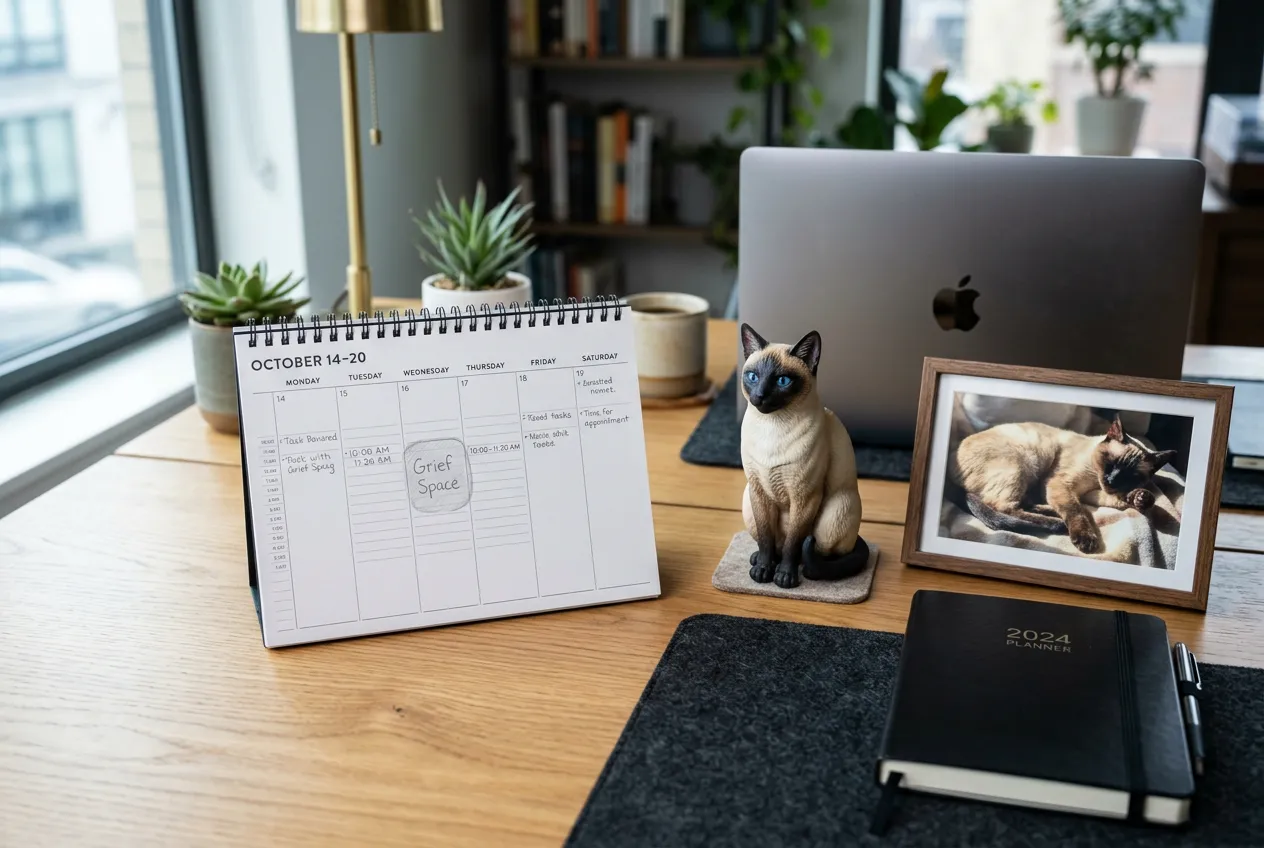
Two summers ago, the garden behind Mariana's townhouse was a tangle of catnip and sun-warmed flagstone—her Siamese, Koda, threading between the lavender like a pale ghost with sapphire eyes. Now the catnip has gone to seed, the flagstone holds no warmth, and the sudden pet loss that took Koda on a Tuesday afternoon has rewritten every color in that garden.
Quick Takeaways
- Structure saves you when emotion can't — a step-by-step system prevents grief from derailing your professional life
- The first 72 hours matter most — specific micro-actions in this window reduce compounding emotional debt
- Siamese cat grief carries unique weight — their vocal, bonded nature makes sudden absence physically disorienting
- Tangible anchors accelerate healing — physical keepsakes like custom pet figurines give grief a place to land
- Professional grief management isn't cold—it's strategic — protecting your career protects the rest of your recovery
Why Sudden Siamese Cat Loss Hits Differently Than You Expect
Here's what most grief guides won't tell you: losing a Siamese cat suddenly isn't just losing a pet. It's losing a conversational partner.
Siamese cats are among the most vocally interactive breeds. They don't just meow—they respond. They argue. They narrate your morning routine with a running commentary that, over years, becomes as familiar as a roommate's voice. When that voice vanishes without warning—no gradual decline, no hospice period, no slow goodbye—your nervous system registers it as a person going missing.
Mariana described it to our team this way: "I kept hearing him. Not imagining it—hearing it. The phantom meowing lasted weeks."
That's not unusual. And it's not a hallucination. It's your auditory cortex doing exactly what it was trained to do—anticipating a sound pattern that was reinforced thousands of times. The Association for Pet Loss and Bereavement notes that sudden pet loss, as opposed to anticipated loss, often triggers a more acute stress response precisely because the brain had no time to begin decoupling.
The counterintuitive insight: gradual loss is devastating, but it comes with what psychologists call anticipatory grief—a head start on processing. Sudden loss offers no such runway. You're at cruising altitude one moment and in free fall the next. For busy professionals who rely on emotional regulation to function at work, this is uniquely destabilizing.
The Vocal Bond Problem
Consider this: most dog owners bond through touch and activity. Most cat owners bond through proximity and routine. But Siamese owners bond through dialogue. The call-and-response pattern between a Siamese and their human mimics conversational turn-taking so closely that its absence creates a specific kind of loneliness—not just missing a presence, but missing a reply.
This matters because it shapes what kind of grief system actually works. Generic advice about "journaling your feelings" or "talking to friends" misses the target. What you need is a system designed for the specific neurological and emotional signature of sudden, dialogue-based loss—while keeping your professional life intact.
That's what the five steps below are built to do.
"Grief doesn't wait for a convenient time. It shows up in the middle of your workday, your commute, your presentation. The question isn't whether it will interrupt—it's whether you have a system to catch you when it does."

Step 1: The 72-Hour Containment Protocol
The first three days after sudden Siamese cat loss are not about healing. They're about preventing cascading damage—to your health, your job, and your capacity to grieve well later.
Most professionals make the same mistake: they white-knuckle through the first week, perform normalcy at work, then collapse around day ten when the adrenaline wears off. The crash is worse than it needed to be because they spent their early reserves on pretending.
Here's a better approach.
Hours 0–24: Triage Mode
Cancel or delegate anything non-essential for the next 48 hours. Not the next week—just 48 hours. This is psychologically easier to commit to and practically sufficient for the acute phase.
Specifically:
- Send one honest message to your manager or closest colleague: "I lost my cat suddenly. I may be off my game for a couple of days." That's it. No over-explaining.
- Set your phone to Do Not Disturb except for essential contacts.
- Eat something with protein within four hours, even if you aren't hungry. Grief floods cortisol. Cortisol crashes blood sugar. Low blood sugar makes everything worse.
- Do NOT make any permanent decisions about your pet's remains in the first 12 hours. You'll want to rush. Don't.
Mariana told us she almost had Koda cremated the same evening. "I just wanted to do something. Action felt like control." She's grateful she waited. The next morning, with slightly clearer eyes, she chose a private cremation with ashes returned—and later, a memorial figurine that captured Koda mid-stride, the way he looked crossing the garden at dusk.
Hours 24–48: The Sensory Audit
This is the step nobody talks about.
Walk through your home and identify every sensory trigger connected to your Siamese. Not to remove them—to acknowledge them. The water bowl. The indent on the couch cushion. The spot on the windowsill where afternoon light made their fur glow amber at the edges.
| Sensory Trigger | Location | Intensity (1-5) | Action |
|---|---|---|---|
| Food bowl / water dish | Kitchen floor | 4 | Store after 48 hrs, not before |
| Favorite sleeping spot | Bedroom windowsill | 5 | Leave undisturbed for now |
| Toys / scratching post | Living room | 3 | Gather into one basket |
| Litter box | Bathroom | 2 | Remove when ready (no rush) |
| Collar / harness | Entry hook | 5 | Place in a memory box |
| Phantom vocalizations | Throughout home | 5 | Acknowledge, don't suppress |
Why do this? Because unidentified triggers cause ambush grief—the kind that hits you mid-Zoom call when you glance at the windowsill. Identified triggers still hurt, but they don't blindside you. You see them coming. That fraction of a second of preparation is the difference between tearing up quietly and breaking down publicly.
Hours 48–72: The Re-Entry Plan
By day three, you need a plan for returning to full professional capacity. Not because your grief is over—it's barely started—but because unstructured grief in a professional context often mutates into shame, and shame is grief's most toxic accelerant.
Write down (literally, on paper):
- Three work tasks you'll complete on your first full day back
- One person at work who knows what happened and can cover for you if needed
- One daily ritual you'll protect no matter what (more on this in Step 3)
This isn't about being tough. It's about giving your grieving brain a minimum viable structure so it doesn't have to make decisions from scratch every morning.
Step 2: Name the Feeling You're Afraid to Name
Here's where we go deeper than any professional grief management guide you'll find on the first page of Google.
Sudden loss doesn't produce clean, simple sadness. It produces a cocktail of emotions, several of which feel shameful—and the shame of feeling them compounds the original grief into something much heavier.
Let's name them.
The Relief You Didn't Ask For
If your Siamese had any health issue—even a minor one, even one you hadn't fully acknowledged—you might feel a flicker of relief mixed with grief when they pass. Maybe they'd been losing weight. Maybe the vet visits were stacking up. Maybe you'd been quietly dreading a future decision about quality of life.
That wave of relief doesn't make you a monster. It makes you someone whose nervous system just set down a weight it had been carrying in secret. The guilt that chases that relief is one of grief's cruelest tricks—it takes your compassion and reframes it as betrayal.
You are not guilty of anything except loving an animal enough to carry their suffering alongside your own.
The Anger Nobody Validates
Sudden Siamese cat loss often triggers anger—at the vet, at yourself, at the universe's apparent indifference. Maybe you're furious that you weren't home when it happened. Maybe you're angry at your partner for not noticing something sooner. Maybe you're enraged at the sheer randomness of it.
This anger is legitimate. It's also uncomfortable, because our culture has a script for pet grief that includes sadness, tears, and gentle remembrance—but not rage. Not the urge to throw something. Not the white-hot thought of this is not fair and I want someone to answer for it.
You don't need to act on the anger. But you need to let it exist without judging yourself for it.
The Fear of Forgetting
This one is quieter, and it tends to surface around week two or three. You'll be in a meeting, fully engaged, and suddenly realize you haven't thought about your cat in three hours. The fear of forgetting hits like ice water.
It feels like betrayal. Like moving on. Like proof that the bond wasn't as deep as you thought.
It's none of those things. It's your brain doing its job—allocating attention to the task at hand. Your love for your Siamese is not measured by the percentage of waking hours you spend actively thinking about them. It's encoded deeper than conscious thought. It lives in your body, your habits, the way you'll instinctively glance at the floor before stepping backward for years to come.
"You don't forget. You integrate. The love doesn't shrink—your capacity to hold it alongside everything else simply grows."
Step 3: Build a Daily Ritual (Not a Shrine)
This is the step that separates functional grief from the kind that slowly erodes your professional and personal life over months.
You need a daily ritual. Not a weekly cry. Not an occasional scroll through photos. A daily, time-bounded, intentional practice that gives your grief a designated space so it stops colonizing every other space.
The 7-Minute Evening Practice
We recommend seven minutes because it's short enough to be non-negotiable and long enough to be meaningful. Here's one structure that's worked for professionals we've spoken with:
- Minutes 1–2: Hold a physical object connected to your Siamese. A collar. A toy. A figurine. Something with weight and texture. Close your eyes. Let whatever comes up, come up.
- Minutes 3–5: Speak out loud. Say their name. Tell them one thing about your day. This sounds strange until you try it—and then it sounds like the most natural thing in the world, because you spent years doing exactly this with a cat who talked back.
- Minutes 6–7: Set an intention for tomorrow. Not a grief intention—a life intention. "Tomorrow I'll finish the Q3 report." "Tomorrow I'll call my sister." This bridges the ritual back into forward motion.
Why Physical Objects Matter More Than Photos
Photos are flat. They live behind glass. You scroll past them.
A physical object occupies three-dimensional space. It has weight, temperature, shadow. It exists in the same material world your cat existed in. This is why so many grieving pet owners instinctively reach for something tangible—a clay paw print, an urn, a custom figurine that captures the specific tilt of their Siamese's head.
"We've noticed that families who hold something tangible in the first weeks process grief differently—not faster, but with more steadiness. Grief needs a physical anchor."
— The PawSculpt Team
The science backs this up. Tactile engagement activates different neural pathways than visual memory. When you hold an object that represents your pet, you're not just remembering—you're communing. The ritual becomes a sacred space, a point of contact between the world you're in and the one your cat now inhabits in memory.
At PawSculpt, we've worked with families who use their 3D-printed pet figurines as the centerpiece of exactly this kind of daily practice. The figurines are digitally sculpted by master 3D artists based on your photos, then precision-printed in full-color resin—so the seal-point markings, the blue eyes, the specific way your Siamese's ears tilted forward are all captured directly in the material itself, not painted on as an afterthought. A clear protective coat gives it a lasting sheen. But the real value isn't the technology. It's having something to hold.
Step 4: Manage the Professional Fallout Strategically
Let's talk about the part no grief guide addresses: what happens at work.
You're a professional. You have deadlines, clients, reports, meetings. You can't pause your career for grief, and honestly—you might not even want to. Work can be a lifeline, a place where you're defined by competence rather than loss. But it can also be a minefield.
The Disclosure Decision
You don't owe anyone at work your grief story. But strategic disclosure—telling one or two trusted people—creates a safety net.
The mistake most people make is either telling no one (and then having an unexplained emotional moment that damages their professional image) or telling everyone (and then feeling exposed and resentful when colleagues offer clumsy comfort or, worse, dismissive comments like "it was just a cat").
| Disclosure Strategy | Pros | Cons | Best For |
|---|---|---|---|
| Tell no one | Full privacy, no awkward conversations | No safety net, higher risk of public breakdown | Very private individuals, short grief timeline |
| Tell 1-2 trusted colleagues | Safety net, someone can cover for you | Requires trust, risk of information spreading | Most professionals (recommended) |
| Tell your manager only | Professional accommodation possible | Manager may not be emotionally supportive | When you need schedule flexibility |
| Tell your whole team | Full support, no hiding | Vulnerability, potential for dismissive comments | Very close-knit, empathetic teams |
| Post on social media | Broad support, community validation | Unwanted advice, performative grief pressure | Only if this is genuinely your style |
Here's the counterintuitive insight: the people who judge you for grieving a cat are telling you something valuable about themselves. File that information. It's useful. But don't let their emotional limitations dictate yours.
The "Feeling Judged" Trap
Many professionals—especially in high-performance environments—experience intense shame about the depth of their grief over a pet. They compare it to colleagues who've lost human family members. They minimize it preemptively: "I know it's just a cat, but..."
Stop. Your Siamese was a daily presence in your life for years. They greeted you. They slept against your body. They responded to your voice with their own. The bond was real, neurochemical, and profound. The grief is proportional to the bond, not to the species.
According to the American Veterinary Medical Association, the human-animal bond produces measurable changes in oxytocin, cortisol, and dopamine—the same neurochemicals involved in human attachment. Your brain doesn't distinguish between species when it comes to love. Why should your grief?
Protecting Your Performance Without Suppressing Your Feelings
The goal isn't to "be strong at work." The goal is to compartmentalize skillfully—which is different from suppression.
Suppression says: "I won't feel this."
Compartmentalization says: "I'll feel this at 7 PM, in my ritual space, with Koda's collar in my hand."
Practical tactics:
- Block 10 minutes on your calendar mid-afternoon as a "focus break." Use it to breathe, check in with yourself, or step outside. No one needs to know what it's for.
- Keep one small object in your desk drawer or bag—a photo, a small figurine, a tag from their collar. Touching it briefly during a hard moment is faster and more effective than trying to think your way through an emotional wave.
- Set a "grief alarm" for the evening. When intrusive sadness hits during work hours, mentally say: "I see you. I'll be with you at seven." This isn't dismissal—it's a promise. And keeping that promise in your evening ritual builds trust between your conscious mind and your grieving heart.
Step 5: Design Your Long-Term Memorial Architecture
This is where professional grief management transcends coping and becomes something closer to spiritual practice.
Most grief systems stop at "process your feelings and move on." But moving on is the wrong metaphor. You don't move on from a soul contract—you move with it. The question isn't how to leave Koda behind. It's how to carry Koda forward.
The Three Layers of Memorial
Think of your long-term memorial not as a single act but as an architecture with three layers:
Layer 1: The Private Ritual
This is your 7-minute evening practice, which you'll gradually modify over months. In the first weeks, it might be raw and tearful. By month three, it might be quieter—a moment of gratitude, a whispered name. By month six, it might fold into a broader evening practice of reflection. The ritual evolves, but it doesn't end. It becomes part of who you are.
Layer 2: The Physical Anchor
This is the tangible object—or objects—that hold space for your cat in the material world. An urn. A garden stone. A custom figurine on the shelf where they used to sit. The key is choosing something with visual weight—something your eye naturally lands on, something that catches the light and reminds you, gently and constantly, that this bond was real and is ongoing.
Mariana eventually placed Koda's PawSculpt figurine on the kitchen windowsill where he used to watch birds. The full-color resin captured his seal-point coloring with startling accuracy—the way the brown darkened at his ears and paws, the particular ice-blue of his eyes. "It's not him," she told us. "But it's of him. And that's enough to keep the conversation going."
Layer 3: The Legacy Action
This is the least discussed and most powerful layer. A legacy action is something you do in the world because of your cat. It might be:
- Donating to a Siamese rescue in their name
- Volunteering at a shelter one Saturday a month
- Mentoring a new pet owner
- Simply being the person at work who, when a colleague loses a pet, says: "I understand. Tell me about them."
Legacy actions transform grief from a private wound into a public gift. They complete the circuit. Energy that was flowing between you and your cat now flows through you and into the world—and that, more than anything, is how a bond survives the death of one of its participants.
"A memorial isn't something you build once. It's something you live inside, every day, with increasing grace."
The Six-Month Grief Trajectory for Busy Professionals
Here's a realistic timeline that no one publishes because it's not neat enough for an infographic:
| Timeframe | What to Expect | What Helps | What Doesn't |
|---|---|---|---|
| Week 1–2 | Shock, disbelief, phantom sounds, disrupted sleep | The 72-hour protocol, sensory audit, one trusted confidant | Rushing decisions, isolation, alcohol |
| Week 3–4 | Anger, guilt, relief-shame cycle, first "ambush grief" at work | Daily ritual, physical anchor, strategic disclosure | Comparing your grief to others', suppression |
| Month 2 | Sadness deepens as shock fades, fear of forgetting begins | Ritual consistency, legacy action planning, photo organization | Premature "moving on," getting a new pet to fill the void |
| Month 3–4 | Grief becomes intermittent, good days outnumber bad | Modifying ritual, engaging with memorial objects, re-engaging hobbies | Guilt about good days, withdrawing from support |
| Month 5–6 | Integration begins—grief coexists with normalcy | Legacy actions, considering future pet relationship, gratitude practice | Expecting to be "over it," comparing to a timeline |
| Month 6+ | New equilibrium, grief as background presence rather than foreground storm | Living inside your memorial architecture, helping others | Ignoring anniversary reactions, abandoning ritual |
The anxiety about getting another pet often surfaces around month three or four. You might find yourself browsing Siamese rescue sites and then slamming the laptop shut, flooded with guilt. Or you might see a friend's new kitten and feel a sharp, confusing jealousy that makes you question your own character.
Both reactions are normal. Both are temporary. And neither one requires immediate action. The decision about whether and when to welcome another animal into your life is one of the most personal choices in grief recovery. There's no right timeline. There's only your timeline.
The Overlooked Truth About Siamese Cat Grief and Identity
Here's the angle you won't find in any other article on this topic, and it's the one that matters most for professionals.
Your Siamese was part of your identity infrastructure.
Think about it. When you described your evening routine to friends, Koda was in it. When you decorated your home, you accounted for his preferences. When you made travel plans, you arranged care for him. When you worked from home, his presence on the desk was part of your productivity ritual.
Losing a Siamese suddenly doesn't just remove a companion. It destabilizes the self-concept you built around being their person. You were "the one with the chatty Siamese." You were the person who sent friends videos of Koda's dramatic yowling. You were someone who was needed at 6 AM for breakfast, at 10 PM for the bedtime conversation.
That identity doesn't dissolve overnight. It lingers like a phantom limb. And for professionals whose identities are already heavily invested in their careers, losing a core piece of their personal identity can feel doubly disorienting—because the work self is fine, but the home self has lost its shape.
The five-step system above isn't just about managing grief. It's about rebuilding identity architecture around the space your Siamese used to occupy. The ritual fills the time. The physical anchor fills the space. The legacy action fills the purpose. Together, they don't replace your cat—nothing could—but they prevent the void from collapsing inward.
When to Seek Professional Help
We're not therapists, and we want to be honest about the limits of any self-guided system.
Seek professional support if:
- You can't perform basic work functions after two weeks
- You're using alcohol or substances to manage the pain
- You're experiencing intrusive thoughts about self-harm
- Your grief is triggering unresolved trauma from previous losses (human or animal)
- You feel completely unable to experience any positive emotion after 30 days
A grief counselor who specializes in pet loss—yes, they exist, and they're excellent—can provide tools that no blog post can. The ASPCA Pet Loss Hotline and the Association for Pet Loss and Bereavement both offer resources specifically for this kind of loss.
There is no weakness in asking for help. There is only the recognition that some grief is bigger than any system, and that your Siamese—who depended on you to make good decisions—would want you to take care of yourself with the same fierceness you used to take care of them.
Coming Back to the Garden
Mariana sent us a photo last spring. The garden behind her townhouse—the one that had gone colorless after Koda died—was replanted. New catnip. New lavender. A small stone bench she hadn't had before.
On the bench, catching the late afternoon light, sat Koda's figurine. Full-color resin. Seal-point markings rendered voxel by voxel. Eyes the exact blue of a winter sky just before dark.
She hadn't "moved on." She'd moved with. The garden was still his. But it was also hers again. The ritual had done its work—not erasing the loss, but weaving it into the living fabric of her days until it became less a wound and more a texture. A depth. A permanent alteration in the way light fell on everything.
Sudden pet loss doesn't follow a schedule. Siamese cat grief doesn't fit neatly into five steps. But having a system—even an imperfect one—means you don't have to rebuild the world from scratch every morning. You just have to show up, hold the object, say the name, and let the sacred geometry of love and loss do what it has always done: transform you into someone larger than you were before.
Your Siamese gave you that. The least you can do is let the transformation happen.
Frequently Asked Questions
How long does grief last after sudden pet loss?
There's no universal timeline, but the acute phase—where grief dominates your daily experience—typically runs two to three months. After that, most people enter an integration phase where sadness coexists with normal functioning. Anniversary reactions (the date of death, their birthday, seasonal triggers) can surface for years. This isn't a failure to heal. It's proof the bond was real.
Is it normal to hear my Siamese cat after they've died?
Completely normal. Siamese cats are exceptionally vocal, and your brain spent years learning to anticipate their sounds. Phantom vocalizations are a neurological echo, not a psychological problem. They typically diminish within two to four weeks, though they may resurface during high-stress periods.
How do I handle pet grief at work without it affecting my career?
Strategic disclosure is key: tell one or two trusted colleagues so you have a safety net, but you don't owe your entire office your grief story. Block short "focus breaks" on your calendar for emotional check-ins, keep a small physical object nearby for grounding, and use a compartmentalization strategy with a dedicated evening ritual to process what you couldn't during the day.
Should I get another Siamese cat after losing one suddenly?
Only when the desire comes from a place of openness rather than desperation to fill the void. For most people, that clarity arrives somewhere around three to six months—but your timeline is your own. There's no betrayal in loving again, and there's no rush to prove you're ready.
What are the most meaningful ways to memorialize a Siamese cat?
The most effective memorials aren't single objects—they're systems. Combine a physical anchor (a custom figurine, urn, or garden stone), a daily ritual (even just a few minutes), and a legacy action (donating, volunteering, or supporting other grieving pet owners). This three-layer approach gives grief a structure to live inside rather than a single moment to visit.
Is it normal to feel guilty or relieved after my cat died suddenly?
Both feelings are extraordinarily common and say nothing negative about your character. Guilt often stems from replaying decisions—"What if I'd noticed sooner?"—while relief may surface if your cat had any health challenges. These emotions frequently arrive tangled together, and acknowledging them without judgment is one of the most important steps in healthy grief processing.
Ready to Honor Your Siamese's Memory?
Some bonds are too vivid for photographs alone. If you're navigating sudden pet loss and looking for a way to anchor your Siamese's presence in your daily life, a custom PawSculpt figurine captures the markings, the posture, the specific light in their eyes—digitally sculpted and precision-printed in full-color resin that holds every detail directly in the material.
Visit pawsculpt.com to explore the process, see examples, and learn how our team works with you to get every detail right.