
The Old Way Was a Box of Ashes on a Shelf: A New Ritual for Honoring Your Persian Cat
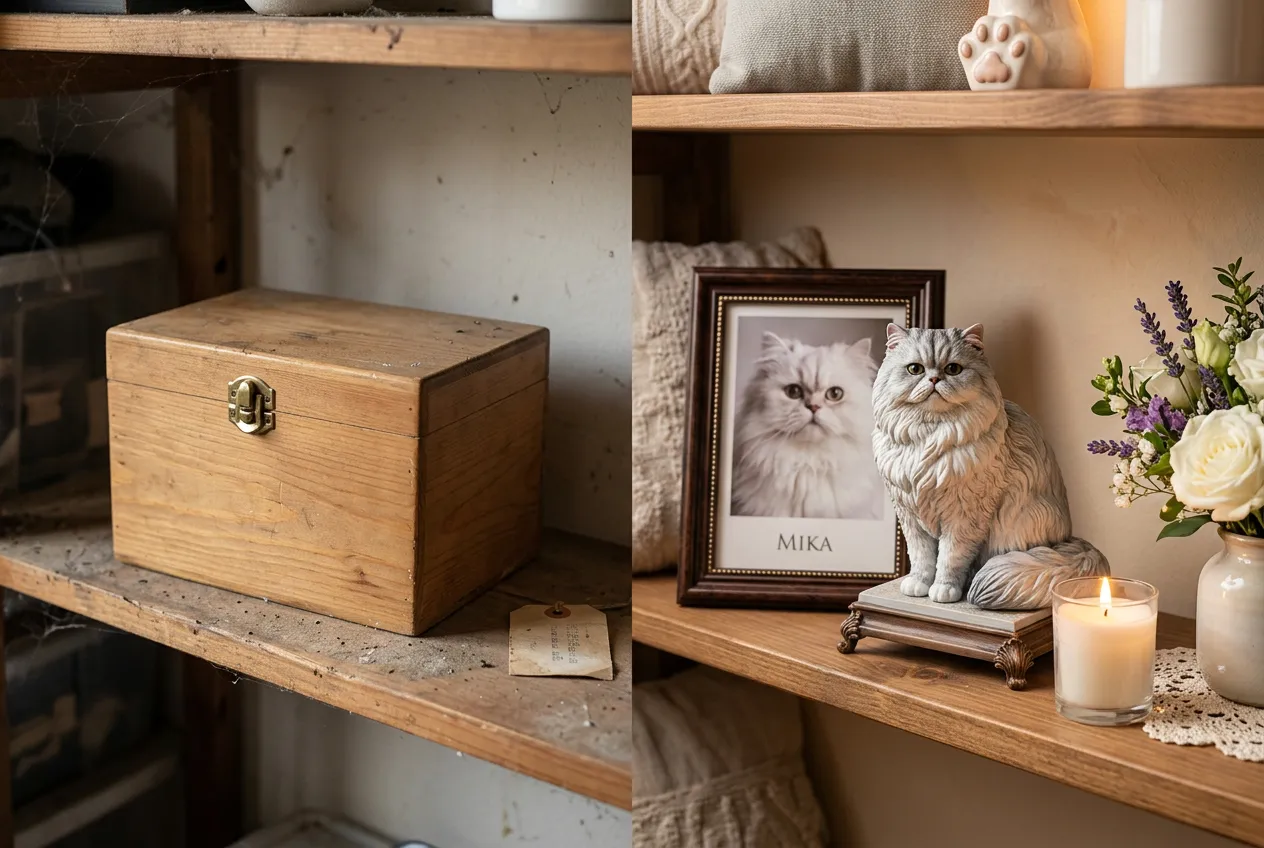
The veterinary assistant handed her the small cardboard box, and Sarah's hands went still. Inside: what remained of Duchess, her Persian cat of fourteen years, reduced to powder and bone fragments that shifted when she tilted the container.
Quick Takeaways
- Traditional ash storage feels incomplete — many pet owners report feeling disconnected from boxed remains on a shelf
- Spatial memory matters in grief — the physical spaces your Persian occupied need acknowledgment, not just the ashes themselves
- Modern memorials blend tangibility with beauty — options like custom 3D-printed figurines capture your cat's unique features in lasting form
- Guilt about "moving on" from ashes is normal — transforming remains into something meaningful isn't disrespectful, it's evolution
- The ritual of creation aids healing — actively participating in memorial design provides agency during powerlessness
The box sat on Sarah's mantel for eight months. She'd walk past it seventeen times a day—to the kitchen, back from the bedroom, out to check the mail. Each time, a small jolt. That's Duchess. But also: That's not Duchess.
This is the paradox of cremation remains. We're told they're sacred, that keeping them close honors our pets. But a cardboard box (or even an expensive urn) on a shelf doesn't feel like honoring. It feels like storage. Like we've filed away someone we loved under "handled" and moved on.
Except we haven't moved on. We're stuck in a strange limbo where the physical presence of ashes prevents us from grieving fully, yet provides no real comfort. The box becomes a guilt object—can't throw it away, can't look at it without pain, can't figure out what it's actually for.
The Unspoken Problem With Ash Storage
Here's what the pet loss industry won't tell you: keeping ashes in a container often prolongs a specific type of grief rather than resolving it. Not because ashes themselves are wrong, but because passive storage creates what grief therapists call "frozen mourning"—you're holding onto the physical remains without integrating the loss into your life story.
The box on the shelf becomes a placeholder for grief work you haven't done yet. Every time you see it, your brain registers: unfinished business. You're not remembering Duchess as she was—the way she'd drape herself across the back of the sofa, the specific rumble of her purr, the weight of her paw on your wrist at 6 AM. You're remembering that she's dead and you haven't figured out what to do about these ashes.
This isn't about disrespecting remains. It's about recognizing that human beings need active rituals, not passive storage, to process loss.
The Relief-Guilt Cycle
Many Persian cat owners describe a specific emotional pattern after cremation: relief that their cat's suffering ended, followed immediately by guilt about feeling relieved, followed by anxiety about the ashes. What if I lose them? What if someone knocks over the urn? What if there's a fire? The ashes become a new source of stress rather than comfort.
Then comes the secondary guilt: I should want to keep these. What kind of person doesn't want their pet's ashes?
Let's be direct: you're not a bad person if the box of ashes makes you uncomfortable. You're a person whose grief needs a different shape than what the cremation industry provides by default.
"Grief isn't a problem to be solved. It's a love story that continues after the last chapter."
Why Persian Cats Make This Harder
Persian cats occupy space differently than other pets. Their long, luxurious coats make them visually substantial—they're not just in a room, they're a feature of the room. That massive tail draped over the arm of your reading chair. The way their fur caught afternoon light coming through the window. The specific corner of the bed they claimed, leaving a permanent impression in the comforter.
When you lose a Persian, you don't just lose a pet. You lose a physical presence that shaped your home's entire aesthetic and emotional geography.
The empty spaces are louder with Persians. That grooming station in the bathroom where you'd spend twenty minutes every evening working through mats. The specific spot on the kitchen counter where she'd supervise meal prep (despite your protests). The chair no one sits in anymore because it was her chair.
A box of ashes doesn't address these spatial voids. You can't put the urn in all the places Duchess used to be. You can't recreate the visual weight of her presence with a container of remains.
The Texture of Memory
Persian cats are tactile creatures. Their fur isn't just beautiful—it's an experience. The difference between the silky hair on their ears versus the dense undercoat on their sides. The way their whiskers would brush your face when they headbutted you for attention. The specific weight and warmth of them sleeping against your leg.
Ashes have no texture. They're uniform, impersonal, identical to any other cremated remains. There's nothing in that box that says "Persian cat" or "Duchess specifically." The very thing that made your cat unique—her physical, sensory presence—is completely absent from her remains.
This is why so many people report feeling disconnected from urned ashes. The container holds biological material, but it doesn't hold memory in any accessible way.
What Actually Helps: Active Memorial Creation
The families who report the most peace after pet loss aren't the ones who found the perfect urn. They're the ones who transformed their grief into something they could interact with.
This doesn't mean getting rid of ashes (though some people do, and that's valid). It means creating a memorial that serves your grief rather than storing it.
The Counter-Point: When Ash Storage Works
Before we go further, let's acknowledge: for some people, keeping ashes in a beautiful urn genuinely provides comfort. If you're one of them, there's nothing wrong with that choice.
Ash storage works best when:
- You have a dedicated memorial space (not just a shelf you pass randomly)
- The urn itself is meaningful and beautiful enough to be a focal point
- You've completed other grief work and the ashes are one element of remembrance, not the only one
- You have a long-term plan (burial, scattering) and the urn is temporary
Where ash storage fails is when it becomes the default rather than an intentional choice. When you keep the ashes because you don't know what else to do, not because they genuinely comfort you.
The New Ritual: Memorial Objects That Hold Memory
The most effective modern memorials share three characteristics:
- They're visually specific — they capture your individual pet's unique features
- They invite interaction — you can touch them, display them, incorporate them into daily life
- They're beautiful enough to be present — they enhance your space rather than creating a "grief corner"
Full-Color 3D Printed Figurines
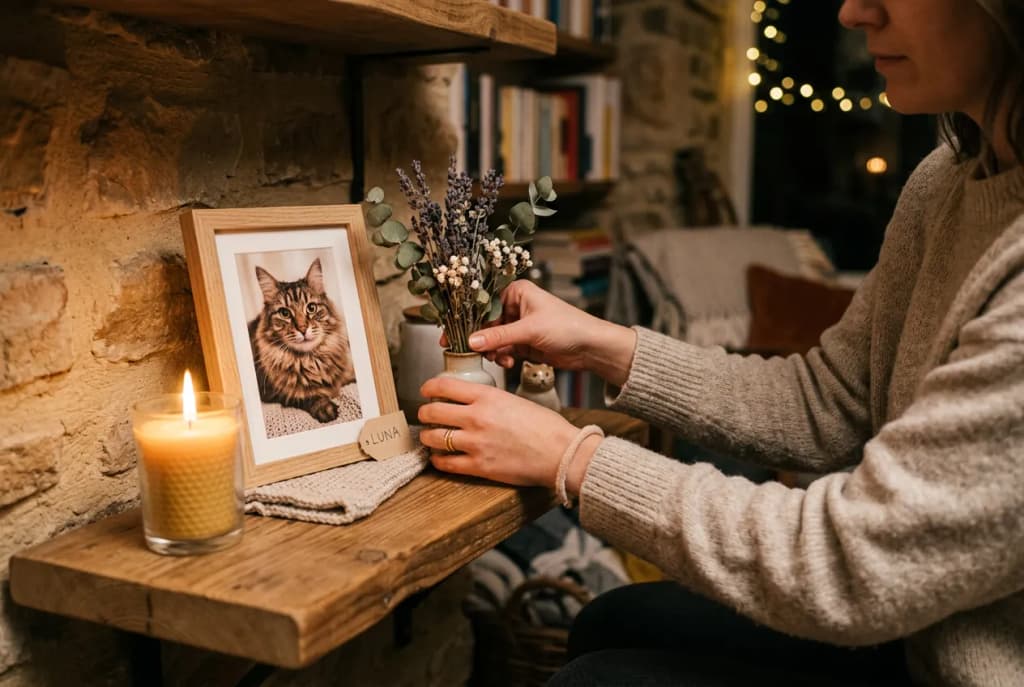
One option gaining traction: custom pet figurines created through advanced 3D printing technology. Unlike traditional urns or photo frames, these capture the specific details that made your Persian cat recognizable—the exact pattern of their coat, the shape of their face, the way they held their tail.
The process involves master 3D sculptors who digitally model your cat from photos, then use full-color resin 3D printing to create a tangible representation. The color is printed directly into the material (not painted on), creating a durable, UV-resistant piece that can sit on your desk, bookshelf, or anywhere you'd naturally see it daily.
What makes this different from a photo? Dimensionality. A photograph is flat, frozen in a single moment. A figurine exists in three-dimensional space the way your cat did. It catches light from different angles. You can pick it up, feel its weight, turn it in your hands. It occupies physical space in your home the way Duchess once did.
For families who choose this route, many report that the figurine becomes a focal point for memory—not in a morbid way, but as a natural prompt for stories. Guests ask about it. You tell them about Duchess. The memories stay active rather than archived.
You can explore this option at pawsculpt.com, where the team works with families to capture the specific details that matter most.
Memorial Gardens With Ash Integration
If you have outdoor space, consider a memorial garden where ashes are integrated into soil that grows something living. Persian cats, despite their indoor nature, often had favorite windows where they'd watch birds or track the movement of leaves.
Plant something beneath that window. Mix a portion of the ashes into the soil. Choose plants that bloom in your cat's favorite season or match their coloring—white roses for a white Persian, purple lavender for a blue-cream.
The ritual of tending the garden becomes the memorial. You're not just storing ashes; you're actively participating in transformation. Death becomes growth. Remains become nourishment. The spatial relationship between your home and your cat's memory stays intact.
Jewelry With Ash Incorporation
For people who need physical proximity, memorial jewelry allows you to carry a small portion of ashes with you. This works particularly well for Persian owners who had that specific type of bond where the cat was a constant companion—the one who followed you room to room, who slept on your pillow, who seemed to sense your moods before you did.
The key is choosing pieces that don't look like memorial jewelry. You want something you'll actually wear, not something that sits in a drawer because it's "too sad" or "too obvious." Simple pendants, rings with small chambers, or bracelets with discreet compartments work best.
Commission Art That Captures Personality
Photography freezes a moment. Ashes preserve biology. But art—good art—captures essence.
Commission a piece from an artist who specializes in pet portraits, but give them more than just photos. Describe how Duchess moved. The specific way she'd tuck her paws under her chest. The expression she'd make when you opened a can of food. The way her whole face would change when she purred.
The best pet artists don't just recreate what a cat looked like. They capture what it felt like to be in a room with that specific cat. That's the memory worth preserving.
| Memorial Type | Spatial Impact | Interaction Level | Emotional Function | Best For |
|---|---|---|---|---|
| Urn on shelf | Minimal | Passive viewing | Storage/preservation | Those with dedicated memorial space |
| 3D figurine | Moderate | Daily visual contact | Active remembrance | Those who want tangible presence |
| Memorial garden | High | Regular tending | Transformation ritual | Those with outdoor space |
| Ash jewelry | Personal/portable | Constant proximity | Comfort through closeness | Those who need physical connection |
| Commissioned art | Moderate-High | Visual engagement | Personality preservation | Those focused on essence over form |
The Spatial Grief of Persian Cats
Let's return to those empty spaces. Because this is where traditional memorials fail Persian owners most dramatically.
Your home still has Duchess-shaped holes in it. The grooming corner in the bathroom. The sunny spot on the living room rug. The specific section of couch where she'd lounge for hours. These spaces don't stop being "hers" just because she's gone.
Some families try to fill these spaces immediately—rearrange furniture, get a new pet, redecorate. Others leave them untouched for months, creating a kind of shrine through absence. Neither approach actually addresses the spatial grief.
The Proximity Problem
Here's what we've learned from working with thousands of pet families: the memorial needs to exist in relationship to the spaces your cat occupied, not separate from them.
If Duchess spent every evening on the back of your reading chair, that's where some element of her memorial should be. Not necessarily the ashes themselves, but something—a small figurine on the nearby bookshelf, a framed photo on the side table, a plant in the window she used to watch from that spot.
You're not trying to replace her presence. You're acknowledging that this space was significant, that what happened here mattered, that the relationship between you and this specific location is part of your grief.
Creating New Rituals in Old Spaces
One approach that helps: assign new meaning to the spaces your cat claimed.
The grooming corner becomes your meditation spot. You sit there for five minutes each morning, not to grieve, but to remember the ritual of care. The chair she claimed becomes your reading chair again, but you keep a small memorial object on the armrest—a reminder that this space has history.
The sunny spot on the rug? That's where you do your morning stretches now. You're not erasing Duchess. You're continuing to use the space she loved, honoring her good taste in finding the best light in the house.
This is active memorial work. You're not storing grief in a box. You're integrating loss into the ongoing story of your home.
"The spaces our pets claimed don't stop being sacred when they leave. They just need new rituals."
The Guilt About "Replacing" Ashes
Let's address the elephant in the room: you feel guilty about wanting something other than the ashes.
You were handed that box at the vet's office. You brought it home. You put it somewhere. And now you're stuck with it because getting rid of it—or even transforming it into something else—feels like betrayal.
This guilt is manufactured. The pet cremation industry has created a narrative that ashes are the "proper" way to honor remains, that keeping them intact and stored is respectful, that any other choice is somehow lesser.
But humans have been creating memorials for thousands of years, and very few cultures actually prioritize ash storage. We build monuments. We plant trees. We create art. We tell stories. We make objects that can be touched and seen and integrated into daily life.
The ashes aren't Duchess. They're what's left after her body was reduced by fire. They're biological material, not personality or memory or love. Treating them as sacred doesn't make you a good pet owner. It just makes you someone following a script the cremation industry wrote.
Permission to Transform
If you're reading this and feeling relief—finally, someone said it—here's your permission: you can do something else with the ashes.
You can scatter them in a meaningful location. You can bury them in a memorial garden. You can keep a small portion in jewelry and scatter the rest. You can commission a glass artist to incorporate them into a blown glass piece. You can divide them among family members who loved Duchess.
Or you can keep them in the urn, but also create other memorials that you actually interact with. The ashes don't have to be the only memorial. They don't even have to be the primary one.
What matters is that your memorial serves your grief, not some imagined standard of what you're "supposed" to do.
The Process of Active Memorialization
Creating a meaningful memorial isn't a single decision. It's a process that unfolds over weeks or months as you figure out what actually helps.
Phase 1: Immediate Aftermath (First 2 Weeks)
Right after loss, you're in shock. Your brain is still expecting Duchess to be there. You reach for the food bowl out of habit. You hear phantom sounds—a meow that isn't there, the jingle of a collar.
Don't make permanent memorial decisions yet. The ashes can sit in their box. That's fine. This is not the time for big choices.
What helps now: small, temporary rituals. Light a candle each evening. Put out fresh flowers. Talk to Duchess out loud (yes, really—your brain needs to practice the past tense). Write down specific memories before they fade.
Phase 2: Early Grief (Weeks 3-8)
This is when the reality settles in. She's not coming back. The empty spaces in your home become more obvious, not less. You start avoiding certain rooms or times of day because the absence is too loud.
Now you can start thinking about memorial options. But don't rush. Spend time in the spaces Duchess occupied. Notice what you miss most—is it visual (how she looked), tactile (how she felt), spatial (where she was), or behavioral (what she did)?
Your answer guides your memorial choice:
- Visual grief → figurines, portraits, photo displays
- Tactile grief → jewelry, textured memorial objects, fur keepsakes
- Spatial grief → memorial gardens, furniture arrangements, location-specific memorials
- Behavioral grief → ritual creation, volunteer work, fostering
Phase 3: Integration (Months 3-6)
You're not "over it" (you never will be), but you're learning to carry the loss. The grief is less sharp, more like a constant low hum than a siren.
This is when active memorials become most valuable. You need something you can interact with regularly—not as a grief trigger, but as a natural part of your environment.
A figurine on your desk that you see while working. A memorial garden you tend on weekends. A piece of jewelry you wear to important events. Art on the wall that guests ask about, giving you permission to tell Duchess's story.
The memorial becomes a bridge between past and present. She's gone, but she's not erased. The relationship continues in a different form.
| Grief Phase | Timeline | What Helps | What Doesn't Help | Memorial Action |
|---|---|---|---|---|
| Shock | Days 1-14 | Small rituals, talking about pet | Permanent decisions, "moving on" pressure | Keep ashes safe, no decisions yet |
| Acute grief | Weeks 3-8 | Acknowledging empty spaces, memory recording | Avoiding grief, filling spaces too quickly | Research memorial options |
| Integration | Months 3-6 | Active memorials, ritual creation | Passive storage, isolation | Create/commission memorial |
| Ongoing remembrance | 6+ months | Regular interaction with memorial | Guilt about healing | Incorporate into daily life |
Why 3D Figurines Work for Persian Owners
Let's get specific about why digitally sculpted, full-color 3D printed figurines have become increasingly popular for Persian cat memorials.
Persians are detail-intensive cats. Their faces have specific structures—the flat profile, the large round eyes, the small ears set wide apart. Their coats have patterns that are genuinely unique—no two calico Persians have identical markings, no two silver tabbies have the same striping.
A generic "cat figurine" doesn't capture this. You need something custom, something that reproduces the specific details that made Duchess recognizable to you.
The Digital Sculpting Process
Master 3D artists work from your photos to create a digital model. They're not just copying what they see—they're interpreting. They understand cat anatomy, how fur lays, how weight distributes when a cat sits or stands. They can take a 2D photo and extrapolate the 3D form.
For Persians specifically, this means capturing:
- The exact shape of the face (Persians vary more than people realize)
- The specific coat pattern and color distribution
- The way the fur creates volume and shape
- The characteristic expression (Persians have very distinct "faces")
- Small details like whisker placement, paw pad color, tail carriage
Once the digital model is approved, it's 3D printed in full-color resin. The color is part of the material itself—printed voxel by voxel—not painted on afterward. This creates a durable piece that won't chip or fade, with a natural 3D print texture that's then protected with a clear coat.
What Makes It Different From Photos
You already have photos of Duchess. Probably hundreds of them on your phone. So why would you want a figurine?
Because photos are frozen moments, and figurines are persistent presence.
A photo shows Duchess as she was on one specific day, in one specific pose, under one specific lighting condition. A figurine exists in your space the way she did—three-dimensional, catching light from different angles, occupying physical volume.
You can pick it up. Feel its weight. Turn it in your hands. Place it in different locations to see where it feels right. It's not a memorial you look at occasionally. It's an object that exists in your daily environment.
For many Persian owners, the figurine becomes a natural conversation starter. Friends visit and ask about it. You tell them about Duchess. The stories stay alive. The memories get reinforced rather than archived.
The Emotional Function of Tangibility
Here's something grief therapists understand but don't always articulate well: humans need physical objects to anchor abstract emotions.
Love, loss, memory—these are intangible. Your brain struggles to process them without something concrete to attach them to. This is why we keep our loved ones' belongings after they die. Why we wear their jewelry or sleep in their shirts. The object becomes a physical anchor for emotional reality.
Ashes serve this function, but poorly. They're hidden in a container. You can't really interact with them. They're more like a storage solution than an emotional anchor.
A figurine—or any well-designed memorial object—gives your grief something to hold onto. Not in a morbid way. In a healthy, integrative way. You're not stuck in the past. You're acknowledging that the past matters and deserves physical representation in your present.
"Memory needs texture. Grief needs weight. Love needs form."
Practical Considerations for Memorial Planning
Let's get tactical. If you're ready to move beyond ash storage, here's how to actually make it happen.
Deciding What to Do With Ashes
You have several options, and they're not mutually exclusive:
Full scattering: Choose a location that mattered to Duchess or to you. Her favorite sunny spot in the yard. A park you used to walk through. A place that feels peaceful. Scatter the ashes and create a different type of memorial (figurine, art, garden) for your home.
Partial scattering: Keep a small portion in jewelry or a mini urn. Scatter the rest. This gives you both proximity and release.
Garden burial: Dig a hole in your memorial garden space. Bury the ashes (in a biodegradable urn if you prefer). Plant something above them. The ashes become part of the soil, part of the growth cycle.
Artistic incorporation: Some glass artists can incorporate small amounts of ash into blown glass pieces. Some ceramic artists can do the same with pottery. The ashes become part of a functional or decorative object.
Keep them, but add other memorials: The ashes stay in their urn, but you also create figurines, art, or other memorials that you actually interact with. The urn becomes one element of remembrance, not the only one.
Choosing the Right Memorial Type
Ask yourself these questions:
What did I miss most in the first week after Duchess died?
- Her physical presence in specific spaces → memorial garden or location-specific figurine
- Her appearance/how she looked → custom figurine or portrait
- Physical contact/touch → jewelry or textured memorial object
- Her personality/behavior → commissioned art that captures essence
How do I naturally interact with objects in my home?
- Visual person (notice what's on walls/shelves) → figurine or art
- Tactile person (touch things frequently) → jewelry or textured objects
- Ritual-oriented (daily practices) → memorial garden or candle lighting
- Story-teller (talk about memories often) → conversation-starter objects like figurines
What's my long-term vision?
- Want something permanent and low-maintenance → figurine or art
- Want something that evolves → memorial garden
- Want something portable → jewelry
- Want something that can be passed down → durable figurine or art piece
Timeline Expectations
Memorial gardens: Can be started immediately, but take months to fully establish. Spring planting works best for most climates.
Custom figurines: The digital sculpting process typically involves photo submission, artist review, digital model creation, your approval, and then 3D printing. Visit pawsculpt.com for current timeline details, as these can vary.
Commissioned art: Depends entirely on the artist. Some work quickly (2-4 weeks), others have months-long waitlists. Factor this into your planning.
Jewelry: Often the fastest option. Many memorial jewelers can create pieces within 1-2 weeks.
Budget Considerations
Memorial costs vary wildly. Here's a realistic range:
| Memorial Type | Budget Range | Longevity | Maintenance |
|---|---|---|---|
| Decorative urn | $50-$300 | Permanent | None |
| Memorial jewelry | $100-$500 | Permanent | Minimal |
| Memorial garden | $100-$1000+ | Evolving | Regular (seasonal) |
| Custom figurine | Visit website for current pricing | Permanent | None (dust occasionally) |
| Commissioned art | $200-$2000+ | Permanent | None |
| Glass/ceramic with ashes | $300-$1500 | Permanent | None |
Don't let budget guilt stop you. A $50 memorial that you interact with daily is more valuable than a $500 memorial that sits in a closet because it doesn't actually help your grief.
The Second-Guessing Phase
Here's what happens after you create a memorial: you second-guess yourself.
Did I choose the right option? Should I have kept the ashes intact? What if I regret this later? What if I'm dishonoring Duchess's memory?
This is normal. This is your brain trying to maintain control in a situation where you had no control (you couldn't prevent her death, so you're trying to control the aftermath).
The truth: there is no "right" memorial. There's only what serves your grief and what doesn't. And you won't know which is which until you try.
Some families create multiple memorials over time. The first one doesn't work quite right, so they try something else. The ashes get scattered, then they commission a figurine because they miss having something tangible. The figurine sits on a shelf for a year, then gets moved to the desk where it's seen daily.
Memorial creation is iterative. You're allowed to adjust. You're allowed to change your mind. You're allowed to try something, decide it doesn't help, and try something else.
When Memorials Don't Help
Sometimes you create a memorial and it makes things worse. The figurine is too realistic and triggers grief every time you see it. The memorial garden becomes a chore you resent. The jewelry feels heavy and uncomfortable.
This doesn't mean you failed. It means that particular memorial doesn't match your grief style.
Try something different. Give the figurine to a family member who loved Duchess. Let the garden grow wild or replant it with something low-maintenance. Put the jewelry away and try a different approach.
The goal isn't to create the perfect memorial. The goal is to find what helps you carry the loss without being crushed by it.
Living With Loss: The Long View
It's been three years since Sarah brought home that cardboard box. Here's what she did:
She kept a small portion of Duchess's ashes in a pendant she wears on special occasions. The rest she scattered in the backyard, beneath the window where Duchess used to watch birds for hours.
She commissioned a custom figurine that sits on her desk—Duchess in her characteristic loaf position, the exact coloring of her calico coat captured in full-color resin. When she's working and glances over, she doesn't feel sad. She feels accompanied.
She planted white roses beneath the window. Every spring when they bloom, she thinks about Duchess. Not with sharp grief, but with the kind of bittersweet appreciation you feel for something beautiful that's passed.
The empty spaces in her home aren't empty anymore. They're just different. The chair Duchess claimed is Sarah's reading chair now. The sunny spot on the rug is where she does yoga. The grooming corner in the bathroom holds plants.
Duchess isn't gone. She's integrated. The relationship didn't end—it transformed. From active companionship to memory, from physical presence to emotional permanence.
This is what good memorials do. They don't freeze you in grief. They help you carry love forward.
The old way was a box of ashes on a shelf—static, passive, separate from life. The new way is active integration—memorials that exist in your daily environment, that invite interaction, that keep the relationship alive in a different form.
You don't have to choose between honoring your Persian cat and moving forward with your life. The right memorial does both.
Frequently Asked Questions
What should I do with my Persian cat's ashes if I don't want to keep them in an urn?
You have more options than most people realize. Scatter them in a location that mattered to your cat or to you—a favorite sunny spot, a peaceful park, or your backyard. Bury them in a memorial garden and plant something above them. Keep a small portion in jewelry and scatter the rest. Commission a glass artist to incorporate ashes into blown glass art. Or divide them among family members who loved your cat. The key is choosing what serves your grief, not what you think you're "supposed" to do.
How long should I wait before creating a memorial for my deceased cat?
Give yourself at least 2-3 weeks before making permanent memorial decisions. In the immediate aftermath, you're in shock—your brain is still expecting your cat to be there. This isn't the time for big choices. Use those first weeks for small, temporary rituals: lighting candles, writing down memories, talking about your cat. Once the initial shock passes and reality settles in (usually weeks 3-8), you'll have clearer insight into what type of memorial actually helps your specific grief.
Is it disrespectful to scatter my pet's ashes instead of keeping them?
Not at all. Ash scattering is a valid memorial practice used across cultures and religions for thousands of years. The ashes aren't your cat—they're what remains after biological processes. What matters is creating a memorial that helps you carry the loss and honor the relationship. For some people, that's keeping ashes in a beautiful urn. For others, it's scattering them and creating different memorials (figurines, art, gardens) that they can actually interact with. Neither choice is more respectful than the other.
How much does a custom pet figurine cost?
Pricing varies based on size, complexity, and specific features. Rather than providing numbers that might change, visit pawsculpt.com to see current pricing options. The website provides detailed information about different sizes, the creation process, and what's included. This ensures you get accurate, up-to-date information rather than outdated estimates.
Can I create multiple memorials for the same pet?
Absolutely. Many families create several memorials over time as they figure out what actually helps their grief. You might keep a small portion of ashes in jewelry, scatter the rest in a memorial garden, and commission a figurine for your home. Or create a figurine first, then add a portrait later. Memorial creation is iterative—you're allowed to adjust, add, or change approaches as your grief evolves. Some families also divide ashes among multiple family members so everyone can create their own memorial.
What photos work best for custom pet figurines?
Clear, well-lit photos from multiple angles give artists the best information. Include front views, side profiles, and three-quarter angles. Close-ups of your cat's face help capture expression and eye color. Detail shots of coat patterns are crucial for Persians, whose markings are often unique. Natural lighting works better than flash. If possible, include photos of your cat in their characteristic pose—how they typically sat, lounged, or held their tail. The more visual information you provide, the more accurately the artist can capture your specific cat's appearance and personality.
Ready to Honor Your Persian Cat's Memory?
Every Persian cat has unique features worth preserving—the exact pattern of their coat, the shape of their face, the way they held themselves. A custom figurine captures those details in lasting form, creating a memorial you can see and touch daily rather than storing grief in a box on a shelf.
Visit pawsculpt.com to explore the process, see examples, and learn about current options for persian cat memorial ideas