
Capturing the 'Head Tilt': How to Photograph Your Pug for the Ultimate 3D Sculpt (And 2 Poses to Skip)
"Every block of stone has a statue inside it and it is the task of the sculptor to discover it." —Michelangelo.
On the front porch, the evening sun catches the velvet texture of your dog's ears, casting long shadows across the floorboards. That fleeting pug head tilt isn't just a cute reaction to a strange noise; it is a moment of perfect asymmetry, a sculptural masterpiece of curiosity waiting to be preserved.
Quick Takeaways
- Eye level is essential — get on your stomach to capture the true stature of your Pug.
- Shadows define the face — avoid direct flash to keep the depth of those signature wrinkles.
- The "Sploot" translates poorly — flat poses often lack the structural volume needed for 3D modeling.
- High-resolution inputs matter — clear photos allow PawSculpt artists to digitally map every whisker.
- Patience creates art — the best expressions happen in the quiet moments between commands.
The Topography of a Pug: Seeing Your Dog as a Sculptor Does
To the casual observer, a Pug is a cute bundle of energy. To an artist, a Pug is a complex topographic map of ridges, valleys, and textures. When we look at photos submitted for custom figurines, we aren't just looking for "a dog." We are looking for the interplay of light and shadow that defines form.
The challenge with Pugs—and the reason they are so difficult to photograph well—is their brachycephalic (flat-faced) geometry. A German Shepherd has a long snout that casts a distinct shadow, easily defining the face. A Pug, however, relies entirely on the subtle "relief" of their wrinkles to create depth.
If you photograph a Pug with a direct flash, you "flatten" the image. You fill in the shadows of the wrinkles with light, effectively erasing the very features that make your dog look like your dog. The result is a beige circle with eyes. To get a photo worthy of a high-end 3D sculpt, you must learn to paint with light.
"A photograph captures a moment, but a sculpture captures a presence. We need the shadows to prove the presence exists."
The Masterpiece: Capturing the Head Tilt
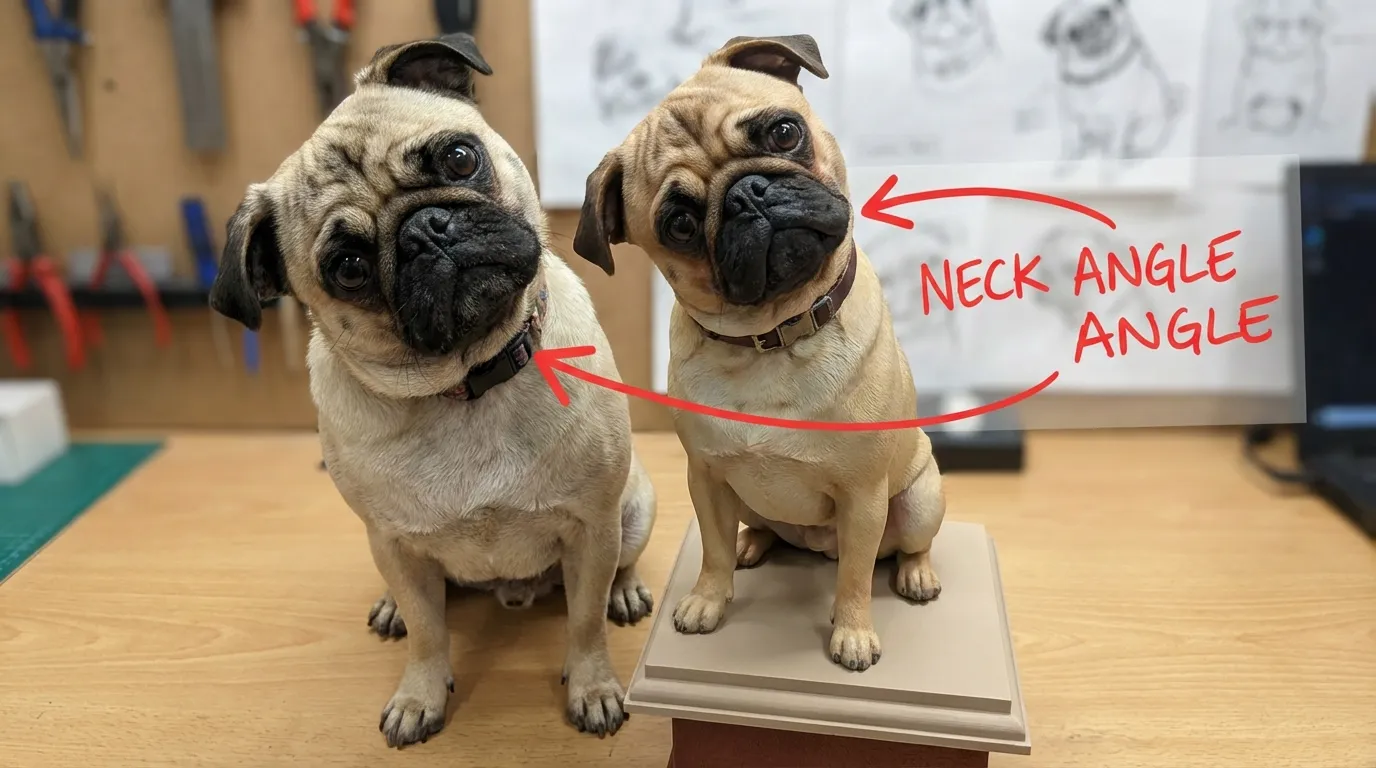
The "head tilt" is the holy grail of Pug photography. But have you ever considered why it is so aesthetically pleasing?
From a compositional standpoint, a dog sitting perfectly straight creates a static vertical line. It is stable, but rigid. When a Pug tilts their head, they introduce a diagonal line—a vector of energy. It implies movement, thought, and engagement. In the world of 3D sculpting, this asymmetry creates a dynamic figure that looks "alive" on your shelf, rather than stiff.
The Auditory Trigger Technique
Pugs tilt their heads primarily to adjust their pinnae (outer ears) to better localize sound. They are trying to understand you. To capture this:- The Setup: Have your camera ready and focused on their eyes.
- The Silence: Wait for a moment of calm.
- The Sound: Make a sound they have never heard before. A high-pitched whistle, a crumbled paper bag, or a mouth-click.
- The Capture: You have exactly 1.5 seconds before they either bark or lose interest.
Pro Tip: Do not use their name or a common command like "treat." These trigger excitement (blur) or routine obedience (stiff posture). You want curiosity.
Lighting: The Chisel That Carves the Face
In our studio, we often say that light is the sculptor's chisel. Since we create our figurines using advanced full-color 3D printing technology, the color is embedded directly into the resin. We don't paint shadows on; the machine prints the colors exactly as the file dictates.
If your photo has poor lighting, the digital sculptor cannot see the volume of the velvet rolls on the neck or the specific "rose ear" fold.
The Rembrandt Solution
The best lighting for a Pug is "Rembrandt lighting"—a technique used by Dutch masters. This involves a light source coming from the side, roughly at a 45-degree angle.Why this works for Pugs:
Wrinkle Definition: Side light casts shadows inside* the wrinkles, making them pop.
- Texture Revelation: It highlights the coarse texture of the fawn or black coat against the smooth wetness of the nose.
- Catchlights: It creates a sparkle in the eye (the catchlight) which gives the subject a "soul."
| Lighting Type | Effect on Pug Face | Suitability for 3D Sculpting |
|---|---|---|
| Direct Flash | Flattens face, erases wrinkles, causes "red eye" | Poor (Avoid) |
| Mid-day Sun | Harsh shadows, squinting eyes, high contrast | Fair (Hard to see details) |
| Overcast/Cloudy | Soft, even light, excellent color accuracy | Excellent (Great for color matching) |
| Window Light (Side) | Creates depth, defines form, adds drama | Superior (Best for structural detail) |
The Angle of Reverence: Get Down on the Floor
This is the single most common mistake we see in submitted photos. Most pet owners shoot from a standing position, looking down at the dog.
In the art world, this is a diminishing angle. It makes the subject look small, submissive, and distorts the proportions—the head looks massive, and the legs look like tiny twigs.
To create a figurine that feels noble and substantial, you must shoot from the "Worm's Eye View."
Lie on your stomach. Place your lens at the same height as your Pug's chest. When you shoot from here:
- The legs appear strong and proportional.
- The chest looks broad and proud.
- You capture the jawline, not just the top of the skull.
- The Pug looks like a hero in their own story.
Counterintuitive Insight: If you are using a smartphone, back up three feet and use the 2x or 3x zoom (telephoto) lens. The standard 1x wide lens on phones creates a "fisheye" effect when close up, making your Pug's nose look bulbous and their ears look tiny. The telephoto lens compresses the image, flattering the flat face and keeping proportions accurate.
2 Poses to Skip (The Sculptor's Nightmare)
Not every cute photo makes a good statue. Some poses, while adorable in 2D, translate poorly into physical objects.
1. The "Full Sploot" (Lying Flat)
Pugs are famous for the "sploot"—lying on their bellies with legs kicked back.- Why it fails in 3D: A sculpture needs volume and negative space to be interesting. A splooting Pug, when reduced to a 4-inch figurine, looks like a flat lump or a loaf of bread. The legs are hidden, the chest is compressed, and the silhouette is undefined.
- The Fix: If you want a relaxed pose, go for the "Sphinx." Lying down, but with the head up and front paws extended forward. This creates a beautiful triangular composition.
2. The Extreme Close-Up Selfie
We all love a nose-boop photo. But for a figurine, we need to see the body.- Why it fails in 3D: We cannot sculpt what we cannot see. If you submit a photo of just the face, we have to guess the body shape, weight, and tail curl. Pugs vary wildly in body type—some are "cobby" (square and thick), others are leaner.
- The Fix: Take a full-body shot for the structure, and close-ups for the facial details. We combine them digitally.
"We don't just print dogs; we print the way they looked at you. That specific gaze is what we chase in the digital clay."
— The PawSculpt Team
The Texture of Memory: Color and Coat
One of the distinct advantages of our process at PawSculpt is the use of full-color resin 3D printing. Unlike traditional statues that are cast in bronze or generic resin and then hand-painted with acrylics, our technology builds the color voxel-by-voxel (a voxel is a 3D pixel).
This means we aren't painting a layer of "fawn" paint over a shape. The material is fawn. This allows us to replicate the complex gradient of a Pug's coat—the way the black mask fades into the velvet ears, or the subtle "trace" (the black line running down the spine) that many Pugs possess.
Capturing the "Trace" and Markings
When photographing for your figurine, don't forget the back. The trace is a breed standard characteristic, but it varies from dog to dog. Some are bold, ink-black lines; others are faint whispers of smoke.Take a photo from behind, looking down at the spine. This "map" allows our digital artists to texture the back of the figurine with the same precision as the face.
Behavioral Psychology: The "Stay" vs. The "Wait"
Getting a Pug to sit still is a challenge. But there is a difference between a dog who is "staying" (holding a command) and a dog who is "waiting" (anticipating).
- The "Stay" Face: Often looks serious, slightly stressed, or bored. The ears may pin back.
- The "Wait" Face: The ears are up (alert), the eyes are bright, and the mouth is often slightly open in a smile.
To get the "Wait" face, use high-value rewards (like a piece of cheese) but don't give it immediately. Hold it near the camera lens. Let them anticipate it. That look of hopeful expectation is the most photogenic expression a dog can have.
How We Translate Your Photos to 3D
It helps to understand our process so you know what we need.
- Digital Sculpting: Our master artists use your photos as reference planes in 3D modeling software. We don't use automated scanning apps; a human artist digitally sculpts every wrinkle based on your images.
- Texture Mapping: We project the colors from your photos onto the digital model. This is why lighting matters—if your photo is orange because of indoor tungsten lights, the texture map will be orange.
- Printing: The file is sent to an industrial full-color 3D printer. It lays down microscopic layers of colored resin, curing them instantly.
- Finishing: The print is cleaned and a clear protective coat is applied to seal the color and give the eyes a natural sheen.
We do not use brushes. We do not wait for paint to dry. We use technology to preserve the exact pattern of your pet's fur.
Frequently Asked Questions
How many photos do I need for a custom Pug figurine?
We recommend submitting 5 to 8 photos. Ideally, we need a "mugshot" lineup: front face, left profile, right profile, back (crucial for the tail curl and spinal trace), and a full-body shot to establish proportions. The more visual data we have, the more precise the digital sculpture will be.Can you fix the 'red eye' from my flash photos?
Yes, our digital artists can easily correct eye color and remove the "glowing" retina effect caused by flash. However, while we can fix the color, we cannot easily invent the texture that the flash washed out. We always recommend natural light for the primary reference photos.My Pug has a very specific black mask pattern. Can you match it?
Absolutely. This is the superpower of our technology. Because we use full-color 3D printing rather than hand-painting, we can replicate complex gradients—like the way the black mask fades into the fawn fur—exactly as they appear in your photos.Does the figurine feel like plastic?
The material is a high-quality full-color resin. It feels solid and substantial in the hand, more like a heavy ceramic or stone than a lightweight toy. It has a fine, matte texture that absorbs light similarly to how fur does, avoiding the unnatural glossy look of cheap plastic.Ready to Celebrate Your Pet?
Every pet has a story worth preserving. Whether you're honoring a beloved companion who's crossed the rainbow bridge or celebrating your furry friend's unique personality, a custom PawSculpt figurine captures those details that make your pet one-of-a-kind.
Free instant AI preview • 3D artist preview within 7 days • 5 free revisions
The Final Frame
Photography, like sculpting, is an act of observation. It requires you to slow down and look—really look—at the creature who shares your life. You begin to notice the way the light catches the whiskers, the specific geometry of the pug head tilt, and the heavy, comforting texture of their presence.
When you take the time to capture these details correctly, you aren't just taking a picture. You are gathering the raw materials for a legacy. You are preparing to turn a fleeting moment into something you can hold, feel, and keep forever.