
5 German Shepherd Markings You'll Want to Remember: A Guide to Auditing Your Dog's Coat for Artists
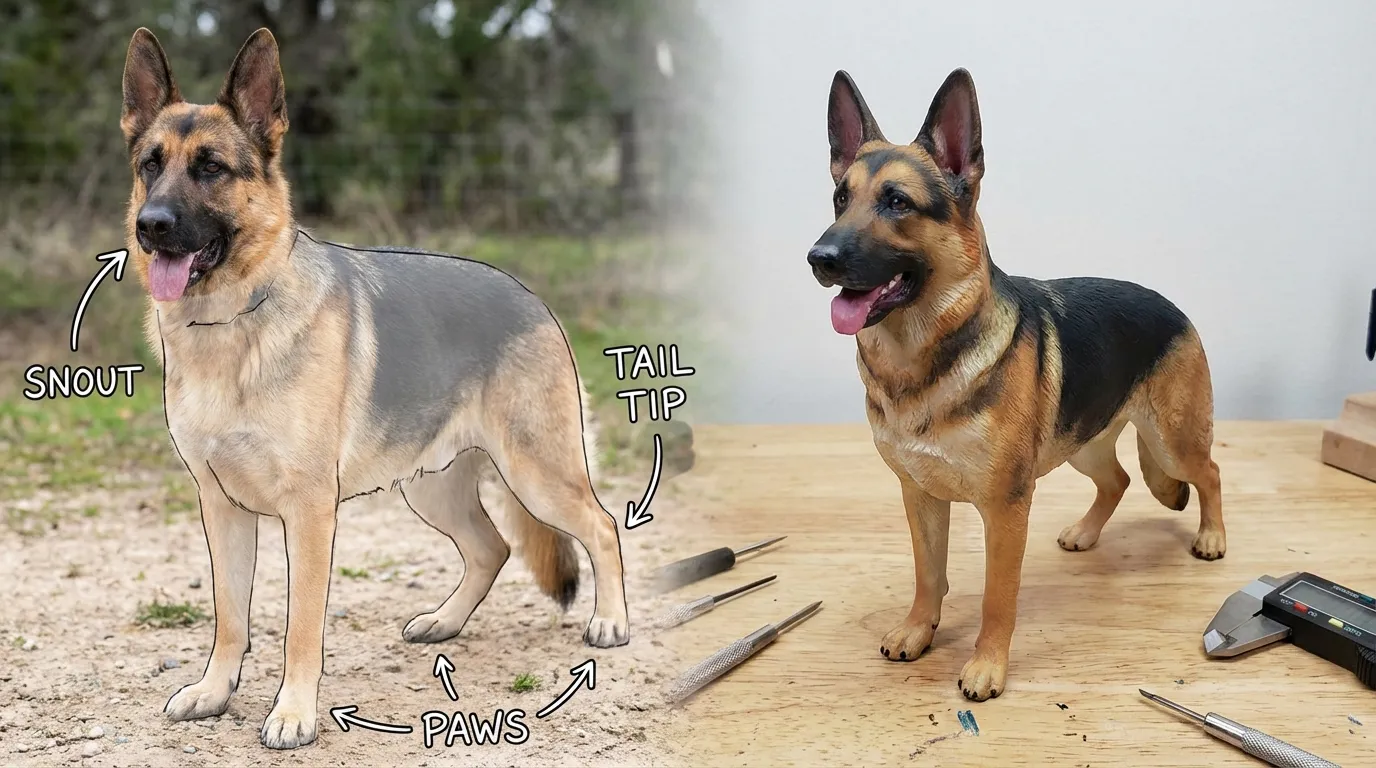
Ten years ago, the sunlight caught the jet-black saddle on his back as he tore through the hydrangeas, a blur of kinetic energy chasing a tennis ball. Today, that same afternoon light filters through the leaves to illuminate the "sugar dusting" of gray on his muzzle, a slow-moving testament to a life well-loved and a loyalty that hasn't faded even as his coat has.
Quick Takeaways
- Combat "Change Blindness" — We often stop truly seeing the details of pets we look at every day.
- Map the Melanin — German Shepherd coats are defined by the specific battle between black (eumelanin) and tan (phaeomelanin).
- The "Tar Heel" Indicator — Look for the specific black venturing down the hocks, a crucial identifier for artists.
- Preserve the Gradient — Custom figurines utilize full-color 3D printing to capture fur transitions that hand-painting often misses.
The Psychology of Seeing: Why We Miss the Details
In cognitive psychology, there is a phenomenon known as "change blindness" or "inattentional blindness." It suggests that the brain is an efficiency machine; once it categorizes an object—in this case, your German Shepherd—it stops processing the raw data and instead projects a stored mental model. You see "my dog," not the specific jagged edge where the black saddle meets the tan flank.
When we work with pet owners to create high-fidelity tributes, we often encounter a moment of cognitive dissonance. An owner might swear their dog is "classic black and tan," only to realize upon close inspection of a reference photo that the dog actually has a "bitch stripe" (a faint line of dark hair on the chest) or "pencil marks" on the toes.
This guide isn't just about identifying colors; it's about breaking that mental shortcut. It is a biological audit of your dog's phenotype. By understanding the specific geography of their coat, you ensure that any artistic representation—whether a digital portrait or a 3D printed sculpture—captures the individual, not just the breed.
"We don't see things as they are; we see them as we are. To truly see your dog is to look past your memory of them and observe the reality of their living detail."
1. The Saddle vs. The Blanket: Mapping the Macro-Pattern
The most defining characteristic of the German Shepherd Dog (GSD) is the mantle of dark fur across the back, but biologically, this is a dynamic boundary. This pattern is dictated by the ASIP gene (Agouti Signaling Protein), which controls the distribution of eumelanin (black pigment).
The Recession Line
Most GSD puppies are born almost entirely black. As they age, the "tan" (phaeomelanin) rises from the legs upward, pushing the black pigment back. Where this battle line stops defines your dog's look.- The Saddle: The black recedes significantly, leaving a distinct patch over the ribs and back, often resembling a horse's saddle. The neck and shoulders may be largely tan.
- The Blanket: The black pigment is more stubborn. It covers the back, the ribs, and extends down the shoulders and thighs, often looking like a heavy wool blanket draped over the dog.
The "Salt and Pepper" Boundary
Here is the nuance most people miss: the edge of the saddle is rarely a sharp line. It is a gradient.The Micro-Story:
We recently worked with a family memorializing "Rex." The owner insisted Rex had a solid black back. However, when we analyzed the high-resolution photos under studio lighting, we found that the transition zone—the two inches between the black back and tan ribs—was actually a mix of banded hairs (agouti), creating a salt-and-pepper transition.
Why this matters for 3D Printing:
If an artist were to use acrylic paint and a brush, blending this transition is incredibly difficult; it often ends up looking like a hard line. However, because PawSculpt uses full-color voxel 3D printing, we can replicate that gradient at the pixel level. The machine mixes the color into the resin itself, creating a soft, natural transition that mimics the biological reality of banded fur.
2. "Tar Heels" and "Pencils": The Extremity Audit
If you look at the first five generic illustrations of a German Shepherd, you will likely see clear tan legs. But biology is rarely so tidy. The lower extremities of a GSD are where the genetic "sootiness" often lingers.
The Tar Heel
Look at the back of your dog's rear legs, specifically the hock (the joint that looks like a backward knee). In many dogs, the black pigment extends down the back of the leg toward the paw, creating a marking known as a "tar heel."- The Gradient: Does the black fade out halfway down the hock, or does it connect all the way to the pad?
- The Intensity: Is it a solid stripe, or a smudging of dark hairs mixed with tan?
Pencil Marks
Now, look at the toes. "Penciling" refers to distinct black lines running down the top of the toes on an otherwise tan foot.Counterintuitive Insight:
Many owners subconsciously "edit out" these marks. They perceive the paws as "tan." But omitting pencil marks on a figurine or portrait can make the dog look strangely "un-grounded" or generic. These marks act as visual anchors. From a cognitive standpoint, these high-contrast details are what the brain uses to recognize texture and depth.
| Marking Type | Location | What to Look For |
|---|---|---|
| Tar Heel | Rear Hocks | Does the black run down the back of the leg to the pad? |
| Penciling | Top of Toes | Are there distinct black stripes on the digits? |
| Garter | Upper Thigh | A faint band of lighter hair separating the thigh black from the leg tan. |
| Smut/Soot | Forelegs | A dusting of black hairs on the front of the forelegs, often uneven. |
3. The Mask and the "Bitch Stripe": Facial Geometry
The face is where we hold the most emotional connection, yet it is often where our memory is least accurate regarding patterns. We stare into the eyes, triggering an oxytocin release, and the peripheral details of the mask blur into the background.
The Mask Recession
Just like the saddle, the mask is a receding tide of black pigment.- The Goggles: Some dogs retain lighter circles around the eyes.
- The Chimney: A dark strip running up the bridge of the nose.
- The Cheek bleed: How far back does the black extend? Does it stop at the corner of the mouth, or does it wash back toward the ears?
The "Bitch Stripe"
Despite the name, this marking appears on both males and females. It is a remnant of the dark puppy coat—a stripe of black fur running down the center of the chest, between the front legs.Why it's often overlooked:
When a dog is standing, their head often casts a shadow over the chest. Or, if the dog has a plush coat, the longer fur obscures the skin-deep pattern. You often only see this when the dog is lying on its back or running. Including this detail in a 3D model adds a layer of hyper-realism that triggers a "double-take" response—it feels real because it includes the imperfections.
"Nature rarely paints in solid blocks. It paints in gradients, speckles, and biological history. Our technology is designed to capture the chaos of organic life, not just the idealized version."
— The PawSculpt Team
4. The Tail and the "Shepherd's Lantern"
There is a poetic piece of folklore regarding the tail of herding breeds. It is said that the white or light tip often found on the tail is a "lantern" to help the shepherd see the dog in the dark while moving the flock.
While GSDs are not known for white markings (and white is a fault in the show ring), many pet GSDs possess a distinct variation in tail color.
The Ventral/Dorsal Split
Lift the tail (or observe it when they are wagging).- Dorsal (Top): Usually matches the saddle—dark, coarse guard hairs.
- Ventral (Bottom): Often much lighter, creamy, or even near-white.
- The Caudal Tip: Look at the very last 10-20 hairs on the tail. Are they black? Or is there a sudden flash of cream?
The Science of Motion:
Biologically, high-contrast markings on the tail serve as signaling mechanisms for pack coordination. When your dog is alert, the tail lifts, exposing the lighter underside. This is a visual semaphore. Capturing this "flash" of lighter color on the underside of a figurine's tail creates a sense of potential movement, even in a static object.
5. The "Sugar Dusting": Honoring the Passage of Time
This is the hardest marking to audit because it represents the scarcity of time. Graying, or "geriatric masking," is caused by the gradual cessation of pigment production in the hair follicles. It usually begins at the muzzle and spreads to the eyebrows and paws.
The Emotional Choice:
When we create a custom piece for a family, we often ask: Which version of your dog do you want to keep?
Some choose the dog at age 3—the peak of their athletic prime, with a solid black mask.
Others choose the dog at age 12—with the "sugar dusting" across the face.
Why the "Sugar" Matters:
From a psychological attachment perspective, the gray muzzle is often associated with the deepest bond. This is the dog that knew your routine, the dog that comforted you through the hardest years. The gray isn't a flaw; it's a badge of tenure.
Because PawSculpt uses digital sculpting followed by precision printing, we can achieve the "salt and pepper" look of a graying muzzle without it looking like a solid patch of white paint was slapped on. We can map the individual gray hairs as they encroach on the black mask, preserving the dignity of the senior dog.
Celebrating the Individual Through Technology
In the past, capturing these nuances required a painter with a single-hair brush and dozens of hours. Even then, the result was an interpretation of the coat sitting on top of the material.
At PawSculpt, we utilize full-color 3D printing technology. This means the color information is embedded into the voxel (3D pixel) structure of the resin itself. There is no paint to chip off. There are no brushstrokes to distract from the texture of the fur.
When you perform this "coat audit" on your German Shepherd, you are gathering the data that allows our digital artists to model a tribute that is scientifically and emotionally accurate.
Frequently Asked Questions
How do I photograph my German Shepherd's markings for a figurine?
The best references come from natural, indirect lighting (like an overcast day). Avoid direct flash, as it washes out the subtle contrast between the rich tan and the black. Be sure to take specific close-ups of the "unusual" spots: the paws (to show penciling), the chest (for the bitch stripe), and the tail.Can you replicate the gray on my senior dog's muzzle?
Absolutely. This is one of our specialties. Because we sculpt digitally and print in full color, we can create the "salt and pepper" effect where individual light pixels mix with dark ones. This captures the dignity of a senior dog far better than painting a solid white patch over the nose.What is the difference between a saddle and a blanket back?
A saddle back has a clearly defined area of black restricted to the back and ribs, leaving the neck, shoulders, and legs tan. A blanket back is much heavier in black pigment, with the dark color extending down the shoulders, thighs, and often the tail, looking like a heavy blanket draped over the animal.My dog has a white patch on their chest, is that normal?
Yes, it is quite common! While it may be considered a "fault" in strict conformation show rings, it is a perfectly normal genetic occurrence. We love these "imperfections" because they act as a fingerprint—proving that the figurine is your dog, not just a dog.Ready to Celebrate Your Pet?
Every pet has a story worth preserving. Whether you're honoring a beloved companion who's crossed the rainbow bridge or celebrating your furry friend's unique personality, a custom PawSculpt figurine captures those details—from the tar heels to the sugar dusting—that make your pet one-of-a-kind.
Free instant AI preview • 3D artist preview within 7 days • 5 free revisions