
Archiving the 'Zoomies': 4 Tips to Photograph a Hyper Husky for 3D Modeling (And What to Avoid)
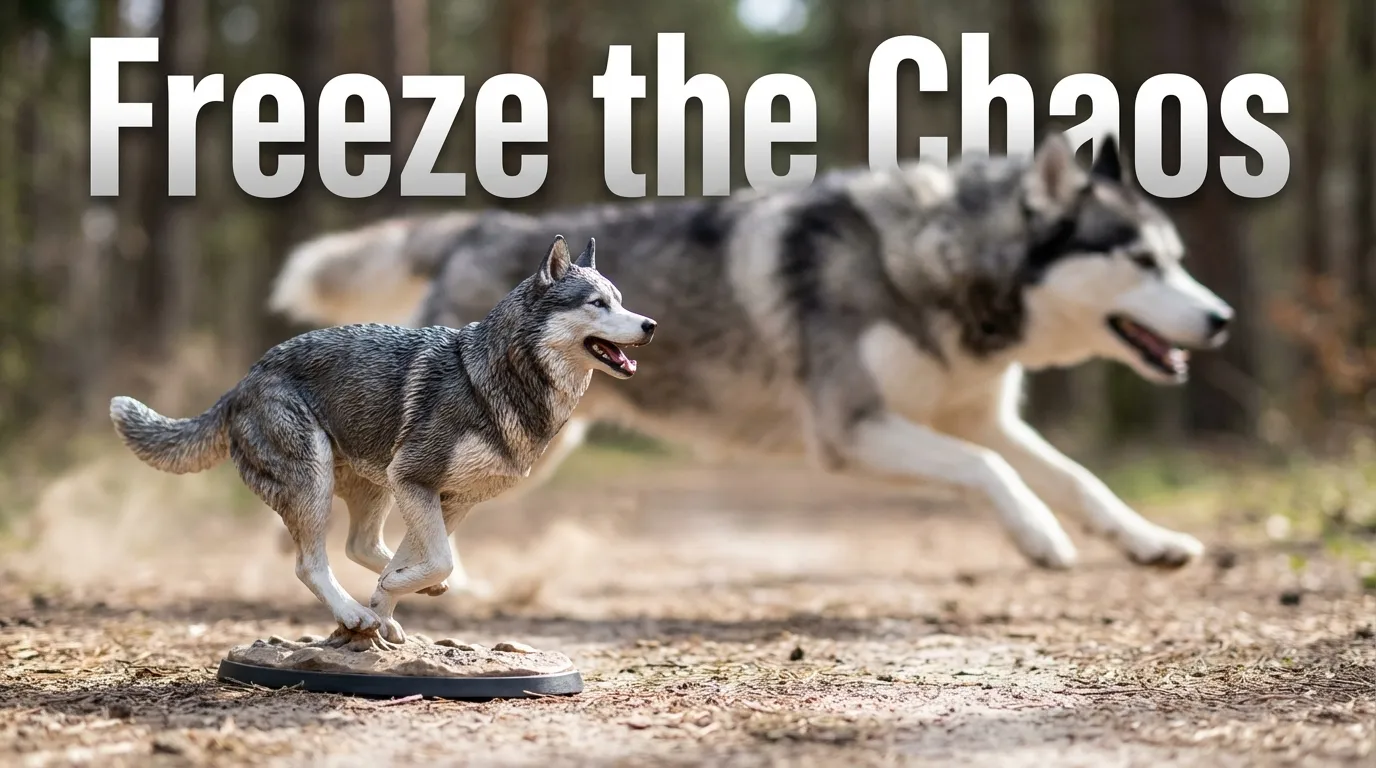
You’re kneeling on the cold concrete of the garage floor, holding a squeaky toy in one hand and your phone in the other, while a blur of gray and white fur ricochets off the stored holiday decorations. In this chaotic moment of trying to capture a single clear photo of your husky for a 3D model, you realize you aren't just battling motion blur—you're trying to bottle lightning.
Quick Takeaways
- Work with the energy — Deplete the "zoomies" first, then photograph during the "golden hour" of post-play contentment.
- The "Elevated Command" technique — Place your husky on a raised surface (like a picnic table) to naturally limit movement and improve posture.
- Video frame extraction — Instead of timing a shutter, record 4K video and pull high-res stills from the footage.
- Focus on the "Soul Gaze" — The most critical data point for custom figurines isn't the tail, but the specific geometry of the eyes and ears.
The Spiritual Geometry of the Husky
We often think of photography as a technical pursuit—shutter speeds, lighting angles, focal lengths. But when you are attempting to document a husky, you are engaging in a spiritual negotiation with a being of pure kinetic energy. Huskies are not merely dogs; they are ancient souls wrapped in winter coats, possessing a spirit that is fundamentally opposed to stillness.
To capture them for a 3D model is to attempt to pause a river.
Most guides will tell you to use high shutter speeds or bribe your dog with cheese. And while treats have their place, the metaphysical truth is that you cannot force a husky to be something it is not. You must wait for the spirit to settle. The goal of a 3D scan or reference photo isn't just to map the physical topography of their snout; it is to enshrine their presence. When we look at a figurine years from now, we don't just want to see a dog standing; we want to feel the vibration of their personality.
"A photograph captures a moment, but a true likeness captures the energy that fills the room."
1. The Ritual of Exhaustion (and the "Golden Lull")
The mistake most people make is attempting to photograph a husky when the dog is "fresh." This is a battle you will lose. A husky’s spirit is fueled by a reservoir of ancestral endurance designed to pull sleds for hundred of miles. If you try to make them sit still while that tank is full, you are fighting nature itself.
Instead, view the photography session as the final step in a ritual.
The Process of Depletion
You need to engage in the "Ritual of Exhaustion." This isn't just a walk around the block. It is 20 minutes of intense fetch, a 3-mile run, or a heavy flirt-pole session. You are honoring their need to move. You are acknowledging their spirit's purpose.The Golden Lull
After the activity, there is a specific window of time—usually about 15 to 30 minutes post-exercise—where the panting slows, but the sleepiness hasn't fully set in. This is the "Golden Lull." Their eyes are bright and alert, their ears are perked, but their body is chemically satisfied. The frantic energy has dissipated, leaving behind the pure essence of the dog. This is when you bring out the camera.| Stage of Energy | Visual Indicator | Suitability for 3D Ref Photos |
|---|---|---|
| The Zoomies | Dilated pupils, tucked tail, blurring | Impossible (Avoid completely) |
| The Crash | Lying flat, eyes half-closed, tongue lolling | Poor (Distorts body shape) |
| The Golden Lull | Seated upright, mouth closed/slightly open, alert | Perfect (Captures true form) |
| The Reset | Pacing, whining, looking for stimulation | Difficult (Requires high patience) |
2. Creating a Sacred Space: The "Pedestal" Method
In the metaphysical sense, elevation implies reverence. In the practical sense, it limits your husky's escape routes.
When a dog is on the ground, the entire world is their domain. They are grounded to the earth, ready to sprint. By placing them on a raised surface, you change the psychological dynamic of the space. This could be a grooming table, a sturdy picnic bench, or even a large rock in the park.
Why This Works Spiritually and Physically
When you elevate the husky, they naturally adopt a more noble, statue-like posture. They become aware of the edges of their platform. Their focus narrows. They are no longer patrolling a territory; they are occupying a specific point in space.For our 3D modelers at PawSculpt, this is crucial. Ground-level photos often suffer from perspective distortion—the head looks huge while the paws look tiny. By elevating the dog, you can easily photograph them at their eye level, creating an orthographic truth that honors their actual proportions.
Pro Tip: Have a helper stand behind you with a high-value object (a squeaker or a piece of liver) held right near the camera lens. This aligns the dog's "Soul Gaze" directly with the viewer, creating that piercing connection huskies are famous for.
3. The Video-to-Still Extraction Technique
Sometimes, the universe does not grant us stillness. Sometimes, the spirit of the wolf is too strong, and the husky simply must move. In these moments, do not fight the flow.
Instead of trying to freeze time with a shutter click (which often results in a blurry ear or a closed eye), embrace the flow of time by recording video.
The Technical Ritual
1. Set your phone to 4K resolution. Most modern smartphones default to 1080p, which is insufficient for the minute texture details of fur. 2. Ensure lighting is abundant. Spiritual clarity requires physical light. Go outside on an overcast day (nature's softbox) or stand facing a large window. 3. Record a "turntable" video. Instead of moving the dog, you move around them. Move slowly, keeping the camera steady. 4. Extract the frames. Later, you can scrub through the video timeline frame-by-frame. You will find that split-second moments of perfection—where the ears are forward and the mouth is closed—hidden within the motion.This method respects the husky's need for movement while allowing you to harvest the stillness hidden within the chaos. It allows the 3D artists to see the transition of the fur and the musculature in a way that a single static image sometimes misses.
"In the flow of movement, the truth of the form is revealed."
4. Mapping the Soul: Eyes, Ears, and Markings
When we create a physical legacy of a pet, we are not just printing plastic. We are trying to capture the unique signature of a soul. For a husky, this signature is written in three specific areas that require special attention during your photo session.
The Mask of Identity
Every husky has a unique "mask"—the pattern of white and color on the face. This is their fingerprint. A common mistake is photographing the face in shadow. We need to see the exact boundary where the white meets the gray, black, or red. If this boundary is obscured by shadow, the figurine loses its specific identity and becomes a "generic" husky.The Heterochromia Factor
Many huskies possess the "ghost eye" or heterochromia (different colored eyes). This is a window into their dual nature. Ensure you get a close-up that accurately captures the specific shade of blue or brown. Is it an icy, white-blue? A deep ocean blue? A warm amber? These nuances are the difference between a toy and a totem.The Ear Set
A husky's ears are their emotional radar. Are they set high and close together? Are they wide and relaxed? Do they have a subtle curve at the tip? Photograph the head from the side and the back. The back of the head is often ignored, yet it is essential for understanding the volume of the neck ruff and the skull shape.What to Avoid: The Energy Blockers
There are actions that disrupt the connection and ruin the reference material. Avoid these pitfalls to ensure the spirit of your animal is honored.
- The "Treat trance": If you hold a treat too close for too long, a husky will often pin their ears back and widen their eyes in a "crazy" expression. This is a distortion of their true self. We want alert curiosity, not desperate hunger.
- The "Top-Down" perspective: Standing over your dog and shooting down minimizes their presence. It makes them look small and submissive. Always get down to their level. Honor them as equals.
- Flash photography: The flash creates "laser eyes" (green or red reflection) that obliterates the iris detail. It also flattens the texture of the fur, turning a rich coat into a single block of color. Use natural, ambient light to respect the depth of their being.
Frequently Asked Questions
Can I use photos where my husky is wearing a harness?
It is best to remove harnesses and collars. These items obscure the neck ruff and shoulder musculature, which are critical for an accurate 3D sculpt. If you want the figurine to wear a collar, photograph it separately, but let the dog's body be free for the reference shots. We want to sculpt the animal, not the accessories.My husky has very specific markings on their tail. How do I capture that?
Tail markings are vital. Try to photograph the tail when it is in a relaxed, downward position to see the length and pattern. Then, try to capture it in its natural 'sickle' curl over the back. The video extraction method works best for this, as tails are rarely still.How many photos do I actually need for a custom figurine?
Quality matters more than quantity, but we generally recommend 8-10 photos. You need: front face, left profile, right profile, back view, and a top-down view of the back markings. Close-ups of the eyes and nose are helpful bonuses.My husky is a mix. Can you still model them?
Absolutely. In fact, mixed breeds often benefit most from custom sculpting because they don't fit standard breed molds. The unique combination of traits—perhaps a husky mask with a shepherd body—is exactly what our digital artists specialize in capturing.Ready to Celebrate Your Pet?
Every pet has a story worth preserving. Whether you're honoring a beloved companion who's crossed the rainbow bridge or celebrating your furry friend's unique personality, a custom PawSculpt figurine captures those details that make your pet one-of-a-kind.
Free instant AI preview • 3D artist preview within 7 days • 5 free revisions
"We don't just look at the photos; we look for the spark. When we sculpt a husky, we're trying to capture that split-second of mischief and wisdom that defines them."
— The PawSculpt Team
When you finally get that perfect shot—the one where the lighting hits the ruff just right, and the eyes are looking into yours with that ancient, knowing gaze—you'll feel it. You have captured a fragment of their soul. And that is the perfect beginning for a legacy that will last forever.