The First Birthday They Miss: Celebrating Your Child Without Their Guardian
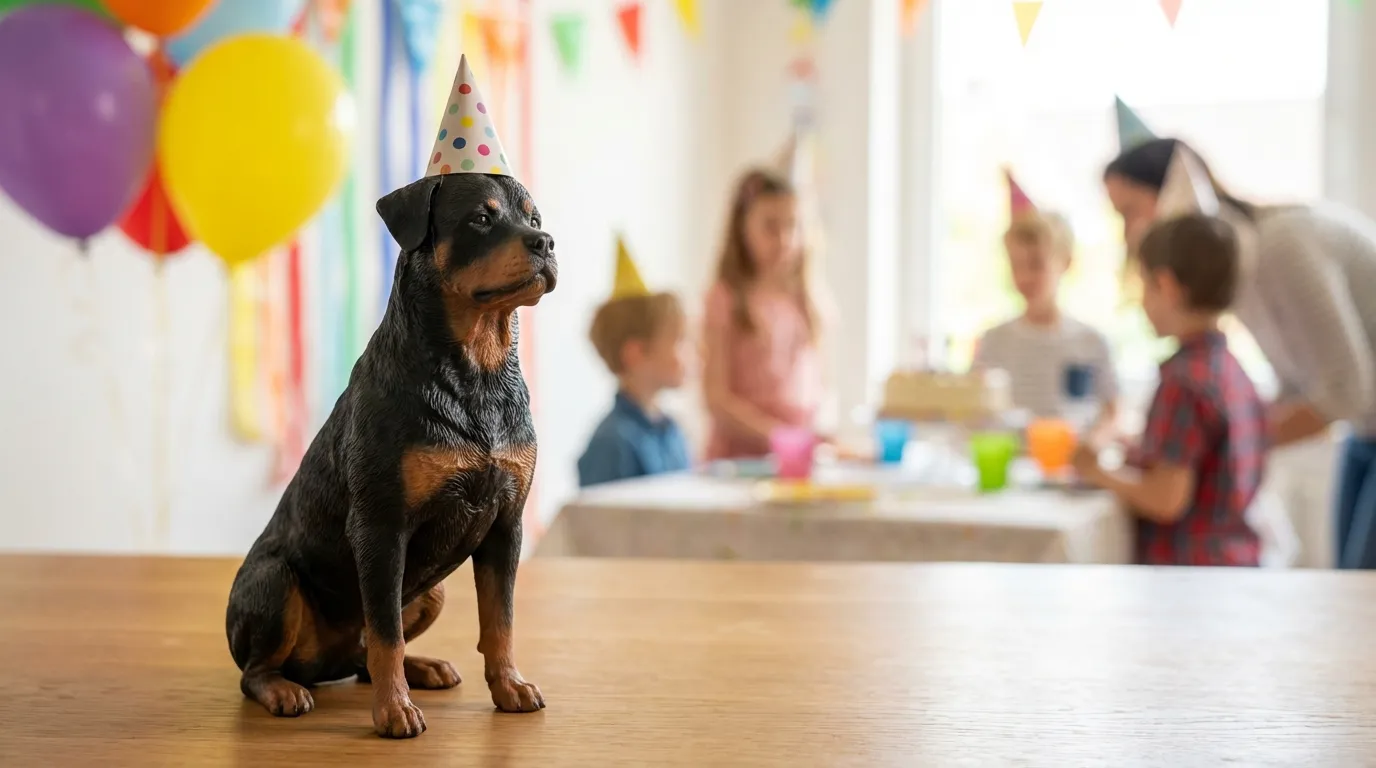
The smell of extinguished wax hangs in the kitchen, but the familiar, heavy rhythmic thumping of a tail against the cabinets is missing. You catch yourself glancing at the floor where your Rottweiler used to station himself during cake cutting, waiting for the inevitable falling crumb. The quiet under the table feels heavier than the celebration above it.
Quick Takeaways
- Grief isn't linear — birthdays often trigger "grief bursts" for children that feel as fresh as the first day.
- Guardians leave a "safety void" — losing a protective breed like a Rottweiler removes a child's sense of physical security, not just companionship.
- Don't force happiness — trying to overcompensate for the sadness often backfires; let the joy and grief coexist.
- Create tangible anchors — physical touchstones like PawSculpt's custom figurines help children direct their feelings toward something real.
- New rituals matter — replace the old routine (feeding the dog cake) with a new tribute (lighting a candle for them).
The Specific Silence of a Missing Guardian
We need to talk about the unique emptiness that comes from losing a "guardian" breed. When a family loses a Golden Retriever, they often mourn a playmate. But when you lose a dog like a Rottweiler, a German Shepherd, or a Mastiff, the family dynamic shifts on a foundational level. These dogs didn't just live in your house; they watched over it.
For your child, that dog was likely a constant shadow. They were the monster-prevention system under the bed. They were the warm, heavy weight leaning against their leg while they did homework.
The "Safety Void" is a real psychological phenomenon we see in families grieving large breeds. Your child isn't just sad; they might feel subtly unsafe. That 100-pound presence that stood between them and the world is gone.
"Grief isn't a problem to be solved. It's a love story that continues after the last chapter."
On a birthday, this absence screams. The chaos of a party—balloons popping, people shouting, wrapping paper tearing—used to be monitored by the dog. Without that regulator, sensitive children might feel overwhelmed by the very party meant to celebrate them.
The "Lean" Factor
If you owned a Rottweiler, you know "The Lean." It’s that physical pressure they apply to their people—a way of checking in and offering comfort. Your child is likely missing that tactile grounding.When the anxiety of the birthday party hits, they might unconsciously reach down for a head that isn't there. Acknowledge this. Tell them, "I miss his heavy head on my lap, too." Validating the physical absence is just as important as validating the emotional one.
Navigating the "Happy" Birthday Paradox
There is a massive pressure on parents to make birthdays magical. We want perfect photos, wide smiles, and core memories. When family grief enters the picture, parents often make a critical mistake: they try to "out-run" the sadness.
You might feel the urge to buy extra gifts, plan bigger activities, or distract your child the moment they look sad. Don't.
The Counterintuitive Approach: Invite the Grief to the Party
It sounds backward, but acknowledging the sadness actually lowers the tension. If you ignore the elephant (or the missing Rottweiler) in the room, your child feels like they have to hide their feelings to keep you happy.Try this instead:
Start the day by acknowledging the loss. "This is our first celebration without Bear. It feels weird, doesn't it? It's okay if we feel happy about the cake and sad about Bear at the same time."
By giving them permission to be sad, you actually free them to be happy. They don't have to carry the burden of "ruining" the mood.
Age-Appropriate Grief Responses
Children process kids and pet loss differently depending on their developmental stage. Here is what you might see on a milestone day:| Age Group | Typical Grief Response | How It Manifests at Birthdays |
|---|---|---|
| Toddlers (2-4) | Confusion, searching behaviors | Asking "Where is Bear?" repeatedly; looking under tables. |
| Early School (5-8) | Personification, magical thinking | Worrying the dog is "lonely" without cake; wanting to save a slice. |
| Pre-Teen (9-12) | Withdrawal, anger, physical symptoms | "This birthday is stupid"; stomach aches; refusing to participate. |
| Teens (13+) | Existential questioning, masking | Acting indifferent; grieving privately on social media; feeling guilty for having fun. |
Tangible Anchors in a Digital World
We live in an era of cloud storage. You probably have thousands of photos of your dog on your phone. But for a child, a digital photo is abstract. They can't hold a pixel. They can't pet a screen.
When a child is grieving, they need something tangible. They need an object that occupies physical space, just like their guardian did.
This is where many families find solace in physical memorials. Some plant trees. Others keep a collar in a shadow box. In our work, we’ve seen a profound shift toward hyper-realistic representations.
A custom figurine isn't just a statue; for a child, it's a focal point. It’s a place to direct their "Happy Birthday" wishes. Because our full-color 3D printing technology captures the exact markings—the specific asymmetrical eyebrow patch, the graying muzzle, the pink spot on the nose—it bridges the gap between memory and reality in a way a generic statue cannot.
"We've seen families heal by holding something tangible. Grief needs an anchor—a place for the love to land when the dog is no longer there to catch it."
— The PawSculpt Team
The "Guardian on the Shelf" Tradition
One beautiful ritual we've learned from a customer involved a 6-inch replica of their late Rottweiler. Every year on the child's birthday, the figurine is placed on the cake table, right next to the presents.The child knows the dog is gone, but seeing that familiar form makes them feel like their guardian is still "attending" the party. It turns a gaping hole in the room into a presence.
The Emotional Nuance: Parental Guilt and Relief
Let's address the emotion you might be feeling but are afraid to say out loud: Relief.
If your dog was a senior Rottweiler, the months leading up to the end were likely hard. Mobility issues, incontinence, the struggle to lift a 100-pound animal—caregiving was a physical and emotional marathon.
On this birthday, amidst the sadness, you might feel a wave of relief that you aren't managing medications or worrying about the dog getting knocked over by excited kids.
Then comes the guilt. You feel guilty for feeling relieved. You feel guilty that you couldn't keep them alive for just one more birthday. You feel guilty that your child is hurting and you can't fix it.
This cocktail of relief and guilt is entirely normal. It doesn't mean you loved them less. It means you loved them enough to bear the burden of their end-of-life care, and you are human enough to be exhausted by it. Give yourself grace. Your child takes their emotional cues from you; if you accept your complex feelings, they will learn to accept theirs.
Creating New Rituals (Without Erasing the Old)
The goal of the first birthday without the pet is to transition from "active interaction" to "active remembrance." You aren't feeding the dog anymore, but you are still honoring them.
Active Remembrance Ideas:
- The "Ghost" Slice: If your dog always got the first bite of a hot dog or a piece of cheese, keep doing it. Put a small piece on a plate and take it outside to a garden spot or memorial area. It acknowledges the routine rather than ignoring it.
- Donation in Their Name: For older kids, taking a bag of food to a shelter in the dog's honor can be empowering. It turns their helplessness into action.
- The Memory Jar: Instead of gifts, ask family members to write down one funny memory of the dog. Read them while eating cake. Laughter is the best medicine for the tension of grief.
What NOT to Do
Avoid getting a "replacement puppy" specifically for the birthday. According to the American Kennel Club, rushing into a new pet before the grief has been processed can lead to resentment, especially if the child feels the new dog is meant to erase the old one. A Rottweiler puppy is nothing like a senior Rottweiler guardian; the chaos might be too much contrast for a grieving child.The Long-Term Gift of Grief
It hurts to watch your child hurt. It goes against every instinct you have as a parent. But navigating the loss of a beloved pet is often a child's first encounter with mortality.
By guiding them through this birthday—by showing them that joy and sadness can sit at the same table—you are teaching them resilience. You are teaching them that love survives absence.
The silence where the tail thump used to be will eventually become less deafening. It will turn into a quiet reverence. The fear of the "safety void" will be replaced by the internalized confidence the dog gave them.
They aren't just celebrating a birthday without their guardian. They are celebrating the person they became because of that guardian.
"They don't just leave a hole in your life; they leave a space shaped exactly like them, filled with the person they helped you become."
Frequently Asked Questions
How do I explain to my child why we aren't getting a new dog for their birthday?
Honesty is best. Explain that hearts need time to heal, just like a scraped knee needs time to scab over. You can say, "We loved Bear so much that we need to let our hearts rest before they are strong enough to do that big job again." It teaches them that pets are individuals, not replaceable objects.Is it normal for my child to act angry at the vet or me on their birthday?
Yes, this is very common. Grief in children often looks like irritability or anger because they don't have the vocabulary for deep sorrow. They might blame the vet, you, or even God. Validate the emotion ("I can see you are so angry that Bear isn't here") without validating the blame.Should we visit the grave or ashes on the birthday?
Put the ball in their court. Agency is a powerful antidote to the helplessness of grief. Ask, "Would you like to visit Bear's spot today, or would you prefer to just look at pictures?" If they say no, respect it immediately. There is no "right" way to grieve.How can a custom figurine help with my child's grief?
Psychologically, grief is "love with nowhere to go." A custom figurine serves as a vessel for that love. It gives the child a specific place to look when they talk to their pet. Because PawSculpt figurines are created with full-color 3D printing technology, they capture the unique essence of the pet—not just the breed—which helps the child feel that their specific dog is being honored.Ready to Celebrate Your Pet?
Every pet has a story worth preserving, especially the guardians who watched over our little ones. Whether you're honoring a beloved companion who has crossed the rainbow bridge or celebrating your furry friend's unique personality, a custom PawSculpt figurine captures those details—the gray muzzle, the soulful eyes, the protective stance—that make your pet one-of-a-kind.
Free instant AI preview • 3D artist preview within 7 days • 5 free revisions