
Sunday Morning Pancakes: The Void Under the Kitchen Table
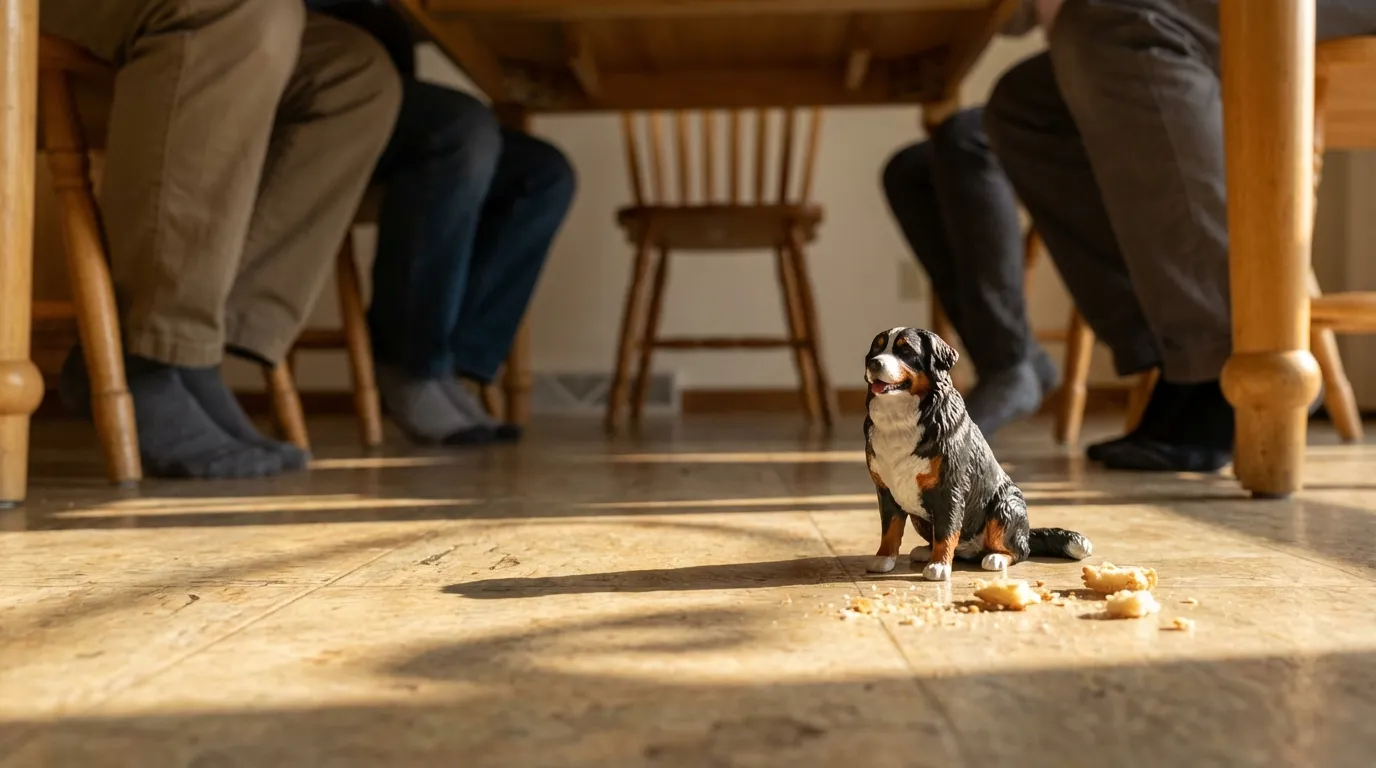
Seventy percent of pet owners report that the most difficult part of grief isn't the initial loss, but the disruption of daily micro-routines—like the sudden silence during breakfast preparations. I dropped a piece of bacon on the floor this morning, and for a split second, I waited for the familiar click-clack of nails on the hardwood that never came.
Quick Takeaways
- The "phantom routine" is real — your brain is wired to expect your pet's presence during specific daily rituals.
- Grief isn't linear — it's circular; you might feel fine on Tuesday and devastated by a pancake on Sunday.
- Memorialize the mundane — honor the small, silly moments (like begging for scraps) rather than just the "dignified" ones.
- Create a physical anchor — holding a tangible object, like a custom figurine, can help ground anxiety when routines are broken.
The Science of the Empty Spot
We often talk about grief as an emotional wave, but we rarely discuss it as a neurological event. Your brain is a prediction machine. For years, it has built a neural pathway that says: If I open the fridge, the dog will appear. If I drop food, it will vanish.
When you lose a pet, particularly a large breed like a Bernese Mountain Dog whose physical presence took up significant space in your home, those neural pathways don't dissolve overnight. They misfire. You step over a dog that isn't there. You reach down to scratch a head that doesn't exist.
This isn't just "missing" them. It's a cognitive dissonance that creates a unique type of exhaustion. You are constantly correcting your own reality.
"Grief isn't a problem to be solved. It's a love story that continues after the last chapter."
The void under the kitchen table is perhaps the loudest silence of all. That space was their domain. It was where the "tax" was paid on every slice of cheese. Seeing it empty doesn't just make you sad; it makes the room feel physically wrong, like a wall has been removed from your house without your permission.
The Guilt of Relief (And Why It’s Okay)
Let's talk about the emotion almost no one admits to: relief.
If your pet was sick for a long time—if you spent months managing incontinence, administering pills, lifting 80 pounds of dead weight, and sleeping with one eye open—their passing brings a sudden cessation of caretaking labor.
Then, immediately after the relief comes the guilt. It hits like a sledgehammer. How can I be relieved that my best friend is gone?
Here is the counterintuitive truth: You aren't relieved they are gone. You are relieved that their suffering is over, and that your hyper-vigilance can finally rest.
One of our customers, Sarah, told us about the first Sunday after her senior dog passed. She woke up, realized she didn't have to rush outside before the accident happened, and stayed in bed. Then she cried for an hour because she felt "lazy" and "selfish" for enjoying the sleep.
If you feel this, you aren't a bad owner. You are a human being who has been running a marathon of caregiving. Putting down the heavy backpack you've been carrying doesn't mean you didn't love what was inside it.
| Emotion | What It Feels Like | What It Actually Means |
|---|---|---|
| Relief | "I'm glad I don't have to clean up a mess today." | You were exhausted from caretaking, not from loving. |
| Anger | "Why is the world still turning?" | Your brain is trying to reconcile a major loss with a normal world. |
| Numbness | "I should be crying more than I am." | Your nervous system is protecting you from being overwhelmed. |
| Guilt | "I should have done more." | You represent the final line of defense for your pet; it's natural to question it. |
Reclaiming the Rituals
The kitchen is often the heart of the home, and consequently, the heart of the grief. You can't just stop eating breakfast. So, how do you navigate the Sunday morning pancakes without the sous-chef under the table?
Don't rush to fill the void.
The instinct is often to remove the bowls, hide the bed, and scrub the nose art off the sliding glass door immediately. But erasing the evidence of their life can sometimes trigger panic. It's okay to leave the water bowl down for a week, a month, or a year.
Create a new "tax."
This sounds strange, but it works for many families. If your dog always got the last bite of toast, put that bite on a saucer and place it outside for the birds, or compost it with intention. You are redirecting the ritual rather than ending it.
Acknowledge the phantom presence.
When you drop that piece of bacon and look down, don't chastise yourself. Say it out loud. "Oops, that would have been yours, buddy." Acknowledging the habit helps your brain slowly rewire itself without the shame of "forgetting" they are gone.
The Anchoring Power of Tactile Memories
In the digital age, we have thousands of photos. We have videos on our phones. But grief is a physical ache. We miss the weight of them leaning against our legs. We miss the texture of their fur.
This is why many people struggle with digital-only memorials. You can't hold a JPEG.
Psychologists often speak about "transitional objects" for children, but adults need them too during trauma. Having something physical to touch when the wave of grief hits can ground you. It stops the spiral.
"We've seen families heal by holding something tangible. Grief needs an anchor."
— The PawSculpt Team
We've seen this shift in how people memorialize their pets. It used to be just an urn on a mantel. Now, we see people seeking hyper-realistic representations—not to replace the pet, but to capture a specific aspect of their spirit.
Perhaps it's the way one ear flopped over, or that specific skeptical look they gave you when you offered them broccoli. A custom figurine isn't just a statue; it's a 3D memory that occupies space in the room, just like they did. It gives your eyes a place to land when you instinctively look for them.
When the Silence Gets Too Loud
There is a specific type of isolation that comes with pet loss. Friends might say, "It's been a month, aren't you over it?" or "At least it was just a dog."
These comments create a secondary layer of pain called "disenfranchised grief"—grief that isn't acknowledged by society. You feel you have to hide the magnitude of your sadness.
Connect with your "tribe."
Breed-specific groups are incredible for this. If you lost a Bernese Mountain Dog, other Berner owners understand the specific hole left by a "Velcro dog" who leaned their entire body weight on you. They know that a house without that 100-pound shadow feels cavernous.
Write the "ugly" letters.
Write a letter to your pet about the things you're mad about. That they left you. That the vet bills were high. That they chewed your favorite shoe. It sounds counterintuitive, but expressing the frustration clears the path for the pure love to shine through again.
Moving Forward vs. Moving On
There is a terrifying fear that eventually, you will forget. You worry that the texture of their ears or the specific sound of their bark will fade.
You won't forget. But the memory will change.
Right now, the memory is sharp and painful, like a jagged stone in your pocket. Over time, it becomes like a smooth river rock. It's still heavy, it's still there, but you can run your thumb over it without bleeding.
Sunday morning pancakes will eventually just be pancakes again. But every now and then, you'll drop a piece of bacon. You'll look down at the empty spot. And instead of a sharp pang of loss, you might just smile and remember exactly how fast they would have inhaled it.
That isn't an absence. That's a legacy.
Frequently Asked Questions
How long does the intense grief last after losing a pet?
Grief has no calendar. While the acute, breathless phase often subsides within a few weeks to a couple of months, the "waves" can hit you for much longer. It is entirely normal to be fine for three months and then break down in the dog food aisle. Be patient with yourself.Is it normal to feel guilty about getting a new pet?
Absolutely. This is often called the "betrayal barrier." You might feel like loving a new animal diminishes the love you had for the one you lost. It doesn't. Love is not a finite resource; it's a muscle that your previous pet helped you build.How can I help my surviving pet deal with the loss?
Animals grieve too. You might notice them searching the house or becoming clingy. The best thing you can do is keep their routine rock-solid. Feed them at the exact same time. Walk them on the same route. The structure provides safety when their pack dynamic has changed.What is the best way to memorialize a pet?
There is no "best" way, only the way that feels right to you. Some people plant a memorial garden. Others donate to a shelter in their pet's name. Many find that having a visual representation, like a custom figurine placed on the mantle or bedside table, provides a comforting focal point for their memories.Ready to Celebrate Your Pet?
Every pet has a story worth preserving. Whether you're honoring a beloved companion who's crossed the rainbow bridge or celebrating your furry friend's unique personality, a custom PawSculpt figurine captures those details that make your pet one-of-a-kind.
Free instant AI preview • 3D artist preview within 7 days • 5 free revisions