
The Cockatiel's Crest: 3 Ways to Communicate 'Mood' to Your 3D Artist (Up, Down, or Pinned?)
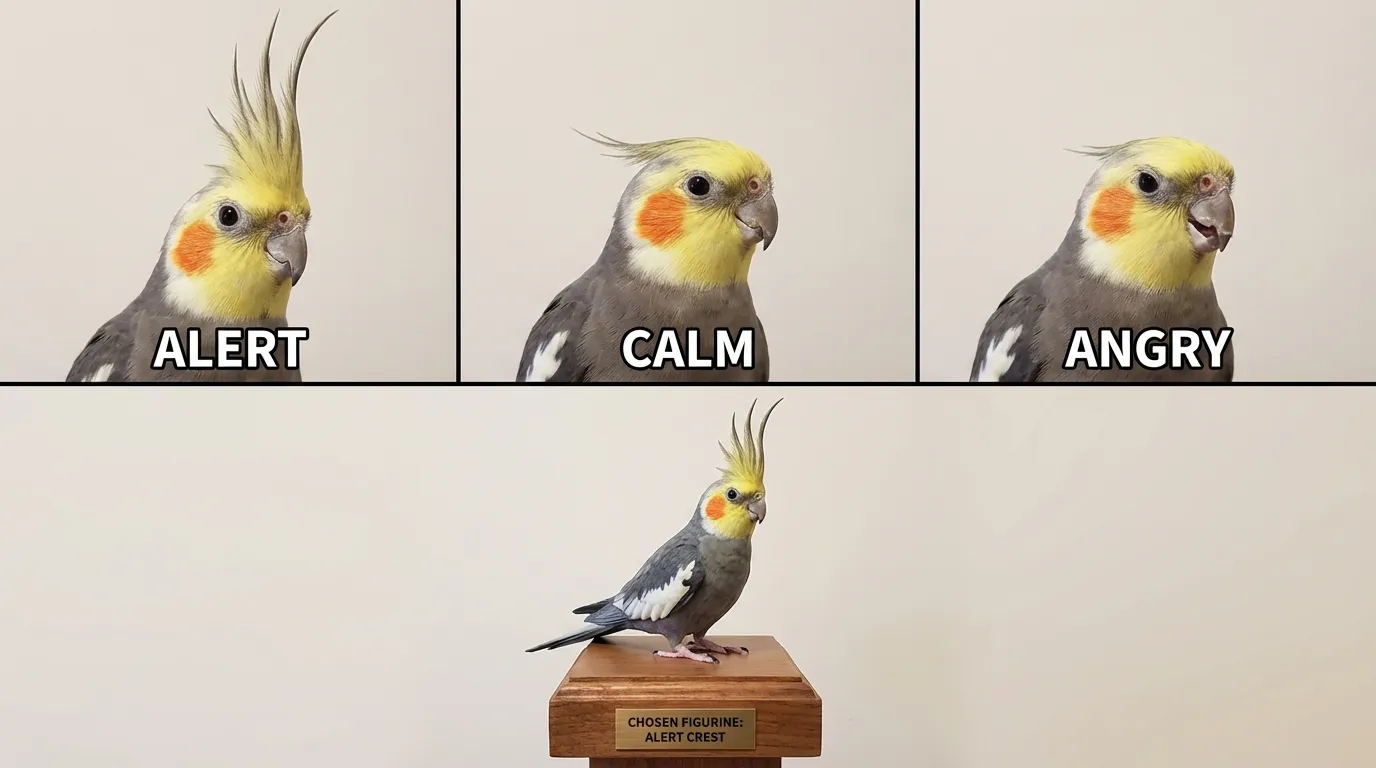
Does that familiar tap-tap-tap on the bedroom mirror always come accompanied by a bright yellow crest fanned out in pure curiosity? We know that specific look well—the one that says, "I see another bird, and I have questions."
Quick Takeaways
- The "Recurve" is vital — A happy crest curves forward; an alarmed crest stands straight up.
- Cheek fluff matters — When the crest goes down in anger, the cheek feathers flatten too.
- Lighting hides texture — Flash photography washes out the individual feather details needed for modeling.
- A custom bird figurine captures the mood — We model the specific emotional state, not just the species.
The Cockatiel's Emotional Barometer
We often joke in the bird community that dogs have tails to show emotion, but cockatiels have hats. If you have shared your home with a 'tiel for any length of time, you know that their crest is perhaps the most expressive piece of anatomy in the avian world. It is a biological mood ring, shifting from "I love you" to "I am a dragon" in less than a second.
When we look back at photos of our birds, we don't just see a grey or lutino parrot; we see a mood. We see the time they were confused by a new toy, or the time they were blissfully grinding their beak before a nap.
However, when it comes time to immortalize that bird in art—specifically in a 3D medium—many owners make the mistake of looking for a "neutral" pose. But does a neutral cockatiel even exist? We don't think so. To truly capture the spirit of the bird you love, you have to choose the crest position that represents their soul.
Here is how we decode cockatiel body language to translate a living, breathing personality into a static, digital sculpture.
1. The "Exclamation Point" (Vertical vs. Curved)
We have all seen it. Something drops in the kitchen, or a wild bird flies past the window, and suddenly your bird looks three inches taller. The crest shoots up.
But here is the nuance that many generic bird statues miss, and one we obsess over: the difference between alarm and curiosity.
The Alarmed Straight-Up
When a cockatiel is genuinely startled or afraid, the crest tends to stand rigidly straight, almost vibrating with tension. The feathers are tight. The bird’s body usually elongates, making them look like a slender bowling pin. If you send us a photo of your bird in this state, the resulting figurine will look alert, perhaps even anxious.The Curious "Recurve"
This is the pose we see most often in "happy" photos. The crest is up, but the long primary feathers at the tip curl gently forward, creating a beautiful silhouette. This is the bird that is whistling at you. This is the bird that is investigating a shoelace.The Counterintuitive Insight:
Most people think "crest up" means one thing. It doesn't. The angle of the tip tells the story. When we digitally sculpt this, we pay attention to the "negative space" between the crest tip and the beak. A large gap usually means alarm; a smaller gap, where the crest curves toward the nose, usually implies playful interest.
"A cockatiel without a crest expression is like a sentence without punctuation."
2. The "Pinned" Look (The Dragon vs. The Jet)
There is a specific look that every cockatiel owner respects—and occasionally fears. The flat head.
The Defensive Flat
If the crest is pinned tight against the skull, and the beak is open (perhaps accompanied by a hiss that sounds like a tiny tire leaking air), your bird is angry. We rarely get requests to sculpt this specific "mood," though it certainly captures a feisty personality!The Aerodynamic "Jet Mode"
However, there is another "flat" look that we love. It’s the "Zoomies" look. When a cockatiel is flying or preparing to launch, they streamline. The crest goes down, but the eyes are bright and the wings are slightly lifted at the shoulders (the "heart wings").If you want a custom bird figurine that looks like it is about to take flight or is in the middle of a courtship display, the pinned crest is actually a sign of energy, not anger.
What to tell your artist:
If you want a sculpture with a flattened crest, you must clarify the eyes. In an angry bird, the eyes often appear narrowed or pinned. In an excited "heart wings" bird, the eyes are wide and round. Since we sculpt digitally before printing in full-color resin, getting that eye shape right is critical to ensuring your figurine doesn't look like it's trying to bite you.
3. The "Mutton Chops" (Relaxed and Fluffy)
This is the holy grail of "cute." This is the pose that makes us melt. It’s Sunday afternoon. The house is quiet. Your bird is perched on one foot, grinding their beak.
The crest is usually at "half-mast"—neither fully up nor pinned down. It sits in a relaxed, 45-degree angle.
But the real secret to this look isn't the crest at all. It's the cheeks.
When a cockatiel is truly relaxed, they fluff their facial feathers forward, covering the edges of their beak. We call these the "mutton chops." A relaxed crest must be paired with fluffy cheeks. If you sculpt a relaxed crest on a bird with sleek, tight facial feathers, it looks sickly or tired. If you pair it with fluffy cheeks, it looks content.
The Texture Challenge:
In our full-color 3D printing process, we don't just paint orange circles on a smooth surface. We actually model the volume of those cheek feathers. The orange patch isn't a sticker; it's a cluster of feathers that sits slightly higher than the grey or white surrounding it. Capturing that volume is what makes the difference between a toy and a tribute.
Visualizing the Moods
To help you decide which "version" of your bird to immortalize, we've broken down the anatomy of the crest positions:
| Crest Position | Tip Shape | Cheek Feathers | Emotional Translation | Best Memorial Pose? |
|---|---|---|---|---|
| Vertical | Straight / Rigid | Sleek / Tight | Alarm, Fear, Startle | Rare (can look anxious) |
| Curved Up | Forward Curl | Normal | Curiosity, Playfulness, Singing | Most Popular |
| Half-Mast | Relaxed | Fluffed (Mutton Chops) | Contentment, Sleepiness | Great for "Sweet" birds |
| Pinned Flat | Tight to Skull | Flared / Open Beak | Aggression, Defense | Only for "Feisty" tributes |
| Streamlined | Flat | Sleek | Flight, Courtship (Heart Wings) | Excellent for action poses |
The Science of Feathers in Resin
We need to address a common misconception about how we create these tributes. In the world of collectibles, you will often hear terms like "hand-painted" or "hand-carved wood."
That is not what we do, and for cockatiels, that is a good thing.
Wood carving struggles with the delicate, thin nature of a cockatiel's crest—it often has to be made thick and chunky to avoid breaking. Hand-painting often obscures the fine texture of feathers under layers of acrylic.
At PawSculpt, we use full-color 3D printing technology. Our artists digitally sculpt every individual feather grouping on a computer screen, zooming in to see details the human eye might miss. We then print the figurine in a specialized resin where the color is embedded in the material itself, voxel by voxel.
"True realism isn't just about getting the colors right; it's about capturing the physics of how feathers lay against each other."
This allows us to create the wispy, thin appearance of the crest feathers without them being incredibly fragile, and ensures the gradient of the orange cheek patch fades naturally into the yellow or grey, rather than looking like a painted circle.
"We've seen families heal by holding something tangible. Grief needs an anchor, and for bird owners, that anchor is often the silhouette of that little crest."
— The PawSculpt Team
How to Photograph Your Bird for 3D Art
If you are planning to commission a piece, you might think you need a professional photoshoot. You don't. In fact, professional photos can sometimes be worse because the flash washes out the texture.
We need to see the "grain" of the feathers.
The "Top-Down" Mistake
Most owners take photos of their birds from above (because the bird is on the floor or a table). This distorts the proportions, making the head look huge and the body tiny. For a sculpture, we need eye-level photos.The Lighting Trick
Try to take photos near a window with natural, indirect light. This creates soft shadows between the feathers, allowing our digital sculptors to see where one feather ends and the next begins. If you use a flash, the bird becomes a yellow blob, and we have to guess at the feather patterns.The "Wet Chicken" Photo
Believe it or not, a photo of your bird after a bath (the dreaded "wet chicken" look) is incredibly helpful for us! It shows us the underlying structure of the body and the skull without the fluff. While we won't sculpt them wet, seeing that anatomy helps us build a more accurate frame.Why This Detail Matters
We focus on these tiny details—the recurve of the crest, the fluff of the cheek—because we know that birds are not just "pets." They are highly intelligent, emotionally complex companions who bond deeply with us.
According to avian behaviorists at the Lafeber Company, cockatiels are flock animals that use these subtle visual cues to communicate safety and danger to their family. You are their flock. You learned to read these signs to know when they were happy, hungry, or scared.
When we create a memorial or a celebration piece, we aren't just making a bird. We are making your bird. The one who hated the color red. The one who whistled the Addams Family theme song. The one whose crest curled just a little bit more to the left than the right.
Frequently Asked Questions
Can you fix the feathers if my bird was plucking in the photos?
Yes. This is a very common request. Many rescued birds or older birds struggle with plucking. Since we sculpt digitally, we can "restore" their plumage to full health in the figurine. Alternatively, some owners prefer to keep the "scruffy" look if that represents who the bird was. We follow your lead.Do you use real feathers in the figurines?
No. Using real organic material would cause the figurine to degrade over time. We simulate the texture of feathers using high-resolution digital sculpting and 3D printing. The result is a solid, durable resin piece that looks soft but will last a lifetime.My cockatiel has a unique mutation (Pearl/Pied). Can you match the pattern?
Absolutely. This is where full-color 3D printing shines. Unlike hand-painting, which can struggle with the intricate, repetitive lacing of a Pearl cockatiel, our technology prints the pattern pixel-perfectly based on your photos. We can match the specific asymmetry of a Pied cockatiel's markings exactly.How fragile is the crest on the figurine?
The crest is the most delicate part of the sculpture, just as it is on the real bird. However, we have developed techniques to reinforce these areas. We often slightly thicken the base of the crest feathers—in a way that is invisible to the eye—to ensure they don't snap off during handling. We treat every crest with the care it deserves.Ready to Celebrate Your Pet?
Every pet has a story worth preserving. Whether you're honoring a beloved companion who's crossed the rainbow bridge or celebrating your furry friend's unique personality, a custom PawSculpt figurine captures those details that make your pet one-of-a-kind.
Free instant AI preview • 3D artist preview within 7 days • 5 free revisions