
Cognitive Decline in Senior Cats: When Your Bengal Starts Forgetting the Way to the Food Bowl
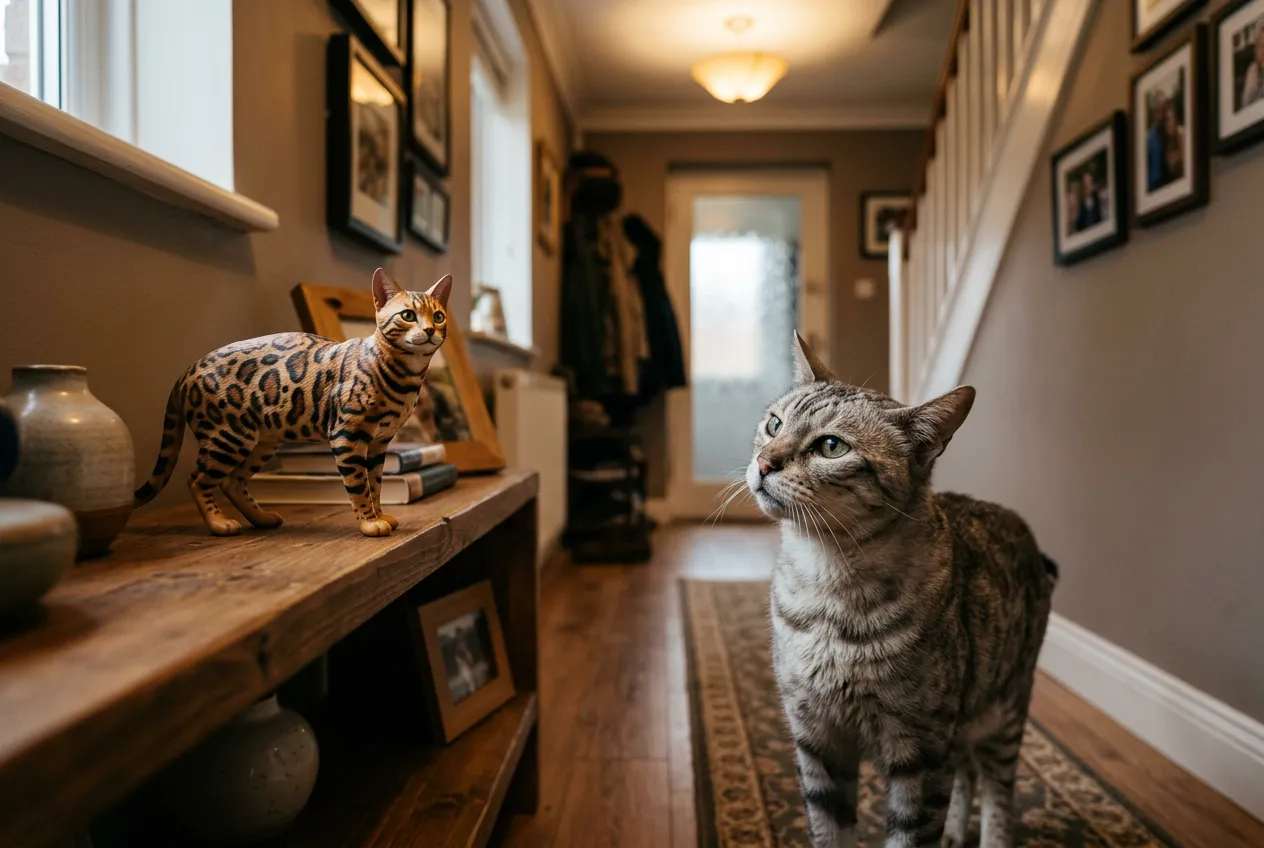
Two years ago, your Bengal would vault onto your home office desk mid-Zoom call, swatting at the cursor, toppling your coffee without apology. Now she stands in the doorway, staring at the far corner like she's forgotten why she walked in. That blank, searching pause is one of the earliest cat cognitive decline signs—and almost everyone misses it.
Quick Takeaways
- Confusion isn't "just aging" — feline cognitive dysfunction is a medical condition with real treatment options
- Bengals' high intelligence can mask early decline — subtle personality shifts matter more than dramatic symptoms
- Spatial disorientation is often the first clue — watch for your cat "getting lost" in familiar rooms
- Environmental changes help more than most people realize — small home adjustments can slow progression significantly
- Preserving your cat's personality now matters later — whether through photos, videos, or a custom 3D-printed figurine, capture who they are today
Feline Cognitive Dysfunction Symptoms: What's Actually Happening in Your Bengal's Brain
Here's what most articles won't tell you: feline cognitive dysfunction syndrome (CDS) isn't just "old cat brain." It's a progressive neurodegenerative condition with actual, measurable changes—beta-amyloid plaque deposits, neuronal loss, oxidative damage. The same category of changes we see in human Alzheimer's patients.
Your Bengal didn't suddenly become aloof. Her brain is physically changing.
And Bengals—with their legendary intelligence, problem-solving ability, and almost dog-like engagement—present a unique challenge. Because when a typically "average" domestic cat starts slowing down, owners often shrug it off. But when a Bengal who used to open cabinet doors and play fetch suddenly can't navigate the hallway? You notice. Hard.
That noticing is actually your advantage.
The ASPCA estimates that over 50% of cats between ages 11 and 15 show at least one sign of cognitive dysfunction, with that number climbing above 80% for cats over 16. But here's what's counterintuitive: the smarter and more engaged the breed, the earlier owners tend to detect changes—which means Bengals often get diagnosed sooner than other breeds, giving you a wider window for intervention.
That window matters enormously. We'll get to why.
The DISHAAL Framework: A Vet's Checklist You Should Know
Veterinary behaviorists use the acronym DISHAAL to categorize feline cognitive dysfunction symptoms. Most cat owners have never heard of it, but once you learn it, you'll start seeing patterns you missed.
| Letter | Category | What It Looks Like in a Bengal |
|---|---|---|
| D | Disorientation | Standing in doorways, staring at walls, "forgetting" room layouts |
| I | Interaction changes | Withdrawing from play, reduced greeting behavior, clinginess |
| S | Sleep-wake cycle disruption | Yowling at 3 AM, sleeping through daytime activity, restlessness |
| H | House-soiling | Missing the litter box they've used for a decade |
| A | Activity level changes | Pacing without purpose OR total lethargy—both count |
| A | Anxiety | New fears, startling easily, hiding in unusual spots |
| L | Learning and memory loss | Forgetting commands, routines, or the location of food and water |
You don't need all seven. Two or three persistent changes are enough to warrant a vet conversation.
"The cats that break our hearts most are the ones whose families say, 'She used to be so sharp.' That sharpness doesn't vanish—it flickers."
— The PawSculpt Team
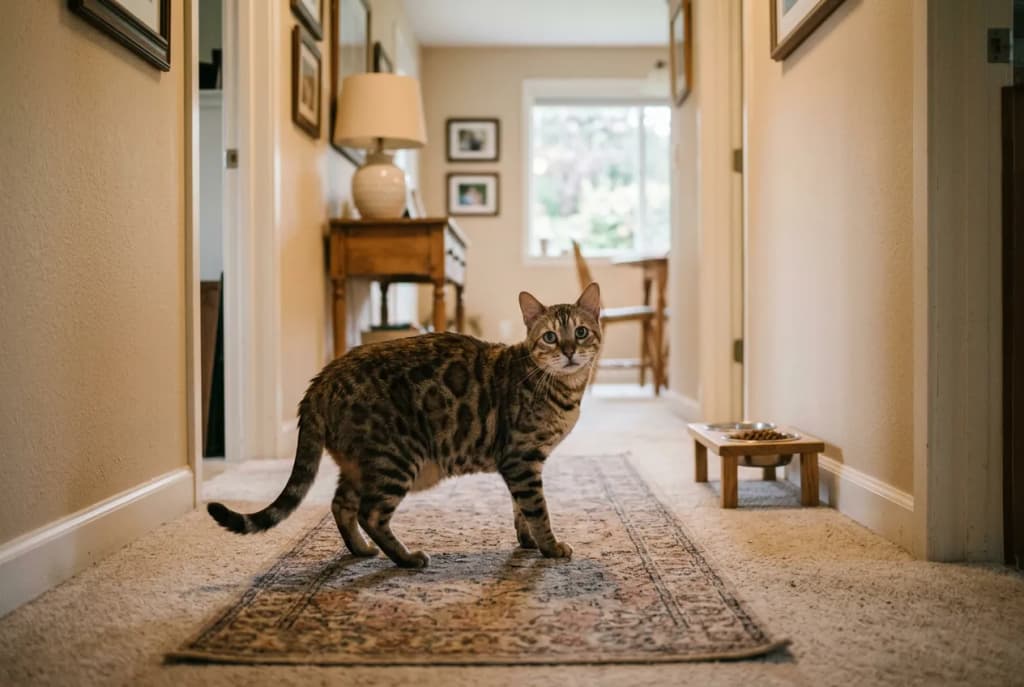
Cat Cognitive Decline Signs That Don't Look Like Decline
This is where most guides fail you. They list the obvious: litter box problems, nighttime yowling, getting lost. And yes, those matter. But the earliest signs of senior Bengal cat dementia? They're sneaky. They look like personality quirks or "just getting old."
We've talked with hundreds of cat owners through our work at PawSculpt, and the stories share a pattern: people describe changes they noticed months before a diagnosis but dismissed because they didn't seem medical.
Here are the ones almost nobody warns you about.
The Greeting That Disappears
Your Bengal used to meet you at the door. Every single time. Tail up, chirping, doing that Bengal thing where they practically narrate your arrival. Then one day, you come home and she's on the couch. She looks at you. Blinks. Doesn't get up.
You think: she's just comfortable. Or tired. Or being a cat.
But the loss of greeting behavior is one of the most commonly reported early signs in cognitively declining cats—and one of the least discussed. It represents a breakdown in the cat's ability to associate the sound of your arrival with the routine of greeting. The motivation might still be there. The connection has frayed.
The Mid-Room Freeze
Watch for this: your cat walks into a room with apparent purpose—heading toward the food bowl, the window perch, their favorite spot—and just... stops. Mid-stride. Stands there for 10, 20, 30 seconds. Then either sits down where she is or turns around and leaves.
This isn't indecision. It's a memory gap. The intention that propelled her forward has dissolved before she could act on it. It's the feline equivalent of walking into the kitchen and forgetting what you came for—except it's happening multiple times a day, and she can't laugh it off.
The Familiar Object That Becomes Foreign
One customer told us their Bengal started hissing at a floor lamp that had been in the living room for six years. Another described their cat backing away from a bookshelf she used to sleep on top of.
When familiar objects trigger fear responses, it's often because the cat's spatial memory and object permanence are deteriorating. The lamp hasn't changed. Your cat's ability to recognize it has.
What Gets Mistaken for Behavioral Problems
Here's the thing that kills us: so many owners go through a phase of frustration before they get to concern. The cat's peeing outside the box and you're angry. She's yowling at night and you're exhausted. She's not playing anymore and you feel rejected.
None of those responses make you a bad person. They make you human. But they also delay the moment you shift from "why is she doing this TO me" to "what is happening TO her."
Most guides say to watch for behavior changes. What actually helps more than watching is documenting. Keep a simple note on your phone. Date, time, what happened. After two weeks, patterns will emerge that you can't see in the day-to-day blur.
"The cruelest thing about cognitive decline is that it steals your cat's quirks first—the very things that made her, her."
What We Wish We Knew Sooner
Candid Retrospective Insights from Our Team
We work with pet families every day—many of them in the process of honoring senior cats or memorializing ones they've lost. These are the things we hear over and over that people wish they'd understood earlier:
- "I wish I'd taken more videos, not just photos." Photos capture how a cat looks. Videos capture how they move—the particular way your Bengal stalks a toy, tilts her head, chirps at birds. When cognitive decline changes those movements, you'll want the "before."
- "I didn't realize how much her routine WAS my routine." When your cat stops doing the things she always did—the 6 AM wake-up tap, the post-dinner lap circuit—your own daily rhythm fractures. Nobody warns you about that disorientation.
- "I spent too long thinking it was my fault." Multiple owners have told us they assumed they'd done something wrong—moved the furniture, changed the food, disrupted something. CDS isn't caused by environmental changes. It's a disease process.
- "The vet visit I dreaded turned out to be a relief." Getting a name for what's happening gives you something to work with. A plan. Medication options. It replaces helpless watching with active caring.
How Senior Bengal Cat Dementia Changes Your Home (Literally)
This is the section you won't find anywhere else, because most guides treat cognitive decline as something happening inside your cat. But it also happens inside your house.
The space your cat occupies shrinks.
Think about it. A healthy Bengal in her prime might use every square inch of your home. The top of the fridge. The bathroom counter. That one impossible shelf in the closet. The windowsill in the room you barely use. Bengals are explorers—they treat your home like territory to be conquered and re-conquered daily.
When cognitive decline sets in, that territory contracts. Slowly, then noticeably.
First, the far rooms go. The guest bedroom she used to nap in. The basement stairs she'd race down. She stops going there—not because she can't, but because she no longer remembers to.
Then the vertical spaces disappear. The cat tree collects dust. The high shelves go unvisited. Her world flattens to ground level.
Eventually, you might notice she's living in two or three rooms. Maybe just one. Her universe has shrunk to the kitchen, the hallway, and whatever room you're in.
This spatial contraction is both a symptom and a diagnostic tool. If you map your cat's movement patterns over a few weeks—literally note which rooms she enters and which she doesn't—you'll have concrete data for your vet. More useful than vague descriptions of "she seems off."
The Empty Corners
Here's what nobody prepares you for: the silence of the rooms she's abandoned.
You walk past the guest bedroom and her dent is still in the comforter. The perch by the upstairs window still has fur on it. The corner behind your home office chair—where she used to curl up while you worked—has been empty for weeks, and you keep glancing at it.
Those empty spaces are a kind of pre-grief. Your cat is still alive, still here, still purring on your lap at night. But parts of her—the adventurous parts, the curious parts, the Bengal-est parts—have already started to leave.
You're allowed to mourn that. Even while she's right next to you.
Practical Interventions That Actually Slow Feline Cognitive Dysfunction
Alright. Enough of the hard stuff—let's talk about what you can do. Because you're not powerless here. Not even close.
Step 1: Get the Vet Visit on the Calendar
We're not veterinarians, and we won't pretend to be. But we'll be direct: if your cat is over 10 and showing any two signs from the DISHAAL list above, schedule a vet appointment this week. Not next month. This week.
Why the urgency? Because CDS is a diagnosis of exclusion. Your vet needs to rule out hyperthyroidism, kidney disease, hypertension, pain, and sensory loss (vision or hearing decline) first. Many of those conditions are treatable, and some mimic cognitive decline almost perfectly.
Your vet may recommend blood panels, a urinalysis, and possibly a blood pressure check. These aren't optional extras—they're the foundation of knowing what you're actually dealing with.
Step 2: Environmental Enrichment (Targeted, Not Generic)
Every article says "enrich your cat's environment." Almost none tell you how to do it for a cognitively declining cat without overwhelming her.
Here's the counterintuitive insight: too much novelty is worse than too little. A healthy Bengal thrives on new puzzles, new toys, new challenges. A Bengal with CDS needs familiar enrichment—the same toys in the same places, the same puzzle feeder she's used for years, the same window perch in the same spot.
New things can cause anxiety. Old things, reliably placed, become anchors.
Specific adjustments that work:
- Add nightlights along her main pathways. Cats with CDS often have disrupted circadian rhythms, and dim lighting in hallways helps with nighttime disorientation.
- Place water bowls in every room she still uses. Not because she can't walk to the kitchen—because she might forget to.
- Lower food and water bowl placement. If she's stopped jumping to a counter where her bowl lives, move it to the floor. Don't make her fail a task she used to ace.
- Add a second litter box on the same floor where she spends most of her time. Closer is better. Covered boxes can increase confusion—switch to open ones if you haven't already.
| Intervention | Effort Level | Impact | Why It Works |
|---|---|---|---|
| Nightlights in hallways | Low | High | Reduces spatial disorientation during peak confusion hours |
| Multiple water stations | Low | Medium | Bypasses memory gaps around hydration |
| Open litter boxes, closer placement | Low | High | Reduces house-soiling by shortening the "decision distance" |
| Consistent furniture layout | None (just stop rearranging) | High | Preserves spatial memory maps |
| Puzzle feeders (familiar ones) | Medium | Medium | Maintains neural pathways without introducing anxiety |
| Scheduled interactive play, 10 min 2x/day | Medium | High | Stimulates cognitive function and reinforces your bond |
Step 3: Nutritional Support
Several veterinary diets are specifically formulated for cognitive support in senior cats, containing antioxidants, omega-3 fatty acids (DHA/EPA), and medium-chain triglycerides (MCTs). According to PetMD's guide on feline cognitive dysfunction, dietary intervention can meaningfully slow progression when started early.
Ask your vet about:
- Prescription cognitive-support diets
- Omega-3 supplements (fish oil, specifically)
- SAMe (S-adenosylmethionine), which has shown promise in some feline studies
- Antioxidant supplementation
Don't self-prescribe. Seriously. Some supplements interact with medications, and dosing for cats is not the same as dosing for humans or dogs.
Step 4: Medication Options
Your vet may discuss selegiline (used more commonly in dogs but sometimes prescribed off-label for cats) or other pharmacological interventions. There's no cure for CDS, but there are medications that can slow progression and manage symptoms—particularly the anxiety and sleep disruption that tend to wear on both cat and owner.
Be honest with your vet about how the nighttime yowling is affecting you. Your wellbeing matters in this equation. A burned-out caregiver isn't good for anyone.
Step 5: The Routine as Medicine
Cats with cognitive decline do best with predictable, consistent daily routines. Same feeding times. Same play times. Same quiet time. The routine itself becomes a cognitive scaffold—a structure that holds your cat's day together when her own internal clock is drifting.
Here's what a good CDS-supportive daily routine looks like:
- Morning: Feeding at the same time, in the same place. 5-10 minutes of gentle interactive play (wand toy, nothing too fast or complex).
- Midday: Check water stations. Brief social interaction—petting, talking to her, just being in the same room.
- Evening: Second feeding. 10 minutes of play, slightly more active if she's willing. This helps tire her before nighttime.
- Night: Dim the lights gradually. Consider a pheromone diffuser (Feliway) near her sleeping area. Nightlight on.
The goal isn't stimulation for stimulation's sake. It's predictability as a form of care.
"You can't stop the fog from rolling in. But you can leave every light on along the path."
The Guilt No One Talks About—And Why It's Universal
Let's sit in this one for a minute, because it's real and it's everywhere.
You're going to feel guilty. Maybe you already do. The guilt has layers:
Layer one: "I should have noticed sooner." You replay the last six months and see all the signs you explained away. The missed greetings. The mid-room freezes. The nights she cried and you put a pillow over your head.
Layer two: "I'm not doing enough." You read articles like this one and think about all the interventions you haven't tried, the vet appointments you've postponed, the enrichment you haven't set up.
Layer three—the hardest one: "Sometimes I miss who she used to be more than I appreciate who she is now." This one hurts to even type. But it's honest. And so many owners feel it.
You are not failing your cat. You are loving a cat whose needs have changed, and you are learning in real time how to meet those needs. That's not failure. That's devotion adapting.
If you're in this place right now, know that the community of owners navigating senior Bengal cat dementia is larger than you think. Online forums, breed-specific groups, even your vet's waiting room—you're surrounded by people having the exact same 3 AM thoughts.
You are not the only one checking whether she's still breathing while she sleeps.
Holding Onto Who They Are (While They're Still Here)
This is the section where we shift from managing the condition to honoring the cat.
Because here's what cognitive decline threatens most: not just your cat's health, but your memory of who she was at her best. As the months go on and the symptoms accumulate, the sharpest version of your Bengal—the one who could open doors, who learned her name, who had seventeen distinct vocalizations—starts to feel far away. Like a photograph slowly overexposing.
Document her now. Not just for nostalgia—for your own mental health later.
What to Capture
- Video of her eating. Weird suggestion? Every cat eats differently. The way your Bengal attacks her food—or delicately picks at it—is uniquely hers.
- Audio of her voice. Bengal owners know: that voice is one of a kind. Record it. You'll want it later.
- Photos in her favorite spots. Not posed. Just her, where she chooses to be. The windowsill. Your lap. That one inexplicable corner of the bathroom.
- The weird stuff. Her obsession with the faucet. The way she carries socks around. The specific head-tilt she does when confused. The things that make her her.
Some families go further. They create memory books, compile video montages, or commission lasting keepsakes. We've worked with many cat owners through PawSculpt who wanted to capture their Bengal's likeness while she was still vibrant enough to photograph well—her specific rosette pattern, her expression, the way she held her tail. Our full-color 3D printing technology reproduces those unique markings directly in resin, so the color is literally part of the material, not something applied on top. It's one way to hold onto the physical presence of a cat whose personality is shifting.
But whatever you choose—photos, videos, a custom pet figurine, a paw print kit, a commissioned portrait—do it sooner rather than later. Not because she's dying. Because she's changing. And the version of her you want to remember most clearly is the one sitting in front of you right now.
The Counterintuitive Gift of Cognitive Decline
We'll be real—it feels wrong to call anything about this a gift. But here's what we've heard from dozens of families on the other side of it:
CDS slows everything down.
Your Bengal, who spent her entire life at 200 miles per hour—climbing, leaping, demanding, performing—is suddenly still. She sits on your lap longer. She sleeps pressed against you. She's quieter, softer, more present in a different way.
It's not the relationship you had. But it's still a relationship. And some owners describe this final chapter as unexpectedly tender. The pace changes. The expectations drop. What's left is just... being together. In whatever room she still chooses to enter.
That's not nothing. That's everything.
Preparing for What Comes Next
We won't sugarcoat this. Cognitive decline in cats is progressive. There's no reversing it. The interventions above can slow it, manage it, and improve quality of life significantly—but they can't stop it.
At some point, you'll have conversations with your vet about quality of life assessments. About whether her confusion has tipped into distress. About whether she's still having more good days than bad.
Those conversations are brutal. And they're also an act of profound love.
A few things that help when you get there:
- Use a quality-of-life scale. The Lap of Love quality-of-life scale is a structured tool that helps you track daily wellbeing across categories like pain, mobility, hydration, and happiness. It removes some of the guesswork from an impossibly emotional decision.
- Talk to your vet honestly. Tell them what a good day looks like. Tell them what a bad day looks like. Let them help you see the trajectory.
- Don't let anyone else set your timeline. Not your neighbor, not the internet, not your well-meaning sister. You know your cat. You'll know when it's time—or close to it.
- Consider at-home euthanasia if it's available in your area. For a cat with spatial confusion and anxiety, dying in a familiar space—her space—can be a final kindness.
After
The home office chair where she used to curl up will still be there. The doorway where she'd freeze mid-step—you'll walk past it and feel the absence like a temperature change. The rooms she abandoned months ago will feel different now, like they were already practicing for this.
Grief after cognitive decline has its own particular shape. It's not the sharp shock of sudden loss. It's a slow exhale you've been holding for months. Relief and sorrow tangled together in a knot nobody taught you how to untie.
Both feelings are allowed. Both are true.
The community of people who've loved a senior cat through this—who've cleaned up the accidents, endured the midnight yowling, held a cat who looked at them like a stranger and then, suddenly, looked at them like home—that community is quiet and enormous. You're part of it now, or you will be.
And the version of your Bengal you carry forward—the one who opened cabinets, who talked back, who knocked your coffee off your desk in your home office while you tried to work—she's not gone. She's the reason you're reading this at all. She's the reason you care enough to learn about cat cognitive decline signs and intervention strategies and nightlights in hallways.
She trained you to pay attention. And you did.
Frequently Asked Questions
What are the first signs of cognitive decline in senior cats?
The earliest signs are often subtle: loss of greeting behavior when you come home, freezing mid-stride in familiar rooms, or startling at objects that have been in your home for years. Sleep-wake cycle disruption—particularly nighttime vocalization—and litter box accidents in a previously reliable cat are also common early indicators. If you notice two or more of these persisting for a couple of weeks, it's time for a vet appointment.
At what age do cats typically develop cognitive dysfunction syndrome?
Most cats begin showing signs after age 10, though it can appear earlier in some individuals. Research suggests over 50% of cats between 11 and 15 have at least one sign of CDS, and that number jumps above 80% for cats 16 and older. Bengals' active, intelligent nature often means owners spot changes earlier than with less interactive breeds.
Can feline cognitive dysfunction be treated or cured?
There's currently no cure, but CDS can absolutely be managed. A combination of veterinary-prescribed medication, cognitive-support diets rich in omega-3s and antioxidants, environmental modifications, and consistent daily routines can meaningfully slow progression and improve your cat's quality of life. The key is early intervention—the sooner you start, the more effective these strategies tend to be.
Are Bengal cats at higher risk for cognitive decline?
There's no evidence that Bengals are genetically more predisposed to CDS than other breeds. However, because Bengals are exceptionally interactive, vocal, and intelligent, cognitive changes become apparent much sooner. This is actually an advantage—earlier detection means a longer window for effective intervention.
How can I help my senior cat who yowls at night?
Nighttime vocalization is one of the most exhausting symptoms for owners. Practical strategies include adding nightlights along your cat's main routes, using pheromone diffusers near sleeping areas, scheduling a play-and-feed session about an hour before your bedtime, and keeping the daytime environment stimulating enough to promote natural nighttime fatigue. Talk to your vet about medication options if the yowling is severe—your sleep matters too.
When is it time to talk to the vet about quality of life?
This is deeply personal, but structured tools can help. If your cat is consistently showing more bad days than good—where "bad" means confusion causing visible distress, inability to find food or water, loss of interest in any interaction, or apparent discomfort—it's time for an honest quality-of-life conversation with your vet. You don't have to make a decision in that conversation. You just have to start it.
Ready to Celebrate Your Bengal?
Every Bengal has a personality too big to forget—the chirps, the chaos, the fierce affection on their own terms. Whether you're honoring the memory of a senior cat who crossed the rainbow bridge or capturing the spirit of your Bengal while she's still knocking things off your desk, a custom PawSculpt figurine preserves the details that make her irreplaceable. From her exact rosette pattern to the tilt of her ears, our full-color 3D printing captures cat cognitive decline signs may change your cat, but nothing changes who she was to you.
Visit pawsculpt.com to explore our process, see examples, and learn about current service details