
Disaster Preparedness for Your Pets: An Emergency Kit Checklist Every Dachshund Owner Needs
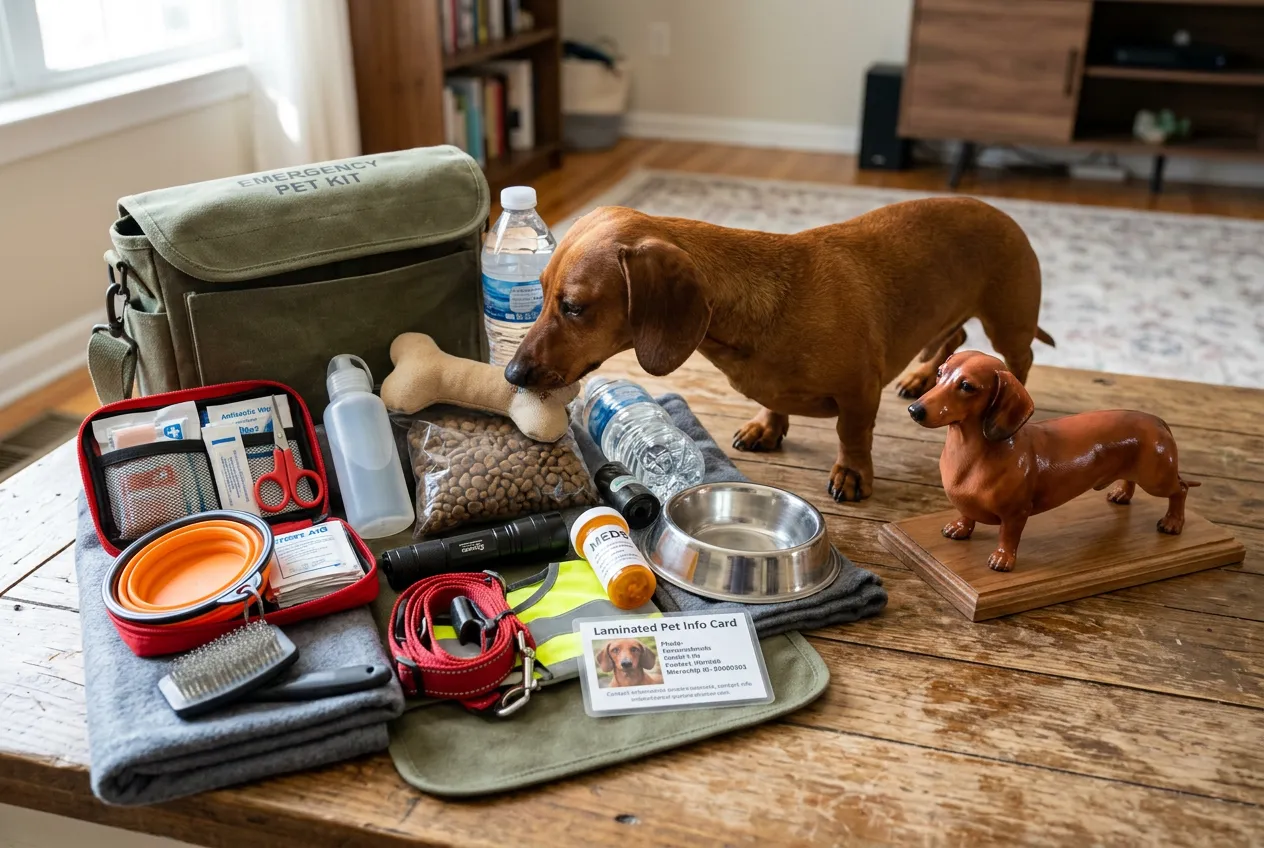
The leash snaps taut as the tornado siren splits the afternoon—your dachshund bolts, and in that split second, you realize the carrier is in the garage, the vet records are somewhere upstairs, and you have no idea where the spare medication went.
Quick Takeaways
- Build your kit now, not during the emergency — disasters don't wait for you to get organized
- Dachshunds need breed-specific supplies — their long backs and small size create unique evacuation challenges
- The 72-hour rule applies to pets too — pack enough food, water, and medication for three full days minimum
- Document everything digitally — photos, vet records, and even custom figurines can help identify and reunite you with your pet
- Practice your evacuation plan quarterly — muscle memory saves lives when adrenaline takes over
Why Dachshund Owners Face Unique Disaster Challenges
Most generic pet emergency guides miss this: dachshunds aren't just small dogs. They're structurally different in ways that matter when you're evacuating through floodwater or carrying them down six flights of stairs during a fire alarm.
Their elongated spines make standard carriers risky during rushed evacuations. Grab a dachshund wrong—supporting only the front or rear—and you risk spinal injury even while trying to save their life. Their low ground clearance means they can't navigate debris fields that a terrier could hop over. And their notorious stubbornness? It doesn't pause for emergencies. A panicked dachshund will burrow under furniture or refuse to enter a carrier precisely when you need cooperation most.
We've worked with families who lost precious minutes during evacuations because their emergency plan assumed their dachshund would behave like the golden retriever next door. They don't. They won't.
The families who reunite fastest after disasters share one thing: they planned for their specific dog, not a generic pet.
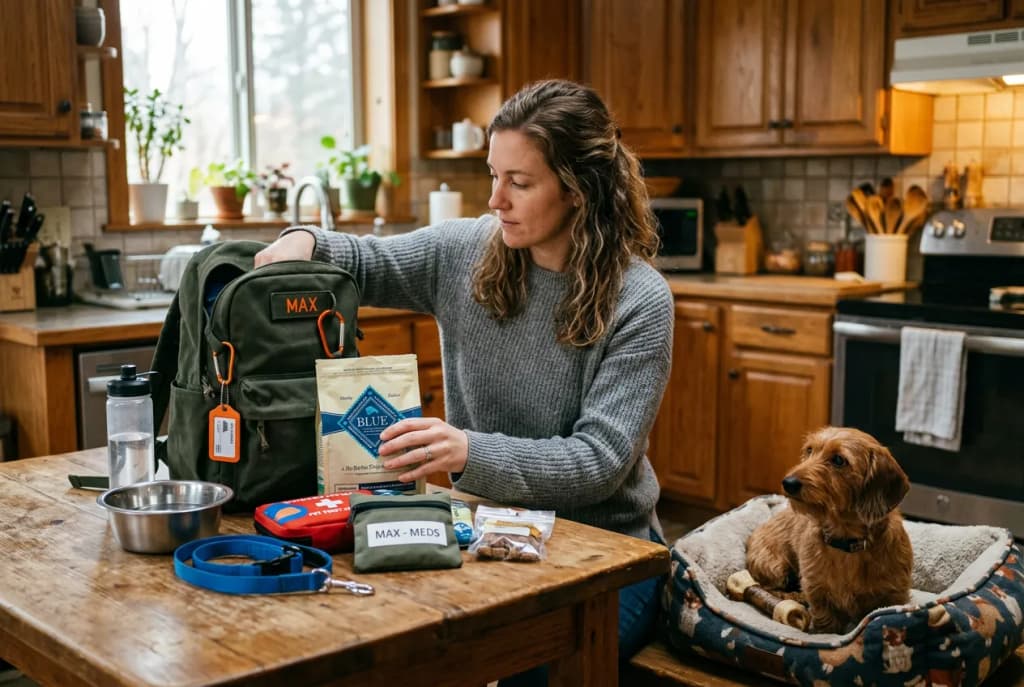
The Core Emergency Kit: What Goes in the Bag
Start with a waterproof duffel or hard-shell container—something you can grab with one hand while holding your dog with the other. Label it clearly. Store it where you can reach it in the dark.
Food and Water (3-day minimum)
Pack your dachshund's regular food in sealed containers, not the original bag. Sudden diet changes during high-stress situations trigger digestive issues you don't need to manage in a shelter. Include:
- 3 days of kibble in airtight containers (measure out daily portions)
- Collapsible water bowl (takes up almost no space)
- 1 gallon of water per day (3 gallons total for a 20-pound dachshund)
- Manual can opener if you feed wet food
- Backup food your dog will actually eat (stress kills appetites—sometimes you need the good stuff)
Medical Essentials
This section separates prepared owners from panicked ones. You need:
- 7-day supply of all medications (more than the 3-day minimum because pharmacies close during disasters)
- Copy of vaccination records in a waterproof sleeve
- Your vet's contact information plus an out-of-state emergency vet
- Basic first aid supplies: gauze, self-adhesive wrap, tweezers, antiseptic wipes
- Any prescription details written clearly (medication names, dosages, frequency)
- Flea/tick prevention (shelters and evacuation sites are breeding grounds)
One family we worked with kept a photo of their dachshund's medication bottles in their kit. When they couldn't remember the exact dosage during an evacuation, that photo let the emergency vet continue treatment without interruption.
Identification and Documentation
Here's what actually works when you're trying to prove ownership at a shelter or reunite after separation:
- Collar with ID tags (check that the phone number is current—right now, before you keep reading)
- Microchip information and registration confirmation
- Recent photos from multiple angles (front, side, any distinctive markings)
- Proof of ownership (adoption papers, purchase receipt, vet records with your name)
- Contact information for your regular vet
The American Kennel Club recommends updating your pet's microchip registration annually, but most owners register once and forget. Set a calendar reminder. That database entry is worthless if your phone number is from three apartments ago.
"We've seen families reunite weeks after disasters because they had clear photos showing their dog's unique markings. Generic descriptions don't cut it when a shelter has fifteen brown dachshunds."
— The PawSculpt Team
Breed-Specific Supplies for Dachshunds
This is where generic checklists fail dachshund owners completely.
The Right Carrier
Standard top-loading carriers force you to lift your dachshund vertically—exactly what you shouldn't do with their spine. Get a front-loading carrier where they can walk in horizontally. Look for:
- Horizontal entry (front or side door)
- Enough length for them to turn around (measure your dog from nose to tail base, add 4 inches)
- Ventilation on at least three sides
- Shoulder strap AND top handle (you need options when navigating obstacles)
- Removable, washable pad (accidents happen during stress)
Practice carrier training now. A dachshund who views their carrier as a safe den will enter willingly during chaos. One who's only seen it before vet visits will fight you.
Back Support Equipment
Pack a support harness or belly band designed for dachshunds. If you need to carry them for extended periods, proper support prevents injury. The harness should:
- Distribute weight across the chest and hindquarters
- Have a handle on top for lifting
- Fit snugly without restricting breathing
- Be easy to put on in under 30 seconds (time yourself)
Temperature Regulation
Dachshunds have minimal ground clearance and short coats (even the long-haired varieties). They lose body heat fast and overheat quickly. Include:
- Cooling vest or damp towel for heat (evacuations often mean sitting in hot cars or crowded shelters)
- Insulated jacket for cold (their belly drags through cold water and snow)
- Emergency blanket (the metallic kind—weighs nothing, retains heat)
The Documentation System That Actually Works
Most people stuff papers in a folder and call it done. Then the folder gets wet, or they can't find the rabies certificate, or the phone number they wrote down is illegible.
Digital Backup Strategy
Create a folder on your phone called "Emergency - [Dog's Name]". Inside, store photos of:
- Your dog from multiple angles (update these every 6 months as they age)
- All vaccination records
- Medication bottles with labels visible
- Your dog's microchip paperwork
- Your contact information and emergency contacts
- Your vet's business card or contact page
Email this folder to yourself and one trusted out-of-state contact. Cloud storage fails when cell towers are down, but email often gets through eventually.
Physical Backup
Keep a waterproof document holder in your emergency kit with printed copies of everything digital. Include:
- A written description of your dog's personality and quirks ("Responds to 'Sausage,' afraid of men in hats, will only take pills in cheese")
- List of behavioral triggers and calming techniques
- Emergency contact list with relationships noted ("Sarah - sister - has house key")
This seems excessive until you're separated from your dog and a shelter volunteer needs to know that your dachshund will bite if someone reaches for their back feet without warning.
The Photo That Matters Most
Take a photo of you WITH your dog. Not just your dog. Proving ownership is easier when you have images of you together. Update this quarterly—your appearance changes, and so does your dog's.
Some families keep a custom figurine of their pet as a three-dimensional reference point. While it won't replace photos for identification purposes, having a detailed physical representation can help describe unique features to search teams. You can explore options at pawsculpt.com if you want a lasting reference piece.
Building Your Evacuation Plan (Not Just Your Kit)
The kit is worthless if you don't know how to use it under pressure.
The 5-Minute Drill
Set a timer for 5 minutes. Practice grabbing your kit, securing your dachshund in their carrier, and getting to your car. Do this quarterly. You'll discover problems: the carrier is blocked by storage bins, the leash is tangled, you can't find your keys while holding the dog.
Fix these problems now.
Shelter Research
Most emergency shelters don't accept pets. Find out now—not during the evacuation—where you can go with your dog:
- Pet-friendly hotels within 50, 100, and 200 miles (save addresses and phone numbers)
- Friends or family outside your immediate area who can take you both
- Veterinary clinics that board during emergencies
- Pet-friendly emergency shelters (some Red Cross locations have separate pet areas)
Call these places. Confirm their pet policies. Ask about size limits, vaccination requirements, and whether they have space for crates.
The Rally Point
If you're separated from your dog during a disaster, where will you look first? Establish this with everyone in your household:
- Primary: Your home (if safe to return)
- Secondary: A specific neighbor's house or local landmark
- Tertiary: The nearest animal shelter or emergency vet
Write these locations in your emergency kit and make sure everyone in your family knows them.
What to Pack for Different Disaster Types
Not all emergencies need the same supplies.
| Disaster Type | Critical Additions | Why It Matters |
|---|---|---|
| Wildfire/Smoke | Pet oxygen mask, eye wash, damp towels | Dachshunds are low to the ground where smoke concentrates |
| Flood | Life jacket, waterproof carrier cover, extra towels | Their short legs make swimming difficult; hypothermia risk is high |
| Hurricane | 7-day supplies (not 3), battery radio, extra medications | You may be cut off from help for a week or more |
| Earthquake | Protective booties, extra leash, flashlight | Broken glass and debris are everywhere; aftershocks continue for days |
| Winter Storm | Insulated jacket, paw balm, extra blankets | Dachshunds lose heat rapidly; salt and ice damage paws |
Customize your kit based on your region's most likely disasters. Coastal owners need different supplies than mountain residents.
The Comfort Items Everyone Forgets
Your dachshund doesn't understand why their routine exploded. They just know everything is wrong and scary.
Pack these psychological essentials:
- Their favorite toy (the one they sleep with, not the newest one)
- A worn t-shirt that smells like you
- Their regular food bowl if possible (familiar objects reduce stress)
- Any comfort item they use during thunderstorms or fireworks
These seem trivial compared to food and medication. They're not. A dachshund who feels some sense of normalcy is easier to manage, less likely to bolt, and recovers faster from trauma.
One customer told us their dachshund refused to eat for two days in an evacuation shelter until they retrieved his specific food bowl from their damaged home. The bowl itself mattered more than the food in it.
Training Your Dachshund for Emergencies
The best emergency kit in the world fails if your dog won't cooperate.
Carrier Conditioning
Starting today, make the carrier a positive space:
- Leave it open in your living area with the door removed
- Toss treats inside randomly throughout the day
- Feed meals inside the carrier
- Never use it only for vet visits
Goal: Your dachshund should voluntarily nap in their carrier within 2-3 weeks.
Recall Training Under Stress
Practice calling your dog during distractions: when the doorbell rings, during dinner prep, when another dog walks by. Use an emergency recall word that you ONLY use for genuine emergencies—not for everyday commands.
Make it worth their while. The emergency recall should trigger the best treat they ever get. We're talking real chicken, not kibble.
Desensitization to Chaos
Dachshunds startle easily. Gradually expose them to:
- Loud noises (play siren sounds at low volume, gradually increase)
- Sudden movements and rushing around
- Being picked up quickly but safely
- Riding in the car in their carrier
The goal isn't to eliminate their fear response—it's to prevent complete panic.
Maintaining Your Emergency Kit
A kit you assembled two years ago is probably useless now.
Quarterly Checks (Every 3 Months)
- Rotate food and water (use the old supplies, replace with fresh)
- Check medication expiration dates
- Update photos if your dog's appearance has changed
- Verify that contact information is current
- Test that batteries still work
- Confirm your dog still fits comfortably in their carrier
Annual Updates
- Replace all medications even if not expired (potency degrades)
- Update vaccination records
- Reassess your dog's needs (senior dogs need different supplies than young adults)
- Review your evacuation plan and shelter options
- Practice your 5-minute drill with the whole family
Set phone reminders. This isn't optional maintenance—it's the difference between a functional kit and a box of expired supplies.
The Myth vs. Reality of Pet Emergency Prep
Myth: "I'll just grab my dog and figure it out."
Reality: Disasters create cognitive overload. You won't think clearly. You'll forget critical items. People leave behind medications, documents, and even pets because they're operating on pure adrenaline without a plan.
Myth: "My dog will stay calm because I'm calm."
Reality: Dogs sense disasters before humans do. They feel the barometric pressure changes before hurricanes, detect seismic activity before earthquakes, and smell smoke before you see flames. Your dachshund may panic before you even realize there's danger.
Myth: "Emergency shelters will take care of my pet."
Reality: Most emergency shelters operated by the Red Cross and similar organizations cannot accept pets due to health codes. Some disasters trigger pet-friendly shelters, but they fill up fast and often have restrictions.
Special Considerations for Multi-Pet Households
If you have multiple dachshunds or other pets, your planning complexity multiplies.
Individual Kits
Each pet needs their own supplies. Don't assume you can share food or medications. Pack separate kits labeled with each pet's name.
Carrier Strategy
You can't carry three carriers at once. Options:
- Large carrier that fits multiple small dogs (only if they get along under stress)
- Pet stroller designed for evacuations (yes, these exist)
- Assign carriers to different family members with clear responsibilities
Triage Planning
This is uncomfortable but necessary: if you can only save one pet immediately, which one? This isn't about favoritism—it's about medical needs, age, and ability to survive independently for a short period.
Write this down privately. Don't share it with kids. But know your answer before you're forced to make it in 30 seconds.
What to Do If You're Separated
Despite perfect planning, separations happen.
Immediate Actions (First 24 Hours)
- Contact every animal shelter within 50 miles
- File a lost pet report with animal control
- Post on local lost pet Facebook groups with clear photos
- Check with neighbors and local veterinary clinics
- Return to your home if safe (pets often return to familiar territory)
Ongoing Search (Days 2-14)
- Visit shelters in person (don't just call—staff turnover is high and descriptions get garbled)
- Post flyers with clear photos at vet clinics, pet stores, and community centers
- Update your lost pet reports daily
- Expand your search radius (pets can travel surprising distances)
Long-Term Recovery (Weeks 2+)
- Keep your microchip information updated even after you move
- Monitor shelter intake pages online
- Don't give up—reunifications happen months later
According to the ASPCA, microchipped dogs are more than twice as likely to be reunited with their owners. But only if the registration is current.
The Financial Reality of Emergency Preparedness
Let's talk about what this actually costs.
| Category | Budget Option | Mid-Range | Premium |
|---|---|---|---|
| Carrier | $30-50 (basic plastic) | $60-90 (soft-sided with support) | $120-180 (crash-tested, ergonomic) |
| 3-Day Supplies | $40-60 (food, water, basics) | $80-120 (includes comfort items) | $150-200 (premium food, extra meds) |
| Documentation | $10-20 (waterproof pouch, prints) | $30-50 (includes digital backup drive) | $80-100 (professional photo session, laminated docs) |
| Training Supplies | $20-30 (treats, basic toys) | $50-70 (quality training aids) | $100-150 (professional training sessions) |
| Total Initial Cost | $100-160 | $220-330 | $450-630 |
Annual maintenance costs run $50-100 for most households (replacing expired items, updating supplies).
This feels expensive until you price what it costs to replace everything after a disaster: emergency vet visits ($200-500), boarding fees ($40-80 per day), replacing lost supplies, and the emotional cost of separation.
Creating Your Personalized Checklist
Generic lists don't work because every dog and situation is different. Build yours by answering these questions:
About Your Dog:
- What medications does your dachshund take daily?
- What food will they actually eat under stress?
- What calms them during thunderstorms or fireworks?
- Do they have any injuries or conditions that need special equipment?
- What commands do they reliably obey?
About Your Situation:
- What disasters are most likely in your region?
- How many people are in your household who can help?
- Do you have a car, or will you evacuate on foot?
- Where is the nearest pet-friendly shelter?
- Who can take your dog if you're incapacitated?
About Your Resources:
- What's your realistic budget for emergency supplies?
- How much storage space do you have for a kit?
- Can you practice evacuation drills, or do you need a simpler plan?
Use these answers to customize the master checklist. Your kit should reflect your specific dog and circumstances, not a generic template.
The Psychology of Disaster Preparedness
Here's why most people don't prepare: it requires imagining the worst happening to someone you love.
That's uncomfortable. So we avoid it.
But here's the reframe: preparing isn't pessimistic. It's an act of love. You're not expecting disaster—you're refusing to let disaster catch you unprepared.
Every item you pack says, "I will protect you." Every drill you practice says, "I won't panic when you need me most." Every document you organize says, "I will find you if we're separated."
The families who reunite fastest after disasters aren't lucky. They're prepared.
"The best time to build an emergency kit was last year. The second-best time is today."
Beyond the Kit: Building Community Resilience
Your emergency plan shouldn't exist in isolation.
Neighbor Network
Identify three neighbors who also have pets. Exchange:
- Emergency contact information
- Spare house keys
- Permission to rescue each other's pets if someone isn't home
- Information about each other's pets (names, medical needs, hiding spots)
Evacuation Buddy System
Partner with another pet owner. If one of you needs to evacuate, the other helps. If both of you need to evacuate, you travel together and share resources.
Community Resources
Know what exists in your area:
- Pet-friendly emergency shelters
- Veterinary disaster response teams
- Local animal rescue organizations
- Community emergency response teams (CERT) with pet components
These networks save lives. A neighbor who knows your dachshund hides under the bed during emergencies can rescue them when you're stuck at work during an evacuation order.
When to Evacuate vs. Shelter in Place
Not every emergency requires evacuation. Sometimes staying home is safer.
Evacuate When:
- Authorities issue mandatory evacuation orders
- Your home is in immediate danger (fire, flood, structural damage)
- You've lost power and your pet needs temperature control or medical equipment
- You can't access food, water, or medical care for your pet
Shelter in Place When:
- Authorities recommend it
- Evacuating is more dangerous than staying (active shooter, chemical spill, severe weather)
- You have adequate supplies and your home is structurally sound
- Your pet has medical needs that can't be met in a shelter environment
If you shelter in place, bring your emergency kit inside to a safe room. You may still need those supplies if utilities fail or you're stuck for days.
The Emotional Aftermath
Disasters don't end when you reach safety. The psychological impact on both you and your dachshund can last weeks or months.
Signs of Trauma in Dogs:
- Changes in appetite or sleep patterns
- Increased clinginess or hiding behavior
- Regression in house training
- Aggression or fearfulness toward previously accepted people or situations
- Excessive barking or whining
Supporting Recovery:
- Reestablish routine as quickly as possible
- Provide extra patience for behavioral setbacks
- Consider calming supplements or medications (consult your vet)
- Give them time to decompress in a quiet, safe space
- Don't punish stress-related behaviors
Some dogs bounce back in days. Others need months. Both are normal.
If behavioral changes persist beyond 4-6 weeks or worsen over time, consult a veterinary behaviorist. Trauma is treatable, but it requires professional help.
The One Thing You Must Do Today
You've read 5,000+ words about emergency preparedness. Here's what matters most:
Do one thing today. Not everything. Just one.
Maybe that's ordering a proper carrier. Maybe it's taking updated photos of your dog. Maybe it's just finding a waterproof container for your kit.
One action breaks the inertia. One action means you're more prepared tomorrow than you are today.
The families who survive disasters intact don't do everything perfectly. They just do something before they need it.
Your dachshund depends on you for everything: food, shelter, safety, love. Emergency preparedness is just another way of showing up for them.
Start small. Start today.
Frequently Asked Questions
What's the most important item in a pet emergency kit?
Medications and medical records top the list. You can improvise food and water in a pinch—people will share, stores might reopen, you can find alternatives. But you can't replace prescription medications without a vet, and during disasters, veterinary clinics may be closed or unreachable for days. Similarly, proving vaccination status is required at most shelters and boarding facilities. Without that documentation, you may be turned away even if you have space available.
How often should I update my pet's emergency kit?
Check your kit every three months for expired food, water, and medications. Do a complete overhaul annually: replace all medications even if they're not expired (potency degrades over time), update photos as your dog ages, verify contact information is current, and confirm your dog still fits comfortably in their carrier. Set recurring phone reminders—this isn't something you'll remember to do without prompts.
Do I need a separate emergency kit for each pet?
Yes, absolutely. Each pet needs their own food (dietary needs differ), medications (never shareable), and supplies. During high-stress evacuations, you won't have time to portion out shared supplies or figure out which medication belongs to which pet. Label each kit clearly with the pet's name and keep them together in one location so you can grab everything at once.
What if my dachshund won't go into their carrier during an emergency?
This is why carrier training matters before disaster strikes. Starting today, make the carrier a positive space: leave it open with the door removed, toss treats inside randomly, feed meals in the carrier, and let your dog nap there voluntarily. Never use it exclusively for vet visits, which creates negative associations. A dachshund who views their carrier as a safe den will enter willingly during chaos. One who only sees it before scary experiences will fight you when you need cooperation most.
How much water should I pack for my dachshund?
The general rule is one gallon per day for a 20-pound dog, so three gallons minimum for a 72-hour kit. Adjust based on your dog's actual weight and your climate—dogs in hot regions need more water, as do dogs with certain medical conditions. Don't forget a collapsible bowl. Water is heavy, so some people pack water purification tablets as a backup, though you'll need to research which are safe for dogs.
Can I bring my pet to a Red Cross emergency shelter?
Most Red Cross shelters cannot accept pets due to health department regulations, though some disasters trigger special pet-friendly accommodations. Don't count on it. Research pet-friendly hotels within 50, 100, and 200 miles of your home right now. Save their phone numbers and pet policies. Identify friends or family outside your immediate area who could take you both. Some communities have separate pet shelters that operate alongside human shelters—find out if yours does before you need it.
Ready to Preserve Your Pet's Memory?
Disasters remind us how precious our time with our pets really is. Whether you're building an emergency kit to protect your dachshund or simply want to celebrate the unique personality that makes them irreplaceable, some families find comfort in creating lasting tributes. A custom figurine captures those distinctive features—the exact tilt of their head, the specific pattern of their markings—that make your pet unmistakably yours. These detailed keepsakes can even serve as identification references in your disaster preparedness documentation.
Visit pawsculpt.com to see how we create museum-quality figurines through advanced 3D printing technology