
The Complete Guide to Siamese Figurine Likeness: What Real Reviews Say About Etsy Sellers
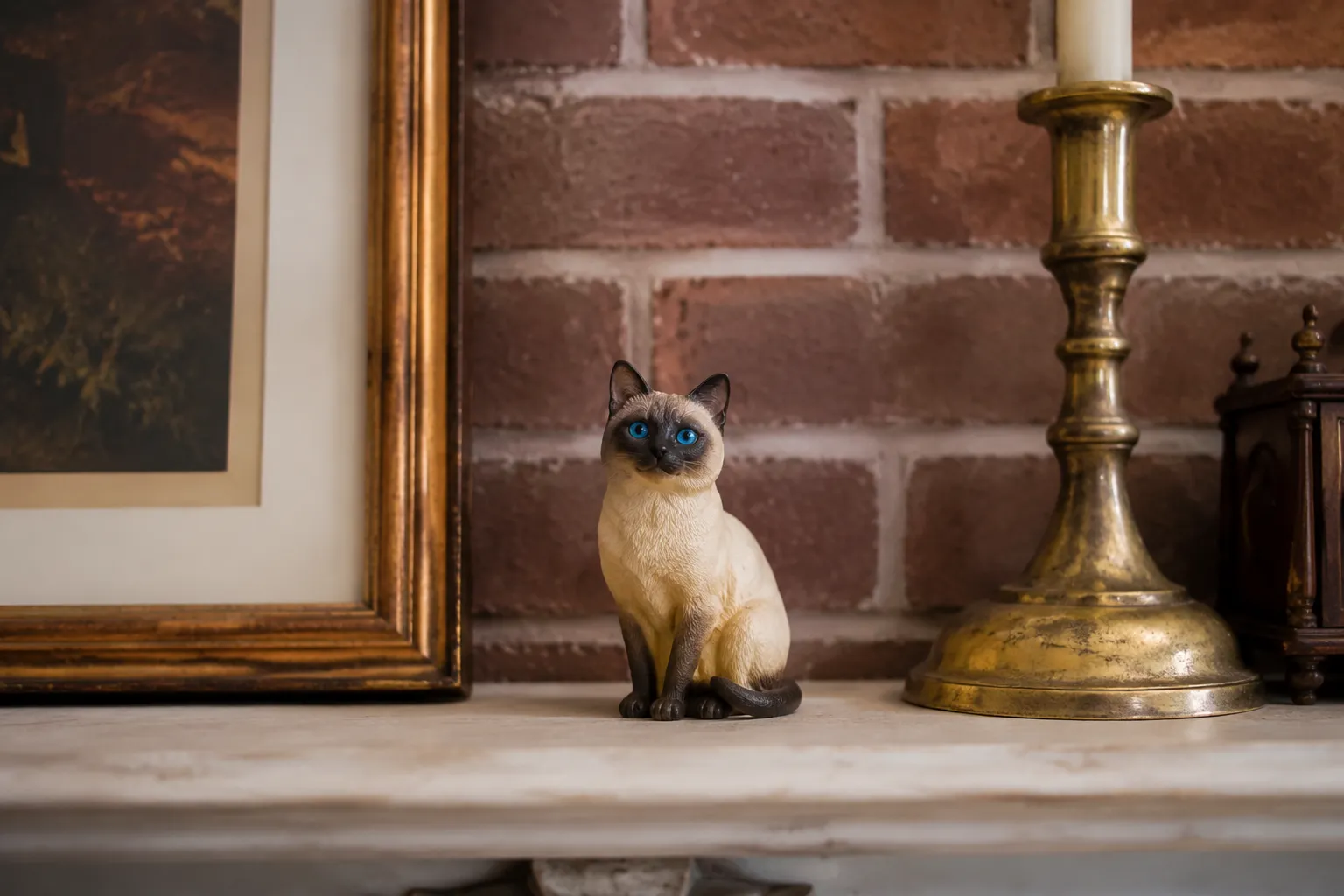
A cardboard box on the front porch, flaps still taped. Bubble wrap, half-peeled. A small ceramic cat inside with the wrong blue in its eyes. The siamese cat figurine looked like a Siamese, just not hers.
When judging a siamese cat figurine, likeness lives in the point coloration and eye tone, not the overall shape. The best custom pet figurine reviews to trust include buyer photos of a real Siamese next to the finished piece, since Siamese markings are a gradient that cheap production tends to flatten into a single flat brown.
Quick Takeaways
- Judge the points, not the pose — a Siamese figurine fails or wins on its color transitions.
- Photoless five-star reviews are noise — real proof always includes a buyer-uploaded image.
- A "too perfect" figurine is a red flag — Siamese coloring is uneven by nature.
- Match the eye tone before you buy — blue depth is the detail most sellers get wrong.
- Compare studios before committing — see how a sculpted full-color pet portrait handles gradient markings.
Why a Siamese Is the Hardest Cat to Turn Into a Figurine
Most cat figurines are forgiving. A black cat is black. A tabby has stripes you can fake. But a Siamese runs on a system called point coloration, and that system is where cheap figurines fall apart.
Here's the mechanism. Siamese cats carry a temperature-sensitive enzyme that only produces dark pigment in the cooler parts of the body: ears, face mask, paws, tail. According to PetMD's Siamese breed profile, the warm core of the body stays pale cream while the extremities darken. So the color isn't a pattern you paint on. It's a gradient that fades from cream to seal or chocolate or lilac.
That gradient is the whole game.
A figurine that shows a hard line between dark ears and cream face has already lost the likeness. Real Siamese coloring blurs. The mask bleeds softly into the cheeks. The legs darken toward the paws like a bruise fading in reverse.
And then there are the eyes. That specific vivid blue is not "blue." It's a cool, almost backlit blue that changes with the light. Get it too pale and the cat looks blind. Too dark and it looks like a different breed entirely.
"A Siamese isn't one color. It's a fade. The moment you see a hard edge where the mask meets the cheek, the likeness is already gone."
This is the part buyers underestimate. You're not asking a seller to reproduce a shape. You're asking them to reproduce a transition. That's a much taller order, and it separates the studios that understand feline color from the ones stamping out generic cat blanks.
How to Actually Read Custom Pet Figurine Reviews
Let me be direct about something. The star rating is almost useless on its own.
Sellers with hundreds of five-star reviews can still produce a mediocre Siamese, because most of those reviews are for dogs, or for solid-colored cats where likeness is easy. The rating measures customer service and shipping speed as much as it measures figurine likeness quality. Those are not the same thing.
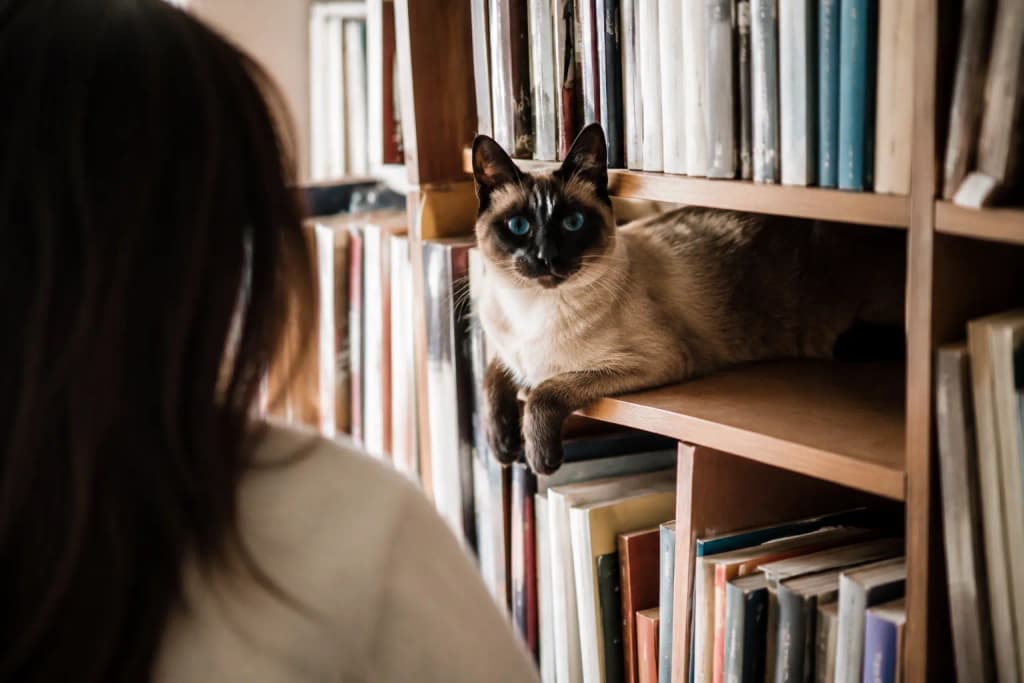
What you actually want is evidence. Buyer-uploaded photos. A real cat on the left, the finished piece on the right.
Here's a framework we use when we look at competitors' review pages, and you can use it too:
| Review Type | What It Actually Tells You | Trust Level |
|---|---|---|
| 5 stars, no photo, "so cute!" | Nothing about likeness. Maybe fast shipping. | Low |
| 5 stars, buyer photo, single color pet | Seller can do easy pets. Says little about Siamese. | Medium |
| 4 stars, buyer photo of a Siamese | Gold. You can judge the points yourself. | High |
| 3 stars with a specific complaint | Often the most honest data on the page. | High |
| Any review mentioning "eye color" | The buyer noticed what matters. Read it twice. | High |
Notice the counterintuitive entry. The three-star reviews are often more valuable than the five-star ones, because a frustrated buyer will tell you exactly what went wrong. "The mask was too dark." "The blue looked gray." That is the specific intelligence you need before spending money on your own Siamese.
The mistake most people make is scrolling for the highest average and stopping there. What actually helps is filtering for photos, then filtering again for cats that look like yours. A seller who nails a chocolate-point tabby-mix tells you very little about how they'll handle your seal-point.
The Myth vs. Reality Callout
Myth: A figurine that looks flawless and uniform in the review photo is the best one.
Reality: For a Siamese, uniform color is a defect. Their coloring is uneven by design. A figurine with perfectly even brown points has erased the exact feature that makes the breed recognizable.
Myth: More positive reviews always mean better likeness.
Reality: Volume measures reliability, not artistry. A newer studio with twenty detailed Siamese photos beats a giant shop with a thousand reviews for keychains.
Myth: Any seller can match blue eyes; it's just a color.
Reality: Blue is the single most-botched detail in cat figurines. It reads as gray, teal, or dead-white depending on the material and finish. It's the first thing to check, not the last.
What "Figurine Likeness Quality" Really Means for a Siamese
Likeness isn't photographic sameness. Nobody's cat holds still like a photograph, and no keepsake should pretend to be one.
What you're really after is recognition. That flicker where you glance at the shelf and, for half a second, it's her. That comes from a handful of specific things, and for a Siamese they are non-negotiable.
- The mask gradient. Soft fade from cream to point color across the face. No hard edges.
- Point saturation on the extremities. Ears, paws, and tail should read darkest, easing lighter toward the body.
- Eye tone with depth. A cool blue that looks lit from inside, not a flat painted dot.
- Posture and expression. The lean of the head, the set of the ears. Personality lives here more than in color.
That last point surprises people. We've worked with thousands of pet families, and the detail that makes someone tear up is rarely the exact shade of the coat. It's the tilt of the head, the specific way their cat sat. Get the posture right and forgive a slightly off point, and most people are moved. Get the color perfect on a generic pose and it feels like a stranger.
"Every whisker matters, but the head-tilt matters more. We've watched people recognize their cat from across a room by posture alone."
— The PawSculpt Team
This is why a sculpted portrait beats a mass-produced blank. The character has to be modeled in, not stamped out. At PawSculpt, pieces are digitally sculpted by 3D artists and then precision printed in full-color resin, so the point gradient is reproduced directly in the material rather than sitting as a flat coat on the surface. The color is the resin. It's the brand line we keep coming back to: a portrait, not a photocopy. The goal isn't to fool you into thinking it's a photo. It's to capture the character you'd recognize anywhere.
The Etsy Seller Landscape: What the Reviews Reveal
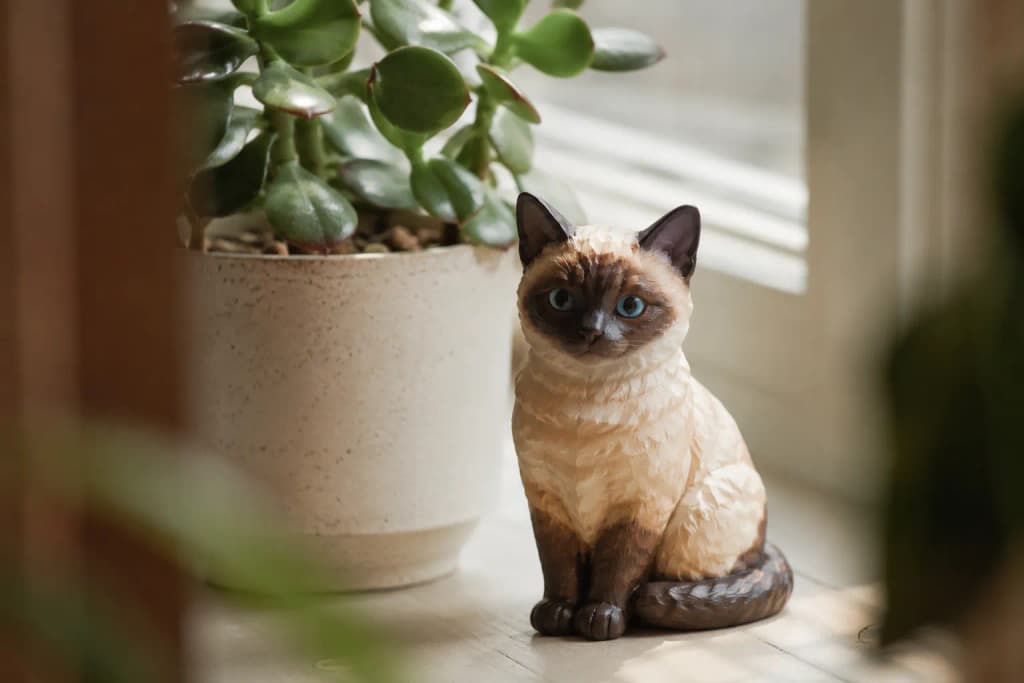
Etsy is a spectrum, not a category. When you read across enough listings, a few distinct approaches emerge, and each shows up differently in the reviews.
Here's how the common seller types compare on the traits that matter for a Siamese specifically:
| Seller Approach | Strength | Weakness for Siamese | What Reviews Show |
|---|---|---|---|
| Mass-produced painted resin | Cheap, fast | Hard color edges, flat blue eyes | Cute-but-generic photos, few close-ups |
| Air-dry clay hobbyists | Charming, characterful | Inconsistent, coloring fades unevenly | Wildly mixed photos, some brilliant |
| Full-color 3D print studios | Gradient reproduction, consistency | Natural print texture (not glass-smooth) | Detailed side-by-side buyer photos |
| Overseas bulk workshops | Very low price | Likeness is a coin flip | Long shipping complaints in reviews |
Read that table with your own cat in mind. If you have a seal-point with a dramatic mask, the mass-produced route will almost certainly flatten it. If you love a rougher, folk-art look, a clay hobbyist might be perfect, and the "imperfection" is the point.
One order that stuck with our team involved a lilac-point named after a jazz musician. The owner had bought two figurines elsewhere first. Both came back as flat gray cats. Lilac-point is the palest, subtlest coloring a Siamese comes in, and it's the ultimate stress test. If a production process can hold that faint fade, it can hold anything.
A quick honest note on process, since reviews rarely explain it. Full-color 3D printing lays down color voxel by voxel, so a gradient is native to the method rather than something a person has to blend by hand. The one manual step afterward is a clear protective coat for sheen and durability. The tradeoff is a fine natural grain in the surface, the texture of a real object rather than glossy plastic. Some buyers mistake that texture for a flaw in reviews. It isn't. It's what an authentic full-color resin print looks like up close.
If you're weighing options across the whole category, our custom cat figurine studio page breaks down how the color-in-resin process handles point breeds, and it's worth comparing against whatever Etsy listing you're considering.
What to Expect When You Order Your Own Siamese Figurine
Reviews get you to a decision. The photos you send determine whether your piece lands in the five-star pile or the three-star one.
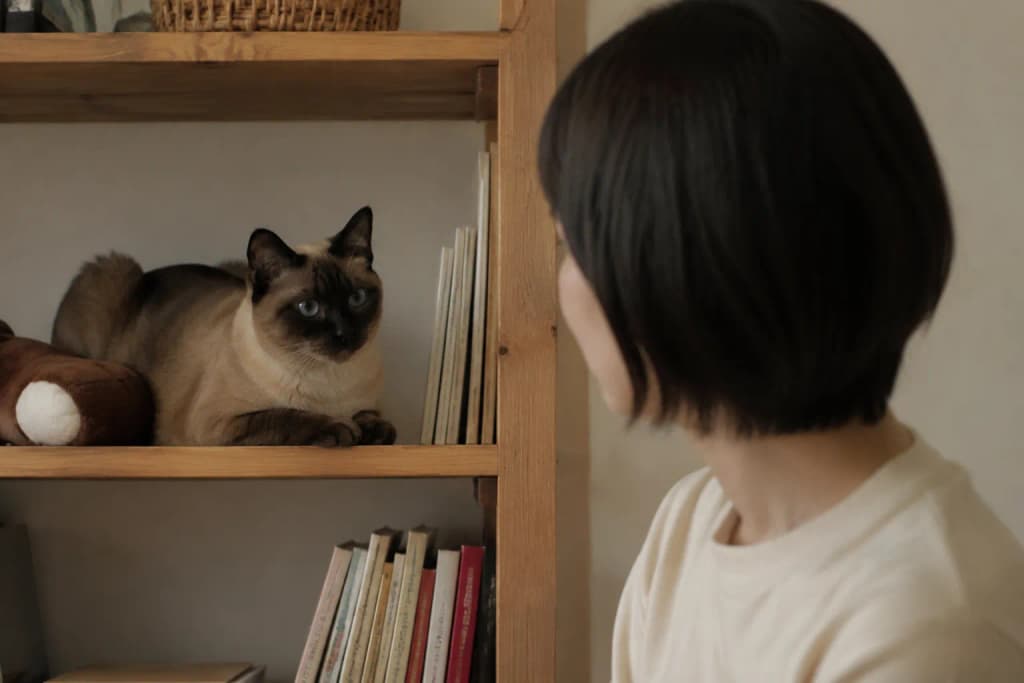
For a Siamese, the photo brief is stricter than for other cats, because the sculptor needs to read the gradient.
- Shoot in soft, even daylight. Near a window, no harsh overhead bulbs. Direct light blows out the pale body and hides the fade.
- Capture the eyes open and forward. The blue needs a clear reference. A squinting cat gives the artist nothing to match.
- Include the paws and tail tip. These are the darkest points and the ones sellers skip.
- Send more than one angle. A three-quarter head shot plus a full-body side view beats ten face-only selfies.
- Add a note about coloring. Tell them "seal-point" or "lilac-point." It's a real, searchable term and it removes guesswork.
That fifth step matters more than it looks. When you name the point color, you're speaking the sculptor's language, and you flag exactly the feature that's easy to get wrong.
"The photo you almost didn't send, the one where she's half-asleep with her ears back, is usually the one that captures who she really was."
On timing and process, honest expectations help. A reputable studio will show you a preview before anything is produced. At PawSculpt, there's a free instant AI preview on the site to sanity-check the concept, and an artist's 3D preview within about seven days of a deposit so you can approve the actual sculpt. Production and delivery typically run 27 to 40 days in the US and 33 to 47 internationally after final payment. Anyone promising a finished custom Siamese in a few days is either stockpiling generic blanks or cutting corners on the color work. Good gradient reproduction takes time.
Care is refreshingly simple. Keep it out of direct, prolonged sun (UV fades any pigment over years), dust it with a soft dry cloth, and skip harsh cleaners on the clear coat. That's genuinely the whole list. For memorial pieces, many families keep them alongside a collar or a favorite photo, and you can see how others arrange those on our pet portrait keepsake page.
We're not vets and we're not appraisers, so if you're buying a high-value collectible for resale, that's a different market with different rules. What we know is likeness and memory.
Frequently Asked Questions
What makes a Siamese cat figurine so hard to get right?
It comes down to point coloration. A Siamese isn't one flat color; it fades from cream on the body to dark on the ears, face, paws, and tail. Reproducing that soft gradient is genuinely difficult, and it's where most inexpensive figurines fail by turning the fade into a hard-edged brown blob.
How should I read reviews to judge likeness quality?
Skip the star average and hunt for buyer photos, especially of Siamese cats. A four-star review with a real side-by-side image tells you far more than fifty photoless five-star raves. And read the critical reviews closely, since a disappointed buyer usually names the exact problem, like eye color or an overly dark mask.
Why do the eyes on so many Siamese figurines look off?
Siamese blue is a specific cool tone that almost looks lit from within. It's the single most-botched detail in cat figurines, coming out gray, teal, or dead-white depending on the material and finish. Always check the eyes in review photos before you check anything else.
Is a custom Siamese figurine actually worth it?
If you want something that captures your specific cat rather than a generic breed blank, yes. The value is in recognition, that flicker where it's her on the shelf. Compare studios first, look at how each handles gradient markings, and choose based on evidence, not just price.
How do 3D printed figurines compare to hand-painted ones for a Siamese?
Full-color 3D printing builds color into the resin itself, so a gradient is native to the process rather than blended on the surface. For point breeds that usually means smoother transitions. The tradeoff is a fine natural surface grain, which is authentic to the material, not a defect.
Ready to Celebrate Your Pet?
Every pet has a story worth preserving. Whether you're honoring a beloved companion who's crossed the rainbow bridge or celebrating your Siamese cat's one-of-a-kind personality, a custom PawSculpt siamese cat figurine — a sculpted portrait, not a photocopy — captures the point coloration, the blue-eyed gaze, and the exact head-tilt that make your cat unmistakably yours.
Start with a free instant AI preview, then approve an artist's 3D preview before anything is produced. Every finished piece ships insured, tracked, and carefully packed.