
Canvas vs. Resin: The Material Science That Makes Your Russian Blue Look Truly Alive
"Where the spirit does not work with the hand, there is no art." — Leonardo da Vinci
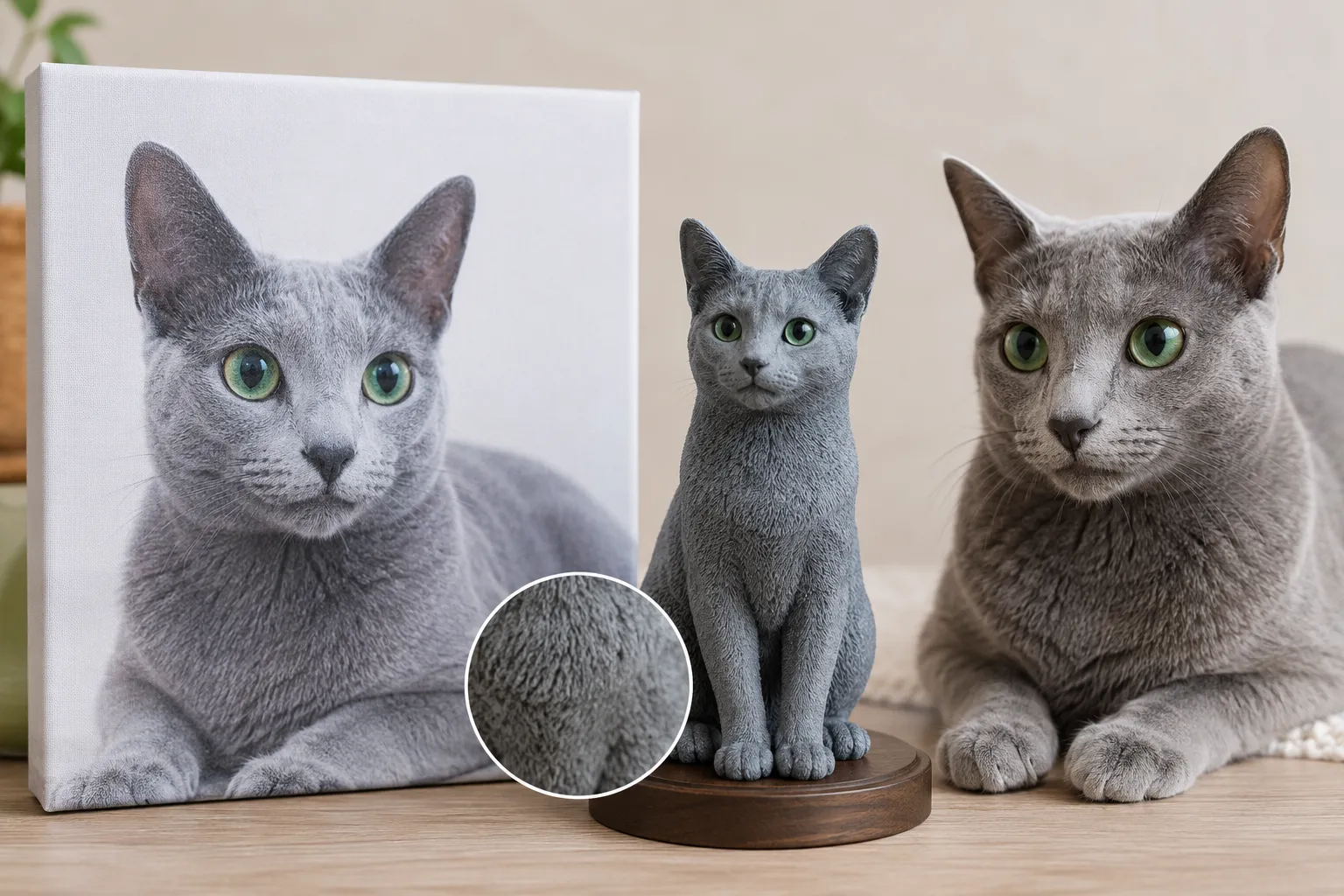
On your dresser sits a small figure of her, and the whole question of russian blue figurine realism comes down to one thing: does the light slide across it the way it slid across her coat every morning?
Quick Takeaways
- A Russian Blue isn't actually blue — the color is scattered light, which is why flat images fail to capture it
- Resin holds color inside the material — not on top, so depth reads as real rather than printed
- Canvas shows one angle; a figurine shows all of them — realism lives in how light moves
- The "alive" feeling comes from micro-texture and highlights — your brain reads them before you consciously notice
- Full-color 3D printed keepsakes like the ones at PawSculpt's custom figurine studio reproduce that shimmer directly in resin
Why a Russian Blue Is the Single Hardest Cat to Capture
Here's something most people never stop to consider. Your Russian Blue was lying to your eyes every single day, and you loved her for it.
That silver-blue shimmer? It isn't a pigment. There's no blue dye in a single strand of her fur. What you saw was structural color — light bouncing and scattering through the coat, the same optical trick that makes the sky look blue when the air itself is colorless.
Cat geneticists call the underlying trait the dilute gene, which softens black pigment into that ghostly gray. Then the dense double coat does the rest, scattering light so the whole cat seems to glow from within.
So when you try to preserve her — in a photo, a painting, a figurine — you're not trying to copy a color. You're trying to copy a behavior of light. That's a completely different problem, and almost nobody talks about it.
We've worked with thousands of pet families, and Russian Blue owners are the ones who send the longest emails. They can't explain why the last portrait felt "off." It looked gray. It looked correct. And it still felt dead.
Now you know why. The gray was accurate. The light was missing.
"A Russian Blue was never one color. Capturing her means capturing how she caught the light, not what shade she was."
The double coat problem nobody warns you about
Run your hand along a Russian Blue and you feel it immediately — that dense, plush, almost velvet resistance. According to the American Kennel Club's breed profile, the breed's short, thick double coat is one of its defining features, standing out from the body rather than lying flat.
That texture matters more than the color. Because texture is what creates the tiny shadows and micro-highlights across the surface. Thousands of them. Your brain doesn't count them, but it checks for them.
Remove that micro-texture and something breaks. The cat looks like a smooth gray object. Present but empty. This is the uncanny valley, and Russian Blues fall into it faster than almost any other breed.
Resin Material Science: Why the Color Has to Live Inside
Let's get into the part that actually changes the outcome. This is the resin material science pet sculpt conversation that determines whether the finished piece feels alive or feels like a paperweight.
Think about how light behaves when it hits real fur. Some bounces off the top layer. Some sinks in a fraction of a millimeter, scatters around, and comes back out slightly changed. That second effect is called subsurface scattering, and it's the reason skin, wax, milk, and living coats all have that soft, lit-from-within quality.
A hard object with color painted only on its outer skin can't do this. Light hits the surface and stops. It reflects flat. Your eye registers "solid," and somewhere underneath conscious thought, it registers "not alive."
Now here's where the material choice becomes everything.
Color that is part of the material, not a coat on top
At PawSculpt, the process is full-color 3D printing — the kind of technology where color is deposited voxel by voxel, meaning the color is built into the resin itself, not layered on afterward.
Read that again, because it's the whole point. The color isn't a skin stretched over a gray shape. It's distributed through the material the way pigment sits inside real tissue.
That's what lets light do the thing it's supposed to do — enter, scatter a little, and come back out soft. The silver-blue reads as depth instead of paint. When you tilt the piece toward a window, the highlight moves across it the way it moved across her back when she stretched in a sunbeam.
The only manual step in the whole process is a clear protective coat — a varnish that adds durability and a natural sheen. No brushes touch the color. No acrylics. The machine prints the markings, the dilution, the subtle warm undertones in her chest ruff, all of it, directly in resin.
"The difference between a keepsake and a decoration is whether light can get inside it."
The natural texture that fools the eye
Here's a detail people expect to be a flaw and end up loving. Full-color 3D printing leaves an incredibly fine grain — subtle micro-layering across the surface.
Most companies would try to sand that away chasing a "perfect" plastic finish. We think that instinct is backwards.
That fine texture is exactly what a Russian Blue's coat needs. It catches light in thousands of tiny points, mimicking the micro-shadows of real fur. A glass-smooth surface would reflect like a bowling ball. The natural print grain, sealed under clear coat, reads like plush.
So the "imperfection" is the realism. This one surprises almost everyone.
Canvas vs. Figurine: What Accuracy Actually Means
Time for the head-to-head, because the phrase canvas vs figurine accuracy gets thrown around like the two things are competing at the same game. They're not.
A canvas — whether it's a painting or a printed photo — captures your cat from exactly one angle, under exactly one lighting condition, frozen forever. It's a memory of a moment.
A figurine captures form. It exists in your world, under your lighting, changing as your room changes. Morning light, lamp light, the gray wash of a rainy afternoon — the piece responds to all of them the way she did.
That's the fundamental divide. Canvas freezes light. A three-dimensional object lives inside light.
Neither is wrong. But if what you miss is the sense that she's present — that you could reach out — a flat image will always keep her behind glass. Literally.
Where each one wins
Let's be honest about the tradeoffs, because we're not here to pretend one option is perfect for everyone.
| Feature | Canvas / Print | Full-Color Resin Figurine |
|---|---|---|
| Captures light behavior | One fixed angle only | Responds to real room light |
| Sense of physical presence | Behind glass, flat | Tangible, holdable |
| Shows coat texture in 3D | Illusion only | Actual dimensional surface |
| Wall space required | Yes | Shelf or desk, small footprint |
| Best for | A specific captured moment | Feeling she's still in the room |
A canvas is beautiful above a fireplace. We'd never tell you otherwise. But it asks you to look at her. A figurine lets you glance over and simply find her there — the way you used to, a hundred unthinking times a day.
That difference is smaller than it sounds and bigger than it sounds, both at once.
The accuracy trap most guides fall into
Most articles about russian blue figurine realism obsess over "matching the exact shade of gray." That's the wrong target, and chasing it is why so many keepsakes disappoint.
Accuracy isn't a color code. Accuracy is recognition — that half-second where your chest tightens because for one moment, it's her.
Recognition comes from proportion, posture, the specific tilt of the head, the width between the ears, and the way light plays across a dimensional coat. A figurine that nails the gesture of your cat but is a shade too light will still stop you in the doorway. A perfectly color-matched flat gray blob won't.
Get the light and the form right. The color takes care of itself.
Myth vs. Reality: Clearing the Air on Pet Figurines
We hear the same assumptions constantly. Let's bust three of them, because believing them leads people to the wrong keepsake.
Myth #1: "The most realistic figurines are hand-painted."
Reality: Painted color sits on top of a surface, which is exactly what kills subsurface scattering and makes a piece look flat. Full-color 3D printed resin embeds color throughout the material, so light penetrates and returns soft — the way it does through a living coat. Print beats paint for realism on a Russian Blue specifically.
Myth #2: "A smoother, glossier finish looks more lifelike."
Reality: High gloss reflects like plastic and flattens all the subtle detail. The fine natural texture of a resin print, sealed under a clear coat, scatters light into thousands of micro-highlights — which is what actually reads as fur. Smoother is not more real.
Myth #3: "A great photo of my cat is basically the same as having her."
Reality: A photo lives at one angle under one light forever. Your grief and your love don't. A dimensional object shares your physical space and changes with it, which is why so many families say a figurine feels present in a way a frame never did.
"You don't miss a color. You miss a presence. That's a three-dimensional feeling."
The Neuroscience of "Alive": Why Your Brain Knows
This is where the psychology earns its keep, because the "it feels alive" reaction isn't sentimental fluff. It's measurable perception.
Your visual system evolved to detect living things fast. Predator or prey, friend or threat — speed mattered. So your brain built shortcuts, and two of the strongest are specular highlights (those small bright glints on a moist eye or a glossy coat) and surface micro-variation (the tiny irregularities of anything organic).
When both are present, a region deep in your visual processing flags "alive" before your conscious mind weighs in. When they're absent — flat matte gray, no eye-glint, no texture — the same region flags "object," and no amount of accurate coloring overrides it.
This is why the material matters more than the palette. Resin that scatters light and holds a natural grain triggers the "alive" shortcut. Flat paint on smooth plastic triggers "thing."
The comfort is neurological, not just emotional
There's a reason holding a well-made keepsake settles something in you. Research into the human-animal bond, including work catalogued by the National Institutes of Health, points to real physiological effects — lowered cortisol (the stress hormone) and shifts in the calming, connection-linked chemistry we associate with being near someone we love.
Your nervous system doesn't fully distinguish between the memory of safety and a present cue of it. A dimensional object your hand can rest on becomes an anchor — a physical "she's still here" that your body can actually feel.
Attachment theory calls these transitional objects. Children have them. Grieving adults reach for them too, and there's no shame in it. It's not clinging to the past. It's how a nervous system holds continuity while it heals.
We're not therapists, and if grief is pulling you under, please reach out to people who are. But we've watched thousands of families, and we'll say this plainly: having something to hold changes the shape of a hard day.
The Smell Memory No Figurine Can Replace (and Why That's Okay)
Let's be real about a limit, because trust matters more than a sales pitch.
A figurine can capture how she looked and even how she felt to the touch. It cannot capture how she smelled. And for a lot of you, that's the memory that ambushes you hardest.
That specific scent of a Russian Blue's plush coat — clean, faintly warm, a little powdery, like sun-dried laundry with something softer underneath. The bread-warm smell of her belly when she'd been asleep in a patch of afternoon light. The way her fur held the scent of the blanket she claimed as hers.
You'll catch it sometimes. Someone opens a certain drawer, or it rains on the porch where she used to sit and watch, and the smell of wet wood and cool air brings her back so fast it steals your breath.
No object replaces that. We won't pretend otherwise.
But here's what a keepsake does: it gives the flood somewhere to land. When the scent memory hits and there's nothing to look at, grief spirals. When your eyes can go straight to her — caught mid-stretch, silver coat lit — the memory has an anchor instead of an abyss. The two work together. Smell brings the wave; the figurine keeps you from drowning in it.
"A keepsake doesn't bring the smell back. It gives the missing somewhere to go."
What to Expect When You Turn a Photo Into a Figurine
Alright — practical mode. If you're considering this, here's how the creative process actually flows, and how to give your Russian Blue the best shot at true-to-life results.
Every piece starts as a digital sculpt. Master 3D artists model your cat's specific form — the wedge of the head, the large ears, the particular posture you chose — and then the model is precision 3D printed in full color, with a clear protective coat as the final touch.
The single biggest factor in the outcome isn't the technology. It's your photos.
The photos that actually work
Russian Blues are hard to photograph well, and most phone cameras make them worse — auto-exposure tends to crush the subtle silver into flat charcoal. So a few deliberate choices make a real difference.
Here's what to aim for:
| Element | What Works Best | Why It Matters |
|---|---|---|
| Lighting | Soft, indirect daylight near a window | Reveals the silver shimmer; harsh flash flattens it |
| Angle | Eye level with your cat, not shot from above | Preserves true proportions and personality |
| Focus | Sharp on the eyes and face | Green eyes are a signature feature to reproduce |
| Coat detail | One close-up showing fur texture | Gives artists the micro-texture to work from |
| Pose | The posture that's most "her" | Recognition lives in gesture, not just color |
A few pointers we've learned from thousands of orders:
- Shoot in the morning or late afternoon. Midday light is harsh and steals the shimmer. That soft, angled light is when a Russian Blue looks most like herself.
- Get down on the floor. Photos taken from standing height distort proportions and make any cat look smaller and rounder than they are.
- Send more than one angle. A front view, a profile, and a texture close-up give the artists what they need to build a full three-dimensional understanding — not a guess.
- Don't over-edit. Skip the filters. A true, unfiltered photo carries the real color information; a heavily processed one sends the artists down the wrong path.
If all you have is one imperfect photo — a cat who crossed the bridge before smartphone cameras got good — that's okay. Send it anyway. Skilled digital sculptors work with what love left behind, and a blurry treasured photo has made beautiful pieces before.
"Every Russian Blue we've reproduced taught us the same thing — realism isn't the color. It's the light living inside the material."
— The PawSculpt Team
Caring for a resin keepsake
These pieces are built to last, but a little care keeps them looking their best.
- Dust gently with a soft, dry microfiber cloth. Skip household cleaners and solvents — they can dull the clear coat over time.
- Keep it out of constant direct sun. The materials are UV-resistant, but no color-bearing object loves years of harsh direct sunlight. A shelf with indirect light is ideal.
- Handle by the base when you can, just to keep fingerprints off the finish.
- No water baths. A slightly damp cloth for a stubborn spot is fine; submerging isn't necessary and isn't recommended.
Treated kindly, a full-color resin figurine holds its detail and shimmer for decades. It becomes the thing a future version of you picks up on a quiet evening, thumb running over that familiar plush texture, and remembers.
Choosing Between a Canvas and a Figurine: A Real Decision Framework
Still torn? Good — that means you're taking it seriously. Here's how we'd actually think it through, honestly.
Choose a canvas or print if what you treasure most is a specific captured moment — a particular photo that already tells the whole story, and you want it large and present on a wall.
Choose a full-color resin figurine if what you miss is presence — the sense of her being somewhere in the room, something you can pick up, something that lives in your light rather than behind glass.
Plenty of families do both, and there's real wisdom in that. The canvas holds the memory; the figurine holds the feeling. They're not rivals. They answer different aches.
If you want to see how the dimensional option looks across different breeds and poses, browsing an existing gallery of custom pet sculptures is honestly the fastest way to know whether it's right for you. Seeing the light move across real examples tells you more than any description we could write.
And whatever you choose — a wall piece, a shelf piece, a memorial garden, a photo book — the point was never the object. It's that the love had somewhere to keep living.
Frequently Asked Questions
Why does my Russian Blue look gray in figurines instead of blue?
Because the blue was never a pigment. Your cat's silver-blue color is scattered light — a structural effect from the dilute gene and her dense double coat. Cheaper flat or painted pieces reflect light only on the surface, so that shimmer collapses into plain gray. Full-color resin that lets light scatter inside the material is what brings the blue back.
Is a resin figurine or a canvas print more accurate for a Russian Blue?
They're accurate in different ways. A canvas captures one moment from one angle under one light. A resin figurine captures three-dimensional form and responds to your room's actual lighting, which creates a sense of physical presence. If you miss the feeling of her being there, a figurine tends to win. If you love one specific photo, a canvas shines.
Are PawSculpt figurines hand-painted?
No. We use full-color 3D printing, where color is embedded throughout the resin voxel by voxel rather than painted on top. That's precisely what gives the piece its lifelike depth. The only manual step is applying a clear protective coat that adds durability and a natural sheen.
What kind of photos give the best figurine results?
Soft, indirect daylight beats flash every time for a Russian Blue — it reveals the shimmer instead of flattening it. Shoot at your cat's eye level, keep the eyes in sharp focus, and include at least one close-up of the coat texture. Multiple angles help the 3D artists build a true likeness. And please, skip the filters.
Can you make a figurine from an old or blurry photo?
Often, yes. Master digital sculptors are used to working with imperfect, treasured photos — the only ones that exist for a pet who passed years ago. More angles help, but even a single beloved image can become a beautiful piece. When in doubt, share what you have and ask.
Won't the fine texture on a 3D print look like a flaw?
It's the opposite. That subtle grain scatters light into thousands of tiny highlights, which is exactly how real fur behaves. A perfectly smooth, glossy surface reflects light flatly and reads as plastic. Sealed under a clear coat, the natural print texture is what makes the coat feel plush and alive.
Ready to Celebrate Your Pet?
Every pet has a story worth preserving. Whether you're honoring a beloved companion who's crossed the rainbow bridge or celebrating your furry friend's unique personality, a custom PawSculpt figurine captures those details that make your pet one-of-a-kind — right down to the light that lives in a Russian Blue's coat. When it comes to true russian blue figurine realism, the material science of full-color resin is what turns a likeness into a presence you can hold.
Visit pawsculpt.com to learn more about our process, revisions, and quality guarantee