
Cremation Urn vs Resin Figurine: An Ultimate Guide to Redo Policies for a British Shorthair
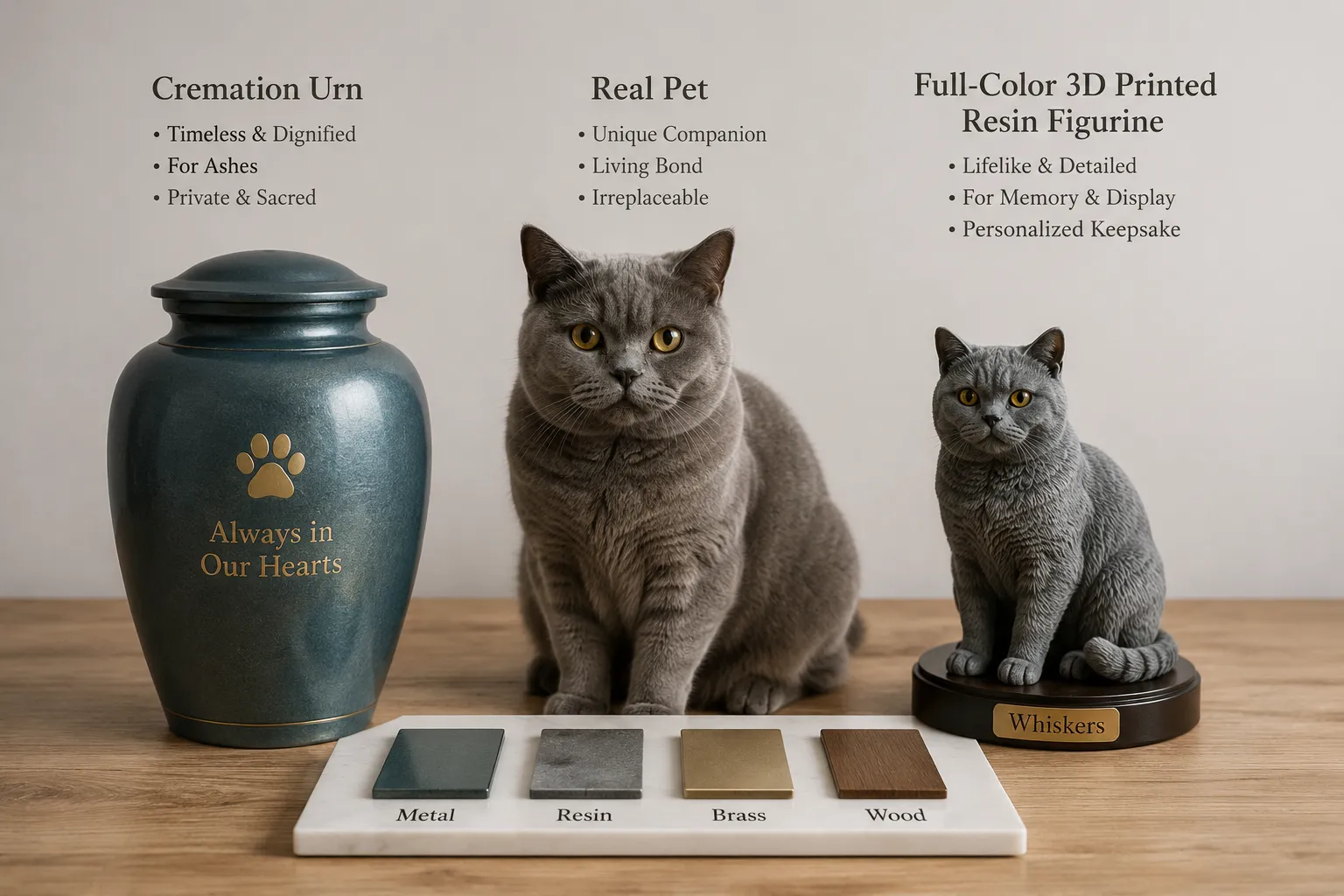
Rain hit the porch where she used to nap, and the cedar shelf still held her scent—which is when the question landed: cremation urn vs figurine? A British Shorthair named Biscuit had left behind two choices, and one redo policy her family didn't yet understand.
Quick Takeaways
- An urn holds remains; a figurine holds presence — they solve different grief problems, not the same one.
- Redo policies matter more than price — a memorial you can't correct becomes a daily reminder of "almost."
- British Shorthair coats fool most reproduction methods — that dense blue-grey plush is the hardest test of any material.
- Material science predicts longevity — full-color resin behaves differently than ceramic, stone, or painted finishes over decades.
- Before you commit, compare how each option ages and what happens if the likeness misses, then explore the craftsmanship details at custom pet figurines.
Why "Urn vs Figurine" Is the Wrong Comparison (Until You Reframe It)
Here's the thing most memorial guides get backwards. They line up an urn and a figurine side by side like two contestants and ask you to pick a winner. Cost, size, shelf appeal. As if you're shopping for furniture.
But these objects answer two completely different questions.
An urn answers "where does the body go?" It's a vessel of containment. A sacred boundary around what remains. A figurine answers something else entirely—"how do I keep the presence?" One is about closure. The other is about continuity.
When Biscuit's family sat at their kitchen table that first week, they assumed they were choosing between two products. What they were actually choosing between were two relationships with absence. And those aren't interchangeable.
"An urn marks where a life ended. A figurine insists that the bond didn't."
Think about it as a cause-and-effect chain. Loss creates two needs: the need to honor the physical, and the need to sustain the emotional. Most families feel both, but in different proportions. Some need the weight of remains in a sealed vessel to believe it's real. Others can't bear a container—they need a face, a posture, the specific tilt of a head that meant I'm hungry or pet me now.
So the real question isn't "which is better." It's "which need is louder right now, and which one will grow louder later?"
That distinction reshapes everything that follows—including the policy fine print almost nobody reads until it's too late.
The Spiritual Math of Containment vs. Continuity
There's an old ritual logic buried in this choice, and it's worth naming. Across cultures, the urn belongs to the language of return—ashes to ashes, the body folding back into the earth or the air. It's a closing ceremony.
The figurine belongs to a different tradition: the household guardian. The small sacred object that keeps a spirit present in the room. Think of ancestral shrines, of the photographs people keep on mantels, of the way a single object can hold an entire energy.
Neither is superior. But if you understand which spiritual instinct you're acting on, you'll stop comparing apples to candles. You'll choose the object that does the work your heart is actually asking for.
The Decision Most Families Regret (And It's Not the One You Think)
We've worked with thousands of pet families, and we'll be honest about a pattern that surprised even us early on.
The regret almost never comes from spending too much. It comes from choosing an irreversible memorial in the first 72 hours of grief.
Here's what happens. The loss is fresh, the house smells wrong—too clean, or still too much like them—and there's a desperate urge to do something immediately. So families rush. They order the first urn they see, or commission a likeness from a blurry phone photo because picking the right image feels impossible through tears.
And then the object arrives. And it's almost right. The urn engraving has a typo. Or the figurine's eyes are the wrong shade of copper—Biscuit's were amber, not gold—and now this thing meant to comfort instead delivers a tiny sting every single time it's seen.
"A memorial that's 'almost right' doesn't fade into the background. It calls attention to the gap, daily."
That's the trap. And it's why the redo policy isn't fine print—it's the entire safety net.
The 72-Hour Rule We Actually Recommend
Counterintuitive advice incoming. Don't create the permanent memorial first. Create a placeholder ritual instead.
In the first 72 hours, your judgment is chemically compromised—grief floods the brain with cortisol, and decision-making genuinely suffers. The American Veterinary Medical Association's guidance on pet loss and the human-animal bond acknowledges how disorienting this window is.
So do this instead:
- Set up a temporary sacred space. A photo, a candle, the collar, the favorite blanket that still carries their scent. This holds the grief while you breathe.
- Gather images slowly. Over a week or two, not an afternoon. The right reference photo changes everything downstream.
- Then decide on permanent memorials with a clearer head—and only after you understand each option's redo terms.
So what? Because the difference between a memorial you treasure and one you tuck in a closet often comes down to those first frantic days. Slowing down isn't weakness. It's reverence.
Cremation Urn vs Figurine: The Honest Comparison Table
Let's get concrete. This is the comparison we wish every family had before they spent a dollar. It maps the two options against the dimensions that actually predict satisfaction five years out—not five days out.
| Dimension | Cremation Urn | Resin Figurine |
|---|---|---|
| Primary purpose | Contains physical remains | Preserves presence & likeness |
| Emotional function | Closure, sacred boundary | Continuity, daily companionship |
| Personalization risk | Low (engraving, shape) | Higher (must capture the face) |
| Why redo policy matters | Engraving errors only | Likeness accuracy is everything |
| Ages over decades as | Stable (metal/ceramic/stone) | Depends entirely on material |
| Best for the person who | Needs to honor the body | Needs to keep the spirit close |
Notice the fourth row. The redo policy carries far more weight for a figurine than an urn, because the failure modes are different. An urn can be wrong in one or two ways—a misspelled name, a wrong date. A figurine can be wrong in a hundred subtle ways, and a British Shorthair multiplies that risk. More on that in a moment.
You Don't Have to Choose Just One
Here's a reframe families rarely consider: these two objects can coexist, and often should.
Plenty of the families we work with keep an urn in a quiet, private space—a bedroom shelf, a closet altar, somewhere intimate—and place a figurine where the living happens. The kitchen windowsill. The home office desk where the cat used to sit on the keyboard at the worst possible moment.
The urn holds the sacred weight. The figurine carries the everyday joy. One for mourning, one for remembering. The bond was never one-dimensional, so why should the memorial be?
Why a British Shorthair Breaks Most Memorial Reproductions
Now we get to the part almost no generic guide covers, because it requires actually understanding the breed and the materials.
A British Shorthair is a reproduction nightmare. We mean that with total affection.
According to the American Kennel Club's standard for the breed, that iconic coat is dense, plush, and "crisp"—it stands away from the body rather than lying flat. The classic British Blue is a solid blue-grey that shifts under light. And the eyes: a deep copper or gold that contrasts against the cool coat in a way that's genuinely hard to reproduce.
Here's why that matters for your decision.
The Three Things That Go Wrong
One: the coat reads as flat grey. Cheap reproduction methods render that complex blue-grey as a single dead tone. The plush dimensionality vanishes. Suddenly your regal Biscuit looks like a generic grey blob, and the specific roundness—that teddy-bear density British Shorthairs are famous for—is gone.
Two: the face loses its structure. This breed has a broad, round head, full cheeks (especially in males), and a sweet, slightly flat-faced expression. Get the cheek volume wrong and it stops being your cat. It becomes a cat.
Three: the eyes go dull. That copper-against-blue contrast is the soul of the face. When eye color is approximated rather than matched, the figurine's gaze goes empty. And empty eyes on a memorial are worse than no figurine at all.
"With a British Shorthair, the difference between a treasure and a stranger is two millimeters of cheek and one shade of copper."
So What Does This Mean for Your Choice?
It means the reproduction method and the redo policy aren't separate considerations—they're the same consideration.
If you're commissioning a figurine of a British Shorthair, you are asking an artist and a technology to clear a high bar. The question becomes: what happens if the first attempt misses the cheek volume or the eye color? Can it be corrected? That's the redo policy. And for this breed, it's non-negotiable.
This is precisely where the manufacturing process matters. At PawSculpt, the figurines are digitally sculpted by master 3D artists and then precision 3D printed in full color, where the color is part of the resin itself rather than a coating sitting on top. For a coat like the British Blue, that voxel-level color reproduction is what lets the blue-grey carry its real depth instead of flattening into one tone. You can see how that translates to actual fur patterns through their 3D pet sculptures.
Pet Memorial Material Science: What Actually Survives 20 Years
This is the section the first five Google results won't give you. They'll tell you resin is "durable" and stone is "timeless" and leave it there. We're going to go deeper, because the material you choose is a promise about how long the memory stays intact.
Let's break it down by what actually happens to these materials over decades.
The Material Comparison That Predicts Longevity
This table maps common memorial materials against how they age, fade, and survive real households—the ones with sunlight, curious hands, and the occasional knock off a shelf.
| Material | Color Longevity | Durability | Detail Capacity | Best For |
|---|---|---|---|---|
| Full-color resin (3D printed) | High (UV-resistant, color in material) | Good—won't shatter like ceramic | Excellent—captures fur patterns | Detailed, lifelike figurines |
| Ceramic / porcelain | High but glaze can craze | Brittle—chips and shatters | Moderate | Classic urns, simple forms |
| Bronze / metal | Permanent (patina shifts) | Excellent | Moderate (sculptural, not detailed) | Heirloom urns, abstract forms |
| Painted finishes (any base) | Variable—surface layers can fade/chip | Depends on base | High initially | Detail that may not last |
| Stone / resin-stone composite | High | Heavy, stable | Low-moderate | Garden markers, urns |
Here's the insight buried in that grid. The vulnerability in most detailed memorials isn't the form—it's the color layer.
When color sits on top of a material as a surface coating, it lives a more fragile life. Sunlight works on it. Handling wears it. Time has an edge to grab. But when the color is integrated into the material itself—as it is in full-color resin printing, where pigment is laid down voxel by voxel throughout the object—there's no surface layer to fade or flake in the same way. The blue-grey of a British Shorthair's coat is part of the resin's body, not a skin over it.
So what? It means a figurine made this way is built to keep Biscuit's exact coloring through the next decade of birthdays, holidays, and ordinary Tuesdays.
The UV Question Nobody Asks
Quick practical note that we genuinely care about. Where will the memorial live?
If the answer is "a sunny windowsill"—and for cats, it almost always is, because that's where they lived—then UV resistance moves from nice-to-have to essential. Many color reproduction methods degrade in direct sun over years. Full-color resin with UV-resistant materials and a protective clear coat is engineered against exactly this.
Pro tip: even with UV-resistant materials, rotating any memorial object a quarter-turn every few months evens out any light exposure. Small ritual, long payoff.
"The bond doesn't fade, so the object holding it shouldn't either. Material is how a promise keeps itself."
— The PawSculpt Team
The Figurine Redo Policy: A Framework for Reading the Fine Print
Okay. Let's talk about the thing this whole article orbits—the figurine redo policy—and give you an actual framework instead of vague reassurance.
We're going to be direct about something. Policies, turnaround times, and revision specifics change, and they vary by company. So rather than quote numbers that might be outdated by the time you read this, we'll teach you what to look for so you can evaluate any company, including ours, intelligently. (For PawSculpt's current specifics, the FAQ page is the source of truth.)
The Five Questions That Reveal a Real Policy
When you're evaluating any custom figurine service, ask these in order:
- Is there a preview before production? This is the single most important safeguard. A digital preview of the sculpt before it's printed means catching the cheek volume or eye color issue while it's still fixable—not after.
- What counts as a revision? Adjusting eye color is different from re-sculpting a pose. Understand which corrections are part of the process.
- What triggers a full redo? If the finished piece genuinely doesn't look like your pet, what's the path to making it right?
- What do they need from you? Often the policy depends on photo quality. A redo can't fix what the reference photo never showed.
- How is "satisfaction" defined? Vague guarantees protect the company. Specific ones protect you.
The Micro-Story That Makes This Real
Biscuit's family came back to us in week three—remember, they'd taken the slow road we recommended. They'd gathered photos. And during the preview stage, the mother noticed something: the first sculpt had the head tilt slightly too symmetrical. Biscuit always held her head with a tiny lean to the left. A quirk. The thing that made her her.
Because the process included a preview before anything was printed, that lean got built in. The finished figurine leaned left. And the first time it sat on the windowsill, catching that grey afternoon light, the family said it looked like she'd just turned to ask for dinner.
That's what a redo and revision process is for. Not fixing disasters. Catching the two-millimeter details that are the entire point.
"A good redo policy isn't insurance against failure. It's permission to be precise about love."
The Counterintuitive Truth About Guarantees
Here's something we've learned that runs against intuition. The best protection isn't a generous redo policy. It's a process that makes redos rarely necessary.
A company that lets you preview and revise before production prevents the heartbreak in the first place. A company that only offers redos after you've received a wrong piece is solving the problem too late—you've already felt that sting once. Prevention beats correction. Always look for the preview step first.
How to Choose: A Decision Framework, Not a Sales Pitch
Let's pull the threads together into something you can actually use tonight. This is an if-then framework based on what your grief is asking for.
If you need physical closure above all—if you can't rest until the remains are held in something sacred—then the urn is your primary object. Choose material for permanence (bronze and quality ceramic lead here), and keep the redo concern simple: triple-check the engraving spelling and dates before it's finalized.
If you need ongoing presence—if the unbearable part is the empty windowsill, the silence where a meow used to be, the spot on the bed—then the figurine is your primary object. Here, material science and redo policy become central. Prioritize integrated full-color reproduction and a preview-before-production process.
If you need both (and many do), give each object its own role and its own space. Sacred and private for the urn. Lived-in and visible for the figurine.
What to Expect From the Figurine Process
For families leaning toward a figurine, here's the general arc of how a quality custom piece comes together—without committing to specific timeframes that vary:
- You provide reference photos. Clear, well-lit, multiple angles. This is the foundation everything is built on.
- Master 3D artists digitally sculpt the form, capturing pose, proportions, and those breed-specific details like the British Shorthair's full cheeks and round head.
- You review a preview. This is your moment to catch the head tilt, the eye color, the things only you know.
- The piece is precision 3D printed in full color, with the coat's exact tones built into the resin itself.
- A protective clear coat is applied for sheen and longevity—the one manual finishing step.
- It arrives with natural 3D print texture, an authentic surface that reads as real rather than plastic-perfect.
For the current specifics on turnaround, revisions, and guarantees, visit pawsculpt.com directly—those are the details worth getting from the source.
The Photo Tips That Make or Break the Result
Since reference photos determine everything, here's what actually works for a British Shorthair specifically:
- Shoot at eye level, not from above. Standing over a cat distorts that beautiful round head.
- Use natural, indirect light to capture the true blue-grey. Harsh overhead light flattens the coat; warm lamplight shifts it too yellow.
- Get the eyes in focus and well-lit. That copper needs to be visible and true—it's the soul of the face.
- Include multiple angles—front, three-quarter, and profile—so the artist can build the full structure.
- Capture their signature pose if you can. The loaf. The head tilt. The way they sat. Personality lives in posture.
So what? Because no redo policy on earth can reconstruct a detail the camera never captured. Great photos are the cheapest insurance you'll ever buy.
When the Memorial Becomes a Ritual
We want to close the practical section with something less practical and more true.
The families who heal best, in our experience, aren't the ones who find the "perfect" object. They're the ones who build a small ongoing ritual around whatever object they choose.
A customer told us she moves Biscuit's figurine to the windowsill every morning when she opens the blinds—the same spot, the same light, the same moment the cat used to claim. It takes four seconds. It's become a sacred space in an ordinary house. A daily acknowledgment that the bond is a legacy, not a closed chapter.
That's the deeper function of these objects. Not decoration. Not even memory, exactly. They're anchors for a continuing relationship—physical permission to keep loving someone who isn't in the room anymore.
The urn says you were here. The figurine says you still are.
"Grief looks for somewhere to land. A memorial gives love a place to keep living."
And whether that landing place is a sealed vessel, a full-color resin likeness on a sunny sill, or both sitting in quiet conversation across a room—what matters is that it tells the truth about the bond. That it holds the specific tilt of a specific head. That it doesn't make you flinch.
Rain on the porch. Cedar shelf. The scent that's slowly fading from the blanket but never from the figurine that leans, just slightly, to the left.
Frequently Asked Questions
What's the real difference between a cremation urn and a figurine?
An urn is a vessel of containment—it holds your pet's physical remains and provides a sense of closure and a sacred boundary. A figurine is about continuity—it preserves their likeness, posture, and presence so they stay visible in your daily life. They answer different emotional needs, which is why many families ultimately choose both, giving each its own space and role.
Why is the figurine redo policy more important than the price?
Because a figurine can be wrong in dozens of subtle ways that an urn simply can't. The right redo and revision process—especially one that lets you preview the sculpt before production—catches small but crucial details like eye color or a signature head tilt while they're still fixable. A lower price means nothing if the finished piece doesn't actually look like your companion.
Why are British Shorthairs so difficult to capture in a memorial?
That iconic look is deceptively complex. The British Blue coat is a deep blue-grey that shifts under light, the head is broad and round with full cheeks, and the copper eyes contrast sharply against the cool fur. Lower-quality reproduction methods flatten the coat into a single dull grey and lose the facial structure, so the figurine stops looking like your cat specifically.
How does pet memorial material science affect how long a figurine lasts?
The biggest factor is where the color lives. When color sits on the surface as a coating, it's more vulnerable to fading, chipping, and UV damage over years. When color is integrated throughout the material—as in full-color resin 3D printing—there's no fragile surface layer, so the piece holds your pet's true coloring far longer, especially with UV-resistant materials and a protective clear coat.
Should I order a memorial right after my pet passes?
We'd gently suggest waiting past the first 72 hours for any permanent memorial. Grief genuinely compromises decision-making early on, and rushing often leads to regret over small errors. Set up a temporary sacred space first, gather reference photos slowly over a week or two, then commission the permanent piece with a clearer head.
Can I keep both an urn and a figurine?
Absolutely, and many families find this the most complete option. They keep the urn in a private, intimate space to honor the physical remains, and place the figurine where daily life happens—a windowsill, a desk, a favorite sunny spot. One holds the sacred weight, the other carries the everyday joy.
Ready to Celebrate Your Pet?
Every pet has a story worth preserving. Whether you're weighing a cremation urn vs figurine for a British Shorthair who's crossed the rainbow bridge, or simply want to capture your cat's plush coat and copper eyes while they're still claiming the windowsill, a custom PawSculpt figurine holds the details that make them unmistakably yours.
Visit pawsculpt.com to learn more about our full-color 3D printing process, preview options, and quality guarantee.