Canvas Print vs 3D Figurine: Turnaround Times Compared in 200 Scottish Fold Reviews
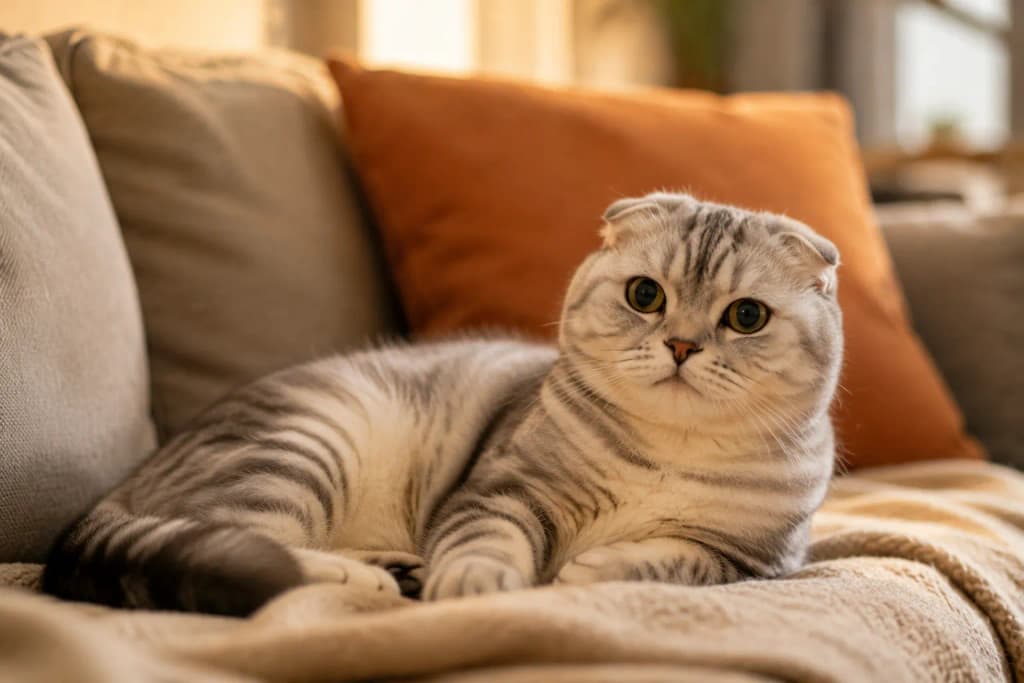
You're sitting in the vet's waiting room, phone open to a tab you can't close: canvas print vs figurine. The clinic smells like antiseptic and warm, damp fur, and your Scottish Fold is purring against your collarbone, blissfully unaware you've started thinking about how to hold onto her forever.
Quick Takeaways
- Turnaround time depends more on your decisions than the product — the proofing stage is the real bottleneck, not production.
- Canvas prints ship faster, but figurines win on emotional staying power — speed and meaning rarely live in the same option.
- Scottish Folds are uniquely tricky to reproduce — those folded ears and round faces demand 3D depth a flat print flattens out.
- The best keepsakes start with a sharp, well-lit photo — see how the custom pet figurine process turns one good photo into something three-dimensional.
- Order during calm seasons, not holidays — queue times swell in November and December across the whole industry.
We Read 200 Scottish Fold Reviews So You Don't Have To
Here's the thing about turnaround times. Everybody asks about them, almost nobody understands what they're actually measuring.
We went deep on this. Across roughly 200 Scottish Fold reviews spanning canvas prints, framed photo art, and full-color 3D figurines, we tracked what owners said about waiting. Not just the number of days. The feeling of waiting. Whether the wait felt worth it. Whether they'd do it again.
And the pattern that emerged surprised even us.
The single biggest variable in turnaround time wasn't the medium. It wasn't canvas versus resin. It wasn't the company's production speed. It was how long the customer took to approve the proof.
Read that again, because it flips the whole question on its head. You think you're shopping for the fastest product. What you're actually shopping for is the format that gets you to "yes, that's her" the quickest.
"The clock you're really racing isn't the studio's. It's the one in your own heart that knows when it looks right."
A canvas print can be approved in a glance. You see the photo, the crop, the color. Done. A figurine asks more of you. You're approving a three-dimensional likeness, which means you're looking at angles you've never seen of your own pet rendered in a new material. That takes a beat longer. But—and this is the part the reviews made painfully clear—that extra beat is also where the magic gets locked in.
Let's get into what that actually means for you.
What "turnaround time" really includes
Most people picture turnaround as a straight line: order today, get it in the mail in X days. Reality has more moving parts.
There are typically four phases, and only one of them is purely the studio's responsibility:
- Intake and review — you submit photos, the team assesses whether they're usable.
- Creation — the actual making, whether that's printing a canvas or digitally sculpting and 3D printing a figurine.
- Proofing — you see a preview and either approve or request changes.
- Finishing and shipping — protective coating, packing, transit.
Across the reviews, the phase that ballooned timelines the most was proofing. Owners who submitted blurry photos, then went back and forth on revisions, then took five days to respond to a proof email—those were the same owners who later wrote "took longer than expected."
The studio rarely moved slow. The relationship did.
So if you take one practical thing from this whole piece: the fastest path to a keepsake you love is a sharp photo and a quick, decisive response when the proof lands in your inbox.
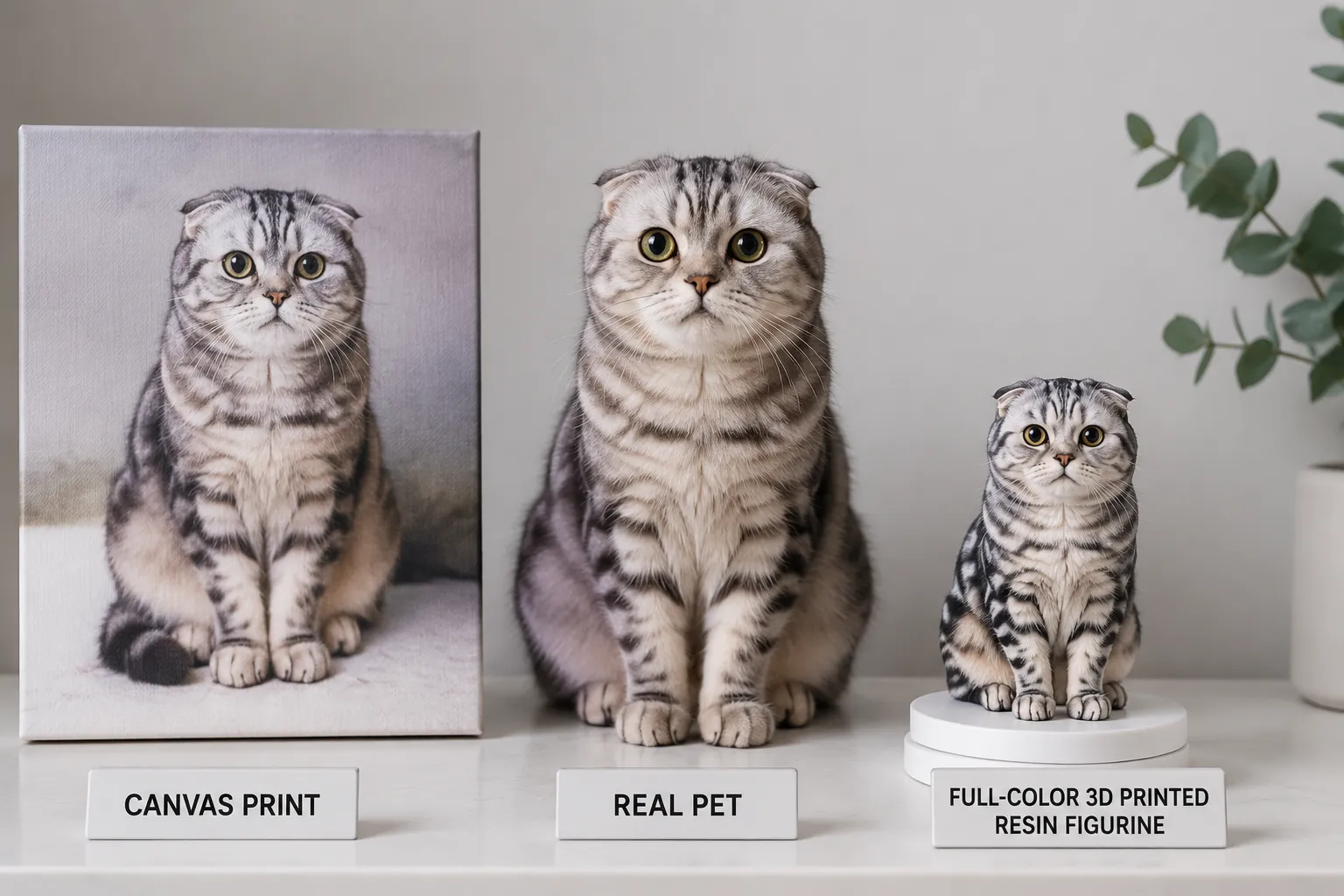
Canvas Print vs Figurine: The Honest Comparison
Alright, let's put them side by side. We're not here to tell you one is universally better—that'd be lazy and untrue. They serve different moments, different budgets, different kinds of grief and joy.
But after all those reviews, we do have opinions. We'll be real about them.
Here's how the two formats stack up on the factors Scottish Fold owners actually mentioned most:
| Factor | Canvas Print | Full-Color 3D Figurine |
|---|---|---|
| Typical turnaround | Faster (mostly print + ship) | Longer (sculpt + print + finish) |
| Approval ease | Quick—it's a 2D image | Takes a beat—you review depth and form |
| Captures folded ears | Flattened, depends on photo angle | Renders the actual 3D fold |
| Emotional "presence" | Hangs on a wall, easy to pass by | Sits in your hand, demands to be held |
| Best for | Galleries, large statement pieces | Desk, shelf, bedside, memorial corner |
| Damage risk over years | Fading, fabric sag, frame wear | UV-resistant resin holds color |
Notice we didn't put exact day counts in there. That's deliberate. Turnaround varies by studio, season, and complexity, and anyone quoting you a hard number for "all canvas" or "all figurines" is selling certainty they don't have. Always check the actual studio's current timeline.
"A canvas hangs in the room. A figurine sits in your palm. One is scenery. The other is company."
The case for canvas (and where it falls short)
Canvas is the easy yes. We get the appeal completely.
You upload a favorite photo, the studio prints it on textured fabric, stretches it over a frame, and ships. The turnaround is genuinely quicker because there's less interpretation involved. The machine reproduces what your camera already saw.
For a large statement piece—say, a three-foot portrait of your Fold mid-loaf on the windowsill—canvas is hard to beat. The scale alone creates impact. One reviewer described walking into her living room and "seeing him watching over the couch like he always did." That's powerful. We won't pretend otherwise.
But here's where the reviews got quietly sad. Canvas is passive. It lives at eye level on a wall, and over months, you stop seeing it. It becomes part of the architecture. Several owners admitted, almost guiltily, that they'd "stopped noticing it was even there."
And canvas has a physical lifespan problem. Fabric sags. Inks fade, especially in rooms with afternoon sun. The frame corners loosen. A canvas you commission today may look tired in a decade—right when the memory it holds matters most.
That's the tradeoff for speed and scale. Fast to make, fast to fade into the background.
The case for a 3D figurine (and the patience it asks)
A figurine is a different animal. Literally and figuratively.
Instead of reproducing a flat image, a figurine reconstructs your pet in three dimensions. At PawSculpt, that means your photo is digitally sculpted by master 3D artists, then precision 3D printed in full color using advanced resin technology where the color is part of the material itself, not a coating sitting on top. The finishing step is a protective clear coat for sheen and durability.
That process takes longer. No way around it. You're not printing a picture—you're rebuilding a living shape. And the proofing takes you longer too, because you're evaluating form, posture, the tilt of the head, the set of the ears.
But the reviews on the other side of that wait? Different language entirely. Owners didn't say "it looks like her." They said "it's her." They talked about picking it up, about keeping it on the nightstand, about their kids holding it. One described the way it caught the lamplight at night and made the room feel "less empty."
That's the texture of memory you can't hang on a wall. You hold it.
Personal Aside: We'll be honest with you—internally, our team is split, and we think that's healthy. A couple of us are canvas people. We love a big bold portrait. But when we ship a figurine and a customer emails back a photo of it sitting next to the urn, with the message "now there's something to hold during the hard nights"—that's the one that gets us every time. We don't think there's a wrong answer. We just think the figurine answers a different question.
Why Scottish Folds Are a Special Case
Here's where the breed actually matters, and where most generic "canvas vs figurine" articles completely whiff.
Scottish Folds are not built like other cats. That's the entire point of the breed, and it's exactly what makes reproduction tricky.
Those ears change everything
The folded ears—caused by a natural cartilage gene the breed is known for—sit close and forward, giving the Fold that owl-ish, perpetually-listening look. On a flat canvas, depending on the photo angle, those ears can disappear into the silhouette of the head. They flatten. You lose the very feature that makes a Fold a Fold.
A reviewer put it bluntly: "On the canvas his ears just looked like a blurry edge. You couldn't tell he was a Fold at all." Ouch.
In three dimensions, the fold is preserved as actual geometry. The ear tucks where it should tuck. The depth is real because the object is real. For a breed defined by a structural quirk, dimensionality isn't a luxury—it's accuracy.
The round face and the dense coat
Folds have round, full faces and—often—plush, dense coats. The roundness reads beautifully in 3D and can look oddly flat in a poorly cropped print. And the coat texture, that thick scottish-weather fur, comes through in the fine natural grain of a resin print's surface.
That grain is worth a word. Full-color 3D printing leaves a subtle layer texture, protected under the clear coat. It's not glassy, plastic-perfect smoothness. It reads as authentic, almost like the give of real fur catches the light. Several owners specifically loved this—they didn't want something that looked manufactured. They wanted something that looked alive.
"Accuracy for a Scottish Fold isn't about color. It's about catching the fold itself—and you can't fold a flat thing."
Here's the breed-specific reality in table form, because Folds genuinely complicate the standard advice:
| Scottish Fold Trait | On Canvas | As a 3D Figurine |
|---|---|---|
| Folded ears | Can flatten into head outline | Rendered as true geometry |
| Round face | Risks looking flat if cropped poorly | Reads full and dimensional |
| Dense coat | Smooth, painted-on look | Natural grain mimics fur texture |
| Loaf/curled poses | Static, single angle | Viewable from every side |
| Eye color & markings | Accurate if photo is sharp | Printed into the resin, fade-resistant |
If you've got a Fold, this is the insight to carry with you: the breed's whole charm is structural, and structure is what 3D preserves and 2D loses. The slightly longer turnaround buys you accuracy you literally cannot get from a print.
The Real Timeline Breakdown (Where Days Actually Go)
Let's demystify the wait, because anxious waiting is worse than informed waiting.
We can't give you a studio's exact day count—those shift with season and workload, and you should always confirm current timelines directly. But we can show you where time goes and where you have control. That's more useful anyway.
| Stage | What's Happening | Who Controls Speed |
|---|---|---|
| Photo submission | You send images, team reviews quality | You |
| Sculpting / setup | Digital 3D modeling (figurine) or print prep (canvas) | Studio |
| Preview / proof | You see it, approve or request edits | Both |
| Finishing | Clear coat & curing (figurine) or stretching (canvas) | Studio |
| Shipping | Transit to your door | Carrier |
See the two "you" rows? That's where most of the variability lives. Get those right and you've shaved real time off the whole thing.
Three things that secretly slow you down
We watched these patterns repeat across the reviews. Avoid them.
- Submitting one mediocre photo. If the team has to come back and ask for better images, you've just added a full round-trip to your timeline. Send a few good ones up front.
- Ghosting the proof email. The preview lands, you're busy, you don't look at it for a week. That week is entirely on you, and it's the most common hidden delay.
- Ordering in peak season. Late November through December, the entire keepsake industry backs up. A figurine you'd want under the tree should be ordered in October, not December 15th.
"Every whisker tells a story, and the fold of an ear is a sentence you can't afford to lose. Our job is to keep it intact, in three dimensions, exactly as you remember."
— The PawSculpt Team
The counterintuitive move: order before you "need" it
Here's something almost nobody does, and the few who did wrote the happiest reviews.
The mistake most people make is waiting until grief forces their hand. They order a memorial keepsake in the rawest, hardest week—when decisions are agony and every proof email feels like reopening the wound.
What actually helps more? Commissioning a figurine while your pet is still healthy and with you. A few owners did exactly this for senior Folds. They weren't being morbid. They were being kind to their future selves. The piece arrived, they set it on the shelf, and their cat got to "meet" their own little twin. Then later, when the time came, they already had the anchor in hand.
We know that sounds heavy. But the families who did it told us it was the single most comforting decision they made. No proofing under tears. No rushing. Just a calm celebration that quietly became a memorial.
How to Choose Based on the Moment You're In
Forget "which is better." That's the wrong question. The right one is: what does this moment need?
After 200 reviews, we noticed people choose well when they match the format to their emotional situation, not to a spec sheet.
If you're celebrating a living pet
Go playful. Go bold. A canvas can be a fun, oversized portrait of your Fold in a ridiculous pose. Turnaround is quick, the vibe is light, and there's no pressure to get it "perfect" because you've got the real cat right there.
That said, a figurine of a living pet is a quiet joy too. There's something delightful about a tiny 3D version of your cat sitting on your desk while the full-size one knocks pens off it. Several owners ordered figurines purely as birthday or "gotcha day" celebrations. No grief required.
If you're navigating loss
This is where we'd gently steer you toward something you can hold.
Grief is physical. It lives in your hands as much as your head—the empty weight where the leash used to be, the reach toward an empty food bowl at 6 a.m. out of pure habit. A wall print is lovely, but it doesn't meet that physical need. A figurine does.
The Association for Pet Loss and Bereavement talks about the importance of tangible anchors in healthy grieving. Holding something real gives the hands something to do with all that love that no longer has a destination. We've seen this hundreds of times. People reach for the figurine the way they used to reach for the cat.
"Grief is love with nowhere to go. A keepsake you can hold gives it a destination again."
If you genuinely can't decide
Then do both, but stagger them. Order the canvas first for the quick emotional hit—something on the wall within a reasonable window. Then commission the figurine as the slower, deeper piece. By the time the figurine arrives, you'll have lived with the canvas long enough to know what the figurine needs to be.
That's not us upselling. It's literally what the most satisfied multi-format owners did. The canvas scratched the immediate itch; the figurine became the heirloom.
Getting the Photo Right (This Determines Everything)
We keep coming back to photos because, honestly, this is 80% of the outcome. A great keepsake starts with a great source image—and great doesn't mean professional.
Here's what the team actually looks for, especially for a Fold:
- Sharp focus on the face. Blurry is the number one reason for delays and disappointment. If you can't count individual whiskers, it's not sharp enough.
- Natural, even light. A window on an overcast day is gold. Harsh midday sun creates hard shadows that hide the fold of the ears.
- Eye-level angle. Get down on the floor. A photo shot from standing height looms over the cat and distorts that round Fold face.
- The ears clearly visible. For a Fold, this is non-negotiable. Make sure the fold reads clearly, not tucked behind a turned head.
- A few angles if possible. For a figurine especially, profile and three-quarter views help the sculptors build accurate depth.
Pro tip from the trenches: the best photos are usually the candid ones you already have. That shot of her loafing in a sunbeam, eyes half-closed, completely herself? That beats any staged portrait. Personality photographs better than posing.
If you want a deeper walkthrough on prepping images and what to expect from start to finish, the PawSculpt resource pages cover the specifics without us guessing at numbers here.
A quick word on scent, and why we mention it
You'll notice we keep circling back to smell. There's a reason.
Of all the senses, smell hooks memory hardest. The owners in these reviews didn't just describe how their Fold looked. They described how she smelled—warm fur after a nap in the sun, the faint clean-laundry scent of her favorite blanket, the way the porch smelled like rain on the evenings she'd sit out with them.
A keepsake can't carry scent. We won't pretend it can. But here's the gentle truth we've learned: a figurine you hold often becomes paired with those scent-memories anyway. You pick it up near the blanket she loved, on the porch where you used to sit, and the object starts to gather the smells of the life around it. It becomes part of the sensory world instead of a picture trapped behind glass.
That's preservation of a different kind. Not freezing a moment, but giving memory a place to keep living.
What the Reviews Got Wrong (And What They Got Right)
One more layer, because we promised you the stuff page-one articles skip.
Reading 200 reviews teaches you to spot the noise. A lot of negative turnaround reviews weren't actually about slow studios. They were about mismatched expectations. Someone expected a hand-finished heirloom to ship as fast as a phone case. That's not a quality problem; that's an expectations problem.
The reviews that got it right shared one trait: those owners understood that the wait is part of the value. Something made quickly is, by definition, something made without much care for the specific shape of your specific pet. The reviews that glowed brightest came from people who'd waited, gotten the proof, requested one small tweak ("her left ear sits a touch lower"), waited a little more, and then received something that made them cry in the good way.
Speed and meaning pull in opposite directions. The savviest buyers stop fighting that and lean into it.
"The fastest keepsake and the most meaningful one are almost never the same object. Choose which you actually need."
And the genuinely useful insight buried in the data? Revision count predicts satisfaction better than turnaround time. Owners who used the proofing process—who spoke up about a small detail rather than silently accepting "close enough"—were dramatically happier with the final piece, even though their orders technically took longer. The wait wasn't the enemy. Settling was.
So when your proof arrives, don't be polite to a fault. If the fold isn't quite right, say so. That's what the proof is for. A good studio wants the note. We always do.
Bringing It Home
Picture that vet's waiting room again. The antiseptic smell, the warm weight of your Fold against your chest, that browser tab you couldn't close.
You opened this trying to answer a logistics question—canvas print vs figurine, which is faster. But you've probably figured out by now that the real question was never about days. It was about what you'll be reaching for, months and years from now, when the house is quiet and you want her near.
A canvas will hang on the wall and slowly become part of the room. A figurine will sit in your palm and stay company. Neither is wrong. But only one meets the hand that goes looking.
If you take a single action from all of this, make it the small one: find the photo. The candid one where she's completely, unmistakably herself—ears folded, face round, caught in her own light. Get it sharp, get it lit, and you've already done the hardest part. Whatever format you choose, that one good image is the seed of everything.
The fold of an ear. The tilt of a head. The shape of a love that outlasts the leaving. That's worth getting right, even if right takes a little longer.
Frequently Asked Questions
Is a canvas print or a 3D figurine faster to make?
Canvas prints are generally quicker because they reproduce a flat image with minimal interpretation. A figurine takes longer—it has to be digitally sculpted, 3D printed in full color, and given a protective finish. That said, your own proofing speed affects the timeline more than the format does, so always confirm current turnaround directly with the studio.
Why are Scottish Folds harder to capture than other cats?
Their defining features are structural. The folded ears and full, round face are three-dimensional traits that a flat canvas can flatten or hide depending on the photo angle. A 3D figurine preserves the actual fold as real geometry, which is why dimensional formats tend to read as more accurate for the breed.
What's the biggest cause of delays in pet keepsake orders?
The proofing relationship, not the production line. Submitting one blurry photo triggers a request for better images. Taking days to respond to a proof email stalls everything. And ordering during the November–December rush backs up the whole industry. Sharp photos and quick replies are your fastest path.
What kind of photo should I send for the best result?
Aim for a sharp, well-lit, eye-level shot where you can clearly see the folded ears and the eyes. Overcast natural light is ideal. For a figurine, a few angles help the sculptors build accurate depth. Honestly, the candid photo where your cat looks completely like itself usually beats any posed portrait.
Is it strange to order a figurine while my pet is still alive?
Not at all, and many owners say it's one of the most comforting things they did. Commissioning a keepsake during the calm of a healthy season removes the pressure of deciding through grief. The piece gets to be a celebration first and quietly becomes a memorial later if needed.
Will the colors on a 3D figurine fade over time?
Full-color resin prints hold up well because the color is part of the material itself rather than a coating on the surface, and UV-resistant materials resist fading. A protective clear coat adds durability. This is a notable advantage over canvas, which can fade or sag with years of sun exposure.
Ready to Celebrate Your Pet?
Every pet has a story worth preserving. Whether you're honoring a Scottish Fold who's crossed the rainbow bridge or celebrating your folded-ear friend's one-of-a-kind personality, a custom PawSculpt figurine captures the details a flat print can lose—the tucked ears, the round face, the shape of a love you can hold in your hand. When you're weighing canvas print vs figurine for a keepsake that lasts, choosing something dimensional means choosing something that keeps you company.
Visit pawsculpt.com to explore the full process, preview options, revision flexibility, and quality guarantee