
Memorial Jewelry vs a 3D-Printed Border Collie: Which Honors Your Eco Values?
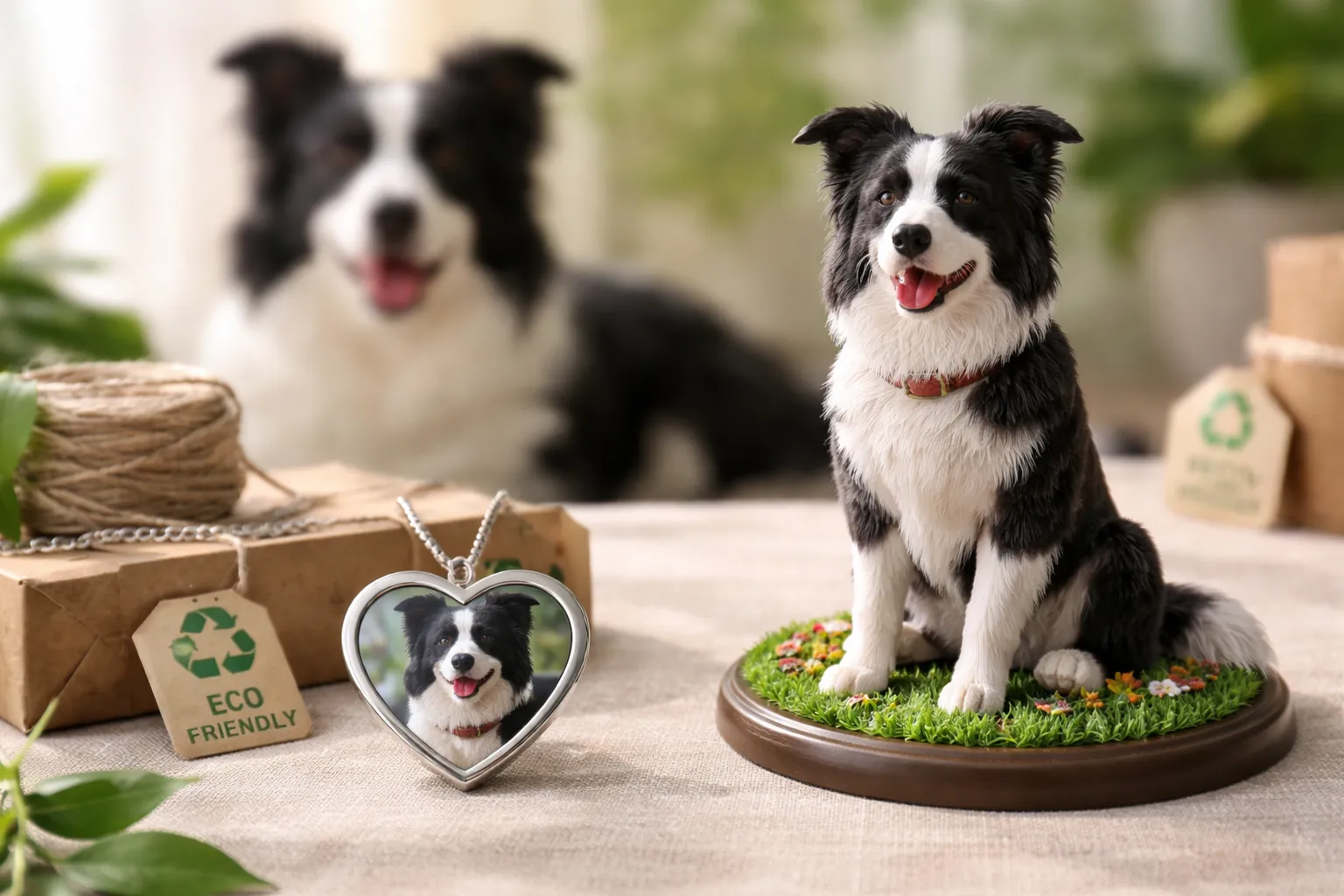
The collar still hangs on the fence post by the back gate, sun-faded after one too many summers, right where you looped it that last morning. And here you are in the backyard, phone in hand, weighing memorial jewelry vs a figurine, trying to decide which choice your dog would actually want you to make.
Quick Takeaways
- Gold and silver carry a hidden footprint — a single small pendant can require mining tons of ore.
- 3D-printed figurines are additive, not subtractive — they build material up instead of cutting it away and wasting it.
- Longevity is the real sustainability metric — the keepsake you keep forever beats the one you replace.
- Match the keepsake to your grief, not the trend — wearable closeness versus a presence in the room are different needs.
- You can compare full-color resin keepsakes and the creative process through custom pet figurines before you commit to anything.
There's a particular kind of paralysis that hits in the days after. You want to do something. You need to do something. The problem is that "something" comes in a hundred forms, each one promising to hold a piece of what you lost, and none of them tells you the truth about what it costs the planet your pet used to run around on.
So let's actually talk about it. Not in vague greenwashed terms. In real ones.
Why the Eco Question Hits Different When It's a Pet
Here's something we've noticed working with thousands of grieving families. People who never once thought about supply chains or carbon footprints suddenly start asking.
It makes sense, when you sit with it.
Your dog was an outdoor creature. A backyard creature. The grass, the dirt under the deck, the patch by the fence where nothing ever grew because she dug there every single afternoon. The natural world wasn't abstract to her. It was her whole life.
So choosing a memorial that quietly damages that world feels like a small betrayal you can't quite name.
"The way you remember a life that loved the earth should not cost the earth more than it has to."
That instinct is worth honoring. And it deserves real information, not a marketing brochure.
The Backyard Test
We tell families to try this. Stand in the yard. Look at the spots that were theirs.
Then ask: which memorial would feel right sitting in this space? Which one matches the muddy-pawed, leaf-chasing, dirt-rolling reality of who they were?
For some people, that's something they wear close. For others, it's a presence that lives in the room. There's no wrong answer here. But the environmental cost of each path is wildly different, and almost nobody tells you that part.

Memorial Jewelry: The Beautiful Truth Nobody Mentions
Let's start with jewelry, because it's the default. The thing everyone suggests.
A pendant. A ring. Sometimes ash-infused glass or a small compartment that holds a clipping of fur. There's a real intimacy to it. You wear it under your shirt and your hand drifts up to it during the hard meetings, the long drives, the moments your throat tightens for no reason anyone else can see.
We're not here to talk you out of that. It's genuinely meaningful.
But here's the part the eco-conscious shopper needs to hear.
The Mining Math
Precious metal is environmentally expensive in a way that's almost hard to believe.
To produce enough gold for a single ring-sized piece, mining operations typically move somewhere on the order of 20 tons of ore and rock. Gold extraction also frequently relies on cyanide and mercury, which is exactly the kind of contamination that ends up in waterways. The organizations tracking this, including environmental researchers cited by the Environmental Protection Agency, have flagged metal mining as one of the most toxic-release-heavy industries in the country.
Silver is gentler than gold, but it's still mined, refined, and shipped through the same heavy industrial pipeline.
This surprised a lot of our customers when they first heard it. A keepsake that's physically tiny can carry one of the heaviest environmental footprints of anything you'll buy this year.
"The smallest objects sometimes leave the largest marks. A pendant can weigh nothing in your hand and tons in the ground."
What "Recycled Gold" Actually Means
You'll see "recycled" or "ethical" metal everywhere now. And it's better. Genuinely.
But read the fine print. "Recycled gold" often means melted-down existing jewelry, which is great, except demand for memorial pieces still pulls newly mined metal into the overall market. One recycled pendant doesn't cancel out the mining; it just shifts where your specific atoms came from.
This isn't a reason to feel guilty if jewelry is what your heart needs. It's a reason to ask better questions before you buy, and to choose certified recycled sources if you go this route.
The 3D-Printed Figurine: Additive, Not Destructive
Now the other path. The one sitting in the room instead of around your neck.
A figurine of your specific dog. Not a generic border collie shape, but yours, with the exact white blaze down the nose and the one ear that never fully stood up and the particular way she planted her front paws when she was about to bolt.
Here's the manufacturing reality, and it matters for the eco question.
How Full-Color 3D Printing Actually Works
A modern custom figurine like this is digitally sculpted by master 3D artists, then precision 3D printed in full-color resin. The color isn't applied on top. It's printed into the material itself, voxel by voxel (a voxel is just a 3D pixel, the smallest building block the printer places). The machine reproduces fur patterns, markings, and color directly in the resin.
The only manual step afterward is a clear protective coat that adds durability and a subtle sheen.
Why does the eco-conscious reader care about this? Because of one word: additive.
Subtractive vs. Additive Manufacturing
Traditional manufacturing is subtractive. You start with a block and carve away everything that isn't the object. All that carved-away material? Waste.
3D printing is additive. The machine lays down material only where the object needs to exist. Almost nothing is removed, because almost nothing extra was ever there to begin with.
Here's a quick comparison of what that means in practice.
| Factor | Memorial Jewelry (precious metal) | Full-Color Resin Figurine (3D printed) |
|---|---|---|
| Raw material extraction | Heavy mining, tons of ore per piece | Resin produced industrially, no ore mining |
| Manufacturing waste | Subtractive; metal removed and refined | Additive; material placed only where needed |
| Toxic processing | Cyanide/mercury common in gold refining | No metal refining; clear coat is the only finish step |
| Replaceability | Often kept for life | Often kept for life, displayed as heirloom |
| Footprint per piece | High relative to size | Lower relative to detail and size |
That additive difference is the part people genuinely have not thought about. The mistake most folks make is assuming "plastic-ish resin = bad, precious metal = pure." The actual numbers tell a more complicated story.
Myth vs. Reality: What People Get Wrong About Eco Keepsakes
We hear the same assumptions constantly. Let's bust three of them, because each one is steering well-meaning people toward the less-green choice.
Myth #1: "Metal is natural, so it's the greener keepsake."
Reality: Metal is natural in the ground, sure. But getting it out of the ground is one of the most resource-intensive, chemically intensive processes in any consumer product. Natural origin doesn't mean low impact.
Myth #2: "A 3D-printed figurine is just disposable plastic."
Reality: A quality full-color resin print finished with a UV-resistant clear coat is built to live on a shelf for decades. Disposability is about how long you keep something, and people keep these for life. A keepsake you never replace is, by definition, sustainable.
Myth #3: "Cremation jewelry is the only way to keep them close."
Reality: Closeness is emotional, not just physical proximity. Plenty of families feel their dog's presence more powerfully from a detailed figurine on the nightstand than from a sealed compartment they can't see into.
"Sustainable isn't the thing you buy once and discard. It's the thing you'll never be willing to throw away."
The Sustainability Metric Almost Everyone Ignores: Longevity
Okay, this is the section we'd underline twice if we could.
The entire eco conversation tends to fixate on the moment of manufacture. Carbon at the factory. Material at the source. And those matter.
But the single biggest sustainability lever for a keepsake is something else entirely: how long it stays in your life before it ends up in a landfill.
Fast Grief vs. Forever Objects
Think about the impulse buys in the first raw weeks. The mass-produced "rainbow bridge" trinket. The printed cushion. The cheap resin angel-dog from a big-box checkout aisle.
We've talked to so many people who bought three or four of those things in a fog, and within a year, two of them were in a drawer and one was in the trash. That's the fast-fashion model applied to grief. High volume, low meaning, short lifespan, straight to landfill.
A keepsake you treasure for thirty years has a footprint spread across thirty years. A trinket you toss in eighteen months concentrates its whole footprint into a year and a half of half-hearted ownership.
So the real eco question isn't only "what's it made of." It's also "will I still want this in twenty years?"
The Heirloom Effect
This is where custom, specific, recognizable pieces win. A keepsake that genuinely looks like your dog, that captures the exact tilt of her head, becomes something you can't bear to part with. It gets passed to the kid who grew up with that dog. It survives the move, the downsize, the decades.
That emotional stickiness is, weirdly, an environmental feature. The things we love, we keep. The things we keep don't become waste.
| Keepsake Type | Typical Lifespan | Eco Outcome |
|---|---|---|
| Big-box memorial trinket | 1–2 years | Fast landfill, footprint concentrated |
| Generic stock figurine | 3–5 years | Eventually discarded, low attachment |
| Memorial jewelry | Often lifelong | Kept, but high upfront mining cost |
| Custom recognizable figurine | Decades / heirloom | Kept, footprint spread over long life |
When Memorial Jewelry Is Genuinely the Right Call
We're not here to sell you one answer. Honestly, jewelry is the better fit for some people, and pretending otherwise would be doing you a disservice.
Choose memorial jewelry if:
- You need physical closeness you can carry. If your grief lives in your body and you need something to touch through your shirt during a hard moment, a figurine on a shelf at home can't do that.
- You travel constantly and want them with you across time zones and hotel rooms.
- Discretion matters to you. Not everyone wants to explain a dog statue to coworkers. A pendant is private.
If this is you, go for it with intention. Seek out certified recycled metals, ask suppliers directly about their refining practices, and choose a piece classic enough that you'll wear it for decades rather than a trend you'll retire.
That last part loops right back to longevity. Even within jewelry, the most sustainable choice is the one you'll never take off.
When the Figurine Wins
A figurine is the stronger choice when your grief is spatial. And spatial grief is wildly underdiscussed.
The Empty-Space Problem
Here's what we mean. Grief after a pet is often about specific places in your home that are suddenly, loudly empty.
The corner of the kitchen where the food bowl lived. The exact rectangle of carpet by the window where she watched the yard. The foot of the bed. The spot on the couch you used to fight over.
These empty spaces ambush you. You walk past them a dozen times a day and each time something in your chest drops.
A figurine answers a need that jewelry simply can't. It reoccupies a space. It gives your eyes somewhere to land that isn't absence. Many families tell us they place the figurine in exactly the spot that hurt the most, and slowly that corner stops being a wound and starts being a small, warm hello.
"Jewelry keeps them on your body. A figurine keeps them in the room. Grief decides which one you need."
The Detail That Heals
There's a reason recognition matters so much here. Generic doesn't comfort. Specific comforts.
When a figurine captures the genuine particulars, the asymmetry of the markings, the alert posture, the slightly-too-long fur on the tail, your brain registers it as them, not as a symbol of them. That recognition is what turns an object into a companion.
This is precisely what advanced full-color 3D printing is good at. Because the color and markings are printed into the resin from a digital sculpt built off your real photos, the result holds your dog's actual coloring, not an approximation. If you want to see how that process turns photographs into a recognizable keepsake, you can explore the approach behind these 3D pet sculptures and what the workflow looks like start to finish.
"We've learned that healing rarely comes from a perfect object. It comes from a recognizable one. People don't grieve symbols, they grieve faces."
— The PawSculpt Team
What to Expect If You Choose a Custom Figurine
If the figurine path is calling to you, here's the honest walkthrough of how it generally works, so there are no surprises. (For the specific timelines, revision details, and guarantees, check the current info at pawsculpt.com, since those things get updated and we'd rather you see the real terms than a number we made up here.)
The General Process
- You gather photos. This is the single most important step you control.
- Master 3D artists digitally sculpt your pet from those photos, modeling the form and proportions.
- The figurine is precision 3D printed in full-color resin, with markings and color printed directly into the material.
- A clear protective coat is applied, the one manual finishing step, for durability and sheen.
- It arrives, and you find its place in the room.
What Photos Actually Work Best
This part genuinely changes your result, so don't rush it. We've seen the difference good source photos make, every single day.
| Photo Element | What Helps | What Hurts |
|---|---|---|
| Lighting | Soft natural daylight, indirect | Harsh flash, deep shadows |
| Angles | 3–5 shots: front, side, 45° | One blurry phone pic only |
| Eye level | Camera down at their level | Shot from far above |
| Focus | Sharp on face and markings | Motion blur, low resolution |
| Expression | Their characteristic look | Unusual, atypical pose |
The biggest tip we can give: multiple angles beat one perfect angle. A single gorgeous photo still hides half the dog. Three decent photos from different sides give the artists the full three-dimensional truth.
And if your pet has already passed and you only have a handful of imperfect images, that's okay. Send what you have. We've worked with families who had nothing but slightly-blurry backyard snaps, and the recognition was still there in the final piece.
Caring for It So It Lasts
Longevity is the eco-strategy, remember? So treat the piece like the heirloom it is.
- Keep it out of direct, all-day sun. UV-resistant materials help, but no material loves years of direct sunlight.
- Dust with a soft dry cloth, not harsh chemical sprays.
- Display it somewhere stable, away from the edge of a shelf a tail or elbow might catch.
Do that, and the thing outlives the grief, then outlives you, then tells the next generation about a dog they never met.
The Hybrid Approach Nobody Talks About
Here's a quiet pattern we see more than you'd think, and almost no article mentions it.
People assume it's jewelry or figurine. A binary. But a meaningful number of families do something smarter and, honestly, more emotionally complete.
They choose one wearable piece for the body and one figurine for the home. The pendant for the hospital visit, the flight, the anniversary of the loss. The figurine for the empty corner that needed filling.
If you go hybrid, here's the eco move: be selective, not duplicative. Two meaningful objects you'll keep forever are sustainable. Six impulse trinkets you'll abandon are not. The goal isn't fewer things for its own sake. It's fewer forgettable things.
"Buy less, but love it longer. That's the whole secret to a keepsake that's kind to the earth."
For a deeper look at how different families have navigated this exact crossroads, the stories on the PawSculpt blog walk through real decision-making rather than generic advice.
A Note on Cremation, Ashes, and What's Actually Required
One last thing worth clearing up, because it shapes the eco comparison.
A lot of memorial jewelry is ash-based, meaning it requires cremation to fill the piece. Cremation itself carries an energy and emissions cost. We mention this not to add to anyone's grief or guilt, those decisions are deeply personal and often made under pressure, but because the full eco picture should include it.
A figurine, by contrast, doesn't require ashes at all. It's built from images. That means it's an option whether or not cremation happened, and whether your pet passed years ago or is happily snoring at your feet right now.
That's the other thing. Plenty of our customers commission figurines of living pets, capturing the prime-of-life version they want to remember forever. There's something quietly wise about that. You don't have to wait for loss to honor a life.
The American Veterinary Medical Association has good general guidance on the emotional side of pet loss and the human-animal bond, if you want a grounded, non-commercial resource while you're processing all of this. We're a figurine company, not grief counselors, so for the heavy days, lean on real support too.
So, Which One Honors Your Eco Values?
If we're being direct, and you asked us to be: for the specifically eco-minded pet parent, a well-made custom resin figurine usually edges out precious-metal jewelry on environmental impact. No tons of mined ore. Additive rather than subtractive manufacturing. No cyanide refining. And a longevity that, when the piece truly looks like your dog, can stretch across generations.
But "usually" isn't "always," and your grief gets a vote too.
If you need to carry them on your body, choose certified-recycled jewelry and wear it for life. If you need to fill the empty corner of the room, choose a figurine and let it stand guard there. If you need both, choose two things you'll never abandon.
The greenest memorial, in the end, is the one true enough that you keep it forever.
Frequently Asked Questions
Which is more eco-friendly, memorial jewelry or a figurine?
For most eco-minded buyers, a custom resin figurine comes out ahead. Precious-metal jewelry relies on ore mining and chemical refining with a heavy footprint, while 3D printing is additive and wastes very little material. That said, certified-recycled jewelry you wear for life is a genuinely responsible choice too.
Is a 3D-printed resin figurine just disposable plastic?
Not when it's made well. A full-color resin print finished with a UV-resistant clear coat is designed to sit on a shelf for decades. Sustainability is mostly about how long you keep something, and people keep recognizable figurines of their own pets for life.
Do I need my pet's ashes to make a figurine?
No. Unlike most ash-based jewelry, a figurine is sculpted digitally from photographs. That means you can commission one whether or not cremation took place, years after a loss, or even while your pet is still curled up beside you.
What photos work best for a custom border collie figurine?
Aim for three to five clear images in soft, indirect daylight, taken at your dog's eye level. Capture the front, both sides, and a 45-degree angle so the artists can see all the markings. Multiple decent photos beat one perfect shot every time.
Does PawSculpt hand-paint the figurines?
No. The color and your pet's markings are printed directly into the resin using full-color 3D printing technology, so the color is part of the material itself. The only manual step is a clear protective coat applied for durability and a natural sheen.
Ready to Celebrate Your Pet?
Every pet has a story worth preserving. Whether you're honoring a beloved companion who's crossed the rainbow bridge or celebrating your furry friend's unique personality, a custom PawSculpt figurine captures the markings, the posture, and the small details that make your pet one-of-a-kind, all in durable full-color resin built to last for generations. When you're weighing memorial jewelry vs a figurine for your eco values, a keepsake you'll treasure forever is the most sustainable choice of all.
Visit pawsculpt.com to learn more about our process, preview turnaround, revisions, and quality guarantee