
Custom Ferret Figurine vs Plush Replica: Which Lasts, and How Long Each Takes to Make
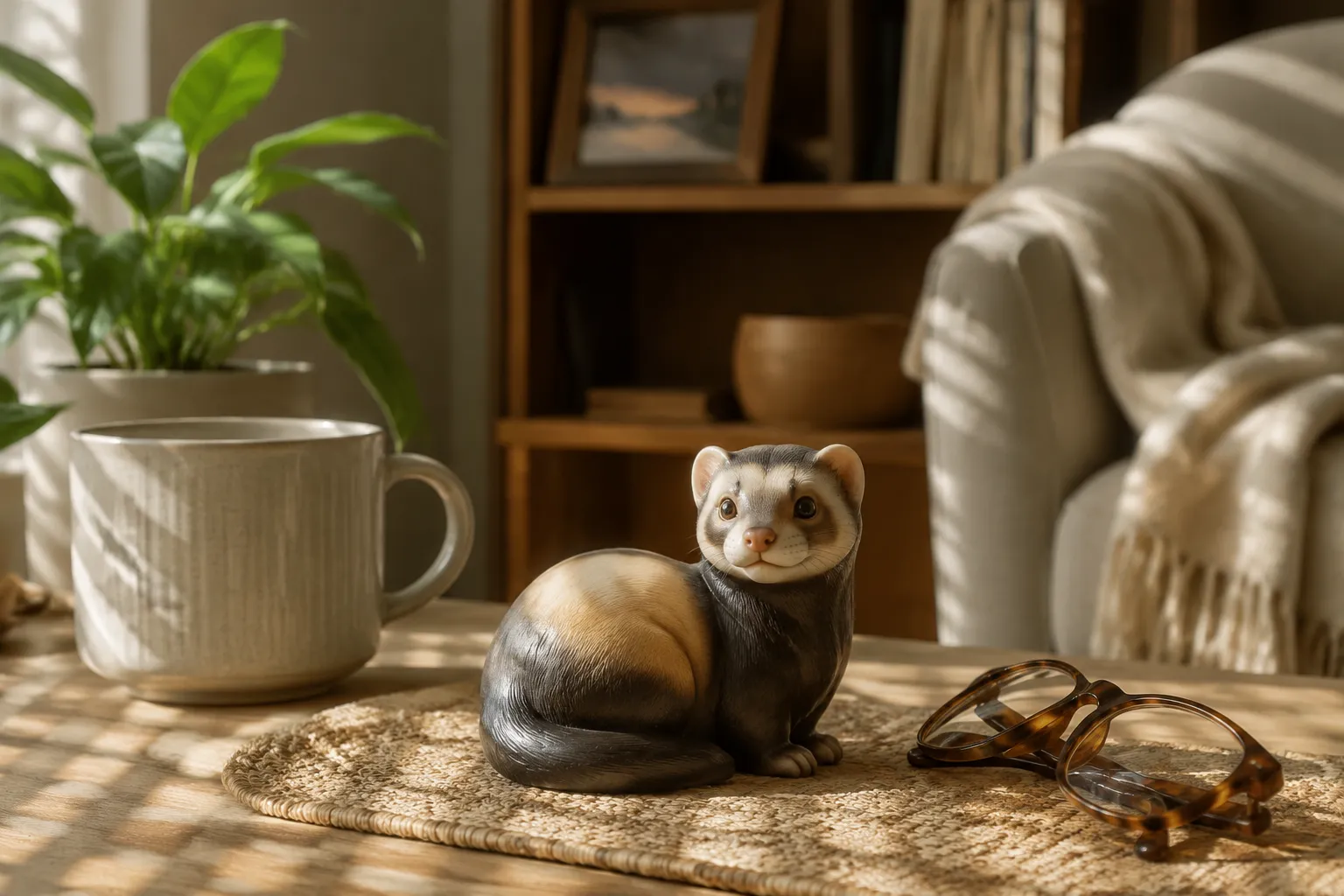
You reach across the home-office desk for the warm little weight that used to drape over your shoulder while you typed, and your fingers land on cool resin instead. That's the moment most people decide between a ferret figurine and a plush replica.
A custom ferret figurine lasts far longer than a plush replica. Full-color resin resists fading, matting, and dust for decades, while plush fabric flattens and yellows within a few years. Figurines take longer to make, often several weeks for a custom sculpt, versus days for a mass-produced plush.
Quick Takeaways
- Resin figurines outlast plush by decades — no matting, no fading, no fabric breakdown over time.
- Plush wins on speed and softness — off-the-shelf pieces ship in days, not weeks.
- Custom sculpts take weeks because a real artist models them — you're paying for time, not stock.
- Compare longevity and turnaround before you commit using this guide to custom sculpted pet portraits and the plush alternatives beside them.
Why This Comparison Is Really About Time, Not Just Texture
Most guides frame this as soft versus solid. Cuddly plush on one side, display figurine on the other. Pick your mood, they say.
That framing misses the real question. What you're actually choosing between is two different relationships with time.
A plush replica is built for the present. You hold it now. It's warm against your cheek now. But fabric is a clock running backward. The nap flattens where your hands rest. The seams loosen. The white belly fur goes the color of weak tea.
A resin figurine is built for later. It asks nothing of you today, no cuddle, no comfort. In return it stays. Ten years on, the sable mask on your ferret's face reads exactly as sharp as the day it arrived.
Here's the part people overlook. A ferret's whole presence in your life was motion and sound. The dook-dook chatter when they got the zoomies. The soft thump of a war dance across hardwood. The scratch of claws inside a pant leg. Neither object brings that back. But each one holds a different fragment of it, and that's the choice nobody names out loud.
The Two Objects Hold Different Kinds of Memory
Think of it as two ways to keep a bond in the room with you.
The plush holds the tactile memory. Weight, softness, the instinct to squeeze something small. That matters more than we admit, especially in the first weeks after a loss when your hands don't know what to do with themselves.
The figurine holds the visual and spiritual memory. Posture. The exact tilt of a curious head. The way your ferret sat up like a tiny question mark. It becomes a fixed point, a small sacred space on a shelf that your eye returns to on hard days.
"The plush is for your hands. The figurine is for the years. Most people don't realize they're grieving on two different timelines."
Which One Actually Lasts: The Honest Durability Breakdown
Let's talk numbers, because "lasts longer" is easy to say and harder to prove.
Plush toys are made of polyester fiberfill wrapped in short-pile fabric. Both degrade in predictable ways. UV light breaks down dye. Body oils and dust settle into the fibers. Washing (which you'll need to do) mats the pile permanently. In our experience talking with pet families, a well-loved plush shows visible wear inside two to four years, and looks noticeably tired by year five.
Full-color resin behaves differently because the color isn't sitting on the surface. In quality 3D-printed resin figurines, the pigment is printed into the material itself, voxel by voxel, so there's no paint layer to chip or peel. A protective clear coat handles dust and adds a gentle sheen. Kept out of direct, all-day sun, a resin piece holds its color and detail for decades.
Here's the durability comparison at a glance:
| Factor | Plush Replica | Custom Resin Figurine |
|---|---|---|
| Typical lifespan | 3-5 years of daily handling | Decades with basic care |
| Color fade | Noticeable in 2-4 years | Highly resistant (UV-stable resin) |
| Physical wear | Matting, flattening, seam stress | Minimal; hard surface |
| Cleaning | Spot-clean or wash (causes matting) | Wipe with a soft, dry cloth |
| Repairability | Difficult once fibers break down | Stable; no moving parts to fail |
One thing we'll say plainly: durability isn't the only thing that matters, and a figurine that sits in a drawer helps no one. If you know yourself and you're someone who needs to hold the thing, longevity is the wrong metric to optimize for. More on that in the counter-point.
What "Care" Actually Looks Like
People assume figurines are fragile and plush is easy. It's usually the reverse.
A resin figurine needs almost nothing. Wipe it with a dry microfiber cloth once a month and keep it off a sun-blasted windowsill. That's the entire maintenance routine. No washing, no fluffing, no worrying about a puppy or a curious kid pulling out the stuffing.
A plush replica needs active care to stay presentable. Dust settles fast into fabric. If it lived on a bed or a couch, it'll pick up oils and odors and need cleaning, and every cleaning shortens its life. That's not a knock on plush. It's just the honest tradeoff for softness.
How Long Each Takes to Make (And Why the Wait Is the Point)
This is where the two paths split hardest.
A plush replica, if it's a stock design or a semi-custom print, ships in days. There's no creation happening for you specifically. You're buying something that already exists. Speed is its gift, and when you're raw with fresh grief, speed is not nothing.
A custom figurine takes weeks because a human being is actually making it. And the sequence matters, so here's how a full-color 3D-printed portrait typically comes together:
- You submit photos and the studio's team reviews your ferret's markings, posture, and personality cues.
- A master 3D artist digitally sculpts the model, shaping the face, the arch of the spine, the set of the ears.
- You review a preview and request adjustments so the sculpt reads like your ferret, not a generic mustelid.
- The piece is precision 3D printed in full-color resin, with the markings printed directly into the material.
- A clear protective coat is applied by hand, the one manual finishing step, then it's carefully packed and shipped insured and tracked.
At PawSculpt, the process starts with a free instant AI preview on the site, and once you place a deposit, an artist delivers a 3D preview within seven days. Delivery typically runs 27 to 40 days in the US, and 33 to 47 days internationally, after final payment. We don't promise faster, because rushing the sculpt is how you end up with a portrait that isn't really your pet.
Here's a realistic timeline comparison:
| Stage | Plush Replica | Custom Resin Figurine |
|---|---|---|
| Order to production start | Immediate (stock item) | After photo review and deposit |
| Creation | None (pre-made) | Digital sculpting + printing |
| Your input | Minimal | Preview and revision built in |
| Typical total wait | A few days | Several weeks |
The wait is doing something, and this is the counterintuitive part. The weeks between ordering and receiving a custom sculpt function as a small ritual of remembrance. You choose the pose. You dig through old photos and sit with them. You approve the preview and feel a flicker of recognition. By the time it arrives, you've already spent time with your ferret's memory in a deliberate way. The plush skips all of that, which is exactly why it feels lighter, in both senses of the word.
"A ferret is all curve and motion. Our job is to freeze one honest gesture in resin, not to copy a photo, but to hold the character underneath it."
— The PawSculpt Team
The Counter-Point: When Plush Is Genuinely the Better Choice
We sculpt figurines, so you'd expect us to crown the figurine. But that would be dishonest, and you'd see through it anyway.
Plush is the right call in several real situations.
If a child is grieving, softness is medicine. A kid who lost their ferret needs something to hold at 2 a.m., not a display piece they're told not to touch. The huggability is the whole point.
If you need it now, plush wins on speed with no contest. Some anniversaries and hard dates don't wait several weeks.
If your budget is tight, a modest plush honors your pet without strain. A memorial that causes financial stress isn't much of a memorial. The bond doesn't get more sacred because you spent more.
And if you're someone who processes grief through touch, be honest about that. A figurine you admire from across the room may not give you what a worn plush pressed to your chest can.
There's also a quieter truth. Some people find a hyper-detailed likeness of a lost pet too much to look at in the early weeks. A softer, simpler plush can feel gentler when the loss is fresh, and a sculpted portrait can wait until you're ready to meet your pet's face again. Grief has its own timeline, and the American Veterinary Medical Association's pet loss resources are a level-headed place to start if you're in the thick of it.
So the real answer isn't "figurine, always." It's this.
"Buy the plush for the nights. Buy the figurine for the decades. Some families, wisely, buy both."
Making the Decision: A Simple Framework
If you like clear rules, here's an if-then way to cut through it.
- If you want to hold it → plush. Touch is the priority.
- If you want to display it and keep it → figurine. Longevity is the priority.
- If it's for a young child → plush, at least first.
- If it's a lasting memorial or a milestone gift → figurine. The permanence is the message.
- If you can't decide → start the figurine now (since it takes weeks) and grab a plush to bridge the gap.
That last one surprises people. Because the figurine has a lead time, you can order it, then pick up an inexpensive plush the same day. The plush covers the raw early stretch. The figurine arrives once you've steadied, ready to become the long-term keepsake. You're not choosing between two objects so much as sequencing them.
For living ferrets, by the way, this logic flips toward celebration. A figurine of a ferret who's very much alive, mid-war-dance or curled in a dead-asleep comma shape, is one of our favorite kinds of commission. It captures the spirit of a personality while it's still bounding around your apartment, and it becomes something you'll treasure long after. Plenty of families explore custom sculpted pet portraits for exactly that reason, not for loss, but for a legacy they get to enjoy together.
A Note on Likeness (Set Your Expectations Right)
Whichever you choose, know what you're getting.
A good plush is a cozy approximation. Soft shape, general coloring, a friendly face. Nobody expects it to be your ferret's twin.
A good figurine is a sculpted portrait, an artist's interpretation of your pet's character, posture, and unique markings. It's a portrait, not a photocopy. Anyone promising a flawless photographic clone in resin is overselling. The magic of a well-made piece isn't that it fools you into thinking it's real. It's that it captures the one gesture that was unmistakably them, the head-tilt, the sprawl, the sly look before a sock heist.
What to Expect From a Custom Ferret Figurine
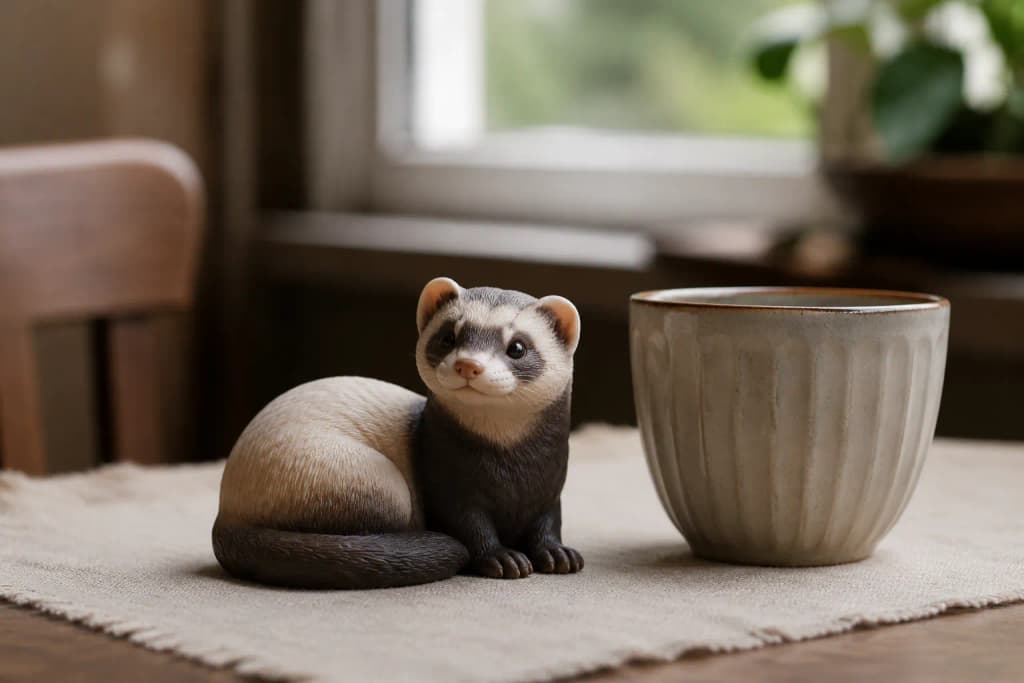
Ferrets pose a specific challenge that dogs and cats don't. They're long, low, and rarely still. So photos matter more here than with almost any other pet.
A few things that genuinely help the artist:
- Shoot at ferret level, on the floor, not from standing height looking down.
- Get the markings clearly — the mask, the mitts, the bib, the tail tip. These are your ferret's fingerprint.
- Capture a characteristic pose, even a slightly blurry action shot, since it tells the artist how your ferret carried themselves.
- Use natural light near a window rather than harsh overhead flash.
You don't need a professional shoot. Phone photos work well when they're clear and well-lit. The studio's team will tell you if they need more angles before sculpting begins.
Frequently Asked Questions
Does a ferret figurine last longer than a plush replica?
Yes, and it isn't close. Full-color resin holds its color and detail for decades because the pigment is printed into the material rather than sitting on top. A plush replica, by contrast, mats and fades within a few years of regular handling. If longevity is your priority, the figurine is the clear choice.
How long does a custom ferret figurine take to make?
Several weeks, because a human artist is genuinely sculpting it for you. The process moves through photo review, digital sculpting, a preview you approve, full-color 3D printing, and a protective clear coat. Plush replicas ship in days since nothing is being made specifically for your pet.
Is a custom ferret figurine worth it compared to a plush?
It depends on what you need from it. For a lasting memorial or a milestone keepsake you'll display for years, the figurine's permanence and likeness make it worth the wait. For cuddling, a grieving child, or a tight budget, a plush is the kinder, faster choice.
How do I care for a resin ferret figurine?
Very little upkeep. Wipe it with a soft dry cloth about once a month and keep it away from a windowsill that gets direct sun all day. There's no washing, no fluffing, and no stuffing to worry about, which is part of why it lasts so long.
Can I get a figurine of a ferret who's still alive?
Absolutely, and it's one of the most joyful commissions there is. Capturing your ferret mid-war-dance or curled in their signature sleep pose becomes a keepsake you get to enjoy together, and one that holds their spirit long after.
Ready to Celebrate Your Pet?
Every pet has a story worth preserving. Whether you're honoring a beloved companion who's crossed the rainbow bridge or celebrating your furry friend's unique personality, a custom PawSculpt figurine — a sculpted portrait, not a photocopy — captures the character that makes your pet one-of-a-kind. If you've weighed the ferret figurine against a plush replica and want something built to last decades, this is where you start.
Start with a free instant AI preview, review your artist's 3D sculpt before anything is printed, and receive your piece carefully packed, insured, and tracked.