
Why Your Dalmatian's Spots are Like a Fingerprint: 4 Steps to Ensure Your Figurine isn't 'Generic'
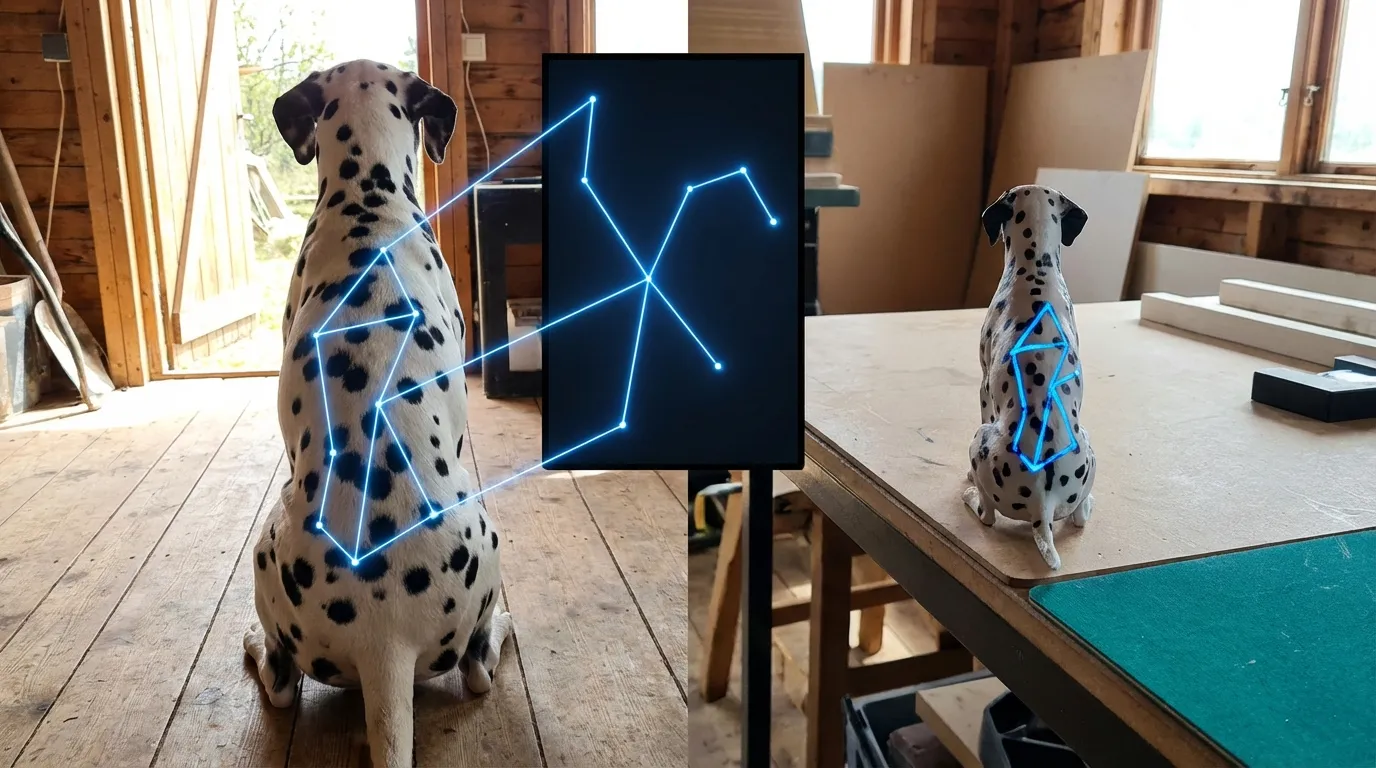
The smell of fresh coffee mingles with the sharp scent of ozone from the printer room, but my eyes are fixed on a high-resolution monitor, tracing the chaotic, beautiful map of black ink on white fur. Every Dalmatian owner knows the truth when they look closely at their dog's coat: those Dalmatian spot patterns aren't just random noise; they are a topographic map of a specific soul.
Quick Takeaways
- The "Snowflake" Rule — No two spots are perfectly round; look for the jagged edges that define your dog.
- Hidden Geometries — Most Dalmatians have a "constellation" of spots on their flank that forms a recognizable shape.
- The Gradient of Truth — Real fur isn't just black and white; capture the grey transition zones where spots merge.
- Preserving the Pattern — Ensure your custom pet figurine utilizes full-color 3D printing to map these details voxel-by-voxel, not by hand.
The Art of Seeing: Beyond Black and White
In the world of digital sculpting, we often talk about "reading" a subject. When most people draw a Dalmatian, they draw a white dog and sprinkle perfect black polka dots over it. It looks like a cartoon. It looks like a toy. It doesn't look like your dog.
The mistake lies in assuming the spots are surface-level decoration. They aren't. They are part of the skin's history.
When we sit down to model a Dalmatian for a custom figurine, we aren't looking at "spots." We are looking for the rhythm of the coat. We look for the heavy clustering on the ears that fades into the stark white of the neck. We look for the "ticking"—those tiny, almost invisible flecks of pigment that appear between the major spots, giving the coat a dusty, lived-in texture that pure white plastic can never replicate.
"A generic Dalmatian has spots. Your Dalmatian has a galaxy."
To truly capture a dog in resin, you have to stop seeing the breed and start seeing the individual. The difference between a generic figurine and a museum-quality keepsake is the willingness to count the specks on the muzzle.
1. Mapping the Constellations
Here is a counterintuitive insight from the sculpting desk: The most important spots are the ones you rarely notice.
Owners often obsess over the large, distinct spots on the back. But the "fingerprint" of a Dalmatian is actually found in the chaotic zones: the ears, the tail, and the paws.
The Ear Map
Dalmatian ears are rarely just white or black. They are usually a marble cake of pigment.- The Rim: Look at the edge of the ear. Is it solid black? Spotted? Or is there a gradient?
- The Interior: The skin inside the ear often carries pink and grey mottling that shows through the thin white fur.
The Tail Gradient
The spots typically get smaller and further apart as they travel down the tail. A generic model will keep the spot size uniform. A true replica respects the tapering of the pattern.| Zone | Typical Pattern Characteristic | The "Generic" Mistake |
|---|---|---|
| Ears | dense merging, marbling | solid black or perfectly round dots |
| Spine | large, distinct, irregular | uniform polka dots |
| Paws | tiny ticking, mixed claws | pure white paws |
| Nose | pink/black mottling (butterfly nose) | solid black nose |
2. The Texture of Pigment
There is a tactile reality to unique pet markings that photography often flattens. When you run your hand over your dog's flank, the black hair often feels slightly different—sometimes coarser, sometimes sleeker—than the white fur.
In our digital sculpting process, we don't just paint color onto a shape. We map the color into the texture.
This is where the technology matters. Traditional hand-painting places a layer of acrylic paint on top of a smooth surface. It covers the texture. It fills in the fine grain of the fur.
Full-color 3D printing is different. The color is inherent to the resin itself. We can print a black hair right next to a white hair. We can capture the "haze"—that soft grey area where a black spot bleeds into the white surrounding it. That haze is where the realism lives. It’s the difference between a sticker and a stain.
3. The Asymmetry of Life
Nature hates perfect symmetry. If you look at the left side of your Dalmatian, it tells a different story than the right. Maybe the left flank has a cluster of three spots that looks like a paw print. Maybe the right shoulder has a massive, isolated ink-blot.
Commonly Overlooked Aspect: The "phantom" spots.
Many Dalmatians have spots on their skin that haven't fully pushed black pigment into the fur. These appear as faint, ghostly grey patches. Most artists ignore these because they aren't "clean."
We love them.
Those phantom spots are evidence of biology. They add depth. When we model these digitally, we dial back the opacity, creating a subsurface scattering effect that mimics how light passes through white fur to reveal the dark skin beneath. It’s a subtle detail, maybe one you only see in certain lighting, but it triggers that subconscious recognition: That’s him.
"Perfection is the enemy of realism. We chase the messy, beautiful truth of biology."
4. Capturing the "Negative Space"
This is the step that requires the most artistic discipline. It’s easy to focus on where the spots are. It is much harder to focus on where they aren't.
The white space on a Dalmatian is just as unique as the black. The expansive white chest, the clear stripe down the snout, the "socks" on the front feet—these negative spaces define the composition of the dog.
When photographing your dog for a custom piece, pay attention to the white.
- Is it a cool, blue-white?
- Is it a warm, creamy white?
- Is the white broken up by "ticking" (tiny specks)?
Pro Tip: Lighting changes white drastically. Indoor yellow bulbs make Dalmatians look beige. Blue daylight makes them look stark. For the best custom 3D print accuracy, take photos of your dog outside on an overcast day. The diffuse light eliminates harsh shadows and reveals the true, neutral tone of the white fur.
Why "Hand-Painted" Fails the Dalmatian
We have great respect for traditional painters. But when it comes to the complex stochastic patterns of a Dalmatian, the human hand has limitations. A brush cannot replicate the density of fur. A brush stroke has a thickness.
Dalmatian spots aren't painted on; they are grown.
This is why we use PolyJet-style technology. It allows us to place color with the precision of a droplet. We can create the jagged, fractal edge of a spot where the black hairs interlock with the white ones. We don't have to approximate. We can replicate.
"The machinery is just a tool; the artistry is in the observation. We use technology to honor the complexity nature created."
— The PawSculpt Team
Frequently Asked Questions
Why do Dalmatian spots change over time?
Dalmatians are actually born pure white! The spots are pigmented skin cells that only become visible as the puppy grows. Throughout their life, especially in the senior years, they may develop "ticking"—smaller flecks of color between the main spots. This means a figurine of your dog at age two will look different than one at age twelve.Can 3D printing capture the tiny ticking spots?
Absolutely. This is the primary advantage of our process over traditional crafting. Because we print voxel-by-voxel (think of it like 3D pixels), we can render the tiny, pepper-like specks that would be impossible to paint accurately by hand without looking messy.What photos do I need for a Dalmatian figurine?
Symmetry is a myth with this breed. We need clear, well-lit photos of both sides of the dog. A photo of the left side does not tell us what the right side looks like. We also highly recommend a "top-down" photo of the head and spine to see how the spots transition from the neck to the back.Do you paint the spots on manually?
No, and that's a good thing for accuracy. We digitally sculpt the dog and then use full-color resin 3D printing. The color is cured directly into the material. This prevents the "brushstroke texture" that often ruins the illusion of fur and ensures the spots are exactly where they belong.Ready to Celebrate Your Pet?
Every pet has a story worth preserving. Whether you're honoring a beloved companion who's crossed the rainbow bridge or celebrating your furry friend's unique personality, a custom PawSculpt figurine captures those details that make your pet one-of-a-kind. We specialize in the complex Dalmatian spot patterns that make your dog who they are.
Free instant AI preview • 3D artist preview within 7 days • 5 free revisions