DIY 3D Scan vs Studio Sculpt: Which Captures a Maine Coon's Fur More Accurately?
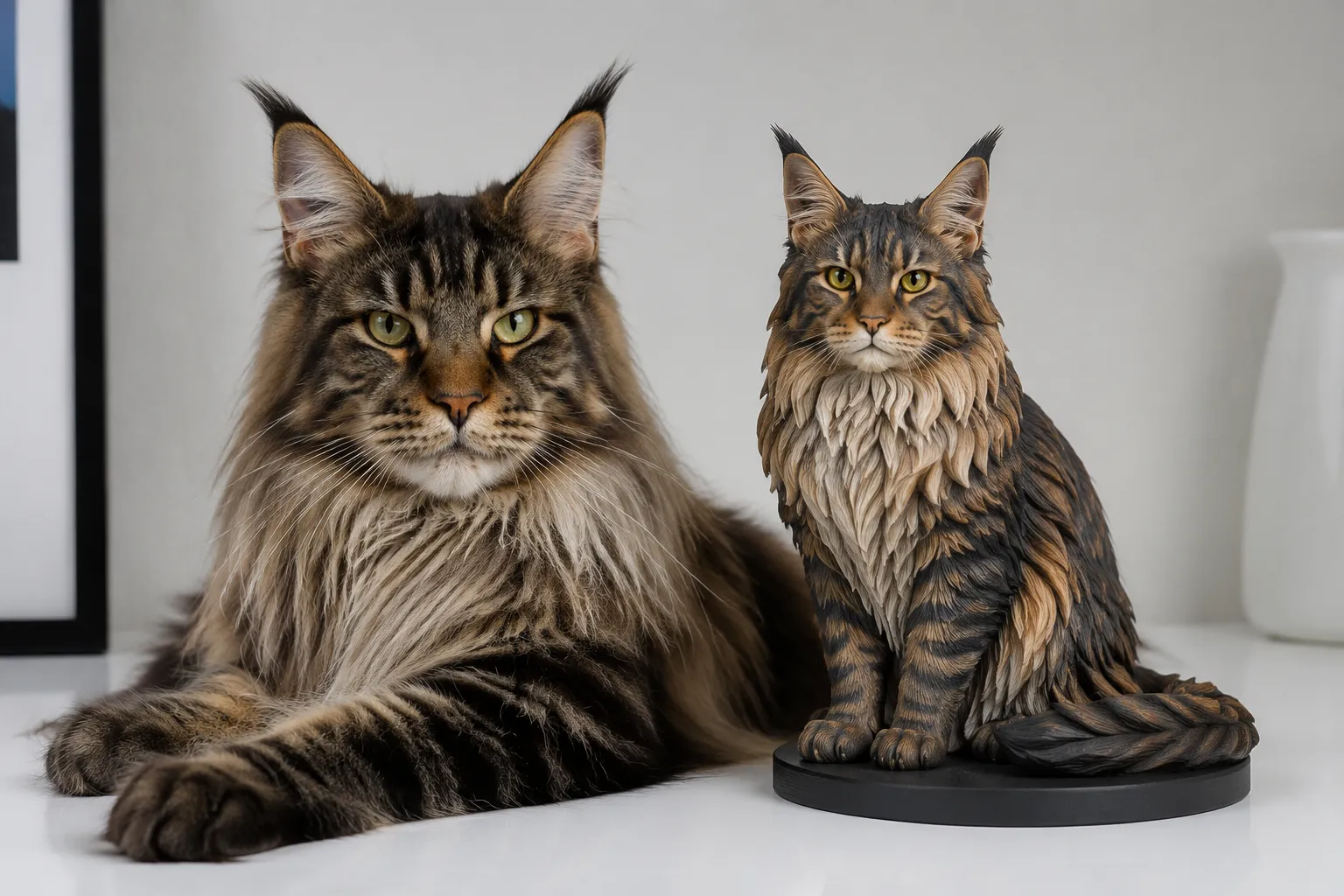
Your phone's flashlight catches it first—that silvery ruff around your Maine Coon's neck, each strand catching light like frost on a window. You're crouched on the home office floor attempting a DIY 3D scan of your pet, phone circling, and already you can feel the app choking on all that fur.
Yeah. We've watched this exact moment go sideways more times than we can count.
Quick Takeaways
- 3D scanners read long fur as noise — they smooth fluffy coats into a solid blob, losing the exact detail you love.
- Studio digital sculpting reconstructs fur intentionally — an artist decides where each tuft of Maine Coon coat goes.
- Photo quality beats capture method every time — a great sculpt from 8 clear photos beats a bad scan from 200.
- Full-color 3D printing carries the coat's color into the material itself, which is why services like PawSculpt's custom pet figurines hold up on markings.
- Neither method is "better" universally — it depends on your cat, your photos, and how you plan to display the result.
Why a Maine Coon's Coat Breaks Almost Every Capture Method
Here's the thing nobody tells you when you Google "how to make a figurine of my cat."
Maine Coons are a nightmare to capture. Not because they're difficult cats—though anyone who's owned one knows the drama—but because their fur does something that fights every single technology we throw at it.
Think about what you actually love visually. That lion-like ruff. The britches on the back legs. The lynx tips on the ears. Those tufts of fur sprouting between the toes. The tail that looks like someone attached a raccoon by mistake.
Now here's the problem: all of that is soft geometry. It's not a shape. It's thousands of individual strands that move, catch light, and change color depending on how she's sitting.
A short-haired tabby? Easy. The surface is basically the true shape of the cat. But a Maine Coon's silhouette is a suggestion. The "edge" of your cat isn't the edge of her body—it's the edge of her fluff, which is different in every photo you take.
"You're not trying to copy a shape. You're trying to capture the way light gets lost in fur."
This is the whole reason the DIY-vs-studio question gets confusing. People compare the two methods like they're comparing cameras. They're not. They're two completely different philosophies about what "accurate" even means for a long-haired cat.
And that distinction changes everything about which one you should pick.
The DIY 3D Scan Reality Check
Let's get practical, because this is where most people burn a weekend.
A DIY 3D scan usually means one of two things: a phone app that stitches together video or photos (photogrammetry), or a phone with a LiDAR sensor doing depth mapping. Both have gotten genuinely impressive for hard objects—furniture, faces, shoes, statues.
For your Maine Coon? Buckle up.
What actually happens when you scan fluffy fur
The scanner is looking for surfaces. Solid, defined, stay-still surfaces. Fur is none of those things. So the software does what software does when it's confused: it guesses, then it smooths.
The result is almost always a cat that looks like it got caught in the rain. That gorgeous ruff collapses into a lumpy collar. The tail loses its plume and becomes a fat sausage. Ear tufts vanish entirely because the software reads them as stray points—noise—and deletes them.
We had a customer send us a DIY scan she'd spent two evenings perfecting. Her exact words: "Why does my cat look like a wet ferret?" She wasn't wrong. The scan was technically accurate to the messy point cloud. It just wasn't accurate to her cat.
The counterintuitive part: a more detailed scan often looks worse, not better. More data points on a fuzzy surface just means more confusion, more artifacts, more of that melted-candle look around the edges.
Where DIY scans genuinely shine
We're not here to trash the technology. DIY scanning has a real place.
- Short-haired pets — a Beagle, a Boxer, a sleek black cat? Scans can nail these.
- Capturing exact proportions — body length, head-to-body ratio, that specific pose.
- Fast, free reference — even a bad scan gives an artist useful information about mass and stance.
- Living pets who'll hold still — good luck, but if yours will, you get real dimensional data.
So a scan isn't worthless for a Maine Coon. It's just not a finished product. It's raw material. And treating a raw scan like a final figurine is the mistake we see most often.
The honest cost of going DIY
Free isn't free when it eats your Saturday. Here's the trade you're actually making.
| Factor | DIY 3D Scan Reality |
|---|---|
| Cost | Low (free apps to ~$40 for premium) |
| Time investment | 2-6 hours, plus cleanup you'll probably outsource |
| Fur accuracy | Poor on long coats—smooths and deletes detail |
| Learning curve | Steep if you want anything usable |
| Best for | Short-haired pets, proportion reference, tinkerers |
If you love the process and you own a short-haired pet, DIY is a genuinely fun rabbit hole. If you have a Maine Coon and you want the coat to look right, keep reading.
Studio Sculpt: What Digital Artists Actually Do
Okay, let's clear up a big misconception first, because it trips people up.
When we say studio sculpted figurine, people picture someone hunched over a clay model with tiny tools. That's the old way. Modern studios—including how we work at PawSculpt—do this digitally. A master 3D artist builds your cat in software, sculpting form and fur virtually, then the model gets precision 3D printed in full color.
No clay. No molds. A digital sculpt, then a full-color resin print.
Why "interpreted" beats "copied" for fur
Here's the insight that reframes the whole debate.
A scanner copies. A sculptor interprets. And for a Maine Coon, interpretation wins—because a human artist looks at your photos and makes decisions a machine can't.
The artist sees the ruff and thinks: that needs to read as directional flow, not a solid mass. They see the tail and build it as a plume with intentional separation. They look at three photos where the ear tufts appear at different angles and they reconstruct what's actually there, filling in what any single photo missed.
That's the magic. A scan can only capture what one moment showed the sensor. A skilled artist synthesizes every photo you give them into one coherent, alive-looking cat.
"A machine captures the fur that was there. An artist captures the fur you remember."
The part everyone forgets: fur is about light, not lumps
This is the commonly overlooked piece.
When you picture your cat's coat, you're not picturing geometry. You're picturing how light moves through it—the silvery shimmer on the guard hairs, the way the undercoat glows warmer, the shadow that pools under the ruff.
At figurine scale (a few inches tall), you physically cannot reproduce individual strands. Nobody can. So the real skill isn't sculpting every hair. It's sculpting implied texture and then letting full-color printing do the heavy lifting on how it reads.
That's why the color technology matters so much here, which we'll get to. Because a beautifully sculpted coat with flat, wrong color looks fake. But a moderately detailed sculpt with accurate color transitions reads as convincingly furry from across the room.
Personal aside from our studio: our artists actually argue about this constantly. The "more detail" camp versus the "let the color sell it" camp. After thousands of Maine Coons, the color camp basically won. The most lifelike figurines we've made weren't the ones with the most sculpted strands—they were the ones where the tabby striping and the ruff's silver-to-cream gradient landed perfectly.
How the Color Gets There (And Why It's Not Paint)
Quick technical detour, because this is where a lot of comparison articles get it flat wrong—and it directly affects Maine Coon accuracy.
A lot of custom figurines are sculpted, then colored by hand after the fact. That's one approach. Ours is different, and the difference matters for a coat as complex as a Maine Coon's.
We use full-color 3D printing. The color is printed into the resin voxel by voxel—it's part of the material itself, not a coat applied on top. So a brown mackerel tabby's stripes, the white bib, the smoky undercoat, the exact spot where his mask fades into his cheek ruff—all of that is baked into the print, right where it belongs.
The only manual step afterward is a clear protective coat for durability and a bit of natural sheen. That's it.
Why this matters for fur specifically: Maine Coon coloring is rarely one flat color. It's gradients. It's ticking. It's that agouti banding where a single hair goes light-dark-light. Full-color printing reproduces those transitions directly in the material, so the coat doesn't just have the right shape—it has the right depth.
The finished piece has a natural 3D-print grain to it—fine texture you can see up close. Honestly, we love that. A Maine Coon shouldn't look like polished plastic. It should look like it has texture, because it does.
"Every whisker and every color shift tells us something about your cat. Our job is to keep the ones that make her her."
— The PawSculpt Team
Head to Head: Which Captures the Coat More Accurately?
Time for the direct comparison you came here for. But we have to define "accurate" first, because it splits two ways.
Geometric accuracy = does the shape/pose/proportion match? Perceptual accuracy = does it look and feel like your cat when you glance at it on the shelf?
For most pet parents, perceptual accuracy is what actually matters. You're not measuring your figurine with calipers. You're catching it out of the corner of your eye and feeling something.
| What You're Judging | DIY 3D Scan | Studio Digital Sculpt |
|---|---|---|
| Body proportions | Very good (if scan is clean) | Very good (built from photos) |
| Long fur / ruff | Poor—smooths and flattens | Excellent—intentionally reconstructed |
| Ear tufts & lynx tips | Usually lost as "noise" | Preserved and shaped |
| Tail plume | Collapses into a tube | Built with volume and flow |
| Color accuracy | Often washed out or patchy | Accurate via full-color printing |
| The "feels like her" factor | Hit or miss | Consistently strong |
So the blunt answer: for a Maine Coon's fur specifically, a studio digital sculpt captures it more accurately—not because scanning is bad technology, but because long fur is the exact case scanning handles worst and interpretation handles best.
If you owned a short-haired pet, this table would look a lot more even. Breed genuinely changes the answer, and any honest comparison has to say so.
The hybrid nobody talks about
Here's a little insider move.
The best results we see often combine both. A DIY scan (or even just a good set of photos) gives the artist accurate proportions and pose. Then the artist rebuilds the fur on top of that dimensionally-correct foundation.
You get the geometric accuracy of a scan and the fur artistry of a sculpt. If you've already made a scan and felt disappointed, don't toss it—it might still be useful reference data. Send it along.
What Actually Determines Accuracy (Hint: It's Your Photos)
Ready for the real plot twist?
The method matters way less than most people think. The single biggest factor in Maine Coon figurine accuracy is the reference material you provide. Photos. Full stop.
We've turned mediocre scans into stunning figurines because the photos were great. And we've struggled with perfect scans because the photos were three blurry shots in bad lighting. Garbage in, garbage out—it's that simple and that unforgiving.
So whether you go DIY, studio, or hybrid, the leverage is in your camera roll.
The photos that actually work
According to general photography and even pet-documentation guidance echoed by groups like the ASPCA on keeping clear ID photos of your pet, natural light and multiple angles beat everything. Here's what our artists genuinely need.
| Shot | Why It Matters | Quick Tip |
|---|---|---|
| Straight-on face | Captures expression & mask pattern | Get down to eye level |
| Full profile (side) | Shows ruff, body length, tail | Whole cat in frame, sharp |
| 3/4 angle | Bridges front and side, most lifelike | The "portrait" angle |
| Top-down or high angle | Shows back markings & tail base | Great for tabby striping |
| Close-up of coat | Reveals color transitions & texture | Fill the frame with fur |
| The "her" photo | Captures personality/pose | The one that makes you smile |
Lighting is the whole ballgame
If you take one thing from this article, take this: shoot in soft, even, natural daylight.
Direct sun blows out the silver in a Maine Coon's coat and kills the shadow detail in the ruff. A bright, overcast day near a window is perfection—that diffused light wraps around the fur and shows every color transition without harsh blacks or blown-out whites.
Avoid your phone's flash. It flattens everything and turns three-dimensional fur into a pale smear. And skip heavy filters—that warm Instagram glow shifts your cat's actual colors and sends the artist down the wrong path.
"The best reference photo isn't the prettiest one. It's the one that looks most like her when she's just being herself."
So what? Because 20 minutes near a window on a cloudy afternoon will do more for your figurine's accuracy than any scanning app on earth. That's not an exaggeration. That's the order of importance, and almost everyone gets it backward.
What to Expect From the Creative Process
If you decide to go the studio route, here's the general shape of how a custom pet figurine comes together. We're keeping this framework-level on purpose—specific turnaround times, revision details, and guarantees change, so check pawsculpt.com for the current specifics.
- You send photos. The more angles and the better the light, the closer the result. This is your homework and it's the most important step.
- A master 3D artist digitally sculpts your pet. Form first, then the coat—ruff, tail plume, tufts, all of it built intentionally.
- You review a preview. This is where you speak up. "The ruff needs more volume." "His mask goes further up." Real cat parents catch details we'd never know.
- Full-color 3D printing brings it to life. Color printed into the resin, markings and gradients included.
- A protective clear coat is applied, then it ships to you.
The preview step is the one people underuse. You know your cat better than anyone. That silver saddle, the slightly crooked ear, the way one cheek tuft is bigger—that's the stuff that makes you gasp when you open the box. Speak up during review and you'll get a figurine that feels like her, not a generic fluffy cat.
For a deeper walkthrough and answers to the practical questions, our pet figurine resource guides go further than we can here, and the PawSculpt FAQ covers the logistics.
A quick word on memorial pieces
We have to acknowledge this, because a lot of you reading are here for a heavier reason.
If your Maine Coon has crossed the rainbow bridge, you might not have a perfect photo library. That's okay. Bring what you have. Our artists have reconstructed beloved cats from a handful of imperfect phone photos more times than we can say—and the review step becomes even more precious, because it's your chance to say "yes, that's him" one more time.
There's no wrong amount of photos to start with. Start with what you've got.
The Bottom Line on DIY vs Studio
Let's be real with each other.
If you own a short-haired pet, love a good technical project, and want something dimensionally accurate for cheap—a DIY 3D scan pet project is genuinely worth your weekend. It's fun and it can turn out great.
But if you've got a Maine Coon and what you love is the coat—that ruff, that plume, that impossible fluff—the honest answer is that a studio digital sculpt with full-color printing is going to capture it more faithfully. The technology of scanning fights long fur. The craft of sculpting embraces it.
And no matter which path you choose, go take better photos first. That's the real cheat code.
Frequently Asked Questions
Can a DIY 3D scan capture a Maine Coon's long fur accurately?
Usually not well. Scanning technology is built to read solid surfaces, so it treats fluffy fur as noise—smoothing the ruff into a collar, deleting ear tufts, and flattening the tail plume. You'll often get accurate body proportions but a coat that looks wet or melted. For long-haired breeds, a scan is best used as reference data, not a finished product.
Is a studio sculpted figurine really better than a 3D scan?
For a Maine Coon's fur, yes—and here's why. A scan copies exactly what the sensor saw in one moment. A digital sculptor synthesizes all your photos and interprets the fur intentionally, building volume and flow a machine can't. That said, for short-haired pets the two methods are much closer, so the "better" answer genuinely depends on your pet.
What photos work best for a realistic pet figurine?
Multiple angles in soft, even daylight. Aim for a straight-on face shot at eye level, a full side profile, a 3/4 "portrait" angle, and at least one tight close-up of the coat to show color transitions. Skip the flash and skip filters—both distort your cat's true colors and mislead the artist.
Are PawSculpt figurines hand-painted?
No. We use full-color 3D printing, where color is printed directly into the resin material itself rather than applied on top. The only manual step is a protective clear coat for durability and a natural sheen. This is what lets a Maine Coon's gradients and ticking read with real depth.
How many photos do I need to get started?
More is better, but you don't need a professional shoot. A solid handful of clear, well-lit shots from different angles is enough for our artists to work with. For memorial pieces where you only have a few imperfect photos, bring what you have—the preview review step lets us refine details together.
Ready to Celebrate Your Pet?
Every pet has a story worth preserving. Whether you're honoring a beloved companion who's crossed the rainbow bridge or celebrating your Maine Coon's ridiculous, magnificent floof, a custom PawSculpt figurine captures the details that make your cat one-of-a-kind—right down to that silver ruff and plumed tail.
Skip the frustration of a DIY 3D scan pet project that smooths away everything you love. Let a master 3D artist sculpt your cat and bring it to life in vibrant full-color resin, so the finished piece looks like her.
Visit pawsculpt.com to explore our full-color 3D printing process, preview turnaround, flexible revisions, and quality guarantee.