
Etsy Seller vs PawSculpt: Turnaround and Resin Quality for Your Bernese Mountain Dog
"The details are not the details. They make the design." — Charles Eames, repeating his wife's words in a 1972 film about their work.
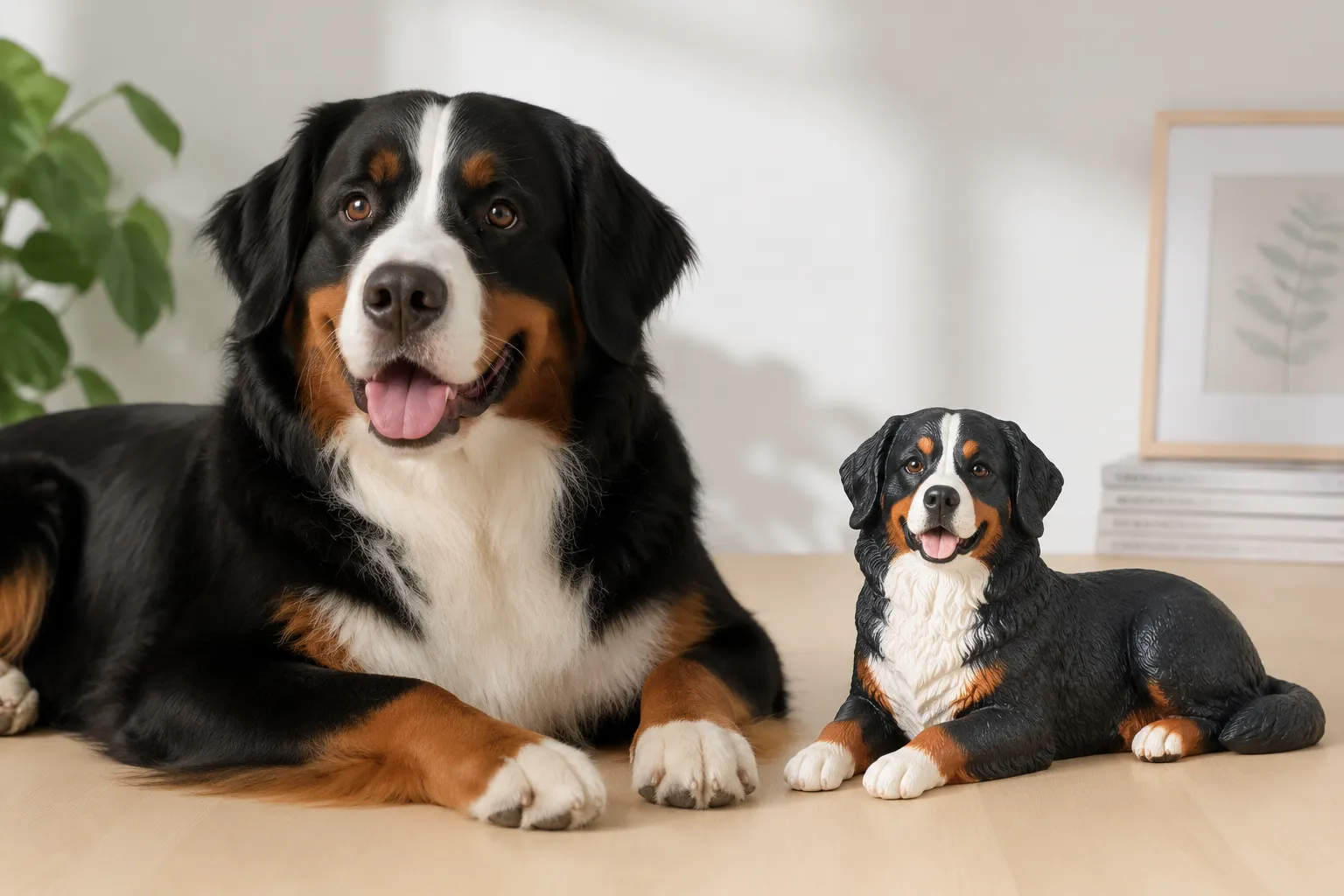
A figurine of a Bernese sits on a garage workbench under a clip-on lamp, and the rust patch above its eye is painted a shade too orange. That single wrong color is the whole story of the Etsy pet figurine vs. studio-printed decision—turnaround, resin quality, and the markings that make your dog your dog.
Quick Takeaways
- The tri-color coat is the real test — black, rust, and white placement breaks more reproductions than any other factor.
- Etsy turnaround is a range, not a promise — solo makers juggle queues, so "3 weeks" can quietly become eight.
- "Resin" describes a dozen different things — finish, durability, and color permanence vary wildly between sellers.
- Color baked into the material outlasts color sitting on top — explore how full-color 3D printed figurines handle complex markings.
- Reference photos decide 80% of the outcome — three good angles beat thirty blurry ones.
Why a Bernese Mountain Dog Is the Hardest Coat to Reproduce
Here's something most comparison guides skip entirely: not all dogs are equally difficult to recreate. A solid-black Lab is forgiving. A Bernese Mountain Dog is not.
The breed carries what the American Kennel Club's breed standard calls a tri-color coat—jet black as the base, rich rust over the eyes, on the cheeks, the chest, and the legs, with crisp white on the chest (the "Swiss cross"), the muzzle blaze, the tail tip, and ideally the paws. Three colors. Specific borders. Symmetry that your eye notices instantly when it's wrong, even if you can't name what's off.
We've worked with thousands of pet families, and the Bernese orders are the ones our team flags before production even starts. Why? Because the margin for error is tiny. Move the rust patch a few millimeters and the face stops looking like your dog. Blur the line between black and white on the chest and the whole figure reads as "generic mountain dog" instead of Bruno, who slept under your desk for nine years.
"With a Bernese, you're not capturing a color. You're capturing a map—and every owner knows their dog's map by heart."
— The PawSculpt Team
So the first question in any Etsy-versus-studio comparison isn't price. It's this: how does this maker handle the boundaries between three colors? That single capability predicts whether you'll be thrilled or quietly disappointed when the box arrives.
The "boundary problem" nobody mentions
Think about where Bernese colors meet. The transition from black to rust isn't a hard line in real fur—it's a gradient, a few hairs of overlap. The white blaze splits the black of the face with surprising precision.
When color is applied as a surface layer (the traditional approach), those boundaries depend entirely on a steady hand and good light. When color is built into the material itself, voxel by voxel, the boundary is data, not dexterity. It renders the same way on the first piece and the thousandth.
That distinction matters more for this breed than almost any other. And it's the kind of thing you only learn after seeing hundreds of these coats come through.
Custom Figurine Turnaround Time: The Number Everyone Quotes Wrong
Let's talk timelines honestly, because this is where the Etsy pet figurine vs. studio question gets practical fast.
Many owners tell us the same thing: they ordered somewhere, saw a friendly "ships in 3 weeks," and then watched the weeks stack up with little communication. This isn't a knock on individual makers. It's a structural reality of how the two models work.
Why solo-maker turnaround is a range, not a date
A single Etsy artist is the designer, the sculptor, the finisher, the photographer, the customer-service rep, and the person who runs to the post office. That's one person holding the entire pipeline. When life happens—a flu, a holiday rush, a backlog of December memorial orders—your piece waits, because there's no second set of hands.
This is the commonly overlooked cost of the lowest-priced option: not the dollars, but the variance. A studio with parallel workflows can run sculpting, printing, and finishing as separate stations. A solo maker runs them in sequence, alone.
Here's the part that surprises people: faster turnaround often comes from more structure, not less care. We're not huge fans of the assumption that "handmade by one person" automatically means more love. Sometimes it means more bottlenecks.
The table below shows the general phases of a custom figurine, regardless of who makes it. We're deliberately not putting hard day-counts on these—anyone who promises you exact dates sight-unseen is guessing—but understanding the stages helps you ask better questions.
| Stage | What Happens | What Slows It Down |
|---|---|---|
| Photo review | Maker confirms your references are usable | Blurry, dark, or single-angle photos |
| Digital sculpting | The 3D model is built from your pet | Complex coats, requested revisions |
| Preview & approval | You see a render before production | Slow back-and-forth, unclear feedback |
| Production | The physical piece is created | Queue depth, single vs. parallel workflow |
| Finishing | Protective clear coat, inspection | Drying/curing, quality re-checks |
| Shipping | Packing and transit | Carrier delays, international customs |
Notice that two of the biggest delays—photo quality and revision rounds—are partly in your control. We'll come back to that.
The counterintuitive timing insight
Most people assume the memorial figurine and the celebration figurine should be ordered on the same timeline. They shouldn't.
If you're ordering to honor a pet who's passed, the emotional clock and the production clock are different. Many families we've worked with say the keepsake mattered more after the first wave of grief settled, not during it. There's no wrong window. But if you're racing a deadline—a birthday, a holiday, an anniversary—build in buffer, and ask the maker directly about their current queue rather than trusting a static listing number.
For PawSculpt's current preview and production specifics, it's always best to check the details on the site rather than trust a number you read in any article, including this one. Timelines shift with season and demand.
Resin Figurine Quality: What That Word Actually Hides
"Resin" sounds like a single material. It isn't. It's a category as broad as "metal," and the resin figurine quality you receive depends on which kind, how it's produced, and how the color lives in it.
This is where a lot of buyers get burned, because the listing just says "high-quality resin" and moves on.
The three things "resin quality" really means
1. Structural resin (the body). This is what gives the piece its weight and resistance to chipping. Cheap castings can be brittle or hollow in a way that cracks if your figurine takes a tumble off the shelf. Sturdier formulations survive real homes with real toddlers and real vacuum cleaners.
2. How color lives in the piece. This is the big one, and it's where the two approaches genuinely diverge. With surface-applied color, the pigment sits on top of the resin. With full-color 3D printing, the color is part of the material—printed into the resin itself rather than laid over it. For a tri-color Bernese, that means the rust-to-black transition is locked into the object, not painted across a curve.
3. The protective layer. Almost every quality piece gets a clear coat or varnish for sheen and protection. At PawSculpt, that clear coat is the only manual step—the color comes from the printing process itself, and the finish protects it and gives it that subtle glow.
Let's be real about what this looks like in hand. A full-color 3D print has a natural fine texture—a faint grain, the honest signature of how it was made. It's not glassy, flawless plastic. We think that's a feature, not a flaw. It reads as authentic, the way a real coat has depth rather than a billiard-ball shine.
"Plastic-perfect looks fake. A little honest texture is what makes your eye believe it's really them."
Myth vs. Reality
Three things we hear constantly, and what's actually true:
Myth: "Hand-finished always means higher quality than 3D printed."
Reality: For complex multi-color coats, color printed into the material reproduces fine markings more consistently than surface application. Different tools, different strengths.
Myth: "All resin figurines are basically the same once they're painted."
Reality: Structural resin, color method, and protective coating vary enormously. Two pieces that look similar in a photo can feel and age completely differently.
Myth: "A glossy, flawless surface signals premium quality."
Reality: A faint print texture under a clear coat often signals a full-color process that captured your pet's actual markings—more honest than a featureless shine.
That middle myth is the expensive one. Plenty of buyers compare two listings purely on the rendered photo and assume equivalence. The photo can't show you how the piece survives a drop, or whether the color will hold its tone in a sunny window.
On UV and the sunny windowsill
Here's an insider detail: where you display the figurine matters for how long it looks right. Color that sits on the surface can fade or yellow faster under direct sun. UV-resistant materials hold their tone longer.
It's a small thing until it's not. We've had customers describe the specific heartbreak of watching a memorial piece slowly lose the warmth in the rust markings over a couple of summers on a south-facing sill. Ask about UV resistance. It's the question almost nobody thinks to ask, and it predicts how the piece looks in year three, not just week one.
Etsy Seller vs PawSculpt: An Honest, Side-by-Side Look
We'll be direct, and we'll be fair—because the right answer genuinely depends on what you want.
Etsy is wonderful for some things. If you want a stylized, illustrative interpretation of your dog, a clay-style cartoon version, or you specifically want to support an individual artist whose aesthetic you've fallen for, an Etsy seller may be exactly right. Some independent makers are extraordinary. We mean that.
But the comparison changes when your priority is lifelike accuracy of a complex coat, predictable turnaround, and consistent resin quality. That's the lane full-color 3D printing was built for.
The table lays it out without spin:
| Factor | Typical Etsy Solo Seller | PawSculpt (Full-Color 3D Printing) |
|---|---|---|
| Best for | Stylized, artistic interpretations | Lifelike accuracy of real markings |
| Color method | Often surface-applied | Color printed into the resin itself |
| Tri-color precision | Depends on individual skill | Consistent, data-driven boundaries |
| Turnaround | Variable, single-person queue | Structured, parallel workflow |
| Consistency | Varies piece to piece | Repeatable across orders |
| Texture | Smooth or painted finish | Natural print grain under clear coat |
| Revisions | Maker-dependent | Preview and revision process—see site |
The micro-story that captures the difference
One order stuck with our team: a family sent photos of their Bernese, Mabel, who had an unusually asymmetric blaze—the white on her face leaned left, a little crooked, entirely hers. They told us a previous keepsake from elsewhere had "corrected" the blaze to make it symmetrical, and it had quietly devastated them. The figure was technically nice. It just wasn't Mabel.
When color and form are sculpted digitally and approved in a preview before production, that crooked blaze gets preserved on purpose, because you signed off on it. The imperfection is the point. Your dog wasn't a breed standard. Your dog was a specific animal with a specific crooked blaze.
That's the deeper reason we built around preview-then-produce: so the asymmetries that make your pet recognizable survive the process instead of getting smoothed away by a well-meaning hand.
When we'd point you elsewhere
If your budget is genuinely tiny and you want something on the shelf this week, a small printed photo or a flat acrylic standee will serve you better than stretching for a full sculpture. We'd rather tell you that than oversell. And if you want a painterly, interpretive piece of fine art rather than a faithful likeness, seek out an independent artist whose style moves you.
A lifelike full-color figurine is one excellent option among several. It happens to be the one that handles a Bernese's coat with the least compromise. That's the honest framing.
What to Expect: Getting a Bernese Figurine Right the First Time
This is the practical core, and it's mostly about photos. Reference photos decide roughly 80% of your outcome. Get them right and almost any capable maker can deliver. Get them wrong and even the best process is guessing.
The photos that actually work
After reviewing countless submissions, here's what separates a usable photo set from a frustrating one:
- Shoot at the dog's eye level, not from above. Looking down distorts proportions and flattens the chest markings.
- Use soft, even daylight—near a window, not under a single harsh bulb. Hard shadows hide the boundaries between black and rust.
- Capture three angles minimum: a straight front, a clean side profile, and a three-quarter view. The three-quarter is the most informative single shot.
- Get one close-up of the face so the blaze, the eye spots, and the muzzle markings are unambiguous.
- Include the full body in at least one frame so leg markings and tail tip are visible.
The most common mistake? Sending many photos that are all the same angle—usually the cute front-facing shot everybody has dozens of. Variety beats volume every time.
This quick reference shows what each angle contributes and why it matters:
| Photo Type | What It Captures | Why It Matters |
|---|---|---|
| Eye-level front | Face symmetry, chest blaze | Sets the recognizable "front" view |
| Side profile | Body proportion, tail line | Anchors the silhouette |
| Three-quarter | Depth, how markings wrap | Most useful single reference |
| Face close-up | Eye spots, muzzle, blaze edges | Locks in the Bernese "map" |
| Full body | Leg markings, paw white | Completes the lower coat |
So what? Because every revision round you avoid by sending good photos up front is time you save on the back end. Good references shorten turnaround. The two things you care about—accuracy and speed—both improve from the same fifteen minutes of careful photography.
A few words on what the figure can and can't do
We're not vets, and a figurine can't bring anyone back. We won't pretend otherwise. What a faithful piece can do is give grief or love an anchor—something with weight you can hold, set on a shelf, walk past in a hallway.
Many owners describe a specific spatial habit after a loss: the corner where the bed used to be, the spot by the door, the side of the couch no one fills. A figurine doesn't erase that empty space. But several families have told us it changes what the eye lands on—a focal point that says here, this is where I remember them instead of only here is where they're missing.
"An empty corner asks a question. A keepsake gives it somewhere to rest."
Care so it lasts
A full-color resin piece is low-maintenance, but a few habits extend its life:
- Dust with a soft, dry brush or microfiber cloth—skip household sprays that can dull a clear coat.
- Keep it out of prolonged direct sunlight to protect color tone, even with UV-resistant materials.
- Display it away from edges and heat sources like radiators and sunny dashboards.
- Handle by the base when you move it, not by thin legs or the tail.
None of this is demanding. It's the same common sense you'd apply to any meaningful object you intend to keep for decades.
Pulling It Together: How to Decide
If you've read this far, you're the kind of buyer who wants the reasoning, not just the verdict. So here's the decision in plain logic:
- If you want a stylized or artistic piece, and you love a specific maker's hand, choose the Etsy artist whose work moves you.
- If you want a faithful likeness of a complex tri-color coat with predictable turnaround and consistent resin quality, a full-color 3D printed figurine is built for exactly that.
- If your timeline is tight, ask about the current queue directly and send great photos to minimize revisions.
- If color permanence matters (and for a keepsake meant to last, it should), prioritize UV-resistant, color-in-material construction.
The Bernese forces the issue more than most breeds because its beauty lives in the precision of its markings. That's not a reason to stress. It's just a reason to choose your method with your eyes open.
Frequently Asked Questions
How long does a custom pet figurine take to make?
Turnaround depends heavily on the maker's structure and the season. A solo Etsy seller runs one queue alone, so a listed estimate can stretch during busy periods. Studios with parallel workflows tend to be more predictable. The smartest move is to ask about the current queue directly and send strong reference photos, since revision rounds are one of the biggest hidden delays.
Is an Etsy seller or PawSculpt better for a Bernese Mountain Dog figurine?
It honestly depends on what you want. Independent Etsy artists can be brilliant for stylized or interpretive pieces. If your goal is a lifelike likeness of that tricky tri-color coat—accurate black, rust, and white boundaries—full-color 3D printing reproduces those markings more consistently, because the color is built into the material rather than applied on top.
What makes resin figurine quality good or bad?
Three factors. First, the structural resin determines durability and how well it survives a drop. Second, how the color lives in the piece—printed into the material versus sitting on the surface—affects accuracy and aging. Third, the protective clear coat adds sheen and shields the finish. A vague "high-quality resin" label tells you almost nothing about these.
Why is the Bernese coat so hard to get right?
The breed's beauty is in precise markings: a black base, rust over the eyes and legs, and crisp white on the chest, muzzle, and tail tip. Those boundaries are exact, and your eye notices instantly when they're off. Shift a patch a few millimeters and the figure stops reading as your specific dog.
How many reference photos should I send?
Quality and variety beat quantity. Aim for five strong angles: eye-level front, side profile, three-quarter, a face close-up, and one full-body shot in soft daylight. Many same-angle photos are less useful than a few varied ones, and good references reduce revision rounds that slow everything down.
Ready to Celebrate Your Pet?
Every pet has a story worth preserving. Whether you're honoring a Bernese Mountain Dog who's crossed the rainbow bridge or celebrating your gentle giant's goofy, loyal personality, the Etsy pet figurine vs. studio question really comes down to one thing: capturing the exact markings that make your dog unmistakably yours. A custom PawSculpt figurine reproduces those tri-color details directly in full-color resin, so the crooked blaze and the rust over the eyes survive the process intact.
Visit pawsculpt.com to learn more about our preview process, revision options, and quality guarantee.