The Complete Guide to Memorial Figurines vs Urns: What a Siamese Keepsake Should Be
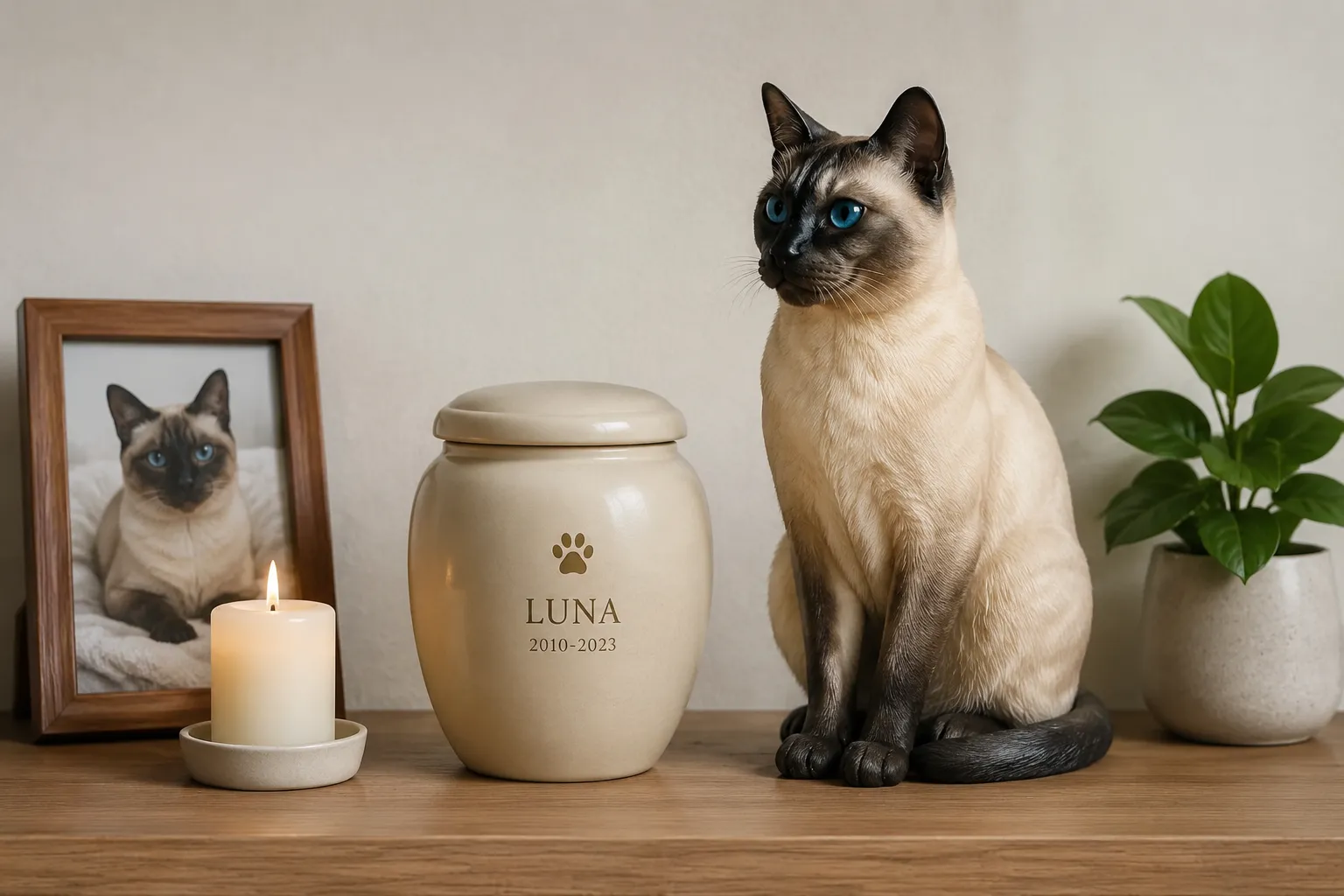
What does a garage sound like the morning after? No tags clinking against the metal food bowl, no claws ticking across the concrete. Just a cardboard box on the workbench and the question every grieving owner eventually faces: in the pet memorial figurine vs urn decision, which one actually helps you carry the weight?
Quick Takeaways
- An urn contains, a figurine represents — choose based on whether you need storage or presence in the room.
- A cremation urn alternative isn't a downgrade — many figurines now double as discreet keepsake vessels.
- Breed-specific accuracy matters more than you think — a generic cat statue won't trigger the memories a true Siamese cat memorial does.
- Full-color resin holds up over decades — ask about UV resistance and finish before you commit to any keepsake.
- You don't have to pick just one — pairing both is the most common path families take, and often the most healing.
The Question Nobody Prepares You For
Here's the thing about the days right after loss: the practical decisions arrive before the grief has even unpacked its bags.
A family we worked with described it perfectly. They'd barely registered that their cat was gone before a brochure landed on the counter, full of urns photographed against soft gray backgrounds. Brass. Ceramic. Engraved wood. And not one image that looked anything like the animal they'd actually lived with.
That gap is the real story here. Most guides treat the pet memorial figurine vs urn question as a matter of taste, like choosing paint colors. It isn't. It's a question about what you need a physical object to do for you in the months ahead.
"An urn answers the question of where. A figurine answers the question of who."
So before we compare materials and prices and finishes, let's name the actual choice. An urn is a vessel. Its job is containment, dignity, and a permanent home for ashes. A memorial figurine is a likeness. Its job is presence, recognition, and the small daily comfort of seeing a familiar shape on the shelf.
Both are valid. They just aren't the same tool. And the mistake most people make is assuming they have to choose one instead of the other.
Why the "Either/Or" Framing Fails You
Picture the workbench in that garage again. If you set down only an urn, you have a beautiful, sealed object that honors the remains but says nothing about the personality. If you set down only a figurine, you have a vivid likeness but no resting place for what was returned to you.
What we've learned from thousands of pet families is that grief rarely wants a single object. It wants an anchor it can look at and a place it can honor. The smart question isn't "which one?" It's "what role does each one play, and do I need both filled?"
That reframe changes everything that follows.
What an Urn Actually Does (And What It Quietly Doesn't)
Let's be practical about the urn first, because it's the default, and defaults deserve scrutiny.
An urn does three jobs well. It stores cremated remains securely. It provides a formal, recognizable symbol of memorial that visitors instantly understand. And it offers permanence — a sealed object you can keep for decades or eventually inter.
Those are real strengths. If your priority is having a dignified, lasting home for the ashes, a quality urn is hard to beat. The ASPCA's guidance on pet loss is worth reading here, because it's honest about how individual the grieving process is — there's no universally "correct" memorial.
But here's what an urn quietly doesn't do, and what no salesperson will mention.
An urn doesn't look like your pet. It doesn't catch the corner of your eye and make you smile before the grief catches up. A polished brass cylinder on the mantel is a symbol, not a face. For some families, that abstraction is comforting — the remains are honored without a constant emotional trigger. For others, it's exactly the problem. They want to see their companion, not a container.
"Some families need the ashes close. Others need the eyes, the markings, the tilt of the head. Both are love."
The Sound Test
This is the part most comparisons skip entirely, and it's the thing we hear about most often from grieving owners.
A house after a pet is gone is defined by absence of sound. The missing scrabble of paws. The silence at the spot by the door where the collar used to jingle. An urn doesn't fill that auditory void — and honestly, it doesn't try to.
A figurine doesn't make sound either, obviously. But families tell us that a lifelike likeness does something interesting: it gives the eye something to land on in those quiet moments, which softens the sharpness of the silence. You walk past the shelf, you see the familiar shape, and the room feels a little less hollow. That's a small thing. In grief, small things matter enormously.
Here's a clear-eyed comparison of what each option delivers.
| Factor | Cremation Urn | Memorial Figurine |
|---|---|---|
| Primary purpose | Contains ashes | Captures likeness and personality |
| Emotional trigger | Symbolic, abstract | Direct, recognizable |
| Daily comfort | Quiet reverence | Active recognition |
| Personalization | Engraving, color | Full markings, pose, expression |
| Best for | Honoring remains | Remembering the individual |
| Combined option | Standard | Some include a keepsake compartment |
Why More Families Are Choosing a Cremation Urn Alternative
A few years ago, asking for a cremation urn alternative would have raised eyebrows. Not anymore.
The shift is generational and emotional. Pet owners increasingly want memorials that reflect the specific animal, not a generic category. They've watched their grandparents' urns sit unremarked on shelves for years, and they want something that actually keeps the personality alive in the room.
We remember one order that stuck with us — a family who'd kept their dog's ashes in the plain temporary container from the crematorium for almost two years. They couldn't bring themselves to "finalize" the loss with a formal urn. It felt too clinical. When they commissioned a figurine instead, something loosened. They finally had a memorial that felt like him, and a few months later they transferred the ashes into a small keepsake box behind the figurine. The likeness made the rest bearable.
The Counterintuitive Part
Here's the insight people rarely articulate: a figurine can grieve forward in a way an urn can't.
An urn is fundamentally about the end. It marks a stopping point. A figurine, by contrast, captures the animal as it lived — mid-stretch, ears up, that particular squint. It's a celebration of presence, not just a marker of absence. For many families, that subtle difference is what lets them move through grief instead of getting stuck staring at a sealed container.
This is also why we encourage people to consider custom pet figurines as a serious memorial option, not a novelty. When the likeness is accurate, it stops being decoration and becomes a genuine anchor for memory.
"We've watched families heal by holding something that finally looks like the one they lost. Grief needs a face, not just a container."
— The PawSculpt Team
When an Urn Alternative Makes the Most Sense
A figurine-first approach tends to fit best when:
- The personality mattered more than ceremony — quirky, expressive pets deserve a likeness, not an abstraction.
- You scattered or buried the ashes — you no longer need a vessel, but you still want a presence.
- The remains feel too heavy to face daily — a likeness honors without the constant weight of "that's all that's left."
- You want a memorial that doubles as celebration — something you'd display proudly, not tuck away.
That said, we'll be real about the tradeoff: a figurine alone doesn't store ashes unless it's specifically designed to. If having the remains physically present is non-negotiable for you, look for a keepsake that includes a discreet compartment, or plan to pair the two.
A Siamese Cat Memorial: Why Breed-Specific Detail Is the Whole Point
Now let's get specific, because generic advice helps no one.
If you're searching for a Siamese cat memorial, you already know something casual cat owners don't: a Siamese is not a "cat-shaped" animal. The breed has a signature that a generic statue will absolutely flatten.
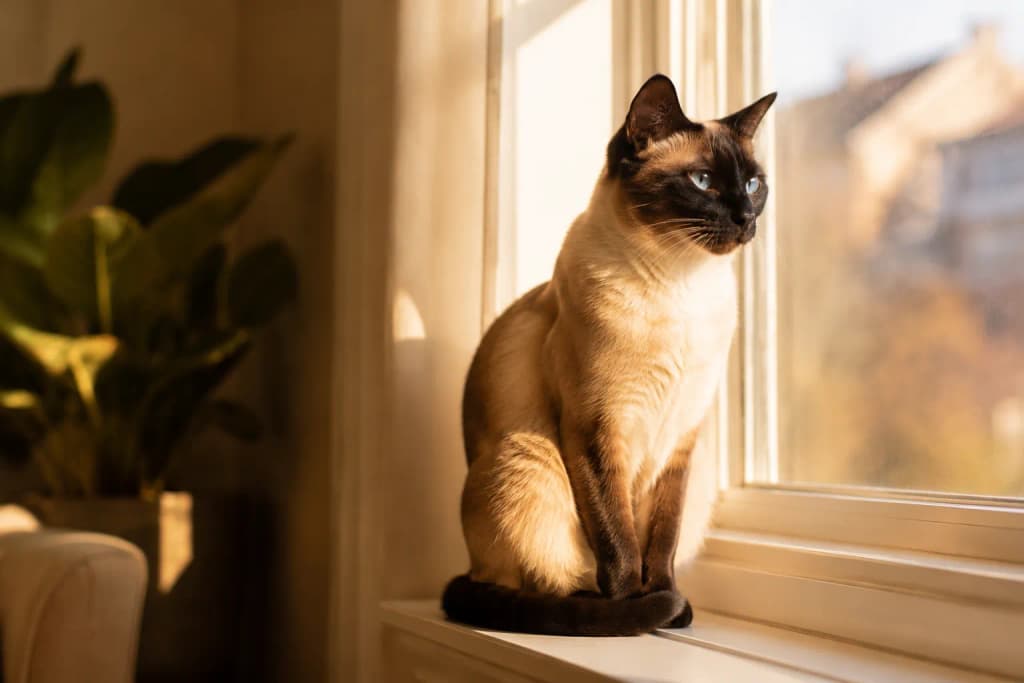
Think about what makes a Siamese instantly recognizable. The color-point pattern — pale cream body deepening to dark seal, chocolate, blue, or lilac on the ears, mask, paws, and tail. The wedge-shaped head. The tall, almost comically large ears. The piercing blue eyes set at that distinctive slant. The lean, athletic body. Miss any of these, and you don't have a Siamese memorial. You have a beige cat.
This is where accuracy stops being a luxury and becomes the entire emotional function of the object.
The Markings That Make or Break the Likeness
A family commissioning a Siamese keepsake should know exactly which features to flag, because these are the ones that trigger recognition.
| Feature | Why It Matters | What to Provide |
|---|---|---|
| Point coloration | Defines the breed instantly | Photos showing face, ears, paws, tail |
| Point shade (seal/blue/etc.) | Varies dramatically between cats | A well-lit shot in natural daylight |
| Eye color and slant | The Siamese "stare" | A close-up, eyes open and facing camera |
| Ear size and set | Signature silhouette | A profile and a front view |
| Body color gradient | The fade from cream to dark | Full-body shot, no harsh shadows |
| Pose or expression | What made yours unique | A photo capturing their typical posture |
Here's the counterintuitive bit. People assume the body color is the hardest thing to get right. It isn't. The hardest thing is the gradient — the way the cream body melts into darker points. A cheap memorial paints (or molds) a hard line between light and dark. A real Siamese has a soft transition, almost like dusk settling. When that gradient is reproduced faithfully, people gasp. When it's a sharp boundary, something feels off even if they can't name it.
"Recognition lives in the details a stranger would miss and you could never forget."
This is exactly why full-color 3D printing has changed what's possible for breed-accurate memorials. The color is printed directly into the resin, voxel by voxel — meaning that subtle seal-point gradient can be reproduced as a true fade, not a painted-on line. We digitally sculpt the likeness first, then bring it to life through full-color 3D printing, so the markings live in the material rather than sitting on top of it. A Siamese cat memorial is honestly one of the best showcases for the technology, precisely because the breed's defining feature is a gradient.
What We Wish We Knew Sooner
A candid sidebar from our team, the kind of thing we'd tell a friend over coffee.
- The "perfect" studio photo is often the worst reference. Overhead lighting flattens the point gradient and washes out eye color. The casual window-light snapshot usually captures the cat better.
- People underestimate how much pose carries personality. Two Siamese cats with identical markings read as completely different animals based on posture. Send the photo that makes you say "that's so him."
- Eye color is shockingly easy to get wrong from memory. Siamese blue ranges from pale ice to deep sapphire. Don't describe it — show it.
- Whisker pads and the dark mask edges do a lot of quiet work. They're the difference between "a cat" and "my cat."
Resin Memorial Figurine: What Actually Matters in the Material
Let's talk materials, because the phrase resin memorial figurine covers a lot of ground, and not all resin is created equal.
The micro-story here: a customer once showed us a figurine they'd bought elsewhere that had yellowed and gone brittle on a sunny windowsill within a year. The likeness had been decent. The material had betrayed it. A memorial that degrades is almost worse than no memorial — it turns into a second, smaller loss.
So here's what to actually scrutinize.
Full-Color Resin vs. Painted Surfaces
This distinction is the one most buyers never think to ask about, and it's the most important.
With full-color resin 3D printing, the color is part of the material itself, printed throughout the object rather than applied to the surface. The only manual step afterward is a protective clear coat for sheen and durability. Nothing is brushed on. There are no surface layers of color to chip, flake, or scratch away over time.
Compare that to a traditionally finished figurine where color sits on top of a base material. Surface color can chip at the edges, fade unevenly, and scratch. With color embedded in the resin, a small scuff doesn't reveal a different color underneath — because the color goes all the way through.
So what? It means a full-color resin piece ages far more gracefully. For a memorial meant to last decades, that's not a technical footnote. It's the difference between an heirloom and a disappointment.
The Texture Honesty Most Brands Hide
Here's something we're upfront about, even though it might surprise you: a quality full-color 3D print has a fine natural texture — subtle layer grain you can feel if you look closely, sealed under a clear protective coat.
Some buyers expect glossy, flawless, plastic-perfect smoothness. We'd gently push back on that expectation. That mass-produced sheen often reads as fake. The slight authentic texture of a 3D-printed piece catches light the way real fur does, with depth rather than a mirror shine. It looks like an object that was made, not stamped out of a mold. Once people hold one, they tend to prefer it.
| Material Trait | Why It Matters | What to Ask |
|---|---|---|
| Color depth | Resists chips and fading | "Is the color in the material or on the surface?" |
| UV resistance | Prevents yellowing in light | "Is it safe near windows?" |
| Protective finish | Adds durability and sheen | "What's the final coat?" |
| Surface texture | Authentic vs. plastic-perfect | "Does it have a natural grain?" |
| Detail resolution | Captures fine markings | "Can it reproduce gradient colors?" |
Placement and Care
A resin memorial figurine is low-maintenance, but a few practical habits extend its life considerably.
- Keep it out of direct, prolonged sunlight. UV-resistant materials help, but no resin loves an all-day south-facing windowsill.
- Dust with a soft, dry cloth. Skip household cleaners and solvents — they can dull the protective finish.
- Avoid extreme heat. Don't leave it on a radiator cover or in a hot car.
- Display at eye level if you can. Families tell us a memorial at sitting-height gets seen — and that daily glance is the whole point.
For more on the technology and finishes, our guide to custom 3D pet sculptures walks through the process in plain language.
What to Expect When You Commission a Custom Memorial
If you've decided a figurine belongs in your memorial — alone or alongside an urn — here's the honest walkthrough. We won't quote you specific prices or turnaround times here, because those shift and you deserve current numbers; for that, check the details directly on pawsculpt.com. What we can do is set realistic expectations about the process.
The General Creative Arc
Most custom memorial work moves through a recognizable sequence:
- You share photos and notes. This is the most important step on your end. More on photos below.
- A master 3D artist digitally sculpts the likeness. This is hand-modeled digitally — shaping the form, posture, and markings in software.
- You review a preview. This is your chance to flag "the ears sit higher" or "her eyes were rounder."
- Revisions refine the details. Good studios expect this; getting a likeness exactly right is collaborative.
- Full-color 3D printing brings it to life. The approved model is printed in full-color resin.
- A protective clear coat is applied, then it ships to you.
The emotional truth nobody warns you about: the preview stage can hit hard. Seeing your pet's face take shape again, even on a screen, can reopen the grief. That's normal. Several families have told us they had to step away from the email for a day before they could look properly. Take that time. There's no rush.
The Photos That Make the Difference
Since photo quality determines everything downstream, here's exactly what helps.
| Shot Type | What It Captures | Quick Tip |
|---|---|---|
| Front face, eyes open | Expression and eye color | Get to their level |
| Full-body profile | Silhouette and proportions | Natural standing or sitting pose |
| Markings close-up | Point gradient, patterns | Daylight, no flash |
| The "signature" pose | Personality | The photo that's so them |
| Multiple angles | Helps the 3D sculpt | More references, better result |
The single best thing you can do is provide natural-light photos from several angles. Flash flattens markings and distorts color. A few casual shots near a window beat one posed studio portrait nearly every time.
And if you only have a handful of photos, or older ones — don't panic. We've reconstructed beloved companions from imperfect references plenty of times. Skilled digital sculptors can interpolate from limited material. Send what you have and be ready to describe the details photos missed.
Making the Choice: A Practical Framework
So let's land this. You're standing in that garage, metaphorically or not, and you need to decide.
Ask yourself three questions, in order.
First: Do I need a physical home for the ashes? If yes, you need an urn or a figurine with a built-in keepsake compartment. If the ashes are scattered, buried, or you simply don't need them present, a figurine alone is complete.
Second: Do I need to see my pet, or honor my pet? Seeing leans figurine. Honoring-as-symbol leans urn. Most people, when they're honest, want both — which is why pairing is so common.
Third: What will help me in six months, not just six days? Early grief and settled grief want different things. A sealed urn can feel right in the rawest days. A familiar face on the shelf often becomes the thing that helps once the initial shock fades and you actually want to remember the good.
"The right memorial isn't the one that hurts least today. It's the one that comforts most a year from now."
Here's our genuinely held opinion, offered as opinion, not gospel: if budget allows only one and the personality was the heart of the relationship, choose the likeness. Ashes can rest in a simple, dignified container. But the squint, the ears, the particular tilt of the head — those only exist now in your memory and in whatever you commission to hold them. A generic urn can be bought anytime. A faithful likeness depends on the photos you have today.
Frequently Asked Questions
What is the difference between a pet memorial figurine and an urn?
An urn is a vessel built to contain cremated remains securely and permanently. A memorial figurine is a likeness built to capture your pet's appearance and personality. The urn answers "where are the remains," while the figurine answers "who did I lose." Many families end up wanting both, since they serve genuinely different emotional needs.
Can a memorial figurine work as a cremation urn alternative?
For a lot of families, yes. If you've scattered or buried the ashes, or simply don't need them physically present, a figurine functions as a complete memorial on its own. If keeping the remains close matters to you, look for a figurine with a built-in keepsake compartment, or plan to display the figurine alongside a small urn.
How do I make sure a Siamese cat memorial looks accurate?
Focus your photos on the breed's signature features: the color-point pattern, the slant and shade of the blue eyes, the large ears, and especially the soft gradient where the cream body fades into darker points. That gradient is what separates a true Siamese likeness from a generic beige cat, so provide well-lit, natural-light images.
Will a resin memorial figurine fade or degrade?
A quality full-color resin piece holds up well because the color is embedded throughout the material rather than applied to the surface, so it won't chip away to reveal a different color underneath. UV-resistant resin and a protective clear coat guard against yellowing. Keep it out of all-day direct sunlight and dust it with a soft dry cloth.
How long does a custom memorial figurine take, and what does it cost?
Timeframes and pricing vary by studio and the complexity of your piece, and these details change, so we'd point you to pawsculpt.com for current specifics. Generally, expect a process of sharing photos, reviewing a digital preview, requesting revisions, and then production. Build in time for the back-and-forth that getting a likeness exactly right requires.
Is it normal to wait months before choosing a memorial?
Completely normal. Plenty of families keep ashes in the temporary crematorium container for a year or more before they're ready to commit to something permanent. Grief doesn't follow a schedule. When you're ready, the photos you have are what matter most — so safeguard those now, even if you decide later.
Ready to Celebrate Your Pet?
Every pet has a story worth preserving. Whether you're weighing the pet memorial figurine vs urn decision or looking for a meaningful cremation urn alternative that actually captures your companion's face, a custom PawSculpt piece reproduces the details that made them one-of-a-kind — the markings, the eyes, the posture you'd know anywhere.
Visit pawsculpt.com to learn more about our full-color 3D printing process, revision options, and quality guarantee.