
The Stoic Path: How My Elderly Beagle's Last Video Became My Anchor in Grief

What do you do with elderly pet loss when the kitchen floor still catches the blue flicker of your beagle’s last video, and for one sharp second the room looks inhabited again?
Quick Takeaways
- Use one short video as a ritual — replay it intentionally, not endlessly, to steady grief.
- Name the mixed emotions directly — relief, guilt, and regret often arrive in the same hour.
- Build memory around place, not just photos — empty corners hold clues to your bond.
- Choose one tangible anchor — some families create urn spaces; others explore custom pet figurines for daily remembrance.
Why the last video can matter more than the “best” photo
Most memorial advice starts with albums, paw prints, framed portraits. Useful, yes. But there’s a quieter truth we’ve seen again and again while working with grieving pet families: the item that helps most is often the least polished one.
Not the holiday portrait.
Not the perfect profile shot.
The shaky clip from an ordinary day.
An elderly beagle shifting on the kitchen mat. Tags tapping once against the bowl. A cloudy eye lifting toward the person behind the camera. Maybe the lighting is bad. Maybe the angle is awkward. None of that matters. What lives inside that video is duration. Breath. Pace. Presence. The way your dog occupied space.
That’s the part grief panics about losing.
For many people navigating beagle memorial decisions, the fear is not only “I miss them.” It’s “What if I stop remembering how they moved through the house?” That fear can get strangely physical. You stand near the pantry and realize your body still leans left to avoid stepping on a dog who is no longer there. You hear the fridge hum and expect a familiar head to appear at knee level. The home keeps performing the bond even after the pet is gone.
And a video catches that in a way still images cannot.
Here’s the counterintuitive insight: watching the last video does not always deepen pain first—it can reduce panic. Why? Because grief is not just emotional; it is spatial and procedural. Your mind is trying to update a map. The video says, “Yes, they were here. Yes, this was real. Yes, this was their rhythm.” It gives the nervous system a bridge.
We’ve heard this from customers who come to PawSculpt after weeks of avoiding every image of their dog. One family kept returning to a seven-second clip of their senior hound turning in a slow circle before lying down by the stove. They told us that clip became their “proof of soul.” Not because it was dramatic. Because it was ordinary.
Ordinary is where love lived.
A kitchen memory is often a grief trigger because routines are sacred
The kitchen is not random. It is command central for a dog’s daily life—bowls, pills, treats, water, waiting, hope. For senior dogs, especially beagles, it often becomes a place of caregiving. Medication hidden in cheese. Anti-slip mats. The midnight refill of water. The soft shuffle of paws at dawn.
That means the kitchen also becomes one of grief’s most charged rooms.
Research on attachment and bereavement suggests that ritual and sensory cues shape how we process absence. We’re not therapists, and we’re not vets, but in our years working with memorial orders, we’ve learned this: rooms remember. Certain corners hold more charge than entire photo galleries.
So if your anchor is a video from the kitchen, that doesn’t mean you’re stuck. It may mean your grief is trying to work through the place where care happened most intensely.
"Grief often returns through doorways, not anniversaries."
The mistake most people make with the last video
They either watch it compulsively, twenty times in a row until they feel flattened, or they bury it so deeply in their phone that opening the gallery becomes impossible.
Neither extreme helps for long.
What helps more is structured viewing. A tiny ritual. Predictable. Contained.
Try this for seven days:
- Pick one time of day to watch the video—morning coffee, after dinner, before bed.
- Watch it once all the way through without pausing.
- Name three concrete details out loud: “His ear lifted.” “The bowl is by the blue cabinet.” “He still looked for me.”
- End with one sentence of witness, not analysis: “You were here, and I saw you.”
Why this matters: the brain under grief often seeks certainty. Repetition without structure inflames distress. Ritualized repetition can soothe it. You’re not trying to solve anything. You’re giving the bond a container.
A brief evening vignette
It’s 6:12 p.m. The dishwasher clicks on. You set a mug near the sink and, out of habit, glance at the square of floor beside the island where your beagle used to wait for the carrot peel. Instead of scrolling numbly through hundreds of photos, you play the eight-second clip once, whisper one detail—“that stubborn little tail”—and then place the phone face down. The room is still empty. But it doesn’t feel erased.
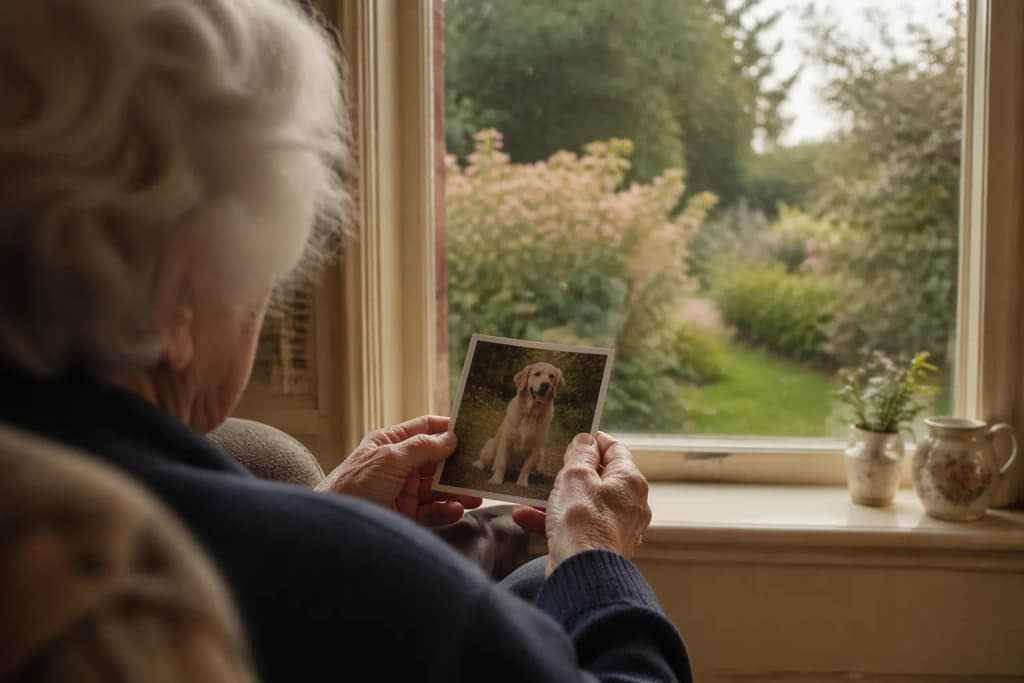
Stoic philosophy grief: what the Stoics get right about pet loss support
The phrase stoic philosophy grief can sound cold at first, as if the goal is to stop feeling. That’s not the useful version. Real Stoic practice is not emotional shutdown. It is disciplined attention. It asks: What is in my control, and what deserves reverence even when I cannot keep it?
That distinction matters deeply in pet loss support.
You could not control aging. You could not negotiate with disease forever. You could not make time hold still in your kitchen. But you can control how you witness your pet’s final chapter. You can decide what story you tell yourself about it. You can build rituals that honor presence instead of circling only around the last day.
That is much closer to Stoicism than forcing yourself to “be strong.”
The Stoic idea that surprises grieving pet owners
Many grief guides imply your task is to let go. The Stoic angle is sharper and, honestly, more relieving: your task is to love without demanding permanence.
That’s hard. But it changes everything.
Marcus Aurelius wrote often about seeing things as they are—brief, precious, changing. Applied to an aging beagle, that doesn’t mean becoming detached. It means noticing the slow walk, the whitening muzzle, the new sleeping spots, and calling them sacred instead of tragic evidence. Even now, after loss, this perspective can steady you. Your dog’s life was not “ruined” by ending. It was completed by being fully lived.
There’s another practical Stoic lesson hidden in the last video: memory becomes more bearable when you stop arguing with reality. The clip is not a substitute for your dog. It never will be. But it is honest. Honest things are stabilizing.
If you feel relief mixed with grief, read this twice
This is one of the least admitted parts of elderly pet loss.
Many pet owners feel a surge of relief after a senior dog dies or is euthanized, especially after months of caregiving, disrupted sleep, medication schedules, accidents in the house, or the helplessness of watching decline. Then the relief is followed immediately by guilt. Crushing guilt. They think, “What kind of person feels lighter?”
A loving one. Often a worn-out one. Often both.
That relief does not cancel love. It confirms that the strain was real and that watching your dog suffer cost you something. We’ve heard versions of this from families whispering it almost apologetically: “I hate saying this, but I slept through the night for the first time.” Or, “I didn’t realize how tense I’d been until I wasn’t listening for him.”
This is more common than most people admit.
Here’s a scenario we’ve seen many times: a woman keeps her senior beagle’s blanket folded on the breakfast chair for two weeks because removing it feels disloyal. But she also notices the house no longer smells faintly of medication and cleanup supplies, and part of her shoulders drop in relief. She feels monstrous for noticing. She isn’t monstrous. She is grieving the dog and the caregiving role at the same time.
If that’s you, try this sentence: “I am relieved their suffering ended, and I am devastated they are gone.” Both can be true. At once. In the same breath.
That sentence opens a door.
Delayed grief is not denial. It’s often logistics.
Another overlooked truth: delayed grief after pet loss often shows up in practical caregivers, especially after a long decline. During the last weeks, you become a nurse, scheduler, observer, cleaner, advocate. You’re gathering medications, calling the vet, counting appetite changes, checking breathing, adjusting rugs, lifting hips, washing towels. Your body goes operational.
Then, a few days or even a few weeks later, the grief lands like weather.
Not because you loved less. Because your mind triaged.
If your tears didn’t come on day one, that does not mean your bond was shallow. Some of the deepest grief we’ve witnessed shows up on day 18, in a grocery aisle, while reaching for deli meat no one needs anymore.
Here’s a simple visualization of what many families experience:
| Time After Loss | What Often Happens | What Helps Most | Why It Works |
|---|---|---|---|
| First 48 hours | Administrative haze, numbness, task mode | Simple rituals, hydration, one trusted person | Reduces overwhelm during shock |
| Days 3-10 | Strong triggers in rooms and routines | Structured video viewing, remove only one item at a time | Prevents emotional flooding |
| Weeks 2-6 | Delayed grief spikes, strange guilt, fatigue | Journaling specific memories, grief support groups | Helps the mind process what logistics postponed |
| Months 2-6 | Fear of forgetting, identity shifts | Memorial object, recurring ritual, anniversary planning | Converts absence into continuing bond |
If your grief doesn’t follow this rhythm, that’s okay. The point is not the schedule. The point is that late-arriving sorrow is normal in caregiving loss.
A resource that can help when people around you don’t get it
If your social circle minimizes pet grief—or says things so clumsy you want to leave the room—outside support can matter. The Association for Pet Loss and Bereavement offers grief resources and support options that many families find grounding, especially when they feel judged or isolated.
And yes, that judged feeling is real too. Some readers will know exactly what we mean: the coworker who says, “At least it wasn’t a person,” as if love ranks itself neatly. It doesn’t.
"Relief after a hard goodbye is not betrayal. It is love after strain."
The overlooked architecture of grief after an elderly beagle loss
Most articles talk about emotions as if they float in the air. But grief is also architectural. It gathers in distances, pathways, thresholds. Where the dog bed used to sit. The corner by the refrigerator. The empty slice of rug at the foot of the couch. With beagles, whose routines are so map-based and food-oriented, these absences can feel especially vivid.
You don’t just miss the dog.
You miss the route.
That’s why one of the most helpful things you can do is a grief walk-through of your home.
Yes, really.
Try a room-by-room mapping ritual
Take 15 minutes. Not an hour. Keep it contained.
Walk through your home and note:
- The three most charged spots where you still expect your dog to appear
- One object in each spot that carries emotional energy
- One action your body still performs automatically in that area
Maybe the charged spots are:
- The kitchen mat near the treat drawer
- The hall corner where your beagle used to turn around before lying down
- The chair beside the window where sunlight pooled over his back
Then ask: Which of these spaces should stay as-is for now, and which needs gentle change?
This matters because grief often worsens when every room remains frozen. But changing everything in a single weekend can feel like erasure. The middle path is kinder.
What to move, what to keep, what to transform
Here’s our rule of thumb from years working with pet families: don’t make permanent decisions in the first emotional surge unless the item itself is distressing.
A practical approach:
- Keep one everyday object visible for 2-4 weeks: a bowl, collar, leash, or blanket
- Store one difficult object out of sight if it spikes panic: medications, mobility aids, cleanup supplies
- Transform one space into a memorial point rather than leaving it as a vacancy
That last step changes the story.
A vacancy says, “Something is missing.”
A memorial point says, “Someone mattered here.”
This memorial point can be simple:
- A framed still from the last video
- A candle you light on Sundays
- A small dish with the tags
- A printed note with your dog’s nicknames
- A figurine or sculpture that gives form to presence
For some families, a memorial keepsake at PawSculpt becomes that anchor because it occupies space without pretending to replace the pet. That distinction matters. A good memorial object doesn’t erase grief; it holds it.
And because PawSculpt figurines are digitally sculpted by master 3D artists and then precision 3D printed in full-color resin, they can reflect the specific markings and expression families don’t want flattened into generic memory. The color is printed directly into the material itself, then protected with a clear coat—so what you receive feels vivid, dimensional, and honest, with natural print texture rather than an artificial perfection. For some homes, that honesty is exactly the point.
Day-in-the-life: a morning after the loss
It’s 7:03 a.m. You open the pantry and still leave the door ajar for a beat, because your beagle always nosed it wider. The hall looks longer now. The chair by the window seems oddly formal without a curled body in it. You touch the collar on the hook, then turn toward a small shelf where one framed video still and a tangible memorial sit together, and the morning becomes survivable.
Don’t underestimate the fear of forgetting
This one arrives stealthily.
Not “I miss them.”
“I can’t quite remember how their paws sounded on the tile.”
Many pet parents are embarrassed to admit this. They think it sounds dramatic. It isn’t. It’s one of grief’s central fears. We hear it constantly, especially after elderly pet loss, when the final months may have blurred into caretaking and medical decisions. People worry the illness will overwrite the whole life.
That is why your memorial practice should capture behavior, not just appearance.
Write down:
- How they asked for food
- Where they stopped on walks
- Which room they preferred at 3 p.m.
- The sound they made before settling
- The expression they wore when pretending not to beg
Those details are soul-language.
And if you have a video, transcribe it. Not just dialogue. Ambient detail. “Dish clink.” “Slow exhale.” “Nails on tile.” This sounds almost too simple, but it works because memory sharpens around specificity.
Here’s a second table—this one can help you choose a memorial form based on what you most fear losing:
| What You’re Afraid of Forgetting | Best Memorial Practice | Why It Helps | Best Time to Do It |
|---|---|---|---|
| Appearance and markings | Curated photo set or 3D pet sculpture | Preserves visual identity with detail | Within first 2-4 weeks |
| Movement and rhythm | One short video ritual | Keeps pace and presence alive | Immediately, in brief sessions |
| Daily habits and personality | Written “ordinary moments” list | Saves quirks often left out of tributes | Over 7-10 days |
| Shared space in the home | Memorial shelf or sacred corner | Reclaims absence as legacy | After first week |
| Caregiving story | Private letter about the last months | Integrates strain, love, and goodbye | When you feel ready |
Beagle memorial rituals that honor spirit, not just memory
A beagle brings such a particular energy into a home—nose first, ears low, heart open, comedy tucked inside stubbornness. Their presence is rarely elegant in the formal sense. It’s earthy. Grounded. Full of routes and rituals. Which means your beagle memorial can be practical, funny, and sacred all at once.
Please don’t feel pressured to make it solemn if your dog was gloriously ridiculous.
Build a ritual around the ordinary, not the dramatic
This may be the most overlooked memorial advice we can give.
Most people build tributes around extraordinary days: adoption day, the last day, the best vacation, the birthday photo. But what often heals more is a ritual built around the dog’s ordinary genius. The way he sat half-in, half-out of the kitchen doorway. The exact patch of morning light he claimed. The tiny huff he gave when dinner was late by three minutes.
Those details carry the spirit.
A practical ritual might look like this:
- Choose one small recurring act tied to your pet’s real routine.
- Repeat it once a week at the same time.
- Add one sentence of witness instead of a speech.
Examples:
- Put a carrot slice in the garden soil every Sunday if that was their favorite snack.
- Sit in their window spot with your coffee for five minutes on Saturday mornings.
- Play the last video once on the first of each month, then write down one remembered habit.
This is not superstition. It’s structure for love.
A family story we still think about
One order that stuck with us came from a family grieving an elderly scent hound with a kitchen-centered life. They did not want a grand shrine. They wanted something quieter. They chose a single still from a phone video where their dog was mid-turn near the food cabinet—head slightly tilted, body softened by age, expression absolutely himself.
They told us later that the keepsake didn’t make the house feel “full again.” That wasn’t the goal. It made one corner feel true again. We think that’s a better standard.
"The healthiest memorials don’t trap love in the past—they give it a place to stand in the present."
— The PawSculpt Team
If you’re second-guessing euthanasia timing
We need to say this plainly because so many pet owners search for it late at night and read answers that are too vague.
Second-guessing euthanasia timing is painfully common. Even when a veterinarian helped guide the decision. Even when suffering was evident. Even when waiting longer would likely have meant more distress.
A person will replay details with courtroom intensity:
Was he still eating enough?
Did she still wag?
Did I rush it?
Did I wait too long?
That mental retrial can become its own form of torment.
From what veterinary professionals and grief counselors consistently emphasize, a compassionate decision made in consultation with your care team is not invalidated by hindsight. If you’re stuck in loops, it can help to review quality-of-life guidance from a trusted veterinary source such as VCA Hospitals’ end-of-life resources or similar support from your own clinic. Not to reopen the case. To ground yourself in reality.
Here’s something hard but freeing: there is almost never a moment that feels mathematically perfect. Love wants certainty. End-of-life rarely offers it.
A useful exercise:
- Write two columns: “What I knew then” and “What I know now.”
- Fill the first column only with facts available at the time.
- Do not let hindsight sneak in dressed as truth.
Why this works: grief often weaponizes information you did not possess in the moment. This exercise restores fairness.
A memorial can be physical without becoming heavy
Some people avoid tangible memorials because they worry the object will become too intense, too painful, too “final.” That can happen if the memorial is oversized, overly ceremonial, or placed where you cannot choose your exposure to it. But smaller, thoughtfully placed objects often help precisely because they are containable.
A shelf near the breakfast nook.
A corner of the bookcase.
The little table by the entryway.
That’s where a full-color 3D pet figurine can serve a real function in grief care—not as decor for decor’s sake, but as a chosen site of contact. You decide when to glance, when to touch, when to pause. The memorial lives in your day without ambushing it.
And for many families, that controllable proximity is a relief.
Pet loss support for delayed grief, guilt, and the strange social aftermath
The first wave of support often arrives fast. Texts. Flowers. A card. Then the world resumes its pace while your inner world is still rearranging furniture in the dark. This is where many people feel isolation most sharply—not on day one, but in the long middle.
Because by then, people expect improvement.
But grief after a senior dog’s death can get more complex in weeks three through eight. Especially if there was prolonged caregiving. Especially if the relationship with the pet carried unusual depth, routine, or emotional refuge. Especially if your dog was your witness through divorce, remote work, a move, infertility, illness, aging parents, or the long quiet stretches of adulthood that no one sees from the outside.
The dog was never “just” the dog.
The dog held a chapter.
The social misunderstanding that hurts more than people realize
Feeling judged by others for the intensity of your grief is more common than most people think. Not always openly. Sometimes it’s subtle. A raised eyebrow when you take bereavement time. A joke about “needing another dog already.” The implication that because the loss is nonhuman, the mourning should be tidy.
That judgment can make people hide. And hidden grief tends to harden.
If this is happening, try using one clear sentence instead of a defensive speech:
“This bond was central to my daily life, and I’m treating the loss accordingly.”
Short. Calm. Final.
You do not need to argue your love into legitimacy.
What actually helps more than “staying busy”
We’re not huge fans of the advice to simply distract yourself. Temporary distraction has its place. But purposeful contact with grief works better than random busyness.
Try this weekly structure for the first month:
- One ritual contact: watch the video once, visit the memorial shelf, read a letter
- One practical action: organize photos, wash one blanket, donate one unopened item
- One social contact: text someone who understands, join a support group, speak the pet’s name aloud
- One body-based reset: short walk, stretching, fresh air, no podcast
Why these four? Because grief needs witness, action, connection, and physical regulation. Miss one, and the week can feel oddly jagged.
If another pet is in the house
Remaining pets grieve too, though not always in the sentimental ways humans expect. Some search doorways. Some sleep more. Some become clingy. Others seem almost unaffected at first. The American Kennel Club’s guidance on grieving dogs can offer a useful baseline for what behavior shifts are common and when to call your vet.
We’re not veterinarians, so if appetite, elimination, or major behavioral changes persist, get professional help. But in general, what helps remaining pets is the same thing that helps people: predictable routine with gentle room for adjustment.
A few signs to watch for:
| Behavior in Remaining Pet | What It May Mean | What You Can Do | When to Call the Vet |
|---|---|---|---|
| Pacing near doors or favorite spots | Searching behavior | Keep routine steady, add calm companionship | If severe beyond several days |
| Sleeping more than usual | Stress or adjustment | Monitor appetite, offer normal walks/play | If lethargy is extreme or worsening |
| Reduced appetite | Grief, stress, disrupted routine | Offer meals on schedule, avoid constant treats | If refusing food for more than a day |
| Clinginess or vocalizing | Anxiety after bond disruption | Increase predictable touch and presence | If distress escalates noticeably |
| No visible change | Normal variation | Don’t force mourning cues | Call vet for any concerning physical signs |
You are allowed to make the memorial practical
There’s a cultural script that memorials must be grand, poetic, almost theatrical. But often the best pet loss support is startlingly practical. Put the ashes where they won’t scare you. Move the mobility sling out of sight. Keep one collar, not six. Set a recurring reminder for the ritual that steadies you. Print the screenshot. Back up the video in two places.
Do the useful thing.
In our experience, useful things often become sacred because they reduce chaos. And chaos is what makes grief feel unlivable.
About getting another dog
This deserves a plain answer too.
The right question is usually not “How soon is too soon?” The better question is: What role am I asking a new dog to play?
If the answer is “replace,” wait.
If the answer is “join a home shaped by love,” you may be closer than you think.
Many people feel guilty even considering another pet after elderly pet loss. Others feel anxious that loving a new animal means diluting the old bond. We don’t see it that way. Love in a home is less like a single candle and more like a hearth. One flame goes out. The space is changed forever. But it is still capable of warmth.
Just don’t let urgency choose for you.
Creating a tangible anchor: from video clip to sacred object
At some point, many grieving pet owners feel the limit of digital memory. The phone holds everything, yet somehow nothing feels settled. You can swipe, zoom, save, hide, archive—but the bond still lacks a place to rest in the room.
That’s where a tangible anchor can help.
Not because objects heal on their own. They don’t. But objects can support ritual. They can turn memory into location. And location matters.
Why a physical memorial often helps delayed grief catch up safely
Here’s the part people miss: delayed grief sometimes lingers because there is no appointed place for it. If every memory lives in your phone, grief stays ambient. Untethered. Ready to flare while buying paper towels or waiting at a traffic light.
A physical memorial gives grief a shoreline.
It might be:
- A video still in a small frame
- A clay paw print from your vet
- A collar wrapped around a candle base
- A custom object that reflects the pet’s specific look and posture
One family we worked with kept replaying a clip of their senior dog turning toward the camera in the kitchen. They eventually used that clip, plus a few older photos, to commission a memorial that could live on a narrow shelf near the breakfast area. They told us the biggest surprise was not that they cried when it arrived—of course they did. It was that they stopped dreading the kitchen.
That’s not a small thing.
What to look for if you want a memorial based on real-life detail
If you’re considering a figurine or sculpture, look for a process that respects the particularity of your pet rather than forcing them into a generic shape. For a beagle, that means body carriage, ear set, muzzle aging, eye expression, coat pattern, even the slight heaviness senior dogs can develop through the shoulders or hips.
At PawSculpt, our team creates digitally modeled pet sculptures from customer photos, then produces them using advanced full-color 3D printing technology. The color is embedded directly in the resin material, voxel by voxel, rather than added as a surface layer. That allows markings and fur pattern transitions to read more naturally in three dimensions, especially when families are trying to preserve subtle details from an elderly pet’s face. A protective clear coat is added after printing for durability and sheen.
We’ll be real: no memorial object can reproduce a living presence. We would never promise that. But a well-made one can become a grounded, daily point of contact. For many people, that is enough. More than enough.
If you’re curious about the creative process, photo guidance, or current service details, it’s best to visit PawSculpt’s custom memorial page directly, since those specifics can change.
Photos that work best for a meaningful memorial
A lot of people assume they need one perfect studio-quality image. They don’t. What usually helps more is a small set of honest photos that show the pet from different angles and life stages.
Especially useful:
- Front-facing image with clear eyes
- Side profile showing muzzle shape and ear position
- Full-body shot standing naturally
- A favorite “expression” image, even if imperfect
- For seniors, one recent image that reflects their later-life face accurately
And if the last video matters most, use it. Screen grabs from video can be emotionally richer than polished photos because they carry posture, not just appearance.
A simple process for turning the last video into a memorial plan
If your anchor is a video, here’s how to work with it:
- Watch once for posture
- Take 3-5 screenshots
- Add 2-3 earlier photos
- Write a short note about personality
- Choose placement before ordering
That last point is underrated. Placement shapes whether a memorial comforts or overwhelms.
"A memorial becomes healing when it gives your love an address."
The spiritual side of a tangible object
For some people, this part comes naturally. For others, it feels awkward. But it’s worth saying: a memorial object can become part of a sacred space even if you don’t think of yourself as spiritual. You are simply acknowledging that the bond had a life beyond utility. It changed the atmosphere of your days. It taught you forms of devotion you didn’t know you had.
That deserves a place.
A sacred space does not need incense, crystals, or elaborate language. It can be one corner of a shelf where the object stands beside a tag, a candle, and a folded note. The power is not in performance. It’s in repetition. In the quiet recognition: your companion’s legacy still moves through this home.
What grief asks for next
By now, you may have noticed that this article isn’t really about a video file. Not only. It’s about the way grief searches for something steady enough to hold love without flattening it. For some people, that anchor is a walk at dusk. For some, it’s the last voicemail from a parent. For many pet owners, especially after elderly pet loss, it’s a small ordinary clip of a dog being exactly himself in a room that now feels too large.
That makes sense to us.
We’ve seen families try to outrun grief with cleaning sprees, productivity, new routines, social media tributes, even immediate pet searches. Sometimes those things help a little. But the deeper shift usually begins when the person allows one true image, one true place, and one true ritual to carry the bond forward.
Not obsessively.
Faithfully.
So here’s a next step you can take today. Pick one room—probably the room that still catches you off guard. Stand there for sixty seconds. Notice where your eyes go first. That is your grief’s compass point. Build your first ritual there. One video viewing. One sentence. One object. Small is better. Small repeats.
And if your sadness is tangled with guilt, relief, anger, or second-guessing, don’t exile those feelings from the memorial. They belong to the story too. Love at the end is rarely neat. It is brave, tired, tender, and imperfect.
The kitchen may never look the way it did before. But with a little ritual, it can stop feeling like a room where love vanished and start feeling like a room where love changed form.
Frequently Asked Questions
Is it normal to feel relief after an elderly pet dies?
Yes. It’s more common than most people admit, especially after months of caregiving, interrupted sleep, medication schedules, or watching visible decline. Relief usually means you are no longer bracing for their suffering—not that your bond was shallow.
Why does delayed grief happen after pet loss?
Because caregiving can push you into task mode. You may spend days or weeks making decisions, monitoring symptoms, cleaning, scheduling appointments, and holding yourself together. Once those demands stop, the emotional reality catches up, which is why delayed grief often arrives after the casseroles, texts, and condolences have faded.
Can a last video really help with grief more than a photo?
Often, yes. A video preserves motion, rhythm, and the way your pet occupied space, which can be especially grounding after elderly pet loss. The key is to use it as a ritual—watch once, notice specific details, then stop—rather than spiraling into endless replay.
How do I make a beagle memorial feel personal instead of generic?
Build it around ordinary habits. A food spot, a window seat, a stubborn hallway turn, a certain expression near the treat drawer—those details carry more soul than generic tribute language. The strongest beagle memorial usually reflects lived routine, not perfection.
What photos work best if I want a custom pet figurine memorial?
Use a small group of images rather than hunting for one flawless picture. Include a front view, side profile, full-body shot, and one image that captures expression. If your pet was elderly, include recent photos so markings, muzzle whitening, and posture feel true to the dog you knew at the end.
Ready to Celebrate Your Pet?
Every pet has a story worth preserving. Whether you're honoring a beloved companion who's crossed the rainbow bridge or celebrating your furry friend's unique personality, a custom PawSculpt figurine captures those details that make your pet one-of-a-kind.
Visit pawsculpt.com to learn more about our process and guarantees