
Acceptance Through Ritual: How My Ashes Container Became a Cultural Bridge After My Tabby's Passing
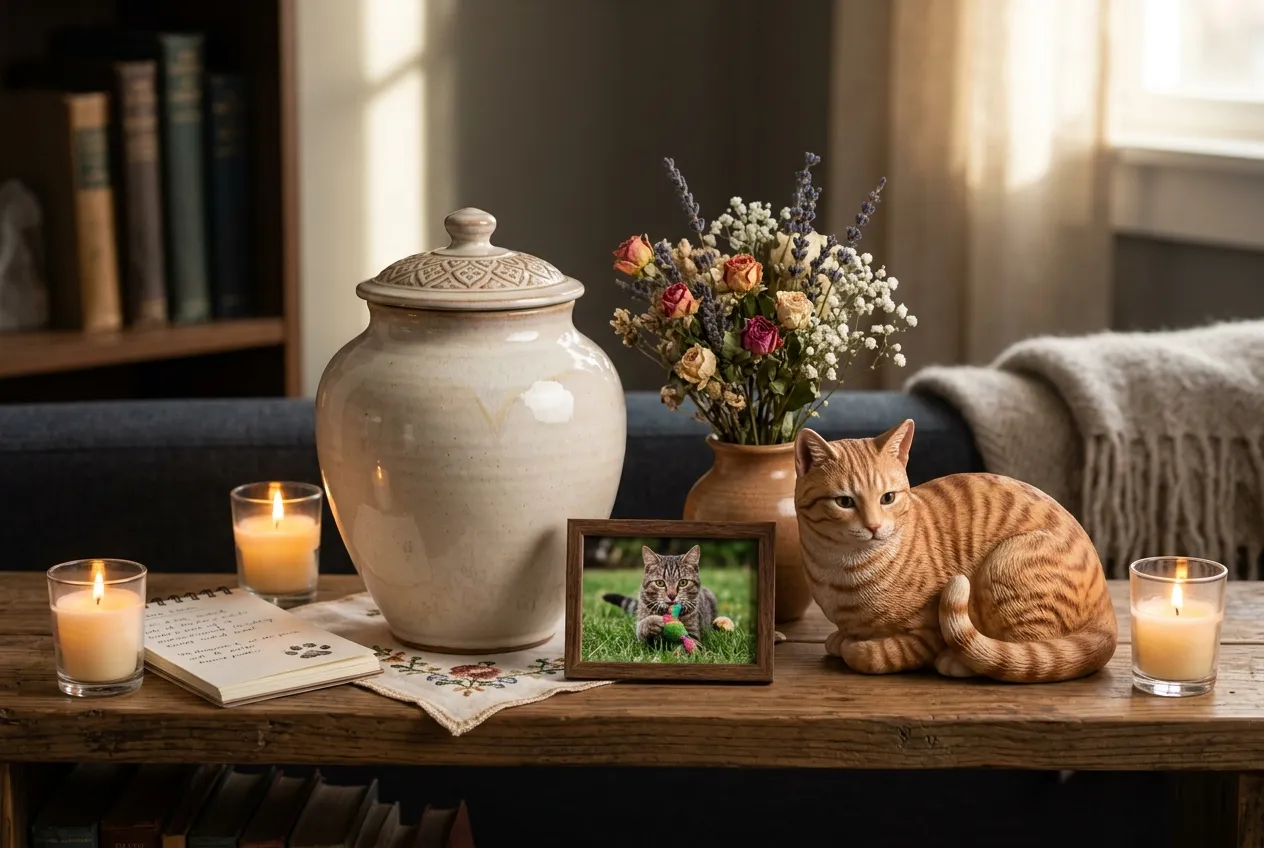
Research suggests tactile objects can reduce acute grief responses by giving the brain a stable sensory anchor; in one customer’s kitchen, a smooth ceramic ashes container sat beside a coffee mug, turning her daily pet loss ritual into something she could actually touch.
Quick Takeaways
- Ritual gives grief a shape — choose one repeatable action tied to your pet’s memory
- Your ashes container can become a bridge — blend family culture with personal pet loss acceptance
- Tactile memorials help the nervous system — touch can calm grief’s unpredictable surges
- Keepsakes can support ritual — explore custom pet figurines as one tactile memorial option
- Mixed emotions are normal — guilt, relief, anger, and second-guessing can coexist with love
Why a Pet Loss Ritual Works When Words Don’t
One of our customers, whom we’ll call Mara, told us her tabby, Saffron, had always slept with one paw tucked under his chest like a tiny loaf of bread. After he passed, she kept reaching for that warm, striped weight at the edge of the bed. Her hands found cotton sheets instead.
That mismatch matters.
Your body often learns your pet before your mind fully understands them. The rough pad of a paw. The soft ridge behind an ear. The specific pressure of a cat leaning into your shin while you chop onions. Attachment is not just emotional; it is sensory and neurological.
When your pet dies, the brain does something disorienting. It continues to predict their presence.
You might still expect the click of nails on the floor or the brush of whiskers against your wrist. This is not “denial” in the dramatic sense. It is predictive processing: your brain has spent months or years building a model of daily life that includes your animal. When the model is suddenly wrong, grief arrives not only as sadness, but as repeated sensory error.
A pet loss ritual helps because it gives your brain a new sequence to practice.
Not a replacement. Never that.
A sequence.
Light the candle. Touch the ashes container. Say their name. Look at one photograph. Place the container back on the shelf. Repeat.
That repetition is not empty symbolism. It is neuroplasticity at work, meaning the nervous system gradually learns new patterns through repeated experience. Ritual says to the brain: “We still love them, and this is how we visit that love now.”
The mistake most people make with memorial rituals
The mistake most people make is trying to create one perfect, emotionally complete ceremony.
They wait for the right words. The right frame. The right urn. The right day when they won’t cry too hard. But grief does not cooperate with perfect design. It responds better to small, repeated contact than to one flawless event.
A five-minute ritual performed every Sunday morning often does more for acceptance than a complex memorial plan you never begin.
Try this within the first 48 hours to 2 weeks after receiving ashes, if you have them:
- Choose one physical anchor: an ashes container, collar, tag, blanket, toy, or printed photo.
- Choose one gesture: touching, bowing your head, speaking a phrase, placing fresh flowers nearby.
- Choose one time: after coffee, before bed, after feeding remaining pets.
- Repeat for 21 days without judging how emotional you feel.
Why 21 days? Not because grief magically changes in three weeks. It doesn’t. But three weeks is long enough for the ritual to become familiar instead of frightening.
Mara started with one sentence: “Good morning, Saffron.” She said it while touching the cool lid of his ashes container before making tea. At first, the container felt clinical to her, almost too final. By week three, the same coolness had changed meaning. It became the place where she could meet him without arguing with reality.
"Ritual does not erase absence. It teaches your hands where love can go."
Why the ashes container matters more than people admit
Many articles treat an ashes container as storage. A vessel. A practical aftercare decision.
That misses the point.
For many families, the container becomes the first object that holds the contradiction of pet grief: your companion is gone, and something of them remains close enough to touch. This can create cognitive dissonance (the mental discomfort of holding two truths at once). Your mind says, “They are not here.” Your body says, “I am holding something connected to them.”
That tension can feel unbearable at first.
But handled gently, it becomes a bridge toward pet loss acceptance. Acceptance does not mean approval. It does not mean you stop missing them. It means the nervous system slowly stops fighting the fact of the loss every few minutes.
The container can help because it gives grief a boundary.
Without a boundary, grief spills everywhere. Into the laundry. Into the grocery aisle. Into the empty corner where the scratching post used to stand. A ritual object does not prevent those waves, but it offers a designated place to return.
Here is a practical way to think about memorial objects:
| Memorial Object | What It Gives the Brain | Best Use | Possible Challenge |
|---|---|---|---|
| Ashes container | Finality plus physical closeness | Daily or weekly ritual anchor | Can feel too stark at first |
| Collar or tag | Sound and texture memory | Holding during acute grief waves | May trigger intense longing |
| Photo book | Narrative continuity | Family storytelling | Can become avoidant if never opened |
| Custom figurine | Visual and tactile recognition | Shelf, altar, or seasonal ritual | Needs strong reference photos |
| Blanket or bed | Scent and body memory | Short-term comfort | Scent fades over time |
The overlooked aspect is this: the object does not need to make you feel better immediately to be helping.
Sometimes the first function of a memorial object is not comfort. It is orientation.
It tells you where you are in the story.
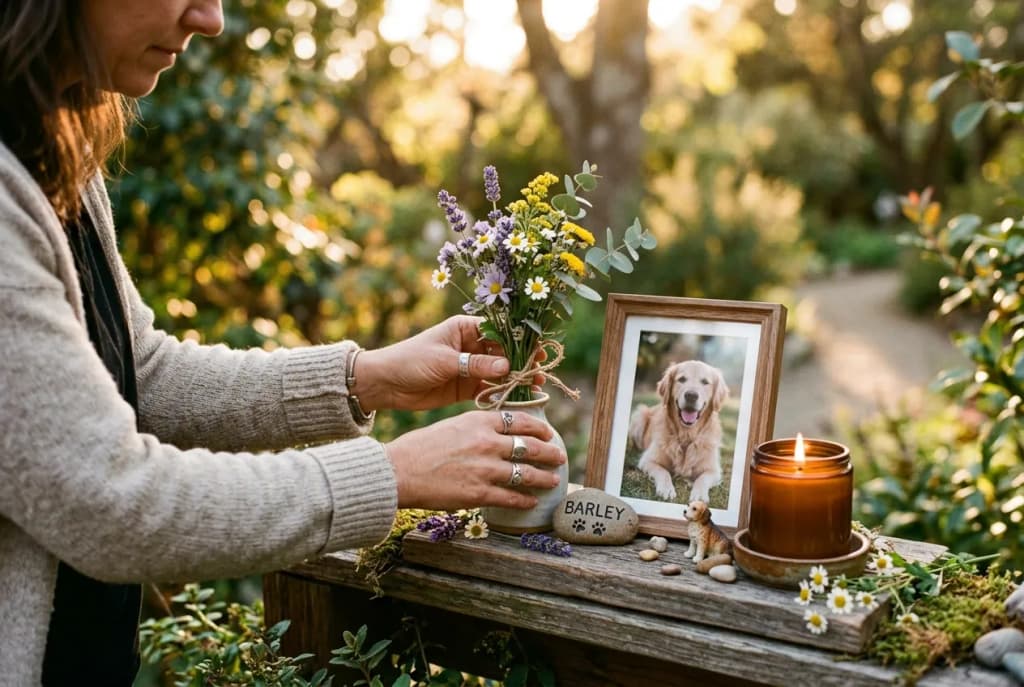
How an Ashes Container Becomes a Cultural Tradition, Not Just a Keepsake
Mara grew up in a family where ancestors were remembered with incense, fruit, and photographs. Her partner came from a Midwestern household where grief was quieter: flowers, church, casserole dishes, a hand on the shoulder. Neither tradition had a clear category for a tabby cat who stole mango slices and slept on tax documents.
So the kitchen shelf became the compromise.
A small ceramic ashes container sat beside a framed photo of Saffron. On Fridays, Mara placed a bit of fresh orange peel nearby because he had loved the smell. Her partner added a smooth river stone from the backyard, something sturdy and plain. Neither element “matched,” culturally speaking.
Together, they made sense.
This is the part many pet memorial guides skip: pet loss ritual often becomes a cultural negotiation.
You may be carrying inherited ideas about what is appropriate to mourn. Some families understand candles. Some understand prayer. Some understand silence. Some understand nothing at all when the one being mourned had paws.
That can leave you feeling judged.
Maybe someone said, “It was just a cat,” and the words lodged under your ribs. Maybe you felt embarrassed for wanting an urn on the mantel. Maybe you hid the ashes container before guests came over because you didn’t want to explain why your tabby had a place of honor near wedding photos.
That shame is more common than you might think.
And it is not evidence that you are overreacting. It is evidence that your bond is real but your social environment may not have language for it.
The Association for Pet Loss and Bereavement offers support specifically because pet grief can be socially minimized. That minimization matters. Grief intensifies when it has to defend itself.
Build a ritual that translates your love
A strong ritual does not have to copy one cultural tradition perfectly. In fact, the most meaningful pet rituals often work like translation. They carry the emotional grammar of your background into a new context.
Ask yourself:
- What did my family do with grief? Candles, food, prayer, flowers, visits, stories, quiet?
- What did my pet actually love? Sunlight, tuna water, tennis balls, fleece, crunchy leaves?
- What object feels respectful but still personal? An ashes container, photo, figurine, paw print, collar?
- Who needs to understand this ritual? You alone, your children, your partner, your parents?
Then build something honest from those answers.
If your family lights candles for relatives, you might light one beside your tabby cat memorial every Saturday evening. If your culture leaves food offerings, you might place a symbolic treat nearby for ten minutes, then compost or dispose of it respectfully. If your tradition values spoken prayer, you might write a blessing that includes your pet’s name.
If your family avoided grief entirely, your ritual may be the first compassionate one you have ever built.
That counts too.
The ashes container as a bridge between generations
Children often understand ritual before adults do.
A child may pat the ashes container and say goodnight without embarrassment. They may tuck a drawing underneath it. They may ask if the cat is cold. These questions can break you open, yes, but they also reveal something important: children naturally seek concrete gestures for abstract loss.
Adults need them too. We just get better at pretending we don’t.
If you have older relatives who don’t understand pet memorials, explain the ritual through familiar language:
- “This helps us remember him respectfully.”
- “We’re keeping a small memorial place, like we do for family photos.”
- “The container gives the kids somewhere to say goodnight.”
- “It’s part of how we’re accepting the loss.”
You do not have to persuade everyone.
But you may be surprised. Sometimes a skeptical parent softens when they see the ritual performed with dignity. Sometimes the person who said, “Don’t make too much of it,” is the one who later touches the photo and says, “He really was a handsome cat.”
Mara’s father was like that. At first, he stood awkwardly in the kitchen, hands in his jacket pockets. Then he noticed the orange peel. He laughed once and said, “That cat did think he owned the fruit bowl.”
There it was.
A bridge.
The Psychology of Pet Loss Acceptance: Why Touch Helps the Mind Believe
Grief lives in the body before it becomes a sentence.
Your shoulders tense when you pass the veterinary clinic. Your stomach drops when you hear a collar jingle from another room. Your hand hovers above the empty food bowl because muscle memory still expects the scoop, the clink, the impatient meow.
This is why touch matters.
Touch activates systems in the body connected to safety and regulation. A familiar texture can lower perceived threat, especially during moments of emotional flooding. We are not saying an ashes container or figurine is a treatment for grief. But tactile grounding is a legitimate coping strategy: you use physical sensation to bring attention back to the present moment.
The cold smoothness of ceramic. The slight grain of paper in a photo print. The soft worn edge of a collar.
These textures tell your nervous system, “Here. Now. You are here.”
The American Veterinary Medical Association recognizes the importance of the human-animal bond, and resources from the AVMA on pet loss and grief can help families understand why the death of an animal companion can be so destabilizing. Your attachment system did not categorize your pet as “less real” because they were not human.
Your body loved them in daily increments.
That is why daily increments help you heal.
Guilt, relief, and the cruel math of euthanasia timing
Many pet owners feel guilty about the final decision.
Not vaguely guilty. Specifically guilty.
You may replay the timing: Was it too soon? Too late? Did they know? Did you betray them? Did you wait because you couldn’t bear it, or decide because you were exhausted? The mind loops because it is trying to locate a single correct answer in a situation that often did not offer one.
This is cognitive dissonance again. You loved your pet, and you made or witnessed a decision that ended their suffering. The brain struggles to hold both truths, so it searches for a verdict: guilty or innocent.
But love at the end of life rarely fits courtroom logic.
That wave of relief when their suffering ended? It does not make you unloving. Relief mixed with grief is one of the most misunderstood experiences in pet loss. It often means your nervous system has been under prolonged stress—high vigilance, disrupted sleep, constant monitoring of appetite, breathing, pain, medication.
When the suffering stops, your body may unclench before your heart is ready.
Then guilt rushes in.
If that is where you are, try this ritual:
- Sit near the ashes container or memorial object.
- Place one hand on the surface—cool ceramic, smooth wood, textured resin, whatever you have.
- Say: “I made the best decision I could with the information and love I had.”
- Write down three facts, not feelings:
Facts help interrupt the guilt spiral. Not because feelings are wrong, but because guilt often edits the record.
A family we worked with after losing their senior beagle told us they kept saying, “We should have known sooner.” Their ritual became reading the final veterinary notes once a week for a month, then placing the paper under the memorial shelf. It sounds clinical. It helped. The document reminded them that they had not imagined the decline, and they had not acted casually.
Sometimes acceptance needs evidence.
Anger belongs at the memorial table too
Anger can feel disrespectful near an ashes container.
You might be angry at the disease. At the veterinarian. At the cost of care. At your partner for not noticing symptoms sooner. At yourself for missing a sign. At people whose pets are still alive and healthy and loudly ordinary.
Jealousy of others with pets can be especially shameful. You see someone complaining about their cat knocking over a plant, and part of you thinks, “I would give anything for that problem.”
This is normal.
Anger is not the opposite of love. Often, anger is grief looking for somewhere to put helplessness.
Give it a ritual outlet that does not harm you or anyone else:
- Write an uncensored letter to the illness, accident, or circumstance.
- Tear the paper slowly and place the pieces in a bowl for one hour.
- Touch the ashes container afterward and say one sentence of tenderness to your pet, not to the anger.
- Repeat only when needed, not daily.
The point is not to become serene. The point is to stop forcing anger to disguise itself as “being fine.”
"Acceptance is not surrendering love. It is surrendering the argument with reality."
A simple grief timeline that does not pretend to be universal
We are cautious with timelines because no chart can map your private bond. Still, many families tell us certain patterns appear at predictable moments. Use this table as orientation, not a deadline.
| Time After Loss | Common Nervous System Response | Helpful Ritual Focus | Why It Matters |
|---|---|---|---|
| First 48 hours | Shock, numbness, fragmented memory | Keep one object nearby | Reduces disorientation |
| Days 3–14 | Waves of crying, guilt loops, searching behaviors | Short daily ritual | Creates predictable contact |
| Weeks 3–6 | Reality deepens; routines feel exposed | Weekly memorial rhythm | Supports new habit formation |
| Months 2–6 | Social support may fade | Cultural or family ritual | Keeps remembrance witnessed |
| Anniversaries | Sudden intensity returns | Planned remembrance | Prevents feeling blindsided |
The counterintuitive part: the second month can feel harder than the first.
In the beginning, people check on you. Your home may still carry your pet’s scent. Administrative tasks keep you moving. Later, the world assumes you are “better,” while your brain is just beginning to understand the permanence.
That is when an ashes container, tabby cat memorial shelf, or other physical ritual can become more important—not less.
Designing a Tabby Cat Memorial Around Texture, Pattern, and Place
Tabby cats are visually specific in a way that makes memory both beautiful and painful.
The M on the forehead. The dark rings around the tail. The pale chin. The warm brown, silver, orange, or gray bands that looked different in morning light than they did under a lamp. You knew those markings the way you know a loved one’s handwriting.
A good tabby cat memorial honors that specificity.
Generic cat silhouettes can be comforting, but they may also feel strangely wrong. Too smooth. Too symbolic. Not enough like the creature who had one crooked whisker and a habit of pressing their forehead into your thumb.
Mara sent our team photos of Saffron because she was considering a custom figurine to place near his ashes container. One image showed him loafed on a flour-dusted kitchen mat, stripes bending around his shoulders. Another showed his tail wrapped tight around his paws. She told us, “I don’t need him perfect. I need him recognizable.”
That sentence stayed with us.
Because memorial objects are not about perfection. They are about recognition.
Use the “three textures” method
When creating a memorial space, think beyond visuals. Choose three textures connected to your pet:
- One soft texture: a folded blanket, felt mat, small piece of fleece
- One firm texture: ashes container, framed photo, stone, figurine
- One organic texture: dried flowers, wood, leaves, fresh herbs, orange peel
Why three? Because grief can feel mentally abstract and physically chaotic. A small range of textures gives the body options. On a raw day, you might need the softness. On a numb day, the cool firmness of the container might help you feel present.
This approach is especially helpful for people who feel isolated in grief. You may not always have someone available to listen. A textured memorial space gives you a nonverbal way to connect when language is too much work.
Where to place the ashes container
Placement changes the emotional function of the ashes container.
A bedroom memorial may feel intimate but overwhelming. A living room shelf may feel public and affirming. A kitchen space, like Mara’s, can be surprisingly powerful because kitchens already hold repetition: water boiling, hands washing, drawers opening, daily return.
Choose based on what you need, not what looks most impressive.
| Placement | Best For | Texture Cue | Watch For |
|---|---|---|---|
| Kitchen shelf | Daily greeting ritual | Cool container near warm mug | Too much exposure on hard days |
| Bedroom dresser | Private mourning | Soft cloth beneath container | Sleep disruption if grief spikes |
| Living room mantel | Family remembrance | Photo frame, figurine, candle | Feeling observed by guests |
| Home office | Continuing companionship | Collar near keyboard | Difficulty concentrating |
| Garden nook | Seasonal ritual | Stone, soil, plant leaves | Weather protection concerns |
The right place may change.
In the first month, you may want the ashes container close. Later, you may move it somewhere quieter. This is not betrayal. This is ritual maturing.
When a custom figurine belongs in the memorial
Some families plant trees. Some frame paw prints. Some keep ashes in a locket. Others choose a custom figurine because they miss the physical outline of their pet—the curve of the back, the tilt of the head, the color pattern that made them unmistakably them.
At PawSculpt, our process is digitally sculpted by master 3D artists, then precision 3D printed in full color. Advanced full-color 3D printing reproduces fur patterns and colors directly in resin, voxel by voxel, so the color is part of the material rather than a surface layer. A clear protective coat is applied afterward for sheen and durability.
The finished piece has vibrant color and a natural 3D print texture—fine grain, subtle layer detail, a real object with presence. Not plastic-perfect. Authentic.
For a tabby cat memorial, that matters because stripes are not decoration. They are identity.
If you are considering memorial keepsakes, gather photos that show:
- Face markings clearly, especially forehead, nose bridge, and eye shape
- Side body pattern, including stripes, spots, or marbling
- Tail rings and posture, if the tail was distinctive
- Favorite pose, such as loafing, sitting tall, stretching, or curled sleeping
- Color in natural light, since indoor lighting can distort warm and cool tones
We’ll be honest: a figurine is not right for everyone immediately.
If looking at your pet’s likeness feels too sharp right now, wait. Use the ashes container alone for a while. Let your nervous system tell you when recognition would comfort more than wound.
"A memorial should not freeze grief in place; it should give love somewhere gentle to land."
— The PawSculpt Team
Creating a Cultural Bridge Without Performing Grief for Other People
There is a quiet pressure after pet loss to make your grief legible.
If you cry too much, some people worry. If you don’t cry visibly, they assume you are fine. If you create a memorial, they may think it is excessive. If you do not, they may think you are detached.
No wonder people feel alone.
One of the most overlooked parts of pet loss acceptance is deciding who your ritual is actually for. A ritual built to satisfy other people will feel hollow. A ritual built only for privacy may protect you, but it can also deepen isolation if you secretly want witness.
You are allowed to choose.
Private, shared, and public rituals
Think of ritual in three circles:
- Private ritual: something only you do
- Shared ritual: something your household or close friends join
- Public ritual: something visible to extended family, social media, or community
Each circle serves a different psychological function.
Private ritual supports regulation. Shared ritual supports attachment. Public ritual supports recognition.
Mara’s private ritual was touching Saffron’s ashes container each morning. Her shared ritual was Friday orange peel with her partner. Her public ritual was a small framed photo during a family dinner, where anyone could tell a story if they wanted.
No speech. No ceremony program. Just an invitation.
Her uncle told a story about Saffron sitting inside an empty grocery bag like royalty. Her niece asked if she could draw him. Her partner cried for the first time in front of everyone, which surprised him more than anyone else.
This is how cultural bridges are built: not by explaining grief perfectly, but by making a small place where memory can be touched.
The counterintuitive insight: do less, but repeat it
Most people assume a meaningful ritual needs depth, beauty, and emotional intensity.
What actually helps more is low-friction repetition.
A ritual you can do when exhausted is better than one that requires emotional courage every time. Your brain benefits from predictability. Your household benefits from clarity. Your grief benefits from not needing to reinvent itself each day.
Try one of these:
- The 30-second touch: touch the ashes container and say your pet’s name once.
- The weekly offering: place one safe symbolic item near the memorial for an hour.
- The monthly story: write one specific memory on the same date each month.
- The seasonal shift: change the cloth, flowers, or photo with the season.
- The anniversary plan: decide ahead of time how you’ll mark the day.
The “So what?” is simple: repetition makes remembrance sustainable.
If your ritual depends on a rare emotional state, you will avoid it. If it is small enough to do while making coffee, it can stay with you.
When family cultures disagree
Sometimes one person wants the ashes container displayed. Another wants it tucked away. One partner wants photos everywhere. Another cannot bear to see them. One family member believes pets should be mourned privately; another wants a full memorial gathering.
This is not just preference. It is often attachment style in motion.
Attachment theory describes how people seek closeness or distance under stress. Someone who wants the container visible may be seeking proximity. Someone who wants it stored safely may be seeking emotional regulation through reduced triggers. Neither person is automatically more loving.
Use a two-location compromise:
- Primary memorial place: where the ashes container or main object stays most of the time
- Ritual place: where it can be moved temporarily for ceremonies or anniversaries
For example, the ashes container might live on a bedroom shelf, but on Fridays it moves to the kitchen table for a shared ritual. This respects both closeness and boundaries.
Use language like:
- “I’m not asking you to grieve my way every day.”
- “Can we create one time each week where the memorial is visible?”
- “I need a place to touch something connected to them.”
- “What part feels hardest for you to see?”
These questions reduce defensiveness because they focus on need, not blame.
What to Do With the Hard Feelings No One Wants to Say Out Loud
There are emotions that pet owners whisper to us indirectly.
They ask about figurines, but what they are really asking is whether they are allowed to still need their pet. They ask where to place an ashes container, but underneath that is fear: “If I move it, am I moving on?” They ask if a memorial is “too much,” and what they mean is, “Will people judge me for loving this deeply?”
Let’s name some of it.
Fear of forgetting
Many pet owners fear forgetting the texture of their pet.
Not the facts. The texture.
The exact silkiness of the fur between the ears. The warmer patch under the belly. The rough little tongue. The weight of a cat stepping carefully onto your chest, one paw at a time, as if your ribs were furniture.
This fear can become urgent after cremation because ashes are abstract. They are connected to your pet, but they do not resemble the body you knew.
A practical exercise helps:
Create a sensory inventory within the first 3 to 6 weeks, or whenever you can.
Write down:
- What their fur felt like in three places
- What their paws felt like
- How heavy they felt when picked up
- The sound they made when settling down
- The smell of their head, blanket, or favorite spot
- One texture they loved touching
Do not make it poetic unless poetry comes naturally. Specific is better than beautiful.
“Saffron’s back fur felt sleek in one direction and slightly rough backward” is more useful to memory than “He was soft.”
Why? Specific sensory language strengthens retrieval cues. In plain English: it gives your brain more doorways back to the memory.
Guilt about moving on
Guilt about moving on often appears the first time you laugh without thinking of them, clean their bed, or consider another pet.
You may feel disloyal.
This is the brain confusing continued life with abandonment. But your pet’s place in your attachment system is not erased because joy returns. Love is not a single-occupancy room.
Try adding a transition phrase to your ritual:
- “I am carrying you with me today.”
- “Your place is still yours.”
- “I can love forward without loving you less.”
- “I am allowed to live in the world you shared with me.”
Say it while touching the memorial object. The tactile cue matters because abstract reassurance may not land when guilt is physical.
A customer once told us she could not bring herself to move her cat’s food bowls for two months. When she finally did, she washed them slowly, dried them with the same towel, and placed the tag beside the ashes container. That action turned cleanup into ceremony.
The bowls were no longer “removed.”
They were retired with honor.
Anxiety about getting another pet
Anxiety about adopting again can show up as moral panic.
What if it’s too soon? What if the new pet doesn’t bond with you? What if you compare them unfairly? What if loving another animal proves your grief was shallow?
Here’s the thing: another pet is not a sequel. They are a different book.
If you are considering adoption, build a readiness ritual before making decisions:
- Spend 10 minutes at the memorial space.
- Say what you miss about caregiving, not just companionship.
- Say what you are not ready for yet.
- Visit a shelter or rescue website without committing.
- Wait 72 hours before taking action.
This pause protects both you and the future pet. It separates longing from readiness.
We are not vets or grief therapists, so if grief is severely impairing sleep, work, eating, or safety, professional support matters. But from years of working with pet families, we can say this confidently: wanting to love again is not betrayal. It is evidence that the bond taught your heart a language it still wants to speak.
Complicated grief when the relationship was difficult
Not every pet relationship was gentle.
Some pets bit, scratched, destroyed furniture, triggered household conflict, required exhausting medical care, or never bonded the way you hoped. After they pass, grief can become tangled with resentment, relief, and regret.
This is normal.
You might mourn the pet and the relationship you wished you had. You might feel relief that the daily stress is over, then feel ashamed because relief seems cruel. It is not cruel. It is information about how hard the situation was.
For complicated grief, avoid rituals that force sentimentality.
Instead, use a truth-based ritual:
- Place the ashes container or memorial object on a table.
- Write two columns: “What was hard” and “What was real love.”
- Include both without editing.
- Fold the paper and place it beneath or near the container for one week.
- After a week, decide whether to keep, burn safely, shred, or store it.
This ritual works because it reduces emotional splitting—the mind’s tendency to make something all good or all bad when complexity hurts.
Your pet does not need a perfect story to deserve remembrance.
And you do not need a perfect relationship to grieve.
Building a Memorial Space That Supports Acceptance Over Time
A memorial space should evolve.
This may sound obvious, but many people unconsciously believe that changing the memorial means diminishing the pet. So the first arrangement stays frozen for months or years, even when it becomes painful to look at or impossible to maintain.
A living ritual is allowed to change.
Mara’s kitchen shelf changed after three months. The orange peel became occasional instead of weekly. The photo stayed. The ashes container moved onto a small woven mat because the bare shelf felt too cold in winter. Later, she added a small full-color figurine of Saffron in his loaf pose—not beside the container at first, but across from it, like a conversation.
That distance mattered to her.
She said the ashes container represented what happened. The figurine represented who he was.
That distinction can help.
Separate “death objects” from “life objects”
This is one of our favorite practical insights, and it surprises people.
A memorial space often works better when it includes both:
- Death objects: ashes container, sympathy card, paw print, final veterinary tag
- Life objects: favorite toy, photo, figurine, collar, story card, seasonal item
If the space contains only death objects, it can feel heavy and final. If it contains only life objects, it may feel like you are avoiding the reality of death. Together, they help the brain integrate the whole truth.
Your pet died.
Your pet lived.
Both deserve a place.
| Memorial Element | Category | Emotional Function | How Often to Refresh |
|---|---|---|---|
| Ashes container | Death object | Acknowledges finality and closeness | Usually stable |
| Favorite photo | Life object | Restores personality and expression | Change monthly or seasonally |
| Collar or tag | Both | Connects body memory and identity | As needed |
| Small offering | Life object | Keeps ritual active | Weekly or monthly |
| Custom figurine | Life object | Preserves posture, markings, presence | Stable, with gentle dusting |
This is also where a 3D pet sculpture can fit naturally for some families. Because PawSculpt figurines are digitally modeled from your pet’s photos and produced through full-color resin 3D printing, they can preserve details like tabby striping, ear shape, and posture in a way that supports recognition.
Again, it is one option. Not the only meaningful one.
A handwritten recipe card for the chicken your cat always begged for can be just as sacred.
Care for the memorial like you are caring for the bond
Dust gathers. Flowers dry out. Candles burn unevenly. The shelf becomes cluttered with mail because life keeps happening around grief.
This does not mean you failed.
But tending the memorial can become part of acceptance. Once a month, set a 15-minute timer and do the following:
- Wipe the surface with a soft cloth.
- Hold each object briefly and decide whether it still belongs there.
- Remove clutter that arrived by accident.
- Add one current-life element, like a seasonal leaf or a note about something you wish they had seen.
- End with one sentence: “You are still part of this home.”
The “current-life element” is important. It tells your nervous system that remembrance is not locked in the week they died. Your bond can accompany the present.
That is acceptance in motion.
Protecting ashes containers and keepsakes
Practical care matters because memorial damage can feel emotionally devastating.
General guidelines:
- Keep ashes containers away from unstable shelf edges.
- Avoid high-humidity areas unless the container is designed for that environment.
- Use museum putty for lightweight objects in earthquake-prone or high-traffic homes.
- If children participate, create a supervised touching ritual rather than unrestricted handling.
- For resin figurines, dust gently with a soft dry cloth and keep them away from extreme heat.
If an object breaks, pause before interpreting it symbolically. Grief loves omens because omens create meaning from shock. But sometimes a shelf is bumped. Sometimes a cat sibling knocks things down. Sometimes glue fails.
Repair can become a ritual too.
Turning the Ashes Container Into a Bridge, Not a Shrine You Fear
A shrine can become frightening if you believe it must hold all your grief perfectly.
A bridge is different.
A bridge allows movement: toward memory, away from acute pain, back again on anniversaries, forward into daily life. Your ashes container can be part of that bridge if you let it serve a living function rather than sit as a test of devotion.
Ask this question:
Does this memorial help me return to love, or does it only return me to the moment of loss?
If it only returns you to the loss, adjust it. Add a life object. Change the location. Shorten the ritual. Invite someone safe to share a story. Replace the formal candle with the silly toy they loved.
If it helps you return to love, keep going.
A 10-minute ritual for pet loss acceptance
Use this when you feel ready, especially around anniversaries, adoption decisions, birthdays, or the day you receive ashes.
You will need:
- Ashes container or another memorial object
- One photo
- One small textured item
- Paper and pen
- Timer
Steps:
- Touch the object for 30 seconds. Notice temperature, weight, surface.
- Name the reality. “You died, and I miss you.”
- Name the continuity. “You are still part of my life story.”
- Write one memory with a texture. “Your fur felt warm from the sun.”
- Write one thing you are carrying forward. Patience, play, routine, tenderness.
- Place the paper near the container for one week.
- Close with a physical gesture. Hand over heart, bow, kiss fingertips, touch the shelf.
This ritual works because it combines grief’s three essential tasks: acknowledging reality, maintaining connection, and re-entering life.
Not moving on.
Moving with.
When to seek extra support
Some grief needs more than ritual.
Please consider support from a pet loss counselor, grief therapist, veterinarian, or a group like APLB if you notice:
- You cannot sleep most nights after several weeks
- You are unable to eat or function at work
- You feel persistent panic or intrusive images
- You avoid entire rooms for months
- You feel unsafe or unable to care for yourself
- Your guilt is becoming obsessive or punishing
Ritual is powerful, but it is not a substitute for clinical care when grief becomes unmanageable. There is no shame in needing another human nervous system to help yours settle.
In fact, support is often what allows ritual to become comforting instead of overwhelming.
"Your pet’s memory is not a place you leave. It is a place you learn to visit safely."
Closing: The Kitchen Shelf, Revisited
Months after Saffron’s passing, Mara told us the kitchen shelf no longer startled her.
The ashes container still felt cool beneath her fingers. The woven mat had softened at the edges. The little figurine across from it held the familiar tabby posture her hands still remembered: loafed body, tucked paw, striped tail close.
Nothing about that shelf claimed the loss was acceptable in the casual sense.
But it had become acceptable in the deeper sense: incorporated, honored, held. A cultural tradition had bent gently enough to include a cat. A household had learned how to speak his name without breaking every time.
If you are standing at your own counter, staring at a container you never wanted to own, start smaller than you think you should.
Touch it once. Say their name. Add one object from life, not death. Repeat tomorrow if you can.
A pet loss ritual does not close the door on love; it gives you a handle you can bear to touch.
Frequently Asked Questions
What is a pet loss ritual?
A pet loss ritual is a repeated action that helps you honor your pet and give grief a stable form. It might be as simple as touching an ashes container each morning, lighting a candle weekly, writing one memory a month, or placing a seasonal flower near a photo. The power comes from repetition, not complexity.
Is it normal to keep my pet’s ashes container visible?
Yes. Many people keep an ashes container visible because it gives them a tangible place to direct love, especially in the first months after loss. If it feels too intense, try placing it somewhere private and bringing it out only during a short ritual. Visibility should support you, not punish you.
How can I make a tabby cat memorial feel personal?
Focus on specific details: stripe pattern, forehead markings, favorite sleeping pose, collar texture, and the places your cat loved. A tabby cat memorial can include an ashes container, photo, blanket, story card, or custom figurine that preserves their recognizable shape and markings. Personal beats polished every time.
Why do I feel guilty after my pet died?
Many pet owners feel guilty after illness, accidents, or euthanasia decisions because the brain searches for control after a painful loss. This is especially common when you are second-guessing timing or remembering small choices. Write down the facts of what happened and repeat a compassionate phrase near your memorial object to interrupt the guilt loop.
Can cultural traditions include pet memorials?
Yes. Cultural traditions can be gently adapted to include pets through candles, offerings, prayers, photos, flowers, remembrance days, or family storytelling. The key is to preserve the emotional meaning of the tradition while making room for the specific bond you had with your pet. You do not need anyone else’s permission to remember with dignity.
Ready to Honor Your Pet’s Memory?
Every pet has a story worth preserving. Whether you're honoring a beloved companion who's crossed the rainbow bridge or creating a tactile anchor for your pet loss ritual, a custom PawSculpt figurine can help preserve the details that made your pet unmistakably yours.
Visit pawsculpt.com to learn more about our process, previews, revisions, and quality guarantees