The 'Empty Bed' Syndrome: 6 Rituals to Perform with Your Great Dane's Collar and Figurine
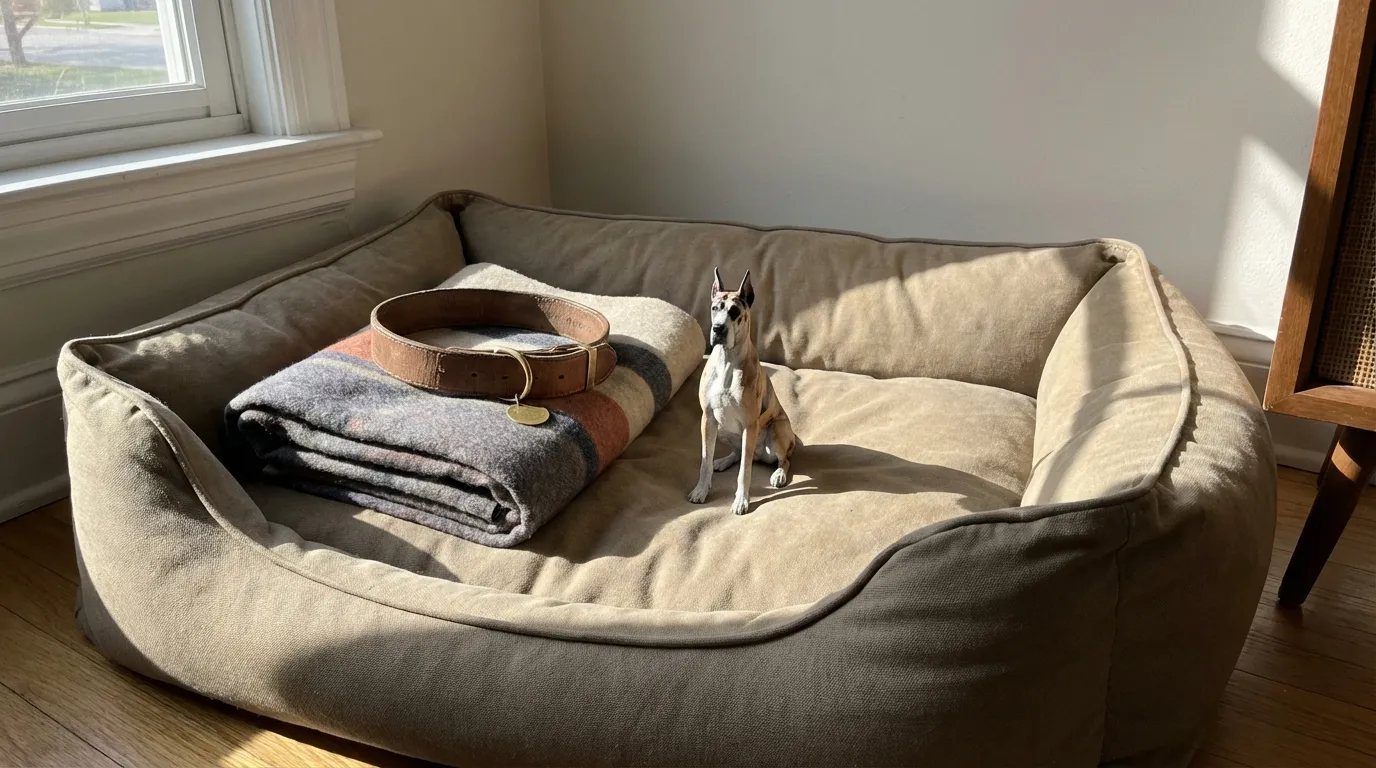
"To inhabit a room is to change it; the walls absorb the memories, the floorboards hold the weight." — Architectural Theory on Space
The sun hits the back corner of the yard differently now. For years, that patch of ornamental grass was permanently flattened, a custom-molded nest shaped by 150 pounds of sleeping Great Dane. Now, the grass is springing back up, reclaiming the earth, and the visual correction feels like a betrayal. The sheer scale of the absence is what catches you off guard; when you lose a giant breed, you don't just lose a pet—you lose the gravitational center of your home.
Quick Takeaways
- The physics of grief — With Great Danes, the silence is louder because the physical displacement of air and space was so significant.
- Don't rush the cleanup — Keeping the "giant" items (beds, raised feeders) visible for a transition period helps your brain adjust to the new spatial reality.
- Anchor the memory — Use tactile rituals involving the collar or a custom replica to provide a physical focal point for your grief.
- Validate the relief — It is physically exhausting to care for a senior giant breed; acknowledging the relief of that burden ending does not negate your love.
The Architecture of Absence: Why Giant Breed Loss Hits Differently
When a Great Dane leaves a home, the "Empty Bed" syndrome isn't just a metaphor—it is a literal, spatial crisis. You are accustomed to navigating around a creature the size of a small pony in your kitchen. Your muscle memory is calibrated to stepping over massive paws and bracing for the "lean" against your thigh.
Most people talk about the emotional void, but few discuss the kinetic confusion. Your body is still bracing for an impact that never comes. You reach out to stroke a velvet ear that usually sits at hip height, and your hand falls through empty air.
The "relief" no one wants to admit
We need to talk about the physical toll of loving a giant. Caring for a geriatric Great Dane is an athletic feat. It involves lifting heavy hips, managing traction on hardwood floors, and cleaning up messes of significant volume.There is a moment, usually in the first 48 hours, where you realize your back doesn't hurt for the first time in months. You realize you can walk through the hallway without turning sideways. And immediately following that realization comes a crushing wave of guilt.
"That wave of relief you felt when their suffering ended? It doesn't make you a bad person. It makes you someone who loved them enough to prioritize their comfort over your own need to keep them close."
This complex intersection of physical relief and devastating sorrow is unique to giant breed owners. It is not a betrayal of their memory to acknowledge that the caretaking was heavy.
Ritual 1: The Collar Shadow Box (Preserving the Patina)
A Great Dane’s collar is substantial. It is wide, heavy leather or thick nylon, often smelling of earth and musk. Tossing this into a drawer feels disrespectful, like hiding a piece of history.
Instead, approach this with the eye of a curator. Create a shadow box that honors the texture of their life.
- Do not clean it. The oils, the fraying at the buckle, the specific bend in the leather where it was set—these are the fingerprints of their existence.
- Mount it unclasped. A clasped collar looks like it’s waiting for a dog. An unclasped collar, laid out in a curve or an 'S' shape, looks like an artifact.
- Add the tag. The metal-on-metal sound of a Dane’s tag is a specific frequency. pinning the tag so it can still move slightly allows you to touch it and hear that familiar chime.
This ritual transforms a functional object into a piece of art that acknowledges the sheer size of the neck it once protected.
Ritual 2: The Scale of Memory (Reclaiming Space)
The hardest part of the "Empty Bed" is the corner of the room that suddenly looks cavernous. Removing the bed immediately leaves a scar on the floor; leaving it there is a painful reminder.
We recommend a transition ritual using a tangible anchor. This is where the intersection of art and memory becomes vital. Many families we work with choose to place a custom 3D printed figurine in that specific spot, often on a small side table or shelf installed where the bed used to be.
Why accurate scale matters
With a Great Dane, generic statues fail because they lack the specific geometry of the breed—the deep chest, the specific slope of the topline, the way the jowls hang.At PawSculpt, we don't hand-paint generic molds. We use full-color 3D printing technology that builds the image voxel by voxel (a 3D pixel). This means the brindle pattern, the harlequin patches, or the specific gray of the muzzle are part of the resin itself, not a layer of paint that can chip away. It captures the light differently, holding a permanence that mimics the enduring nature of your bond.
- Clear the large bed.
- Clean the floor space thoroughly (a ritual in itself).
- Place a small table or shelf in that exact coordinates.
- Place the figurine or urn in the center.
You are not erasing their space; you are condensing it. You are acknowledging that while their physical mass is gone, their presence still holds weight in the room.
Ritual 3: The "Ghost Walk" Transition
The routine of walking a Great Dane is a lifestyle. It dictates your morning and evening. Stopping that routine cold turkey can lead to severe depressive episodes and a feeling of aimlessness.
For the first two weeks, continue the walk.
This sounds counterintuitive, and perhaps painful, but your body needs to decompress from the habit. Walk the route. Carry the leash if you need the tactile sensation of leather in your hand.
Focus on the sensory details you usually missed:
- The sound of the wind (usually masked by heavy panting).
- The pace (usually dictated by a slower, giant stride).
- The interactions (Danes attract attention; walking alone makes you invisible again).
Acknowledge the invisibility. It is part of the grief. This ritual allows you to mourn the lifestyle change, not just the loss of the animal.
Ritual 4: The Feeding Station Altar
Great Dane raised feeders are essentially furniture. They are large, often industrial, and occupy significant square footage.
Before you donate or store the feeder, use it as a temporary altar. The height of a raised feeder is often perfect for a candlelight vigil.
The Setup:
- Clean the bowls thoroughly.
- In the water bowl side, place a potted plant (something hardy like a succulent or a peace lily).
- In the food bowl side, place a large pillar candle.
- Light the candle during the times you would normally be preparing their dinner.
This ritual helps rewire the brain's trigger. The time of day that used to mean "food prep" now means "reflection." It honors the rhythm of their life while changing the output of your energy.
Table: The Physics of Grief (Giant vs. Standard)
| Aspect of Loss | Standard Breed Experience | Great Dane / Giant Breed Experience |
|---|---|---|
| Spatial Void | A corner of a room feels empty. | Entire rooms feel cavernous; traffic flow in the house changes. |
| Physical Toll | Carrying/lifting is manageable. | Caretaking often requires team lifting or harnesses; physical relief is a major component of grief. |
| Social Impact | You lose a companion. | You lose a "celebrity" status in the neighborhood; walks become solitary and quiet. |
| Equipment | Beds/crates can be tucked away. | Equipment is furniture-sized and requires logistical planning to move or donate. |
Ritual 5: Tactile Grounding with Texture
Memory is multisensory, but grief often traps us in our heads. To get out of your head, you need to engage your fingertips.
Great Danes have distinct textures: the velvet of the ears, the rougher callous of the elbow (hygroma), the smooth, short coat that feels like satin over muscle.
Find a textile that mimics these sensations.
- Velvet: Keep a square of velvet in your pocket to rub when you feel anxious.
- Weight: Use a weighted blanket. The pressure mimics the sensation of a 140-pound dog leaning against your legs or laying across your feet.
"We've seen families heal by holding something tangible. Grief needs an anchor. When your hands remember the weight, but the air is empty, having a physical object to ground you prevents you from drifting away."
— The PawSculpt Team
Ritual 6: The Legacy Donation
Eventually, you will need to deal with the "stuff." The XL crate that takes up half the living room. The orthopedic mattress the size of a twin bed.
Because Great Dane equipment is expensive and specialized, donating it is a powerful ritual.
Do not just drop it at Goodwill.
Find a Giant Breed specific rescue. These organizations are desperate for large-size equipment.
- Write a note about your dog to attach to the donation. "This bed belonged to Atlas, who snored like a chainsaw and loved cheese. May it bring comfort to the next giant."
- Knowing that the physical object that comforted your dog is now comforting another giant who is waiting for a home transforms the act of "cleaning up" into an act of "passing the torch."
According to the American Kennel Club, the lifespan of a Dane is heartbreakingly short, usually 7-10 years. This means the equipment often outlasts the dog. Letting that equipment serve another is the highest honor.
The Art of Preservation
When we create memorials, we are trying to freeze time. We are trying to stop the fading of the image in our mind.
The reason we advocate for full-color 3D printing over traditional painting for memorials is the precision of the data. A painter interprets your dog's markings. A computer maps them. When you are grieving, you don't want an "interpretation" of your dog's harlequin patches—you want the map. You want the truth.
The resin material we use has a specific density. It warms slightly to the touch. When you run your thumb over the figurine, you feel the grain of the print—a texture that reminds you this was built, layer by layer, just as your relationship was built day by day.
Frequently Asked Questions
How long does the 'empty house' feeling last after losing a Great Dane?
The spatial adjustment often takes longer with giant breeds than smaller pets, typically spanning 3 to 6 months. Your brain has to literally rewire its spatial awareness and muscle memory to stop anticipating the large physical mass in your hallway or kitchen.Is it normal to feel relief after my Great Dane passes?
Yes, and it is crucial to forgive yourself for this. Caring for a giant breed with mobility issues is an athletic event; it causes physical strain on your back and joints. Feeling relief that the physical labor has ended is a normal biological response to the cessation of stress, and it does not diminish the depth of your love or grief.What should I do with my Great Dane's ashes?
The volume of ashes for a dog over 100lbs is significant. Many owners find standard urns too large or imposing for a mantle. A common approach is to scatter the majority in a favorite outdoor spot and keep a small portion in a keepsake urn, or incorporate a small amount into memorial jewelry.How can I get a figurine if I don't have perfect photos of my dog?
You don't need a 3D scan. Our digital sculptors specialize in forensic-level reconstruction. We can use multiple imperfect photos—a shot of the face here, a side profile there—to build a composite 3D model that captures the essence and markings of your pet. We understand the anatomy of the Great Dane, from the stop of the nose to the tuck of the waist.Ready to Celebrate Your Pet?
Every pet has a story worth preserving, but a Great Dane has a presence that deserves to be captured in full scale and color. Whether you're honoring a beloved giant who has crossed the rainbow bridge or celebrating your gentle giant's unique markings right now, a custom PawSculpt figurine freezes that majesty in time.
Free instant AI preview • 3D artist preview within 7 days • 5 free revisions