8 Things to Include in a 'Greyhound Legacy Box' (Start with the Collar, End with the Figurine)
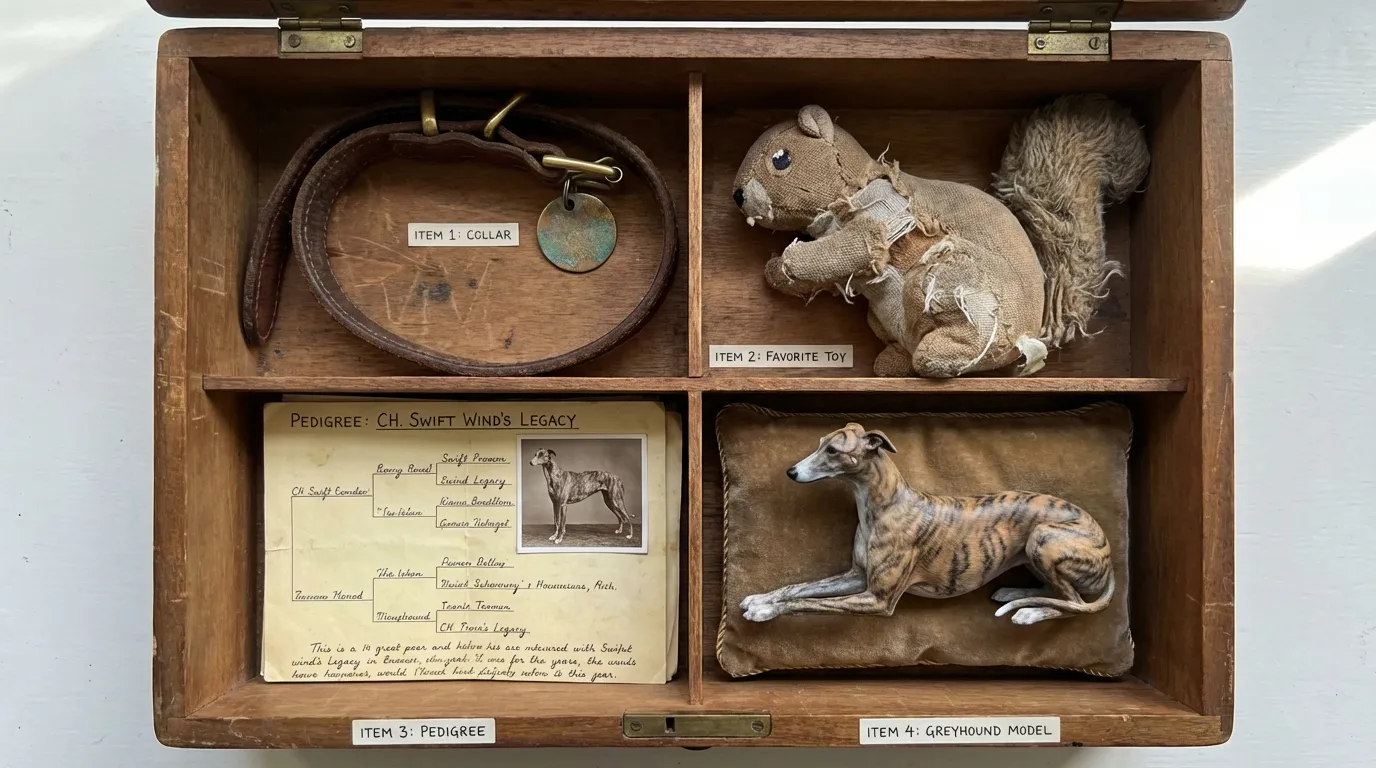
The hallway floorboards still creak in that specific spot where you instinctively step sideways to avoid a phantom pair of long, spindly legs. In the sudden vacuum of the house, the absence of that rhythmic click-clack-click of nails on hardwood feels louder than any noise.
Quick Takeaways
- Olfactory triggers are potent — Seal unwashed items (like collars) in airtight bags immediately to preserve scent-based memories.
- Touch regulates cortisol — Keeping tactile objects like fleece pajamas helps ground you during panic-inducing waves of grief.
- Narrative coherence aids healing — Organizing physical items chronologically helps the brain process the trauma of loss.
- Visual anchors bridge the gap — High-fidelity custom pet figurines provide the 3D spatial reference your brain craves.
The Psychology of the Legacy Box
When we lose a Greyhound, we aren't just losing a dog; we are losing a pervasive physical presence. These "45mph couch potatoes" take up an enormous amount of space—both physically, with their limbs akimbo in every direction, and emotionally.
From a psychological perspective, a "Legacy Box" serves as a transitional object. Much like a child uses a security blanket to navigate the unknown, grieving adults use physical artifacts to navigate the cognitive dissonance of loss. Your brain, wired for habit, still expects to see them on the sofa. When reality clashes with that expectation, the result is the neurochemical storm we call grief.
A curated box isn't about hoarding; it's about externalizing memory. It moves the burden of "remembering" from your exhausted mind to a physical space. For Greyhound owners, whose dogs come with specialized gear and unique anatomies, generic memory boxes often fail. Here is how to construct a legacy box that honors the specific biology and spirit of your hound, grounded in the science of memory.
1. The Martingale Collar (The Olfactory Anchor)
The wide, distinct shape of a martingale collar is the universal symbol of Greyhound ownership. But its value in a legacy box goes beyond aesthetics. It is an olfactory powerhouse.
The olfactory bulb in the human brain has a direct hotline to the amygdala (emotion) and hippocampus (memory). This is why a scent can trigger a vivid memory faster than a photograph. The leather or fabric of that collar holds the pheromones and unique scent profile of your dog.
The Mistake Most People Make:
They wash the collar before storing it.
The Scientific Approach:
Do not wash it. Place the collar in a vacuum-seal bag or an airtight glass jar immediately. This traps the volatile organic compounds that make up your dog's scent. When you are hit with a wave of "forgetting panic"—that terrifying feeling that you can't recall exactly how they smelled—opening that jar provides immediate neurochemical grounding.
2. The Fleece "House Coat" or Jammies (Tactile Grounding)
Greyhounds have virtually no body fat and paper-thin skin. If you owned one, you likely owned a wardrobe of fleece pajamas, snoods, and coats. While the collar is for smell, the pajamas are for touch.
Grief often manifests as a somatic (physical) experience—shaking, coldness, or a desperate need to hold something. This is your parasympathetic nervous system crashing. The texture of their favorite worn fleece offers tactile grounding.
"Grief is love with nowhere to go. A legacy box gives that love a physical address."
Choose the item they wore most often. The pilling on the fabric, the stray hairs woven into the weave—these imperfections are the data points your fingers need to read to reassure your brain that the memories are real.
3. The Muzzle or Racing Silk (Radical Acceptance)
This is where Greyhound grief differs from other breeds. Many of our dogs had lives before us—lives as professional athletes. You might feel conflicted about including a racing muzzle or their track silks, especially if they came to you with trauma.
However, from a psychological standpoint, integration is healthier than avoidance. Your dog's resilience, their journey from a crate at the track to a "roach" on your sofa, is the core of their story. Including a symbol of their past life honors their complete identity, not just the part you witnessed.
Pro Tip: If the plastic muzzle feels too clinical, keep the racing tag or the tattoo number registration card. It acknowledges the miles they ran to get to you.
4. A Vial of Soil from Their "Zoomie" Spot (Spatial Memory)
Greyhounds are creatures of speed. When they ran, they tore up the earth. Their joy was written in the dirt.
Human memory is deeply spatial. We remember events in the context of where they happened. Go to the dog park, the backyard track, or the sandy beach where they did their best "zoomies." Collect a small glass vial of that earth.
This sounds unusual, but it acts as a spatial anchor. Looking at that soil triggers the visualization of motion—the thundering paws, the double-suspension gallop. It shifts the brain from focusing on the stillness of death to the vibrancy of their life.
| Sensory Input | Brain Region Activated | Legacy Item |
|---|---|---|
| Smell | Amygdala (Emotion) | Unwashed Martingale Collar |
| Touch | Somatosensory Cortex | Fleece Jammies / Fur |
| Sight (Static) | Visual Cortex | Photos / Pedigree |
| Sight (3D/Spatial) | Parietal Lobe | Custom 3D Figurine |
5. The Medical Tag or "Do Not Resuscitate" Order (Processing Relief)
We need to talk about the emotion almost no one admits to feeling: Relief.
Greyhounds are prone to osteosarcoma (bone cancer). The end often comes fast, and the pain management is grueling. If you spent the last months carrying a 70-pound dog up stairs, managing complex medications, and watching them suffer, the moment they pass brings a flood of relief.
Then, immediately, comes the guilt.
“I shouldn't feel relieved. I'm a monster.”
You aren't. This is compassion fatigue resolving itself. Including the medical tags or the calendar where you tracked their meds helps validate the struggle. It is proof that you fought for them. It frames the relief not as a lack of love, but as the cessation of their suffering and your hyper-vigilance. It is a testament to the hard work of caretaking.
6. The "Gotcha Day" Photo and The Last Photo (Narrative Closure)
Our brains crave narrative arcs: a beginning, a middle, and an end. Grief can feel like a book that was slammed shut mid-sentence.
- The Arrival: The confused, skinny, perhaps shy dog on day one.
- The Departure: The grey-faced, soft-eyed, deeply loved senior.
Placing these side-by-side creates cognitive closure. It shows the transformation. It proves that despite the pain of the end, the journey between those two points was successful. You did your job. You turned a racer into a pet.
7. A Saved Piece of "Roaching" Foam (The Quirk)
Greyhounds sleep in impossible positions—legs straight up, spine twisted, the famous "roach." They often dig nests in memory foam beds or sofas.
If you are retiring a bed, cut a small square of the foam. It sounds strange, but squeezing that foam mimics the resistance of their muscle mass. It’s a proprioceptive trigger—a reminder of the weight and density of them.
8. The Custom 3D Figurine (The Object Permanence Totem)
The hardest part of grief for the human brain is the failure of object permanence. We are biologically wired to track our pack members. When a being we lived with for years simply vanishes, the brain enters a state of frantic searching.
Photos are flat. They engage the visual cortex, but they don't satisfy the brain's need for spatial depth. This is where a PawSculpt custom figurine serves a critical psychological function.
Unlike a generic statue, a custom figurine captures the specifics of your Greyhound.
- The way their ears folded (rose vs. button).
- The specific pattern of their brindle or the patches on their white coat.
- The scar on their shoulder from their racing days.
The Science of the Replica
At PawSculpt, we don't use "paint." We use advanced full-color 3D printing technology. The color is embedded directly into the resin, voxel by voxel, created from your photos by master digital sculptors.Why does this matter for grief? Because the brain detects inauthenticity. A hand-painted statue that gets the markings wrong can trigger the "Uncanny Valley" effect—it looks almost right, but wrong enough to be unsettling.
Our process uses digital precision to map the exact geometry of your dog’s deep chest and tuck. When you place a PawSculpt figurine on the shelf, you are giving your brain a 3D focal point. It stops the frantic searching. It allows your eyes to rest on a representation that occupies space, just as they did.
"A photo captures a moment. A sculpture captures a presence."
The "Counterintuitive" Insight: Don't Seal the Box Forever
The common advice is to pack the box and put it away to "move on." Psychology tells us otherwise.
Grief is not a linear line; it is a spiral. You will revisit it. The Legacy Box should be accessible. It is an interactive tool, not a time capsule.
On anniversaries, or days when the silence in the hallway is too loud, open the box. Smell the collar. Touch the fleece. Look at the figurine. This is called continuing bonds theory. We don't get over grief by detaching; we heal by incorporating the loss into our lives in a new way.
Frequently Asked Questions
How soon should I create a memory box after my dog passes?
There is no wrong time. Some owners find comfort in gathering items immediately (within 48 hours) to feel purposeful. Others need weeks before they can touch the items without overwhelming pain. Follow your own pace, but seal scent-items immediately.Why shouldn't I wash my Greyhound's collar before storing it?
Scent is the strongest trigger for memory recall. Washing removes the unique pheromones and natural oils that trigger the emotional centers of your brain. To preserve the scent, seal it in a glass jar or vacuum bag.Is it normal to feel relieved after my sick dog dies?
Yes, it is completely normal and valid. This is often "caregiver relief"—relief that their suffering has ended and the intense stress of medical care is over. It does not mean you loved them any less; it means you are human.How does a 3D figurine help with grief differently than a photo?
Photos are 2D and static. A 3D figurine occupies physical space, helping to satisfy the brain's desire for "object permanence." It provides a tangible presence that can be viewed from different angles, mimicking how we see living beings.What photos are best for creating a custom Greyhound figurine?
We need clear photos of the face (front and profile), the body from both sides (to see markings), and the tail. For Greyhounds, photos showing their specific ear set and any unique scars or balding patterns help us create the most realistic tribute.Ready to Celebrate Your Pet?
Every pet has a story worth preserving. Whether you're honoring a beloved companion who's crossed the rainbow bridge or celebrating your furry friend's unique personality, a custom PawSculpt figurine captures those details that make your pet one-of-a-kind.
Free instant AI preview • 3D artist preview within 7 days • 5 free revisions
"We've seen families heal by holding something tangible. Grief needs an anchor, and sometimes that anchor needs to be held in your hands."
— The PawSculpt Team