
11 Ways to Explain Your French Bulldog's Death to Children (Plus 4 Phrases to Never Use)
Her car seat still smelled like him—that warm, corn-chip funk that only French Bulldog owners recognize—and she was gripping the steering wheel in the veterinary clinic parking lot, rehearsing words she hadn't found yet. Not for herself. For the six-year-old buckled in the back seat, kicking his sneakers against the console, asking why Gus's leash was still hanging from the rearview mirror. Explaining pet death to kids isn't something you practice. It lands on you mid-breath, in a car that still smells like your dog.
Quick Takeaways
- Use clear, honest language — words like "died" and "death" prevent confusion far more than euphemisms do
- Follow your child's lead on timing — most kids process grief in short bursts, not long conversations
- Create a physical ritual together — tangible actions like a custom memorial figurine or memory box help children externalize invisible feelings
- Avoid the four phrases that backfire — "put to sleep," "went away," "God needed them," and "they're in a better place" each create specific fears in young children
- Expect behavioral regression, not just tears — bedwetting, clinginess, and appetite changes are normal grief responses in kids under ten
Why Most Advice About Explaining Pet Death to Children Misses the Point
Here's what frustrates me about the standard guidance you'll find online: it treats the conversation as a single event. One talk. One careful script. Done.
That's not how this works. Not even close.
We've processed thousands of memorial orders at PawSculpt, and the families who reach out often share details about their experience—especially when kids are involved. What we've learned is that explaining a French Bulldog's death to a child isn't a conversation. It's a season. It unfolds over weeks, sometimes months, in fragments. A question at breakfast. A drawing at school. A meltdown at bedtime three weeks later that seems to come from nowhere.
The angle most guides miss? Children don't grieve the death. They grieve the absence. That distinction changes everything about how you approach this. An adult understands finality. A child understands that Gus isn't at the door anymore. That nobody is snoring on the couch. That the kitchen doesn't smell like kibble at 6 PM.
Your job isn't to explain a concept. It's to help them make sense of a missing presence.
"Children don't need perfect words. They need someone willing to sit in the mess with them."
The 11 Ways That Actually Work (Organized by Your Child's Age)
Not every approach fits every kid. A three-year-old and a ten-year-old live in different emotional universes. So instead of a one-size-fits-all list, here's what we've seen work—organized by developmental stage, with the "why" behind each one.
1. Use the Word "Died" (Ages 3+)
This is the single most counterintuitive piece of advice, and it's the most important. Every instinct tells you to soften it. Don't.
Say: "Gus died. That means his body stopped working and he can't come back."
The word "died" is concrete. Children's brains are literal processing machines. When you say "passed away" or "crossed the rainbow bridge," a three-year-old hears a journey—one their dog might return from. That ambiguity isn't kind. It's confusing. And confusion breeds anxiety.
One family we worked with told us their four-year-old waited by the front door for eleven days after they said their Frenchie "went to a better place." He thought she was on vacation.
The American Kennel Club's guidance on pet loss supports direct, age-appropriate language. Use it.
2. Explain "Why" in Body Terms, Not Abstract Terms (Ages 3-6)
Young children understand their own bodies. Use that.
"Gus's heart got very sick. The vet tried to help, but his body was too tired to keep working. When a body stops working, it can't start again."
Notice what's happening here: you're anchoring death in something physical. Not spiritual. Not metaphorical. A body that stopped. This is crucial for kids under six, who don't yet have the cognitive framework for abstract concepts like "heaven" or "energy returning to the universe."
You can layer in spiritual beliefs later. But the foundation needs to be concrete.
3. Invite Their Questions—Then Wait (Ages 4+)
Here's a mistake that catches almost every parent: filling the silence after you deliver the news.
Kids need processing time. Sometimes thirty seconds. Sometimes thirty minutes. The urge to keep talking, to explain, to comfort—it's your anxiety, not theirs. After you've said the core truth, try this:
"Do you have any questions about what happened to Gus?"
Then wait. Really wait. Count to twenty in your head if you need to. Some kids will ask something immediately. Others will say "Can I have a snack?" and then ask a devastating question at bedtime. Both responses are normal.
4. Use a Picture Book as a Bridge (Ages 3-7)
Not as a replacement for the conversation. As a bridge into it.
The best books for this aren't the ones that sugarcoat. They're the ones that name the feeling and sit with it. A few that families have recommended to us:
| Book Title | Best For Age | What It Does Well |
|---|---|---|
| The Invisible Leash by Patrice Karst | 4-8 | Focuses on continued connection |
| Dog Heaven by Cynthia Rylant | 3-7 | Gentle, visual, comforting imagery |
| When a Pet Dies by Fred Rogers | 3-6 | Validates all feelings, including anger |
| Saying Goodbye to Lulu by Corinne Demas | 4-8 | Specifically about a dog; realistic |
Read the book first, alone. Make sure you can get through it without breaking down—or at least know where the hard parts are. Kids take emotional cues from you. If you shatter, they'll focus on comforting you instead of processing their own grief.
5. Create a "Gus Box" Together (Ages 4-10)
This is the one that surprises people with how well it works.
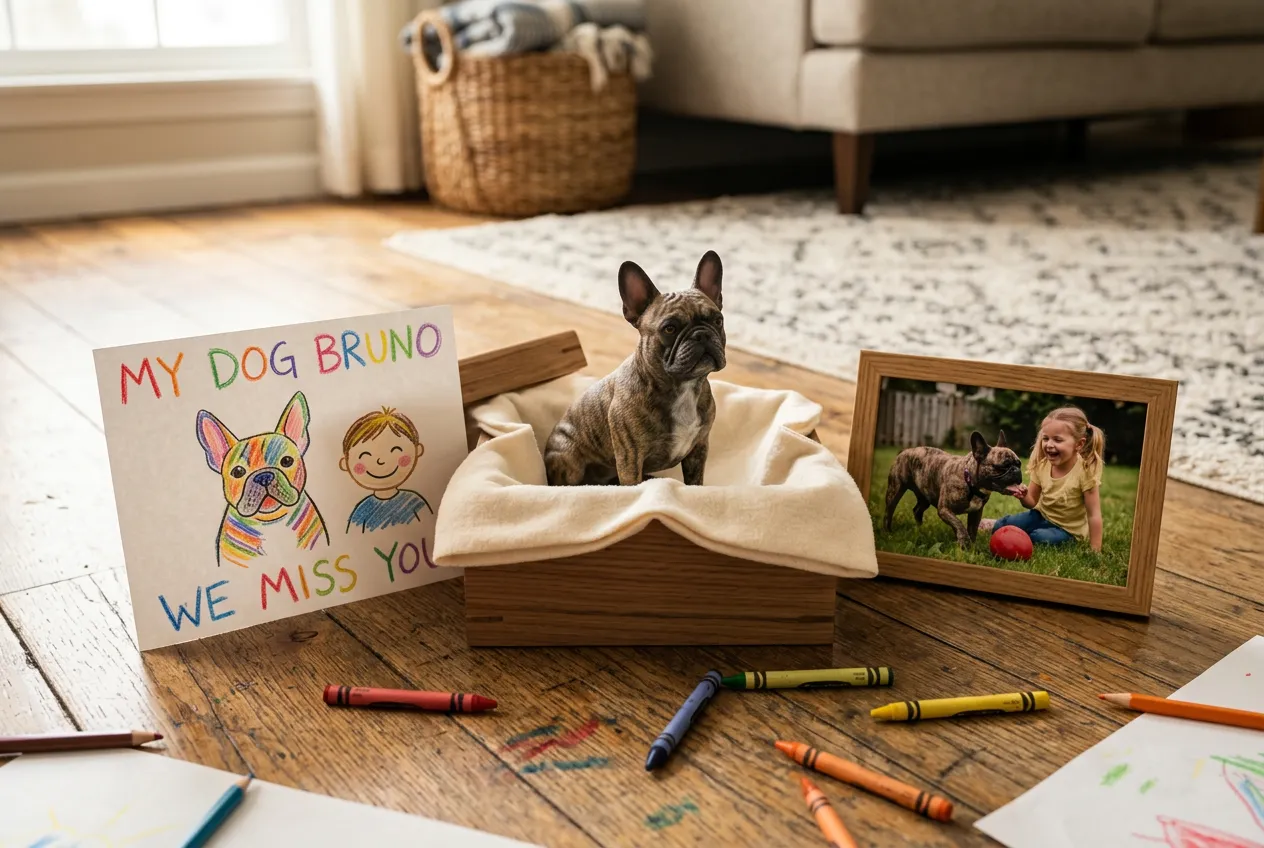
Get a shoebox. Decorate it together. Fill it with things that smell like your Frenchie, feel like your Frenchie, remind you of your Frenchie. A collar. A favorite toy. A tuft of fur if you have one. A photo. A paw print if the vet made one.
Why this works: Children are tactile grievers. They can't journal. They can't meditate. But they can hold a worn collar and remember what it felt like to clip it on. They can open a box and catch a fading scent—that unmistakable Frenchie smell, somewhere between warm bread and dusty sunshine—and feel connected to something real.
"Grief needs an anchor. For children especially, something they can hold changes everything."
— The PawSculpt Team
Some families add to the box over time. A drawing from school. A figurine. A written memory from when they're old enough to write. The box becomes a living memorial, not a static one.
6. Let Them See You Grieve—Within Limits (Ages 5+)
This is nuanced, so stay with me.
Children need to see that sadness is a normal response to loss. If you hide every tear, you're teaching them that grief is something to be ashamed of. But if you collapse into uncontrollable sobbing in front of them, you become the emergency, and they'll suppress their own feelings to take care of you.
The sweet spot: Let them see you cry briefly. Name what's happening. "I'm sad because I miss Gus. It's okay to be sad. I'm going to be okay."
Then—and this is the part most guides skip—show them what you do with the sadness. Go for a walk. Look at photos. Call a friend. You're modeling coping, not just feeling.
7. Draw a "Life Map" of Your Frenchie (Ages 5-9)
Get a big piece of paper. Draw a timeline of your dog's life. When you got them. Their first car ride. The time they stole a whole pizza off the counter (because every Frenchie has a food crime story). The funny sounds they made. The way they slept with their tongue out.
This reframes the conversation from death to life. You're not asking the child to process an ending. You're inviting them to celebrate a story. And somewhere along that timeline, naturally, comes the ending. It hurts less when it's part of a bigger picture.
Picture this: It's a Saturday morning. Pancakes on the table. Your seven-year-old is coloring a stick-figure Frenchie with bat ears and a crooked smile, narrating the time Gus fell off the couch chasing his own tail. She's laughing. And then she's crying. And then she's laughing again. That's grief working itself out in real time, and it's exactly what's supposed to happen.
8. Assign Them a Role in the Memorial (Ages 6+)
Kids who feel powerless in grief often act out. Giving them a job—a real one, not a fake one—restores a sense of agency.
- Let them choose a photo for a framed memorial
- Let them pick flowers for a garden planting
- Let them select the pose or expression for a memorial keepsake
- Let them write or dictate a letter to their dog
- Let them decide where the memorial goes in the house
That second-to-last point matters more than you'd think. When families order custom pet figurines from PawSculpt, we often hear that the child was involved in choosing the reference photo or describing their dog's personality to help our digital sculptors capture the right expression. That participation transforms a memorial from something that happened to them into something they helped create.
9. Normalize the Weird Grief (Ages 7+)
Here's where we need to talk about something most parenting guides won't touch.
Kids sometimes laugh when you tell them their pet died. They sometimes say "okay" and walk away. They sometimes get angry—not sad, genuinely furious. They sometimes ask if they can get a new dog before the old one is even buried.
None of these responses mean something is wrong with your child.
Laughter is a stress response. "Okay" is overwhelm masquerading as indifference. Anger is grief wearing a mask it knows how to wear. And asking for a new dog? That's a child trying to solve the problem of absence the only way they know how: replacement.
Your job in these moments is to not react to the surface. Don't scold the laughter. Don't force sadness. Don't shame the request for a new pet. Just note it, stay present, and circle back later.
10. Address the "Did I Cause This?" Fear (Ages 4-8)
This one keeps parents up at night once they learn about it, because most kids never say it out loud.
Young children are egocentric thinkers. Not selfish—egocentric. They genuinely believe the world revolves around their actions. So when a pet dies, a quiet, terrifying thought often forms: Was it because I pulled his tail that one time? Because I forgot to give him water? Because I wished for a cat instead?
You need to preempt this. Don't wait for them to ask.
"Gus didn't die because of anything you did. Nothing you said or thought or wished made this happen. His body got sick, and that's not anyone's fault."
Say it even if your child seems fine. Say it more than once. This fear is a seed that grows in silence.
11. Revisit the Conversation at Milestones (Ages 5+, Ongoing)
The first conversation is not the last. Grief resurfaces at transitions: starting a new school year, moving to a new house, getting a new pet, even watching a movie where a dog appears.
Mark your calendar. One month after. Three months. Six months. The anniversary. Check in casually: "I was thinking about Gus today. The house still smells different without him, doesn't it? Do you ever think about him?"
This gives your child ongoing permission to grieve. It says: This isn't over. Your feelings didn't expire. And I'm still here to hold them with you.
| Milestone | Why Grief May Resurface | What to Say |
|---|---|---|
| 1 month after | Routine fully disrupted | "I noticed Gus's spot by the door is empty. I miss him there." |
| First holiday without pet | Rituals feel incomplete | "Christmas morning feels different. Want to hang his stocking anyway?" |
| New pet arrives | Guilt, excitement, confusion | "Loving a new pet doesn't mean forgetting Gus." |
| Moving homes | Leaving the "shared space" | "Gus never lived here, but his memory comes with us." |
| Anniversary of death | Calendar trigger | "One year ago today. Want to look at his photos?" |
The 4 Phrases to Never Use When Explaining Pet Death to Kids
These aren't just "less ideal" options. Each one creates a specific, documented problem. Here's what to avoid and exactly why.
Phrase #1: "We Put Gus to Sleep"
The problem: Children go to sleep every night. If sleep equals death, you've just created a bedtime terror that can persist for months—sometimes years.
We've heard from families who didn't connect their child's sudden sleep anxiety to this phrase until a therapist pointed it out. By then, the fear had calcified.
Say instead: "The vet gave Gus medicine that let his body stop hurting. It was peaceful and gentle, and he wasn't scared."
Phrase #2: "Gus Went Away"
The problem: Away implies a destination. Destinations can be returned from. You've just set your child up for an agonizing wait.
Worse, "went away" can trigger abandonment fears. If Gus went away, could Mom go away? Could Dad?
Say instead: "Gus died. He didn't leave us—his body stopped working. He would have stayed forever if he could."
Phrase #3: "God Needed Gus in Heaven"
The problem: Even in deeply religious households, this framing backfires with young children. It positions God as someone who takes—who takes the things your child loves. That's a terrifying theology for a five-year-old.
Say instead (if faith is part of your family): "We believe Gus's spirit is in a safe, peaceful place. His body couldn't keep going, but the love part of him—that energy—it's still here."
Phrase #4: "It's Okay, Don't Be Sad"
The problem: This one seems harmless. It's the most damaging of the four.
When you tell a child not to feel what they're feeling, you teach them that their emotions are wrong. That grief is a problem to be fixed. That the appropriate response to loss is to perform composure.
Say instead: "It's okay to be really, really sad. I'm sad too. We can be sad together."
"Your child doesn't need you to fix the grief. They need you to prove it's survivable."
The Emotion Nobody Talks About: When You Feel Relief
We need to go here. Because if you euthanized your French Bulldog after watching them struggle—the labored breathing that's common in brachycephalic breeds, the mobility issues, the seizures—there's a feeling that probably hit you within hours of their death.
Relief.
And right behind it, like a shadow: crushing guilt about feeling relieved.
That wave of relief you felt when their suffering ended? It doesn't make you a monster. It makes you someone who loved them enough to absorb their pain as your own. The guilt that chases that relief is one of grief's cruelest tricks—it takes your compassion and reframes it as betrayal.
Here's why this matters for your conversation with your child: kids pick up on your emotional dissonance. If you're performing sadness while secretly feeling a complicated mix of relief, guilt, and exhaustion, your child senses the disconnect. They can't name it, but they feel it. And it makes them distrust the emotional framework you're trying to build.
So be honest—age-appropriately.
For kids 7+: "I feel a lot of things right now. I'm sad that Gus is gone. But I'm also glad he isn't hurting anymore. It's possible to feel both at the same time, and that's okay."
You just gave your child permission to hold contradictory emotions. That's not just grief support. That's emotional intelligence training that will serve them for life.
When Your Child's Grief Looks Like Something Else
Most parents expect tears. What they get instead often looks like:
| Behavior | What It Might Mean | How to Respond |
|---|---|---|
| Bedwetting (after being dry) | Stress regression | No shame. Extra comfort at bedtime. |
| Aggression toward siblings | Displaced anger about loss | Name the real feeling: "I wonder if you're mad about Gus." |
| Refusing to eat | Appetite disruption from anxiety | Offer, don't force. Keep meals calm. |
| Excessive clinginess | Fear of more loss | Extra physical closeness. Reassurance. |
| Pretending the pet is alive | Not ready to accept reality | Don't correct. Let the fantasy run its course. |
| Obsessive questions about death | Trying to master the concept | Answer patiently. Every. Single. Time. |
That last row is worth lingering on. A child who asks "But WHY did Gus die?" fourteen times isn't being difficult. They're doing cognitive work. Each repetition is them testing the reality from a slightly different angle, the way you'd press on a bruise to understand its edges. Answer every time. Same words if you need to. The repetition is the point.
Building a Sacred Space for Your Child's Grief
Here's where the spiritual dimension of this experience becomes practical.
Every culture across human history has understood something that modern Western grief culture often forgets: loss needs a physical place. A shrine. An altar. A garden stone. A shelf with a candle and a photo. Something that says: this is where we honor what was here and isn't anymore.
For children, this is especially powerful. Abstract grief—grief that lives only in the mind—is overwhelming for a developing brain. But grief that has a location? That's manageable. That's visitable. That's something they can approach when they're ready and walk away from when they're not.
Create a memorial corner together. It doesn't need to be elaborate. A shelf. A photo. Their Frenchie's collar. Maybe a candle you light together on Sunday evenings. Maybe a custom 3D-printed figurine that captures Gus mid-snore, jowls pooled on the floor, exactly the way your child remembers him. The figurine becomes a proxy—something to hold, to talk to, to include in the ongoing story.
Here's the day-in-the-life version: It's a Tuesday evening. Your daughter comes home from school quiet. She goes to the shelf, picks up the figurine, holds it against her cheek for a moment. Sets it back down. Goes to do homework. She didn't need a conversation. She needed a ritual. And the ritual—brief, private, entirely on her terms—did its work.
That's what a sacred space does. It gives grief a home so it doesn't have to live everywhere.
The Fear of Forgetting (And Why It Hits Kids Harder Than Adults)
Adults have decades of memories. Kids might have three or four years of them. So when a child loses a pet, they're not just grieving the loss—they're terrified of losing the memory of the loss.
"What if I forget what Gus looked like?"
This fear is real, and it deserves a real response. Not "you won't forget"—because honestly, details do fade. The specific shade of brindle. The exact sound of that snort-wheeze combo every Frenchie owner knows.
Instead, help them build memory anchors. Things that exist outside their mind.
- A photo album they can flip through
- A video compilation on a tablet they can access
- A scent—Gus's blanket, unwashed, sealed in a ziplock bag (smell is the strongest memory trigger we have, and kids respond to it instinctively)
- A figurine that captures the physical details their memory might soften over time
This is one of the reasons families tell us they order memorial figurines. The technology captures details—the exact color pattern, the specific ear tilt, the way one eye was slightly bigger than the other—that photos flatten. A three-dimensional object preserves spatial memory in a way a two-dimensional image can't. For a child who's afraid of forgetting, holding something that feels right provides a specific kind of comfort that's hard to replicate.
What About Getting a New Dog? (The Question That Makes Everyone Uncomfortable)
Your child will ask. Maybe the same day. Maybe six months later. And you'll feel a complicated stew of emotions about it—including, possibly, a flash of anger that they could "move on" so quickly.
Here's the counterintuitive truth: a child asking for a new pet is not a sign they didn't love the old one. It's actually a sign that the bond was so good, they want to experience it again. That's not disloyalty. That's a testimony to how well you raised them to love.
But timing matters. The ASPCA's resources on children and pet loss suggest waiting until the acute grief phase has passed—typically several weeks to a few months—before introducing a new animal. Not because there's a "correct" mourning period, but because a new pet adopted in the fog of grief often becomes a replacement object rather than its own relationship.
What to say when they ask:
- Too soon: "I love that you want to share your life with another dog. Let's give our hearts a little time to heal first, and then we'll talk about it."
- When ready: "A new dog won't be Gus. They'll be their own person with their own weird habits. And that's a good thing. Gus's spot in your heart stays Gus's."
Explaining French Bulldog Loss: Breed-Specific Conversations
This section exists because French Bulldogs die differently than many other breeds, and that changes the conversation.
Frenchies are brachycephalic. Their compressed airways, spinal issues, and susceptibility to heat stroke mean that many French Bulldog deaths involve a visible decline—breathing that gets louder, mobility that shrinks, episodes that are frightening to witness. If your child saw any of this, they're carrying sensory memories that need to be addressed.
"I know Gus's breathing was scary sometimes toward the end. That wasn't his fault, and it wasn't ours. His body was built in a way that made breathing hard. The vet helped us make sure he wasn't in pain."
If your Frenchie died suddenly—from a spinal event, an anesthesia reaction, or heat stroke—the conversation shifts to address shock:
"Sometimes bodies stop working very fast, without any warning. It's scary and confusing. There was nothing we could have done differently."
That last sentence matters enormously. For you as much as for your child. Because if you're privately second-guessing the euthanasia timing, wondering if one more day would have been the right call, or replaying the emergency vet visit in your head—your child might be absorbing that uncertainty.
Let yourself off the hook. Then let them off too.
A Note on Grief Timelines (Because Someone Will Tell You It's "Taking Too Long")
Someone—a well-meaning relative, a teacher, a neighbor—will eventually suggest that your child should be "over it by now."
Ignore them.
Children's grief doesn't follow adult timelines. A child might seem fine for three months and then fall apart at a dog food commercial. They might grieve intensely for a week and then genuinely move on. Neither pattern is wrong.
What is worth watching for: grief that interferes with daily functioning for more than a few weeks. Refusing to go to school. Persistent nightmares. Complete withdrawal from friends. These are signals to bring in a professional—a child therapist who specializes in grief, not just your pediatrician (though starting there is fine).
Most children, given honest information, emotional permission, and a few tangible anchors, move through pet grief with remarkable resilience. Not because they feel it less. Because they haven't yet learned to fight it.
The Long Game: How This Conversation Shapes Everything After
Here's what nobody tells you about explaining your French Bulldog's death to your child: you're not just navigating one loss. You're building the template for how they'll handle every loss that follows.
The grandparent. The friend. Eventually, decades from now, you.
How you handle this moment—the honesty, the emotional permission, the refusal to pretend it doesn't hurt—becomes their internal blueprint. You're teaching them that love and loss are inseparable. That grief is not a malfunction but a feature. That the price of deep connection is deep pain, and it's worth paying every single time.
That's not a burden. That's a gift.
So back to that parking lot. The one that still smells like corn chips and warm fur. The six-year-old in the back seat has stopped kicking. He's looking at the leash hanging from the mirror.
"Is Gus coming home?"
You take a breath. You turn around. You look him in the eyes.
"No, buddy. Gus died today. His body stopped working. He's not coming home. But I want to tell you about how brave he was, and how much he loved you. Can we talk about that?"
He nods. And the conversation—the real one, the one that matters—begins.
That leash will hang from the mirror for another two weeks before you move it. And when you do, you'll put it in a box your son decorated with stickers and Frenchie drawings. Next to a collar that still carries a fading scent. Next to a figurine that looks so much like Gus that your son whispered "hi, buddy" the first time he held it.
The presence isn't gone. It just changed shape.
Frequently Asked Questions
How do I explain my dog's death to a 4-year-old?
Use the word "died" directly, followed by a concrete explanation: "Gus died. That means his body stopped working and he can't come back." Avoid euphemisms like "put to sleep" or "went away," which create confusion and can trigger sleep anxiety or abandonment fears. Keep sentences short and be prepared to repeat the same explanation multiple times—that repetition is how young children process new realities.
Is it normal for a child to not cry when a pet dies?
Absolutely. Children express grief in ways that often don't look like grief at all. Laughter, silence, immediate requests for a new pet, or simply saying "okay" and walking away are all documented stress responses. These reactions don't mean your child doesn't care. They mean their brain is processing the information in the only way it currently can. Circle back in a few hours or days—the real emotional response often arrives on a delay.
How long does pet grief last in children?
There's no standard timeline, and anyone who gives you one is guessing. Some children grieve intensely for a few days and then seem fine. Others appear fine for months and then break down at an unexpected trigger—a dog in a movie, a friend's new puppy, the anniversary of the death. Watch for grief that interferes with daily functioning (school refusal, persistent nightmares, complete social withdrawal) for more than a few weeks, which may warrant professional support.
Should I let my child see me cry over our pet?
Yes—with intention. Brief, named emotions ("I'm crying because I miss Gus, and that's okay to feel") model healthy grieving. The key is to also model coping: after the tears, show your child what you do next. Look at photos. Go for a walk. Call a friend. Avoid extended breakdowns in front of young children, which can shift them into a caretaker role and suppress their own grief processing.
When should we get a new pet after our dog dies?
Wait until the acute grief phase has passed—typically several weeks to a few months. Rushing into a new pet can turn the animal into a replacement object rather than allowing a new, independent bond to form. When your child asks (and they will), validate the desire: "I love that you want another dog. Let's give our hearts some time first." When you do welcome a new pet, explicitly name that it won't replace the one you lost.
How do I help my child remember a pet that died?
Build tangible memory anchors that exist outside your child's mind. A photo album, a video compilation, a memorial box with the pet's collar or a blanket that still carries their scent—these all help. Some families find that a three-dimensional keepsake, like a custom figurine that captures their pet's specific markings and expression, provides a unique kind of comfort because it preserves spatial details that photographs flatten. Let your child choose which memories to preserve; the act of choosing is itself a form of healing.
Ready to Honor Your French Bulldog's Memory?
Explaining pet death to kids is one of the hardest conversations you'll ever have. But creating something tangible—something your child can hold, talk to, and keep on their shelf for years—transforms invisible grief into something manageable. A custom PawSculpt figurine captures your Frenchie's exact colors, expression, and personality through advanced full-color 3D printing, preserving the details that matter most to your family.
Visit pawsculpt.com to explore the process, see examples, and learn about current options