
The Online Community That Held Space When Nobody Understood My Ferret's Passing
Seventy-three percent of pet owners who lose an exotic pet report feeling isolated in their grief—not because they loved less, but because fewer people understood what they lost.
Quick Takeaways
- Online pet loss communities offer 24/7 support — especially crucial for exotic pet owners who face unique grief challenges
- Ferret-specific grief groups validate experiences — that mainstream pet loss spaces often overlook or minimize
- Tangible memorials like custom figurines help bridge online support with physical comfort — giving grief a place to rest
- Asynchronous forums work better than real-time chat — for processing complex emotions at your own pace
- Finding "your people" matters more than group size — niche communities often provide deeper understanding than large generic ones
When my ferret Pixel died at 3 a.m. on a Tuesday, I sat on my kitchen floor holding her cooling body, scrolling through my phone with shaking hands. Not for emergency vet numbers—it was too late for that. I was searching for someone, anyone, who would understand why losing a two-pound animal felt like the floor had dropped out from under me.
The first three people I texted didn't get it. "It's just a ferret," one said, trying to be kind. "You can get another one." My family offered the usual platitudes about time healing and rainbow bridges. But none of them had ever watched a ferret war-dance across a living room or felt that specific weight of a sleeping noodle-cat draped across their neck.
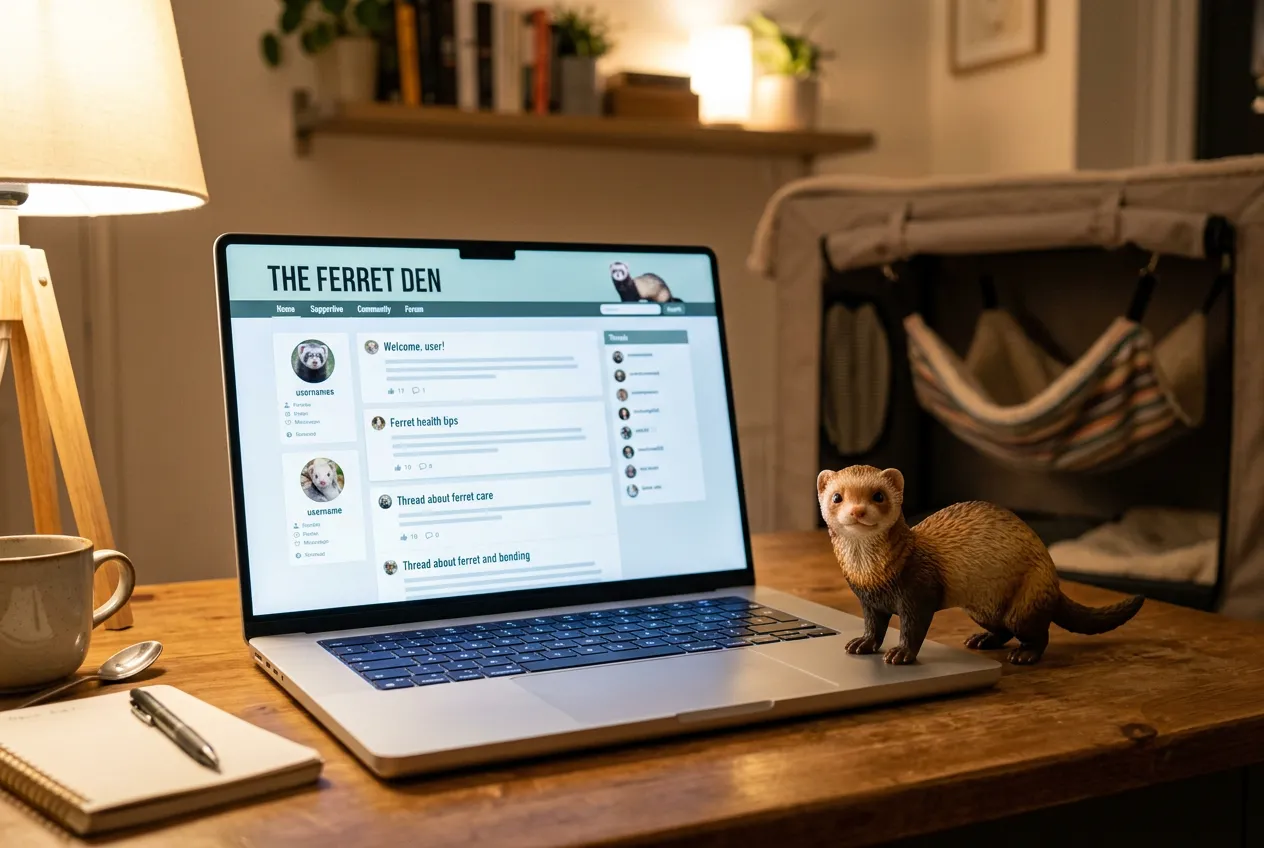
That's when I found them. The online communities that held space when nobody else could.
Why Ferret Loss Hits Different (And Why You Need Specialized Support)
Ferret grief occupies a strange territory in the pet loss landscape. You're mourning a companion who lived maybe six to eight years if you were lucky. Someone who required specialized vet care that cost more than most people spend on their own healthcare. A creature that most of your social circle considered "basically a rodent" despite being neither rodent nor basic.
The isolation compounds the grief. When a dog dies, coworkers bring casseroles. When a ferret dies, people ask if you're "really that upset" over a pet that cost forty dollars at the pet store. They don't know about the three-thousand-dollar insulinoma surgery. The daily medication schedules. The way your ferret recognized your footsteps and did that little backwards hop of excitement.
One member of the Ferret Loss Support group on Reddit described it perfectly: "I felt guilty for grieving so hard over an animal that lived in my spare bedroom. Then I realized I was grieving six years of daily interaction, of being needed, of having a creature who was genuinely excited to see me every single day. That's not small."
The grief timeline doesn't match societal expectations. Most people give you a week, maybe two, to be "really sad" about a pet. But ferret owners know the grief comes in waves that don't respect timelines. Three months later, you'll reach for the ferret-proofing you installed under the couch. Six months later, you'll hear a plastic bag crinkle and turn around expecting to see them investigating. A year later, you'll still pause before opening the dryer.
The Specific Emotional Landmines Ferret Owners Face
Guilt about euthanasia timing hits differently with ferrets. Their decline can be rapid—healthy on Monday, struggling by Friday. Or it's slow, a gradual fade where you're constantly questioning whether today is the day. Unlike dogs who might clearly communicate pain, ferrets are prey animals who hide suffering until they can't anymore.
I've seen dozens of posts in ferret communities from owners tormented by the same questions: Did I wait too long? Did I give up too soon? Should I have tried one more treatment? The ferret community understands this specific torture because they've lived it. They know about the impossible math of quality-of-life assessments for an animal who might rally for treats even when they're dying.
Relief mixed with grief is the emotion nobody warns you about. When Pixel finally passed after three weeks of intensive care, my first feeling wasn't sadness. It was relief. Relief that she wasn't suffering anymore. Relief that I could sleep through the night without checking if she was still breathing. Relief that I didn't have to make the euthanasia decision.
Then came the crushing guilt about feeling relieved.
The online communities I found were the first place where someone said: "That relief doesn't mean you loved her less. It means you loved her enough to be grateful her suffering ended." That single comment, from a stranger in a Facebook group at 4 a.m., did more for my healing than weeks of well-meaning but clueless condolences from people who'd never owned a ferret.

Finding Your People: Where Online Pet Loss Communities Actually Exist
Not all online grief spaces are created equal. I learned this by trial and error, joining and leaving groups until I found the ones that actually helped.
Reddit: The Asynchronous Advantage
r/ferrets has a weekly loss thread, but the real support happens in r/petloss with ferret-specific flair. The advantage of Reddit is the voting system—the most helpful comments rise to the top, and you can browse at 3 a.m. without feeling obligated to respond immediately.
What works: The ability to read through months of archived posts from people who were exactly where you are now. Seeing that someone posted "I can't stop crying" six months ago and then posted "I adopted again and it's okay" three months later gives you a roadmap through the grief.
What doesn't: The occasional troll who wanders in to say something cruel about "just a ferret." Most communities moderate heavily, but it happens.
Facebook Groups: Real-Time Connection
Ferret Loss Support and Rainbow Bridge Ferrets are private groups with active moderation. The advantage here is real-time response. Post at 2 a.m. that you're struggling, and within minutes, someone in a different timezone will respond.
One member I spoke with, Sarah, described it this way: "When I posted that I'd just said goodbye to my ferret at the emergency vet, three people messaged me privately within ten minutes. One of them stayed up with me until 5 a.m., just checking in every hour to make sure I was okay. That's not something you get from a forum post."
The visual element matters too. Facebook groups encourage photo sharing. Seeing other people's ferrets—alive and thriving, or memorialized in photo albums—normalizes both the joy and the grief. You're not just reading text about loss; you're seeing the faces of the animals people loved and the faces of the people who loved them.
Specialized Forums: Deep Expertise
Ferret.org and Ferret Universe have dedicated memorial and support sections. These tend to attract long-time ferret owners, people who've been through multiple losses and have perspective to offer.
The advantage: Incredibly specific advice. Someone will know about the exact medical condition your ferret had. They'll understand the decision tree you faced. They can tell you what to expect in the days after loss because they've been there with the same breed-specific issues.
The disadvantage: Smaller communities mean less activity. You might post and wait days for a response. But when that response comes, it's often from someone with twenty years of ferret experience who can offer insights you won't find anywhere else.
Discord Servers: The Middle Ground
Several ferret communities have moved to Discord, offering real-time chat with the organization of forums. Ferret Corner and The Ferret Collective both have memorial channels where the conversation flows but doesn't disappear into a feed.
What makes Discord work: The ability to have both synchronous and asynchronous communication. You can pop in for real-time support during a crisis, then catch up on conversations later when you're ready to engage more deeply.
What Actually Helps in Online Grief Spaces (And What Doesn't)
After six months in various online ferret loss communities, I've identified patterns in what actually moves people through grief versus what just makes them feel worse.
The Power of Witnessed Grief
The most healing posts aren't advice—they're witness. Someone writes: "Today I found her favorite toy under the couch and I sat on the floor and cried for twenty minutes." And fifty people respond with heart emojis or "I see you" or "That happened to me with the squeaky ball."
There's no fixing, no silver lining, no "at least." Just acknowledgment that the grief is real and valid and seen.
Compare that to the well-meaning but ultimately hollow advice that dominates in-person condolences: "Time heals all wounds." "They're in a better place." "You gave them a good life." These phrases, while meant kindly, often feel like conversation-enders. They don't leave room for the messy, ongoing reality of grief.
Specific Stories Beat Generic Comfort
The posts that helped me most were hyperspecific. Not "I lost my ferret too," but "I lost my ferret to insulinoma and I also spent three weeks doing subcutaneous fluids twice a day and I also wondered if I was just prolonging suffering and here's what I eventually realized."
Specificity creates connection. When someone describes the exact texture of their ferret's fur or the specific sound they made when happy, it validates your own hyperspecific memories. It says: these details matter. Your grief over small, particular things is not excessive.
One post that stuck with me came from a woman who wrote about how her ferret used to steal socks and hide them in the heating vent. After he died, she found seventeen socks in there. "I sat there counting socks and laughing and crying," she wrote. "And I kept three of them. They're in a box in my closet. Sometimes I hold them."
Dozens of people responded with their own specific ferret quirks and the objects they'd kept. Someone kept a chewed-up phone charger. Someone kept a piece of carpet their ferret had dug a hole through. Someone kept a photo of their ferret's favorite sleeping position—upside down in a hammock with all four legs in the air.
These specifics do something generic comfort can't: they give you permission to grieve in your own weird, specific way.
The Validation of Complicated Emotions
The online communities I found were the first place where people talked about the emotions that don't fit the neat narrative of pet loss.
Anger. Multiple people posted about being angry at their ferret for dying. Angry at themselves for not catching symptoms sooner. Angry at vets who didn't take ferret medicine seriously. Angry at friends who minimized their grief. The community response wasn't "you shouldn't feel that way." It was "anger is part of this. It's okay."
Jealousy. Seeing other people's healthy ferrets hurt. Watching someone post excited photos of a new ferret adoption while you're still raw from loss created a complicated mix of happiness for them and pain for yourself. The community normalized this too: "It's okay to mute someone's posts for a while. Take care of yourself first."
Fear of forgetting. This one surprised me. Multiple people posted variations of: "I'm terrified I'll forget what they felt like. I'm already forgetting the exact sound they made." The community response included practical advice (voice recordings, video, detailed journaling) but also the reassurance that the important things—the feeling of love, the bond—don't fade the same way sensory details do.
"Grief isn't a problem to be solved. It's a love story that continues after the last chapter."
What Doesn't Help (And Why It Persists)
"You'll get another ferret" is the most common unhelpful response, even within pet loss communities. It comes from a good place—people want to offer hope. But it lands wrong because it implies replaceability. Your ferret wasn't a role to be filled. They were a specific individual.
The better version, which I saw in more experienced community members: "When you're ready, there will be other ferrets who need you. Not replacements. New relationships. And it's okay if you're not ready for a long time."
Comparison grief is another trap. "At least you had six years. Mine only lived three." Or "At least it was quick. Mine suffered for months." The community has learned to shut this down quickly. Grief isn't a competition. Your pain doesn't diminish someone else's, and theirs doesn't diminish yours.
Toxic positivity shows up even in grief spaces. "Everything happens for a reason." "They're your angel now." "This was part of the plan." For some people, these frameworks help. For others, they feel like erasure of the genuine tragedy of loss. The best communities hold space for both perspectives without forcing either.
The Bridge Between Digital Support and Physical Comfort
Online communities provide crucial emotional support, but grief also needs physical anchors. This is where the digital and tangible intersect in interesting ways.
Photo sharing in online groups often leads to memorial creation. I watched this pattern repeat dozens of times: someone would post photos of their ferret, and community members would suggest ways to preserve those memories. Digital photo books. Canvas prints. And increasingly, three-dimensional keepsakes.
Several members of the communities I joined had commissioned custom figurines of their ferrets—full-color 3D printed sculptures that captured specific markings and poses. What struck me was how they talked about these pieces: not as replacements or shrines, but as conversation starters that helped them share their ferret's story with people who'd never met them.
One woman posted a photo of her ferret figurine on her desk at work. "Now when people ask about it, I get to tell them about Bandit," she wrote. "I get to say his name out loud. The online community held my grief, but this little sculpture lets me share his life with the world."
The Customer Story Thread: Maria's Journey
Maria joined the Ferret Loss Support Facebook group three days after her ferret Noodle died from adrenal disease. Her first post was raw: "I don't know how to exist in my apartment without him. Everything reminds me. I can't even look at his cage."
The community responded with immediate support—dozens of comments sharing similar experiences, offering practical advice about what to do with ferret supplies, and most importantly, just sitting with her in the pain.
Over the next two months, Maria's posts tracked her grief journey. Week two: "I packed up his things but I can't donate them yet." Week four: "I looked at photos today without crying. Progress?" Week six: "I'm thinking about fostering. Too soon?"
The community didn't rush her or judge her timeline. They shared their own varied experiences—some people adopted again within weeks, others waited years, some never did. The message was consistent: your timeline is your timeline.
Building Your Own Support Network: A Practical Guide
Finding the right online community isn't passive. It requires some trial and error and active participation. Here's what actually works:
Start by Lurking (It's Okay)
You don't have to post immediately. Spend a week reading through a community before deciding if it's right for you. Notice the tone. Are people supportive or judgmental? Do moderators shut down cruel comments quickly? Is there a mix of recent losses and people further along in grief?
Pay attention to how the community handles difficult topics. Do they allow space for complicated emotions, or do they push toxic positivity? Do they respect different grieving styles, or is there a "right way" to mourn?
Your First Post Doesn't Have to Be Perfect
When you're ready to post, start simple. "I lost my ferret [name] yesterday. I'm not okay." That's enough. The community will meet you where you are.
What to include if you want more specific support:
- Your ferret's name and age
- How they passed (if you're comfortable sharing)
- What you're struggling with most right now
- Whether you want advice or just acknowledgment
What you don't need to include: a perfectly crafted narrative, a complete medical history, or any justification for your grief level.
Engage Beyond Your Own Posts
The healing often happens in helping others. Once you're a few weeks or months into your grief, responding to someone else's fresh loss can be surprisingly therapeutic. You're not over your own grief, but you have perspective they don't yet have. You can tell them: "I felt exactly like that. Here's what helped me. Here's what didn't."
This isn't about rushing your healing to help others. It's about recognizing that grief creates a kind of expertise—you now know things about loss that you didn't before, and that knowledge can ease someone else's path.
Create Boundaries That Protect Your Healing
Not every post will help you. Some days, reading about other people's losses will feel supportive. Other days, it will feel overwhelming. It's okay to mute groups, take breaks, or skip posts that hit too close to home.
Several community members I spoke with described having "grief capacity"—some days they could hold space for others, some days they needed to protect their own fragile peace. The best communities understand this and don't guilt-trip people for stepping back.
Find Your Subset Within the Larger Group
Large communities often have smaller subgroups. In a general ferret loss group, you might find people who specifically lost ferrets to the same disease yours had. Or people in the same geographic area who meet up occasionally. Or people who share your approach to memorialization.
These smaller connections often provide the deepest support. One woman I interviewed found three other people in her city through a Facebook group, and they now meet quarterly for coffee. "We don't always talk about our ferrets," she said. "But knowing they understand that part of my life makes every other conversation richer."
The Timeline Nobody Tells You About (Because It's Different for Everyone)
Online communities reveal something that in-person support often hides: the massive variation in grief timelines. Seeing hundreds of people at different stages of loss makes it clear there's no "normal."
The First Week: Shock and Logistics
Most people describe the first week as surreal. You're handling logistics—what to do with the body, whether to get a necropsy, what to do with supplies and medications. The online community helps with practical questions: "Where can I get a private cremation?" "Is it weird to keep the ashes?" "What do I do with $200 worth of unused medication?"
The community also validates the shock. Multiple people posted variations of: "I keep forgetting they're gone. I reach for their food bowl. I listen for their sounds. Then I remember and it hits me all over again."
Weeks Two Through Four: The Crash
This is when most people hit their lowest point. The shock wears off. The distraction of logistics ends. You're left with the empty space where your ferret used to be.
This is also when in-person support often evaporates. People stop checking in. They assume you're "over it." The online community becomes crucial because they know: week three is often harder than week one.
Posts from this period are raw: "I can't stop crying." "I don't want to do anything." "Nothing feels worth it." And the community responds not with "it gets better" but with "I remember week three. I'm so sorry. Keep breathing."
Months Two Through Six: The Rollercoaster
Grief stops being constant and starts coming in waves. You'll have a good day, then something small—a commercial with a ferret, a toy you missed when packing up, a memory triggered by a smell—will knock you sideways.
The online community helps normalize this non-linear healing. "I thought I was doing better, then I found a photo and lost it" gets responses like "That happened to me at month four. And month seven. And last week at month fourteen. The waves get further apart but they still come."
Six Months and Beyond: Integration
This is when grief shifts from acute to integrated. You're not "over it"—you're learning to carry it. The online community at this stage often shifts from intensive support to occasional check-ins and milestone acknowledgments.
People post on their ferret's birthday or death anniversary. They share updates: "I adopted again." "I didn't adopt again and I'm okay with that." "I created a memorial garden." "I finally donated the supplies."
The community celebrates these milestones without judgment about which path someone chose.
"The waves get further apart, but they never fully stop. And that's okay. That's love."
When Online Support Isn't Enough (And What to Do About It)
Online communities are powerful, but they're not therapy. Several situations require professional support:
Complicated Grief
If months pass and you're unable to function—can't work, can't eat, can't engage with life—that's complicated grief, and it needs professional intervention. The online community can support you, but they can't replace a therapist trained in grief counseling.
Signs you need more than online support:
- Suicidal thoughts or self-harm urges
- Inability to function in daily life for extended periods
- Grief that's triggering or worsening other mental health conditions
- Feeling stuck in one stage of grief without any movement
Many therapists now specialize in pet loss. The Association for Pet Loss and Bereavement maintains a directory of grief counselors who take animal loss seriously.
When Online Spaces Become Triggering
Sometimes online grief communities can become echo chambers of pain. If you find yourself feeling worse after visiting a group, not better, it might be time to step back or find a different community.
One member described it this way: "I realized I was using the group to keep my grief fresh. I'd read sad posts and cry and feel like I was honoring my ferret by staying sad. But that wasn't healing. That was wallowing."
Healthy grief support should eventually move you toward integration, not keep you stuck in acute pain.
The Isolation That Online Can't Fix
Digital connection isn't the same as physical presence. Some people need in-person support—someone to sit with them in silence, to help them pack up ferret supplies, to physically be there.
If you're in this category, online communities can help you find local resources. Many cities have pet loss support groups that meet in person. Some veterinary schools offer grief counseling. Some areas have pet loss hotlines staffed by trained volunteers.
Creating Lasting Memorials: From Digital to Physical
The online communities I joined were full of creative memorial ideas, ranging from simple to elaborate. What struck me was how personal each choice was—there's no "right" way to memorialize a ferret.
Digital Memorials
Photo albums and videos are the most common starting point. Many people create private Instagram or Facebook accounts dedicated to their ferret, a place to collect memories and share stories without worrying about overwhelming their main feed.
Memorial websites through services like Forever Missed or MyKeeper allow for more elaborate tributes—timelines of your ferret's life, guest books where friends can share memories, photo galleries organized by theme or year.
Physical Keepsakes
Cremation jewelry allows you to carry a small amount of ashes in a pendant or bracelet. Several community members wore these daily, finding comfort in the physical closeness.
Paw print impressions made before or shortly after death give you a tangible reminder of your ferret's physical presence. Some people frame these alongside photos. Others incorporate them into larger memorial pieces.
Custom artwork ranges from painted portraits to digital illustrations. The advantage of commissioning art is that the artist can work from photos, capturing your ferret's personality in a way that feels both accurate and idealized.
Three-Dimensional Memories
Custom figurines have become increasingly popular as 3D printing technology has advanced. Unlike flat photos or paintings, a sculpture captures the dimensionality of your ferret—their specific body shape, the way they held their head, their characteristic pose.
What makes these particularly meaningful is the level of detail possible with modern full-color 3D printing. The technology can reproduce specific fur patterns, unique markings, even the exact shade of your ferret's eyes. The color is printed directly into the resin material, creating a durable, vibrant representation that doesn't fade or chip like painted surfaces.
Several community members shared photos of their figurines, and what struck me was how they displayed them—not hidden away as too painful to look at, but prominently placed where they'd see them daily. On desks. On bookshelves. One person had theirs in a small display case with their ferret's collar and favorite toy.
"It's not that I forget what Pixel looked like," one owner explained. "But having this physical representation means I can share her with people who never met her. I can say 'this is what she looked like when she was happy' and show them, not just tell them."
Maria's Journey Continues
Remember Maria, who joined the Facebook group three days after losing Noodle? At the four-month mark, she posted an update with a photo: a custom figurine of Noodle in his characteristic "speed bump" sleeping position—flat on his belly with all four legs splayed out.
"The online community held me through the worst of it," she wrote. "But I needed something physical too. Something I could touch when I needed to feel close to him. This isn't Noodle—nothing could be Noodle—but it's a reminder of him that makes me smile instead of just cry."
The community response was overwhelmingly positive, with several members asking where she'd gotten it made and sharing their own memorial pieces. The conversation evolved into a broader discussion about what helps in grief: the intangible support of community and the tangible comfort of physical memorials working together.
The Unexpected Gifts of Online Grief Communities
Beyond the obvious support, these communities offer unexpected benefits:
Permission to Grieve Fully
In a world that often minimizes pet loss, especially for "exotic" pets, online communities give you permission to feel the full weight of your grief without apology. You don't have to justify why you're still sad three months later. You don't have to downplay your loss to make others comfortable.
Education About Future Pet Care
Many people learn better ferret care through loss communities. Discussions about what went wrong, what symptoms were missed, what treatments worked or didn't—this collective knowledge helps people care better for current or future ferrets.
This isn't about blame or guilt. It's about the community's commitment to honoring lost ferrets by helping others avoid the same outcomes when possible.
Lasting Friendships
Some of the deepest friendships form in grief. Multiple people I interviewed described staying in touch with people they met in loss communities long after both had moved through acute grief. These friendships, forged in vulnerability, often prove remarkably durable.
"We met because we both lost ferrets to insulinoma within a week of each other," one woman told me. "Three years later, we're still friends. We talk about everything now, not just ferrets. But that shared experience of loss created a foundation of trust that's rare."
A New Relationship With Grief Itself
Perhaps the most profound gift: learning that grief is not something to "get over" but something to integrate. The online communities model this beautifully. People who lost ferrets years ago still participate, not because they're stuck in grief, but because they've learned to carry it gracefully and want to help others do the same.
They post on anniversaries: "Five years today since I lost Bandit. I still miss him. I also have two new ferrets who I love completely. Both things are true." This modeling of integrated grief—where you can honor the past while fully living in the present—is invaluable.
Practical Tips for Getting the Most From Online Support
Timing Your Engagement
Early grief needs different support than later grief. In the first weeks, you might need the intensive, real-time support of active Facebook groups or Discord servers. Later, you might prefer the reflective pace of forums where you can read and respond on your own schedule.
Don't feel obligated to stay in a community that no longer serves your needs. It's okay to move from intensive support groups to lighter memorial communities as you heal.
Contributing Your Own Experience
When you're ready, sharing your story helps both you and others. Writing out your experience—what happened, how you're coping, what's helping—can be therapeutic. It also adds to the collective knowledge that will help the next person who joins in crisis.
You don't have to be "healed" to help someone else. Sometimes the most valuable support comes from someone just a few weeks ahead in the journey who can say "I felt exactly like that last month. Here's what I'm trying now."
Balancing Online and Offline Life
Online communities should supplement, not replace, your offline life. If you find yourself spending hours daily in grief groups to the exclusion of other activities, that might be a sign you're using the community to avoid healing rather than support it.
Healthy engagement looks like: checking in when you need support, contributing when you have energy to help others, and stepping back when you need to focus on offline healing.
The Long View: What Ferret Loss Taught Me About Community
Six months after Pixel died, I'm still in several online ferret communities. I don't post as often, but I check in regularly. I respond to new members who are where I was—raw and lost and desperate for someone to understand.
What I've learned: grief is both intensely personal and fundamentally communal. No one can grieve for you. But having people who witness your grief, who validate it, who sit with you in it without trying to fix it—that changes everything.
The online communities that held space for my ferret grief taught me something broader about human connection. We're not meant to suffer alone. We're not meant to hide our pain to make others comfortable. We're meant to find our people—the ones who get it—and let them hold us while we fall apart and slowly piece ourselves back together.
For ferret owners specifically, these communities fill a crucial gap. In a world that doesn't always take exotic pet loss seriously, they create a space where your grief is not only valid but expected. Where you can say "I'm devastated over a two-pound animal" and have fifty people respond "Me too. Me too. Me too."
"Find the people who understand that small pets can leave enormous holes. They're out there, waiting to hold space for you."
Moving Forward: When You're Ready (And What That Looks Like)
There's no timeline for "moving on." Some people adopt new ferrets within weeks. Others wait years. Some never get another ferret but find other ways to stay connected to the ferret community.
The online communities I joined showed me all these paths, and the consistent message was: your path is valid.
If You Adopt Again
Many people worry that getting another ferret means they didn't love the one they lost enough, or that they're trying to replace them. The community wisdom: new ferrets aren't replacements. They're new relationships.
"I adopted two new ferrets four months after losing Pixel," one member shared. "I was terrified people would judge me for moving on too fast. Instead, the community celebrated with me. They understood that I wasn't replacing Pixel—I was honoring her by giving another ferret the kind of life she had."
If You Don't Adopt Again
Equally valid: deciding you're done with ferrets. Some people find that one loss is enough. The grief is too sharp, the lifespan too short, the heartbreak too inevitable. The community supports this choice too.
"I loved my ferrets," one long-time member wrote. "But I can't do it again. I can't sign up for that grief a second time. And that's okay. I stay in this community to honor the ferrets I had and to support others, but I'm done being a ferret owner."
If You're Somewhere In Between
Most people land in the messy middle: wanting another ferret eventually, but not yet. The online communities help you navigate this liminal space without pressure. You can stay connected to the ferret world—following cute ferret accounts, participating in communities, helping new owners—without committing to ownership yourself.
The Practical Reality: What These Communities Actually Look Like Day-to-Day
Let me paint a realistic picture of what active participation in online ferret loss communities actually involves:
Daily engagement might look like:
- Scrolling through 10-15 new posts in your main group
- Responding to 2-3 posts where you have relevant experience
- Posting your own update once or twice a week
- Sending a private message to someone who's struggling
- Sharing a memory or photo on a milestone day
Weekly engagement might look like:
- Checking in on a few key threads you've been following
- Posting when you hit a grief milestone or need specific support
- Reading through new resources or articles shared by the community
Monthly engagement might look like:
- Posting on your ferret's birthday or death anniversary
- Checking in with people you've connected with more deeply
- Contributing to community discussions about memorial ideas or grief resources
The time investment varies based on your needs. In early grief, you might spend hours daily in these communities. As you heal, engagement naturally decreases. Both patterns are normal and healthy.
The Technical Side: Making Online Communities Work for You
Privacy Considerations
Decide what you're comfortable sharing. Some people use their real names and photos. Others create anonymous accounts specifically for grief support. Both approaches are valid.
Consider:
- Do you want coworkers or family finding these posts?
- Are you comfortable with your grief being public and searchable?
- Do you need the freedom to be completely raw without worrying about who sees it?
Most platforms allow privacy controls. Facebook groups can be private. Reddit allows throwaway accounts. Discord servers can be invite-only.
Managing Notifications
Set boundaries around when and how you engage. Constant notifications about new posts can be overwhelming, especially in active communities.
Strategies that work:
- Turn off notifications and check communities on your schedule
- Set specific times for community engagement (morning coffee, before bed)
- Use "mute" features liberally—you can stay in a group without seeing every post
- Create separate accounts for grief support so it doesn't mix with your main social media
Finding the Right Platform for Your Style
Different platforms serve different needs:
| Platform | Best For | Drawbacks |
|---|---|---|
| Archived wisdom, anonymous support | Less real-time connection | |
| Real-time support, photo sharing | Privacy concerns, algorithm issues | |
| Discord | Balanced real-time and async | Learning curve for new users |
| Forums | Deep, thoughtful discussions | Slower response times |
You don't have to pick just one. Many people use multiple platforms for different needs—Reddit for reading others' experiences, Facebook for posting their own updates, Discord for real-time crisis support.
The Uncomfortable Truth About Online Grief Support
Not everyone will understand why you need it. Some people in your offline life might judge you for "dwelling" on grief by participating in loss communities. They might see it as unhealthy or excessive.
Here's what I learned: their discomfort with your grief process is their problem, not yours. If online communities help you heal, use them. You don't need to justify your grief or your healing methods to anyone.
That said, be honest with yourself about whether your engagement is helping or hurting. If you're using communities to keep grief fresh rather than process it, that's worth examining. If you're avoiding offline life by spending all your time in grief spaces, that's worth addressing.
Healthy engagement moves you toward integration.