
What the First Anniversary of Losing Your German Shepherd Actually Demands of You
Sarah was scraping dried sweet potato off a baking sheet when her knuckle brushed the edge of the counter where the ceramic food bowl used to sit—and the first anniversary of losing her German Shepherd hit her like a wall of heat from the oven door. That phantom bowl, that empty square of tile, became the entire kitchen. The first anniversary of pet loss doesn't arrive gently. It detonates in the middle of something ordinary.
Quick Takeaways
- The first anniversary isn't one day—it's a season — grief re-intensifies weeks before the actual date, and that's neurologically normal
- Ritual beats remembrance — structured, intentional acts provide more relief than passive reflection
- Your body remembers before your mind does — physical symptoms like appetite changes and insomnia often spike around the anniversary
- A tangible anchor helps — families who hold something physical, like a custom pet figurine, report feeling more connected to their pet's presence on hard days
- Guilt about "not grieving enough" is as common as guilt about "grieving too much" — both are normal, and neither defines your love
Why the First Anniversary of Losing a German Shepherd Hits Differently
Most grief guides treat anniversaries as a single emotional event. Show up, feel sad, light a candle, move on. But the neuroscience tells a different story.
Your brain encodes loss along temporal markers—seasons, light quality, ambient temperature. If your German Shepherd died in October, your nervous system started bracing in September. You may have noticed it as restlessness. Trouble sleeping. A strange irritability you couldn't name. That's not weakness. That's your limbic system doing exactly what it evolved to do: pattern-matching threat and loss.
Here's the angle nobody talks about. The German Shepherd memorial anniversary carries a specific weight because of the breed's role in your daily architecture. These aren't dogs that sit quietly in a corner. They're schedule-builders. They structure your mornings, your walks, your evenings. When a German Shepherd dies, the loss isn't just emotional—it's structural. Your entire day had a shape, and that shape collapsed.
Sarah—the customer we mentioned—told our team she'd been "fine for months." Then mid-September rolled around, and she found herself standing in the pet food aisle at Target, crying between the kibble and the cat litter. Her Shepherd, König, had died the previous October 14th. Her body knew the date before her calendar reminded her.
This is anniversary grief, and it follows a predictable (if uncomfortable) three-phase pattern:
| Phase | Timing | What It Feels Like | What's Actually Happening |
|---|---|---|---|
| Pre-anniversary tension | 2-6 weeks before | Irritability, sleep disruption, random sadness | Your nervous system recognizes seasonal/temporal cues |
| Anniversary acute grief | The day itself ± 3 days | Intense waves, crying, physical heaviness | Full emotional processing re-engages |
| Post-anniversary integration | 1-3 weeks after | Exhaustion, then gradual relief | Your brain updates the loss narrative |
The counterintuitive insight: Phase 1 is usually harder than Phase 2. The anticipation of the anniversary creates more sustained distress than the day itself. Most people white-knuckle through weeks of dread, then find the actual date oddly manageable—followed by confusion about why they "didn't feel enough."
Which brings us to something we need to address head-on.

The Guilt You Won't Find in Sympathy Cards
Let's talk about the feeling nobody warns you about: guilt about how you're grieving on the anniversary.
Some of you will reach October 14th (or March 3rd, or July 22nd—whatever your date is) and feel... not much. A dull ache, maybe. A heaviness. But not the tsunami you expected. And then the guilt floods in: Do I not love them enough? Have I already forgotten? What's wrong with me?
Nothing is wrong with you.
Grief doesn't perform on schedule. The fact that you cried in Target three weeks early doesn't mean the anniversary itself owes you tears. Your brain may have already done its heaviest processing during Phase 1.
But there's a darker variant of anniversary guilt that's even more isolating. Some of you—and if this is you, please stay with me—felt relief when your German Shepherd died. Maybe they'd been struggling with degenerative myelopathy. Maybe the last months involved carrying 80 pounds of dog up and down stairs, cleaning accidents, watching those powerful hindquarters fail. Maybe you made the euthanasia decision, and the moment it was over, a wave of relief washed through you before the grief even landed.
That relief doesn't make you a monster. It makes you someone who was carrying an unsustainable weight—physically and emotionally—for an animal you loved enough to suffer alongside. The guilt that follows that relief is one of grief's cruelest mechanisms. It takes your compassion and reframes it as betrayal.
On the anniversary, this guilt can resurface with fresh teeth. Should I have waited longer? Was there one more treatment? Did I choose my own comfort over theirs?
"The decisions we second-guess most are usually the ones we made out of the deepest love."
Here's what the AVMA's resources on pet loss confirm: the vast majority of veterinarians support the euthanasia decisions their clients make. The timing is rarely "wrong." It's almost always a choice between suffering now and suffering later—and choosing "now" is an act of profound, costly love.
If the anniversary is reopening that wound, you don't need to relitigate the decision. You need to honor what it cost you to make it.
What the Anniversary Actually Demands (It's Not What You Think)
Here's where we break from every other pet loss anniversary article you'll find.
Most guides suggest: look at photos, write a letter to your pet, donate to a rescue. Fine. All fine. But they're treating the anniversary as a remembrance event—a passive exercise in looking backward.
What your psyche actually needs is a ritual. And there's a critical difference.
Remembrance is cognitive. You think about your pet. You recall memories. It lives in your head.
Ritual is embodied. It engages your hands, your senses, your physical presence in space. It lives in your body—and that matters, because grief is stored in the body, not just the mind.
The distinction explains why scrolling through 200 photos of your German Shepherd on your phone can leave you feeling worse, not better. You're activating the memories without giving your body anything to do with the emotion. It's like revving an engine in neutral.
What the first anniversary demands is action with intention. Something you do with your hands. Something with texture and weight.
The Five-Sense Ritual Framework
We've seen hundreds of families navigate this anniversary. The ones who report feeling most "held" by the experience—rather than flattened by it—tend to engage multiple senses deliberately. Not accidentally. Not passively. With purpose.
Here's a framework we've developed from those conversations:
Touch: Hold something that connects you to your pet's physical presence. This could be their collar (notice the worn leather, the cool metal of the tag). It could be a blanket they slept on. It could be a memorial object—a stone, a figurine, something with weight and dimension that your hands can close around.
Smell: German Shepherd owners consistently report that scent is their most powerful trigger. If you still have a bed or blanket with their scent, this is the day to take it out. If not, consider the smell of the outdoors they loved—wet grass, pine, creek water. Go to that place.
Sound: Play the sounds of your shared life. Not sad music. The actual sounds. The jingle of tags. The specific creak of the door they'd barrel through. One family told us they played a recording of their dog's bark on the anniversary, and it broke something open in a way that finally felt like release rather than just pain.
Taste: Share a meal. This sounds strange, but it's ancient. Every culture on earth marks sacred moments with food. Cook something you ate during your years together. If your Shepherd used to sit at your feet during Sunday pancakes, make pancakes.
Sight: This is where intentionality matters most. Don't just scroll photos. Print one. Put it somewhere specific. Frame it. Or choose a physical representation—a commissioned piece, a memorial object, something three-dimensional that occupies real space in your home.
"Grief needs an anchor. Something your hands can hold when your heart can't hold itself."
— The PawSculpt Team
The reason physical objects matter isn't sentimental fluff. It's functional. Your brain processes three-dimensional objects differently than flat images. An object on your shelf exists in your peripheral vision, becoming part of your daily landscape. It normalizes the ongoing relationship with your pet's memory rather than relegating it to a photo album you open twice a year.
This is one reason families increasingly turn to tangible memorial keepsakes—things like garden stones, paw print castings, or custom 3D pet sculptures that capture a pet's specific markings and posture in full-color resin. These aren't replacements for the pet. They're anchors for the bond.
The Anniversary Ritual: A Step-by-Step Structure
Unstructured grief days tend to spiral. You wake up knowing it's "the day," and then every hour becomes a negotiation between feeling too much and feeling too little. Structure helps. Not rigid scheduling—just a loose container for the day's emotional energy.
Here's a framework. Adapt it. Break it. Make it yours.
Morning: Acknowledgment (15-30 minutes)
- Say their name out loud. Not in your head. Out loud. "Today is one year since König died." The vocal cords engage differently than internal monologue. You're making the grief physical from the first moment.
- Touch their object. Whatever you've chosen—collar, blanket, figurine, tag—hold it for two full minutes. Don't narrate. Don't think. Just feel its weight and texture against your skin.
- Set an intention for the day. Not "get through it." Something specific: "Today I will let myself feel whatever comes without judging it."
Midday: Sacred Action (30-60 minutes)
This is the core of the ritual. Choose one action that creates something:
- Write a letter to your dog (then burn it, bury it, or keep it—your choice)
- Plant something living—a tree, a bush, a pot of herbs—in their honor
- Walk their favorite route at their pace (German Shepherds covered ground with purpose; match that energy)
- Cook their favorite treat and share it with another dog
- Commission or create a physical memorial if you haven't yet
- Donate to a German Shepherd rescue in their name and write a note explaining why this dog mattered
The key: this isn't passive reflection. You're building something. A letter. A garden. A path walked. A gift given. The action metabolizes the grief in a way that thinking alone cannot.
Evening: Release and Integration (15-30 minutes)
- Light a candle. Place it near their photo or memorial object. The flame is temporary—just like their life was. Let it burn for a set time (an hour, an evening) and then let it go out.
- Speak to them. Tell them one thing about the past year. Something funny. Something hard. Something they would have been part of.
- Close the ritual. Blow out the candle. Say "Thank you." Mean it.
| Ritual Phase | Duration | Purpose | Sensory Focus |
|---|---|---|---|
| Morning Acknowledgment | 15-30 min | Name the day; ground in the body | Touch, voice |
| Midday Sacred Action | 30-60 min | Create something tangible; metabolize grief | Varies by activity |
| Evening Release | 15-30 min | Honor the bond; close the container | Sight (flame), voice |
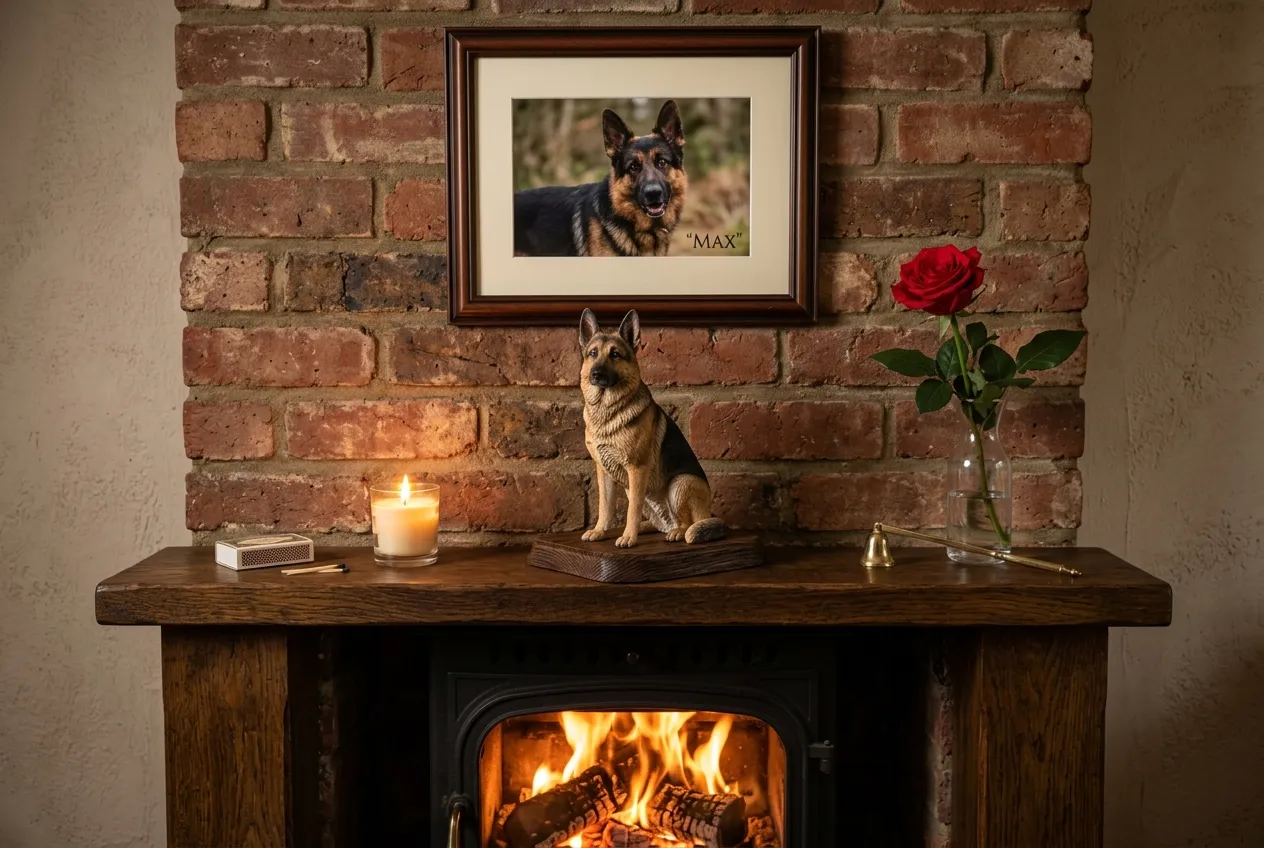
Sarah told us she followed a version of this framework on König's first anniversary. She walked their trail in the morning—the one along the creek where he'd wade in up to his belly, ears forward, scanning the water like he was solving it. At midday, she placed his custom memorial figurine on the mantle next to his favorite rope toy. The figurine had been created from her favorite photo—König mid-stride, tail level, that signature Shepherd focus locked on something just outside the frame. The full-color resin caught the exact sable pattern of his coat, the dark saddle across his back rendered voxel by voxel through advanced 3D printing. She said running her thumb across the surface—the fine grain of the print, the smooth clear coat—felt like touching a memory made solid.
That evening she lit a candle, told König about the new fence she'd put up (he would have hated it), and let herself laugh.
That laugh mattered more than the tears.
The Isolation Problem: Why Pet Loss Anniversaries Feel Lonelier Than the Death Itself
Here's a pattern we've observed that nobody else seems to address: the anniversary is often lonelier than the initial loss.
When your German Shepherd first died, people showed up. Cards arrived. Friends texted. Your coworker brought flowers. The world acknowledged your pain, however briefly.
On the anniversary? Almost nobody remembers.
This isn't cruelty. It's human nature. Your loss exists in your daily architecture. For everyone else, it's a footnote in a year's worth of events. They're not being callous—they simply don't carry the date the way you do.
But the isolation stings. And it triggers a specific shame: the shame of grief intensity. You're one year out. Society's unspoken timeline says you should be "over it" by now—or at least functional enough not to mention it. The thought of telling a coworker "Today's the anniversary of my dog's death" feels risky. You can almost hear the internal calculation behind their eyes: It's been a year. It was a dog.
That judgment—real or imagined—drives the grief underground. And underground grief festers.
So here's a concrete strategy: tell one person. Not everyone. One. Choose someone who either lost a pet themselves or who met your German Shepherd. Send a text the morning of: "Today's a year since [name] died. I'm having a hard time. You don't need to do anything—I just needed someone to know."
You'll be surprised how often the response is: "I'm so glad you told me. I've been thinking about you."
The act of being witnessed—even by a single person—breaks the isolation loop. It's not about getting support. It's about refusing to carry the weight invisibly.
"A grief spoken aloud loses half its power to crush you."
What Changes in Year Two (And What Doesn't)
The first anniversary is a threshold. Crossing it matters—not because the grief disappears, but because your relationship with the grief shifts.
Here's what typically changes after the first anniversary, based on patterns we've observed and what grief researchers describe:
What gets easier:
- The physical symptoms (appetite disruption, insomnia, chest tightness) tend to become less frequent
- You can tell stories about your pet without the story collapsing into tears every time
- The guilt—about the euthanasia decision, about moving on, about laughing again—loosens its grip
- You start to feel your pet's presence as warmth rather than absence
What doesn't change:
- The triggers. A German Shepherd at the park will still stop you mid-stride. A specific bark pitch on a TV show. The weight of a leash in your hand.
- The empty spaces. The spot on the bed. The patch of worn carpet by the back door. These become familiar aches rather than fresh wounds, but they don't vanish.
- The love. That stays exactly where it was. Grief doesn't diminish it. Time doesn't dilute it. If anything, the love clarifies as the pain recedes—like a photograph developing in reverse.
And here's the counterintuitive truth that most grief timelines get wrong: Year Two is not "better" than Year One. It's different. Year One is acute. Year Two is chronic. The waves are smaller but more frequent—little ambushes instead of tsunamis. Many people find Year Two harder in some ways because the world has fully moved on while they're still navigating a changed landscape.
Knowing this in advance helps. You're not failing if month 14 feels harder than month 11. You're just entering a new phase of integration.
The Question Nobody Asks: What About the Other Pets?
If you have surviving pets—another dog, a cat, anyone—the anniversary carries an additional layer.
Animals grieve. This isn't anthropomorphism; it's well-documented behavior. The American Kennel Club notes that dogs who lose a companion often show changes in appetite, sleep patterns, vocalization, and social behavior. German Shepherds, who tend to be deeply bonded to their household pack, leave particularly large holes in the social structure.
But here's what's less discussed: your surviving pet's behavior on the anniversary may trigger you in unexpected ways.
If your remaining dog seems perfectly happy on the anniversary—playing, eating, napping in the sun—you might feel a flash of something uncomfortable. Maybe even resentment. How can you act like nothing happened? This is grief looking for a target, and it often lands on the beings closest to us.
Alternatively, if your surviving pet does seem subdued on the anniversary—lying in the deceased pet's spot, sniffing their old bed—it can amplify your own grief exponentially. Their sadness validates yours, but it also doubles the emotional weight.
Neither response from your surviving pet is right or wrong. And neither of your responses to their behavior is right or wrong.
What helps: include them in the ritual. Walk the old route with them. Let them sniff the collar. Give them an extra-long evening of contact—your hand in their fur, their warmth against your leg. The physical connection grounds you both.
One family we worked with had two German Shepherds—Hugo and Maren. When Hugo died, Maren spent three weeks sleeping in Hugo's crate. On the first anniversary, the family placed Hugo's memorial figurine on a low shelf where Maren could see it. They reported that Maren sniffed it thoroughly, then lay down next to the shelf and slept. They couldn't know what Maren understood. But the gesture felt like completion.
Building a Sacred Space (Without Making Your Home a Shrine)
There's a tension in memorial practice: you want to honor your pet's presence, but you don't want your living room to feel like a mausoleum. The anniversary is a natural time to figure out this balance.
The concept of a sacred space doesn't require a shelf full of urns and framed photos (though that's fine if it suits you). It requires intentional placement of a single anchor object in a spot that integrates with your daily life.
The psychology behind this: objects in peripheral vision become part of your environmental baseline. You don't stare at them constantly—but you register them. They become a quiet, steady presence. Like the sound of a clock ticking. You stop hearing it, but you'd notice if it stopped.
Here's how to create an effective memorial space:
- Choose one spot your pet frequented. Not their death spot or their illness spot—their life spot. Where they lounged. Where they greeted you. Where they watched out the window.
- Place one to three objects there. A photo. Their tag. A physical memorial—a paw print, a stone, a figurine. Less is more. The space should breathe.
- Make it functional. Put it near something you use daily—the coffee maker, the bookshelf, the entryway. The memorial becomes woven into routine rather than set apart from it.
- Refresh it on the anniversary. Add a flower. Reposition something. Clean the surface. The annual tending makes the space feel alive rather than frozen.
The best memorial objects have weight and texture—something your hand naturally reaches for. This is why two-dimensional photos, while valuable, serve a different function than three-dimensional objects. A figurine you can pick up, turn over, run your fingers across—that engages the motor cortex, the somatosensory system, the parts of your brain that remember your pet through touch rather than just sight.
PawSculpt's full-color resin figurines are designed with this tactile function in mind. The digital sculpting process captures specific details—the angle of a Shepherd's ears, the particular way they held their tail—and the 3D printing technology reproduces those details in color resin where the pigment is built into the material itself, not applied on top. The finished piece has a natural grain texture protected by a clear coat, giving it a surface that feels substantial and real under your fingers. Not fragile. Not precious. Built to be touched.
The Counterintuitive Truth About Moving Forward
Here's the insight that changed how we think about pet loss anniversaries—and it contradicts almost everything you'll read in standard grief resources.
The first anniversary is not about closure. It's about permission.
Permission to keep grieving. Permission to stop performing grief. Permission to get another dog—or to never get another dog. Permission to feel relief. Permission to feel fury. Permission to laugh at a memory without immediately feeling guilty about the laughter.
The anniversary functions as a spiritual checkpoint. You arrive at it carrying a year's worth of accumulated emotion—processed, unprocessed, and everything in between. The ritual gives you a container to set it all down, examine it, and decide what you're carrying into Year Two.
Some of what you've been carrying, you'll choose to keep. The love. The lessons. The way your German Shepherd taught you to be present—because a dog running full-tilt through an open field is the purest expression of now that exists.
Some of what you've been carrying, you can set down. The guilt. The second-guessing. The sense that you failed them somehow. The exhausting performance of appropriate grief for an audience that stopped watching months ago.
The anniversary gives you authority over your own mourning. Nobody else can tell you what this day means. Nobody else walked that trail with your dog. Nobody else felt the specific weight of that specific head on their lap, the coarse topcoat giving way to the soft undercoat beneath, the warmth of a body that trusted yours completely.
That bond was a contract between two spirits. The anniversary is your chance to affirm that the contract didn't expire—it evolved.
| What You Can Release | What You Keep | What You Build |
|---|---|---|
| Guilt about the decision | The love—unchanged, undiminished | A ritual you return to annually |
| Shame about grief intensity | The lessons they taught you | A sacred space in your home |
| The need for others' validation | The sensory memories (fur, warmth, weight) | Permission to grieve on your own terms |
| The performance of "appropriate" mourning | Their presence in your daily life | A relationship with the grief that serves you |
Coming Back to the Kitchen
Sarah emailed us six weeks after König's anniversary. She'd made it through. Not gracefully—she'd burned the sweet potatoes she was making that day (the oven timer went off while she was on the kitchen floor, palm pressed flat against the cold tile where his bowl used to sit). But she made it through.
She said something that stuck with our entire team: "I thought the anniversary would be the end of something. Like crossing a finish line. But it wasn't an ending. It was a turn. I'm still on the same path. I'm just facing a different direction now."
The figurine of König still sits on her mantle. She touches it every morning on her way to the coffee maker—a two-second gesture, thumb across the textured surface of his back, barely conscious. It's become part of her routine. Part of her architecture. The shape of her day has changed, but it has a shape again.
That's what the first anniversary of pet loss ultimately offers. Not resolution. Not closure. Not the end of missing them. Just a turn in the path. A new direction that still carries everything that mattered.
Your German Shepherd gave you their whole life. The anniversary is your chance to show that you received it—every morning walk, every ear scratch, every fierce and loyal heartbeat—and that you're still holding it. Not as weight.
As warmth.
Frequently Asked Questions
How long does pet grief last after losing a German Shepherd?
There's no expiration date. Acute grief—the phase where loss dominates your daily experience—typically runs three to six months. But grief doesn't end; it integrates. Anniversary grief, sensory triggers, and unexpected waves can surface for years. German Shepherds build themselves so deeply into your daily routine that the structural absence can take longer to adapt to than the emotional pain itself. Both timelines are normal.
Is it normal to still cry a year after losing my dog?
Completely. In fact, many pet owners report that the weeks leading up to the first anniversary are more emotionally intense than the day itself. Your nervous system recognizes seasonal and temporal patterns associated with the loss, re-engaging the grief response before you're consciously aware of it. Tears at the one-year mark aren't a sign of being "stuck"—they're a sign of a bond that mattered.
How do I honor my pet on their death anniversary?
Move beyond passive remembrance into intentional ritual. Walk their favorite route. Hold a physical object connected to them—a collar, a memorial figurine, a favorite toy. Light a candle and speak to them aloud. The key is engaging your body, not just your mind. Structure the day into three phases: morning acknowledgment, midday action (creating or doing something in their honor), and evening release.
Should I feel guilty about feeling relief when my sick pet died?
No. Relief after watching your pet suffer is one of the most human responses possible. It means you were present for their pain, carrying it alongside them, and your body finally exhaled when theirs did. The guilt that follows relief is grief misdirecting itself. Veterinary professionals consistently affirm that choosing to end suffering is an act of love, not selfishness.
Do other pets grieve when a companion dies?
Yes. Research and veterinary observation confirm that dogs, cats, and other companion animals display measurable behavioral changes after losing a housemate—including appetite loss, increased vocalization, and searching behavior. On the anniversary, include your surviving pet in whatever ritual you create. Walk together. Offer extra physical contact. Their presence grounds you, and yours grounds them.
How do I create a pet memorial space at home without it feeling overwhelming?
Select one location your pet associated with living, not with illness or death. Place a small number of meaningful objects—a photo, their tag, a figurine—near something you interact with daily. The goal is integration, not shrine-building. The memorial should exist in your peripheral awareness, becoming a steady, quiet presence rather than a focal point of pain. Refresh it once a year on the anniversary to keep the space feeling active.
Ready to Honor Your German Shepherd's Legacy?
Some bonds transcend the physical. Your German Shepherd's spirit lives in the trail you walked together, the doorway they guarded, the warmth they pressed against your side on cold nights. A custom PawSculpt figurine captures the details that made them irreplaceable—every marking, every posture, every expression—preserved in full-color resin built to last as long as the love itself.
Visit pawsculpt.com to see how our process works and explore your options for honoring your pet's first anniversary and beyond