
What No One Tells You About Explaining Your Beagle's Passing to a Five-Year-Old
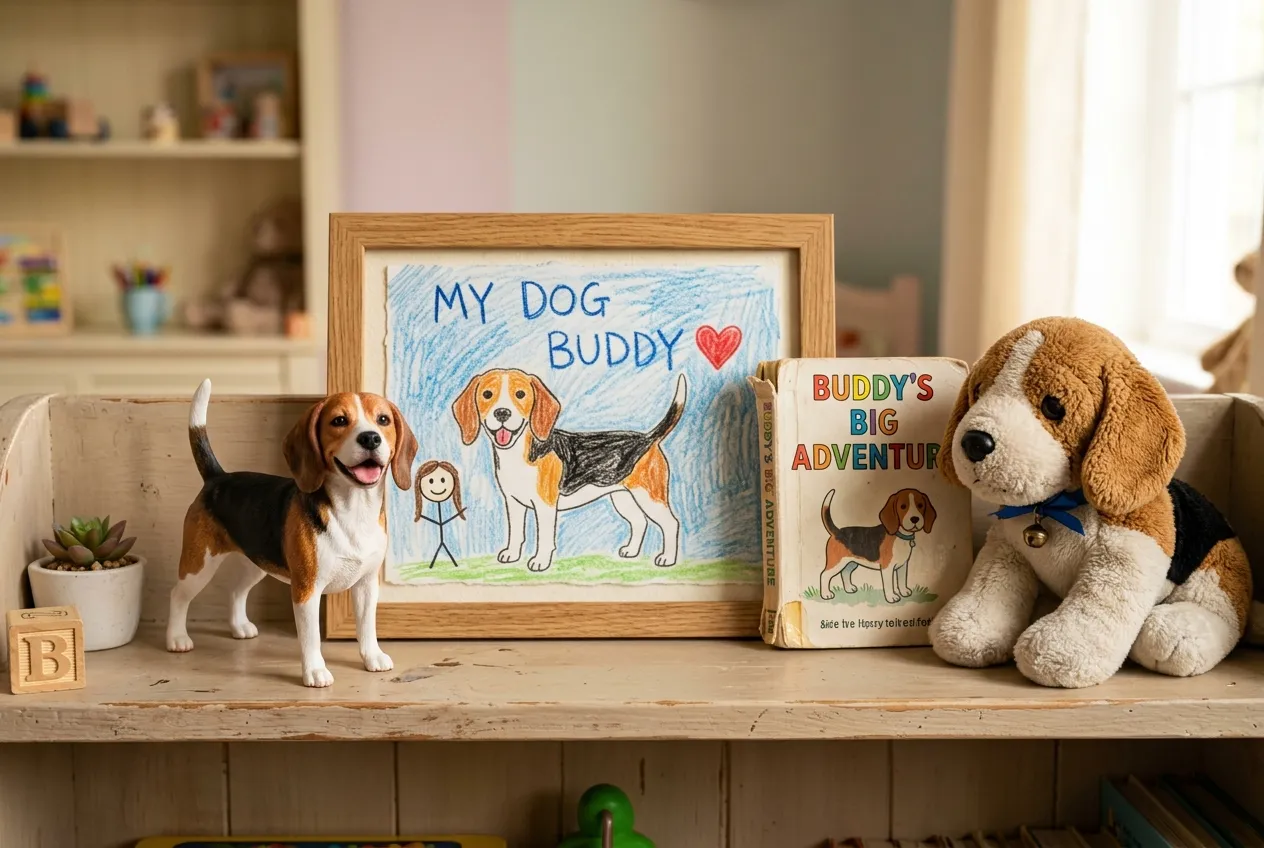
The backseat smelled like Cheerios and dog breath—that particular warm, yeasty mix you only notice when it's gone. And the moment your five-year-old asks why Biscuit's car seat is empty is the moment explaining pet death to a child stops being theoretical and becomes the hardest conversation of your Tuesday afternoon.
Quick Takeaways
- Skip euphemisms like "went to sleep" — they confuse young children and can create real fears around bedtime
- Let your child see you grieve openly — modeling emotion teaches them sadness is safe, not shameful
- Use a physical object as a grief anchor — tangible keepsakes like a custom pet figurine give small hands something to hold when words fail
- Expect the questions to come in waves — a five-year-old may seem fine for days, then ask about death at the grocery store
- Don't rush to "fix" their sadness — sitting with a child in their grief is more powerful than any explanation you can offer
Why Most Advice About Telling Kids Gets It Backwards
Here's what bothers us about the standard guidance on how to tell kids a dog died. Nearly every article leads with scripted language—word-for-word phrases to memorize, as though this is a boardroom presentation and not a conversation with a small person who just lost their best friend.
The scripts aren't useless. But they miss the point.
The real challenge isn't finding the right words. It's managing your own emotional state while you say them. A five-year-old reads your body before they process your sentences. They feel the tremor in your hand on their shoulder. They notice you avoiding the kitchen where the food bowl used to sit. They're watching you before they're listening to you.
So the counterintuitive first step? Before you sit your child down, sit yourself down. Alone. In the car, in the bathroom, wherever. Let yourself fall apart for ten minutes. Cry until your chest aches. Because if you try to white-knuckle your composure during the conversation, your child won't hear your careful words—they'll feel your tension and learn that grief is something to suppress.
"Children don't need perfect explanations. They need permission to feel what they're already feeling."
Most parents we've worked with at PawSculpt tell us the same thing afterward: they spent hours rehearsing what to say, and the part that mattered most was what happened in the silence after they said it.

The Words That Help (And the Ones That Backfire) When Explaining Pet Death to a Child
Let's get practical. Your five-year-old is standing in front of you, maybe holding a stuffed animal, maybe not. Here's a framework—not a script—for the next few minutes.
What to Say in the First 30 Seconds
Lead with the truth, stated simply. One sentence. "Biscuit's body stopped working, and he died." That's it for the opener. Don't pad it. Don't soften it with a preamble. Children this age process direct information better than narrative buildup.
Then pause. Wait for them. They might stare. They might ask "Why?" immediately. They might go back to playing. All of these responses are normal.
The Euphemism Trap
This is where well-meaning parents cause accidental harm. Here's a quick reference:
| Phrase to Avoid | Why It Backfires | What to Say Instead |
|---|---|---|
| "Biscuit went to sleep" | Creates bedtime anxiety — child fears they won't wake up | "Biscuit's body stopped working and he died" |
| "We lost Biscuit" | Child may want to go look for the dog | "Biscuit died, which means his body can't work anymore" |
| "God took Biscuit" | Can make child angry at or afraid of God | "Biscuit's body was too sick to keep going" |
| "Biscuit went to a farm" | Delays grief; child waits for dog to come home | Honest, age-appropriate truth |
| "Biscuit went away" | Child feels abandoned by their pet | "Biscuit didn't choose to leave — his body just couldn't stay" |
The ASPCA's guidelines on children and pet loss reinforce this: concrete, simple language is always better than metaphor with children under seven. Their brains are literal. "Went to sleep" means went to sleep.
The Follow-Up Questions (They Will Come)
A five-year-old's questions about death aren't philosophical—they're logistical. Expect these:
- "Will it happen to me?" — "Your body is healthy and strong. What happened to Biscuit doesn't happen to healthy kids."
- "Did it hurt?" — "The vet made sure Biscuit wasn't in pain." (If true. If you don't know, "We did everything we could so Biscuit was comfortable" works.)
- "Where is Biscuit now?" — This depends on your family's beliefs. Whatever you say, keep it concrete. "Biscuit's body is buried in the garden" is more grounding than vague spiritual language for this age group.
- "Can we get a new dog?" — Don't panic. This isn't callousness. It's a five-year-old trying to solve the empty space. "Not right now. We need time to be sad about Biscuit first."
That last question—the one about a new dog—tends to gut-punch parents. You're drowning in grief, and your child is already asking for a replacement. But they're not replacing. They're trying to fill a spatial void they can feel but can't name. The corner where the crate was. The spot at the foot of the bed. The empty backseat.
The Grief No One Warns You About: Yours
Most guides focus entirely on the child. But here's what we wish someone had told the families we work with: your grief and your child's grief are happening simultaneously, and they look nothing alike. Managing both at once is disorienting.
Your five-year-old might cry for twenty minutes, then ask for a snack. You'll still be crying at midnight. They might draw a picture of Biscuit with wings and move on to coloring a dinosaur. You'll find a single beagle hair on your jacket three weeks later and lose it in a parking lot.
This isn't because your child loved the dog less. It's because five-year-olds grieve in puddles, not rivers. They step into sadness, splash around, step out, and come back later. Adults wade in and sometimes can't find the shore.
The Guilt You're Not Supposed to Feel
We need to talk about something that almost never appears in the cheerful "how to help your child" articles.
Many parents feel guilty—not just about the dog's death, but about their own relief. If your beagle was elderly, incontinent, in pain, requiring medications four times a day, waking the household at 3 a.m.—there's a part of you that exhaled when it was over. And then the guilt arrived like a freight train, because how dare you feel relieved when your child is crying and the house is so quiet.
That relief doesn't mean you didn't love your dog. It means you were exhausted. It means you were carrying a weight—the weight of caretaking, of watching suffering, of making impossible decisions—and your body recognized when it was set down. The guilt that chases relief is one of grief's cruelest tricks. It takes your compassion and repackages it as evidence of failure.
If you chose euthanasia, you may also be second-guessing the timing. Was it too soon? Too late? Should you have tried one more medication, one more vet visit? This is normal. This is so common that veterinary grief counselors have a name for it: decisional guilt. And it can quietly eat you alive if you don't name it.
Name it. Say it out loud to a partner, a friend, a therapist. "I'm not sure we made the right call, and it's haunting me." The words lose power once they're outside your head.
"Grief needs an anchor—something you can hold when the memories feel like they're slipping. For families, especially those with young children, having a physical reminder changes the conversation from loss to legacy."
— The PawSculpt Team
When Your Child's Grief Triggers Your Shame
Here's another layer no one discusses: some parents feel ashamed of how intensely they're grieving a "just a dog." Maybe your coworker made a comment. Maybe your mother said, "It's not like losing a person." Maybe you told yourself the same thing and then sobbed in the shower anyway.
Your child won't judge you for crying. In fact, letting your five-year-old see you sad—genuinely, messily sad—is one of the most important things you can do. It teaches them that big feelings are survivable. That adults have them too. That sadness isn't a problem to be hidden but a response to love.
You don't need to perform composure for your child. You need to show them what it looks like to feel something enormous and keep breathing.
What We Wish We Knew Sooner
Candid notes from the PawSculpt team, based on thousands of conversations with grieving pet families:
- Kids remember the rituals more than the words. The family who lit a candle every night for a week. The mom who let her daughter pick flowers for the burial spot. These are what children recall years later—not the speech you agonized over.
- The "fine" phase is temporary. Your child may seem completely fine for one to three weeks. Then a trigger hits—a dog at the park, a beagle on TV, the sound of tags jingling—and the grief resurfaces. This is normal, not a setback.
- Physical objects matter more than you'd think. A collar on a shelf. A paw print in clay. A figurine on the nightstand. Children process abstract concepts (death, permanence, absence) better when they have something concrete to touch.
- You will reach for the leash. It might happen at 6 a.m. when your hand moves to the hook by the door out of pure muscle memory. It might happen when you hear a sound that could be nails on hardwood. These phantom habits can last months. Let them come. They're not signs you're "not over it." They're proof the bond was real.
- Siblings grieve differently, and that's okay. If you have an older child and a five-year-old, their grief timelines will not sync. The eight-year-old might journal. The five-year-old might act out at school. Neither response is wrong.
A Practical Timeline: What to Expect in the Weeks After Your Beagle's Passing
Every family is different, but patterns exist. Here's a rough map of what child grief after pet loss often looks like, drawn from both developmental research and what families share with us:
| Timeframe | What Your Child May Do | What Helps |
|---|---|---|
| Days 1–3 | Ask repetitive questions; seem fine, then cry suddenly; want to sleep in your bed | Answer patiently each time; maintain bedtime routine; extra physical closeness |
| Week 1–2 | Draw pictures of the pet; mention the pet casually; regress slightly (thumb-sucking, baby talk) | Provide art supplies; talk about the pet naturally; don't correct regression—it's self-soothing |
| Week 3–4 | Seem "over it"; mention the pet less; may have one intense grief burst triggered by a reminder | Don't assume they've moved on; keep the pet's memory accessible; validate if grief resurfaces |
| Month 2–3 | Begin integrating the loss; ask bigger questions ("Will YOU die?"); test boundaries around death | Answer honestly with reassurance; expect mortality questions to expand beyond the pet |
| Month 4–6 | Grief becomes quieter; pet becomes part of their story rather than their daily pain | Share happy memories; involve them in any memorial decisions; watch for lingering anxiety |
A critical note: If your child shows persistent changes—refusing to go to school, significant sleep disruption lasting more than a few weeks, aggressive behavior that doesn't ease—consider speaking with a child therapist who specializes in grief. This isn't a failure. It's good parenting.
Building Rituals That Actually Help (Not Just Pinterest-Pretty Ones)
The internet is full of memorial ideas. Plant a tree. Make a scrapbook. Release butterflies. And look—some of those are genuinely lovely. But a five-year-old doesn't need a curated memorial experience. They need something they can do with their hands and their body.
Rituals That Work for Young Children
1. The Goodbye Box
Find a shoebox. Let your child decorate it however they want—stickers, crayons, glitter, whatever. Inside, place a few items: a photo, a piece of the dog's collar, a favorite toy. This becomes the box they can open when they miss Biscuit. It gives grief a physical location, which is surprisingly powerful for children who think in concrete terms.
2. The Nightly Check-In
For the first two weeks, add a one-minute ritual to bedtime. "What's one thing you remember about Biscuit today?" Some nights the answer will be sweet. Some nights it'll be "I don't want to talk about it." Both are fine. The point is the invitation, not the response.
3. The Memory Walk
Walk the route you used to walk with your beagle. Let your child lead. Let them point out where Biscuit liked to sniff, where he pulled on the leash, where he barked at the neighbor's cat. This transforms the walk from an absence into a presence. You're not walking without your dog. You're walking with the memory of your dog.
4. A Tangible Keepsake
This is where physical memorials earn their weight. A framed photo is meaningful but flat—literally. Children at five are tactile learners. They want to hold things, turn them over, carry them around.
Some families commission custom 3D pet figurines that capture their beagle's specific markings, the tilt of their head, the way their ears folded. PawSculpt's process uses advanced full-color 3D printing—color built directly into the resin, not applied on top—so the result looks like a tiny, vivid version of the dog your child knew. For a five-year-old, having a small figurine on their nightstand can be the difference between "Biscuit is gone" and "Biscuit is right here."
"Memory isn't just something you keep in your head. Sometimes it's something you hold in your hands."
5. The "Biscuit Was Here" Art Project
Give your child a large piece of paper and ask them to draw every room in the house. Then ask: "Where did Biscuit like to be?" Let them draw the dog in each spot. The kitchen. The couch. The foot of the bed. Under the table during dinner. This exercise does something remarkable—it maps the dog's presence onto the home, making the invisible visible.
How to Handle the Ambush Moments
You'll be in the cereal aisle. Or at a birthday party. Or buckling your child into the car—that backseat again, with its ghost of warm dog breath—and your five-year-old will say something that levels you.
"Is Biscuit cold in the ground?"
"Can dead dogs still dream?"
"If I'm really really good, will Biscuit come back?"
These questions don't arrive when you're prepared. They arrive when you're holding a gallon of milk or trying to parallel park. And your first instinct will be to deflect, to change the subject, to say "We'll talk about it later."
Don't.
Not because you need to deliver a perfect answer in the Target checkout line, but because when a child asks is when a child needs. Their emotional timing doesn't respect your schedule. A brief, honest response—even "That's a really big question, and I want to think about it so I can give you a good answer. Can we talk about it at dinner?"—is infinitely better than "Not now."
The key is to acknowledge the question immediately, even if you delay the full answer. The acknowledgment tells your child: your feelings matter. Your curiosity is welcome. Death isn't a forbidden topic in this family.
When Other Adults Say the Wrong Thing
Brace yourself for this one. Well-meaning relatives, teachers, and neighbors will say things to your child that make your skin crawl.
- "Don't be sad—Biscuit's in a better place!"
- "You can always get another dog."
- "Big kids don't cry about puppies."
- "At least it wasn't a person."
You can't control what other people say. But you can debrief with your child afterward. "Uncle Dave said you can get another dog. How did that make you feel?" This teaches your child that not all adult statements are equally valid, and that their emotional experience matters more than someone else's discomfort with grief.
If you're feeling isolated in your grief—if the people around you are minimizing your loss or your child's loss—know that this is one of the most commonly reported experiences among pet-loss families. You're not being dramatic. You're being human.
The Question Behind the Question: "Will You Die Too?"
Almost every child who loses a pet between ages four and six will eventually connect the dots to their parents' mortality. This is developmentally appropriate and healthy, even though it feels like a knife to the chest.
When your child asks, "Are you going to die?"—and they will—here's a framework:
- Don't lie. "Everyone dies someday" is honest without being terrifying.
- Emphasize the timeline. "I plan to be here for a very, very long time—long enough to see you grow up, go to school, and have your own adventures."
- Redirect to safety. "My job is to take care of you, and I'm going to keep doing that."
- Follow their lead. If they want more detail, give it simply. If they seem satisfied, let it go.
The mistake most parents make here is over-explaining. A five-year-old doesn't need a lecture on the human lifespan. They need reassurance that their world is stable. Three sentences. Then a hug.
When Beagle Loss Hits Children Differently: Age-Specific Nuances
We've been focusing on five-year-olds, but if you have multiple children, the grief landscape gets more complex. Here's what shifts by age:
| Age | How They Understand Death | Common Grief Behaviors | What They Need Most |
|---|---|---|---|
| 2–3 | Doesn't understand permanence; may search for the pet | Clinginess, sleep disruption, regression | Routine, physical comfort, simple language |
| 4–5 | Beginning to understand "forever" but tests it with questions | Repetitive questions, magical thinking ("If I wish hard enough...") | Patient repetition, concrete answers, rituals |
| 6–7 | Understands death is permanent; may fear it happening to others | Anxiety, nightmares, anger, guilt ("Was it my fault?") | Reassurance about safety, open conversation, creative outlets |
| 8–10 | Fully grasps death; begins to understand emotional complexity | Withdrawal, journaling, wanting to help with memorial tasks | Inclusion in decisions, respect for their process, space when needed |
The child who worries it was their fault deserves special attention. If your five-year-old once pulled the dog's tail, forgot to fill the water bowl, or left the gate open that one time—they may be carrying a secret belief that they caused the death. Ask directly: "Do you think anything you did made Biscuit sick?" Then correct it clearly: "Nothing you did caused this. Biscuit's body was sick in a way that nobody could fix."
Navigating the Empty Spaces in Your Home
This is the part that ambushes you physically. The house changes shape when a dog dies.
The corner where the crate sat now has a rectangular indent in the carpet. The spot by the back door where the leash hung has a single hook with nothing on it. The kitchen floor is clean—too clean—because nobody's licking up dropped crumbs anymore. The couch has an empty cushion that the dog claimed years ago, and nobody sits there now, not because they've decided not to but because it feels wrong.
Your child feels these spatial changes even if they can't articulate them. A five-year-old might suddenly refuse to go into a room. Or they might start sleeping in your bed. Or they might rearrange their stuffed animals to fill the gap where the dog used to lie.
Practical steps:
- Don't rush to rearrange. Leave the dog's space intact for at least a week or two. Erasing the evidence too quickly can feel violent to a child's sense of order.
- Let your child decide when to move things. "Do you think it's time to put Biscuit's bed away, or do you want to keep it out for a while?" Giving them agency over the physical space gives them agency over their grief.
- Fill the space intentionally, not reactively. When the time comes, let your child choose what goes in that corner. A beanbag. A reading nook. A small shelf with Biscuit's photo and a memorial keepsake. The space transforms from "where Biscuit was" to "where we remember Biscuit."
The Long Game: Grief Isn't a Week-Long Project
Six months from now, your child will mention Biscuit out of nowhere. Maybe at dinner. Maybe during a car ride—there's that backseat again. And you'll realize that grief didn't end; it just changed shape.
Beagle loss in children doesn't follow a schedule. Your five-year-old may grieve in micro-bursts for a year or more. A song, a smell, another dog's bark—any of these can open the door. And each time, your job is the same: be present, be honest, be warm.
Some parents worry about whether they're "letting" their child grieve too long. Here's a definitive answer: there is no "too long" for missing someone you loved. There is only "too alone." As long as your child knows they can talk about Biscuit whenever they want—at the dinner table, in the car, at bedtime—they're processing healthily.
The American Kennel Club's resources on pet loss note that children who are allowed to grieve openly tend to develop stronger emotional resilience. You're not just helping your child survive this loss. You're teaching them how to love bravely, knowing that love always carries risk.
"The way you grieve your dog in front of your child is the way they'll learn to grieve everything—teach them it's safe."
What Happens When They Ask for a New Dog
It will happen. Maybe a week later, maybe six months. And when it does, you'll feel a complicated cocktail of emotions—annoyance, guilt, hope, dread, maybe even a flash of jealousy that your child can move forward so easily (they can't, actually—they're just wired differently).
Don't say yes to ease the pain. And don't say no out of loyalty to the dog who died. Both reactions come from your grief, not your child's needs.
A better approach: "I love that you want another dog. That tells me how much love you have. Let's give ourselves some time to miss Biscuit, and then we'll talk about it."
The "how much time" question has no universal answer. Some families are ready in weeks. Others need a year. The only wrong timeline is one imposed by someone else's expectations.
And here's the thing nobody says: getting another pet doesn't erase the grief. It just adds a new chapter. Your child can love Biscuit and love a new dog simultaneously. The heart doesn't replace; it expands.
Putting It All Together: Your First-Week Action Plan
Because you're probably reading this in the middle of it, and you need something concrete. Here's your roadmap for the first seven days:
Day 1: Have the conversation. Use simple, honest language. Let your child react however they react. Hold them if they want to be held. Let them play if they want to play.
Days 2–3: Establish a small ritual (the nightly check-in, the goodbye box). Answer repeated questions with patience. Let yourself cry when you need to.
Days 4–5: Watch for behavioral changes at school or daycare. Give the teacher a heads-up: "Our dog died this week, and our child may need extra patience."
Day 6: Do something physical together—a walk, baking, building something. Grief lives in the body, and movement helps it move through.
Day 7: Check in with yourself. Are you sleeping? Eating? Have you talked to another adult about how you're doing? Your child needs you resourced, not depleted.
This isn't a prescription. It's a starting point. Adjust it. Skip steps. Add your own. The only rule is: don't do this alone, and don't expect your five-year-old to do it alone either.
Closing Thoughts: The Backseat Won't Always Be Empty
Months from now, you'll buckle your child into the car and the Cheerio-and-dog-breath smell will be gone. The seat next to them will hold a backpack, or a jacket, or nothing at all. And your child might say, quietly, from the back, "I miss Biscuit."
And you'll say, "Me too."
That's it. That's the whole thing. Not a lecture. Not a lesson. Just two people who loved a beagle, sitting in a car, letting the missing be present between them.
The empty space doesn't stay empty forever. It fills—slowly, unevenly—with new routines, new memories, and eventually, maybe, a new heartbeat with four paws and a wagging tail. But the space that was Biscuit's? That stays Biscuit's. Your child will carry it with them into adulthood, this first lesson in love and loss, shaped by how you walked through it together.
You're doing this right. The fact that you searched for how to explain your beagle's passing to your child—that you're reading this at all—tells us everything about the kind of parent you are.
The kind who shows up. Even when it's hard. Especially when it's hard.
Frequently Asked Questions
How do I explain my dog's death to a five-year-old?
Use clear, simple language: "Biscuit's body stopped working and he died." Avoid euphemisms like "went to sleep" or "went to a farm," which can confuse literal-minded young children and create new fears. Answer their follow-up questions honestly, and don't be afraid of the word "died." Pausing after your initial statement gives your child space to process and respond in their own way.
Is it normal for my child to seem completely fine after our pet dies?
Very normal. Young children grieve in what experts call "puddles"—short bursts of sadness followed by seemingly unrelated activities like playing or asking for snacks. This doesn't mean they're unaffected. Grief often resurfaces days or weeks later, triggered by a sound, a place, or seeing another dog. Stay available for those moments.
Should I let my child see me cry about our beagle?
Yes—this is actually one of the most helpful things you can do. When children see a trusted adult express sadness and then recover, they learn that big emotions are survivable. You don't need to have a breakdown in front of them, but letting tears come naturally during conversation shows that grief is a safe, shared experience.
How long does pet grief typically last for a young child?
There's no set endpoint. A five-year-old may seem to move on within weeks but then mention their dog unprompted months later. Micro-bursts of grief can continue for a year or more, especially around triggers like visiting the vet's office or hearing a dog bark. The goal isn't to "get over it" but to integrate the loss into their growing understanding of the world.
When is the right time to get another pet?
There's no universal answer. The key is making sure the decision comes from readiness rather than an attempt to erase the pain. If your child asks early on, it's okay to say, "Let's give ourselves time to miss Biscuit first." When the family feels ready—whether that's two months or two years—a new pet doesn't replace the old one. It simply opens a new chapter.
Is it normal to feel guilty about choosing euthanasia for my dog?
Extremely normal. Second-guessing the timing of euthanasia—wondering if it was too soon or too late—is one of the most common experiences in pet loss. Many owners also feel an initial wave of relief that their pet's suffering ended, followed by intense guilt about that relief. These layered emotions are a sign of deep love, not failure. If the guilt persists, speaking with a grief counselor who understands pet loss can help.
Ready to Honor Your Beagle's Memory?
Some families find that explaining pet death to a child becomes easier when there's something tangible to hold onto—a small, vivid reminder that their dog was real, was loved, and mattered. A custom PawSculpt figurine captures your beagle's exact markings, expression, and personality in full-color resin, giving your child (and you) a keepsake that turns absence into presence.
Visit pawsculpt.com to see how it works and explore your options