
Why Building a Memorial Garden for Your Corgi Is More Logical Than You Think
You're standing where the tide just pulled back, bare feet pressing into cool, packed sand, and your hand drifts down to your side—reaching for a head that isn't there anymore. The spot where your corgi used to plant herself, right against your left ankle, every single time you brought her to this beach. Building a corgi memorial garden might sound sentimental, but what you're actually doing is giving your brain exactly what neuroscience says it needs.
Quick Takeaways
- Memorial gardens aren't just emotional—they're neurologically therapeutic, giving your brain a physical "home" for unresolved grief
- Corgis' low-to-the-ground nature makes ground-level garden design uniquely meaningful and personal to the breed you loved
- You don't need a big yard or a green thumb—a container garden on a patio works just as powerfully for healing
- Combining tactile memorial elements like a custom pet figurine with living plants creates a multi-sensory space that supports long-term memory retention
- The best time to start isn't when you "feel ready"—it's when you notice yourself needing somewhere to go
The Neuroscience Behind Why a Physical Memorial Space Actually Works
Here's the counterintuitive thing most grief articles won't tell you: your brain doesn't fully understand that your corgi is gone.
Not at first. Not for a while. Your amygdala—the part of your brain responsible for emotional memory—has encoded thousands of micro-moments with your dog. The sound of nails on hardwood. The specific weight of a corgi body flopping across your lap (heavier than anyone expects, every time). The coarse texture of that double coat between your fingers. Your neural pathways don't just delete those files when your dog dies. They keep firing. They keep reaching.
This is why you still hear phantom tags jingling. Why your foot slides to the edge of the bed at night, making room for a body that won't curl up there. Neuroscientists call this "searching behavior," and it's rooted in attachment theory—the same framework psychologists use to understand human bonding. Your brain formed an attachment bond with your corgi, and now it's doing what brains do when a bond is severed: scanning the environment for the missing piece.
A pet memorial garden gives your brain something it desperately needs—a designated place to direct that searching energy. Instead of your grief ambushing you in the kitchen doorway or the car or aisle seven of the grocery store, you create a physical location where your brain can go, on purpose, to process.
This isn't metaphor. Research from the field of environmental psychology shows that place attachment—the emotional bond between a person and a specific physical space—activates the same neural reward circuits as social bonding. You're essentially giving your grief an address. And that's more powerful than it sounds.
"A memorial isn't about holding on. It's about giving your love a place to live now that it has nowhere to go."
Most guides about dog memorial gardens focus on the Pinterest-worthy aesthetics. What plants to choose. What stepping stones look cute. And sure, we'll get there. But the reason a corgi remembrance garden works isn't because it's pretty. It's because it's functional—a neurological tool disguised as a flower bed.
Why Corgis Deserve a Ground-Level Memorial (And What That Actually Means for Design)
Let's talk about something nobody else is saying: the breed you lost should shape the memorial you build.
Generic pet memorial guides treat every dog the same. A Great Dane and a Chihuahua get the same advice. But you didn't lose a generic dog. You lost a corgi—a low-riding, earth-skimming, dirt-loving, grass-belly creature who experienced the world from about ten inches off the ground.
That matters for your garden design more than you'd think.
Corgis are ground-level dogs. Their entire sensory world was down there—nose in the clover, belly brushing the cool grass, stubby legs churning through ground cover. When you build a memorial that honors that perspective, something shifts. You're not just making a garden. You're recreating the vantage point your dog actually lived in.
Here's what that looks like in practice:
Design From the Ground Up, Not the Top Down
Instead of tall planters and elevated flower beds (which are fine for some dogs), consider:
- Creeping thyme or chamomile ground cover that releases scent when you walk through it—the way your corgi's belly used to crush herbs in the yard and come inside smelling like a tiny apothecary
- Low stone borders (6-8 inches high) that mirror corgi height—you'll be surprised how emotional it feels to crouch down to that level and see the garden from where they saw the world
- A flat, smooth river stone placed at ground level for sitting beside, not standing over—grief doesn't always want a bench; sometimes it wants the earth
Texture Is Everything
Your corgi was a tactile experience. That dense double coat—coarse guard hairs over impossibly soft undercoat. The velvety triangle ears. The firm, rounded ribcage under your palm. Your memorial garden should have texture you can touch.
| Element | Texture | Sensory Connection | Maintenance Level |
|---|---|---|---|
| Lamb's ear plants | Soft, velvety leaves | Mimics the feel of corgi ears | Low—drought tolerant |
| Ornamental grasses | Feathery, flowing | Recalls brushing through fur | Low to moderate |
| Smooth river stones | Cool, polished | Grounding tactile anchor | None |
| Moss patches | Dense, springy | Like pressing into a thick coat | Moderate—needs shade and moisture |
| Rough-hewn wood border | Grainy, warm | Earthy, natural, imperfect | Low—weathers beautifully |
This isn't decorating. This is somatic therapy—using physical sensation to process emotional pain. When you run your fingers over lamb's ear leaves and something in your chest unclenches, that's your nervous system responding to familiar tactile input. Your body remembers what your mind is still trying to accept.
The Emotions Nobody Warns You About (And How a Garden Holds Them)
We need to talk about the guilt.
Not the general, vague "it's okay to grieve" kind of comfort you find everywhere online. The specific, 3 AM, stomach-churning guilt that you're not saying out loud.
Many corgi owners feel guilty about the euthanasia decision. Not because they made the wrong call—but because corgis are so stoic, so absurdly cheerful even when they're hurting, that you might have missed the window. Or you might wonder if you acted too soon. That stumpy tail was still wagging the morning of. She still wanted her breakfast. And now you're replaying that last day on a loop, looking for the evidence that you made the right call, and some days you find it and some days you don't.
This is called cognitive dissonance—holding two contradictory beliefs at the same time. "I did the merciful thing" and "Maybe I gave up too early" existing in the same brain, at the same time, and neither one winning. It's exhausting. It's also completely, devastatingly normal.
A memorial garden doesn't resolve that dissonance. Nothing does, not fully, not quickly. But here's what it does: it gives you a place to sit with it.
There's a concept in psychology called "containment"—the idea that overwhelming emotions become more manageable when they have a boundary. A therapist's office is a container. A journal is a container. A garden can be one too. When you step into that small, defined space you built with your own hands—soil under your fingernails, stone edges you placed yourself—your brain gets the signal: this is where we hold this feeling. It lives here. Not everywhere.
"Grief without a container floods every room. Give it a garden, and it learns to stay in one place."
And then there's the other feeling. The one that's even harder to say.
Relief.
If your corgi had degenerative myelopathy—and so many corgis do, because the breed is predisposed to it—you watched a dog who used to herd your children across the living room slowly lose the use of her back legs. You lifted her. You carried her outside. You cleaned up after her when she couldn't make it to the door. And when it was over, mixed in with the grief, there was this awful, unwanted wave of relief. Not because you wanted her gone. Because you didn't want her to suffer anymore. Because you were exhausted. Because both things are true.
That relief doesn't make you a monster. It makes you a person whose cortisol levels were elevated for months—maybe years—while you provided end-of-life care for a creature you loved. Your nervous system was in a sustained stress response. When that stressor ended, your body exhaled. The guilt that chases that exhale is one of grief's cruelest tricks, and it doesn't mean what you think it means.
Building something with your hands—digging, placing stones, pressing roots into soil—is one of the few activities that simultaneously engages your sympathetic and parasympathetic nervous systems. You're exerting effort (activation) while doing something rhythmic and grounding (regulation). For grief that's tangled up with guilt and relief and second-guessing, this dual engagement is more useful than almost anything else you can do.
Practical Blueprint: Building Your Corgi Memorial Garden Step by Step
Enough theory. Let's build this thing.
You don't need acreage. You don't need a landscaping degree. One of the families we worked with at PawSculpt built their corgi's memorial in a 24-inch wooden planter box on an apartment balcony, and it's one of the most moving spaces we've ever seen. What matters isn't size. It's intention.
Step 1: Choose Your Spot (And Why "Imperfect" Locations Work Better)
Most guides say to pick a peaceful, secluded corner. And sure, that's fine. But here's what actually works better for most people: pick a spot you already pass through daily.
The psychology behind this is simple. If your memorial is tucked away in the far corner of the yard, you have to decide to visit it. That decision requires emotional energy. On hard days, you won't go. On really hard days, you'll avoid it entirely, and then feel guilty about avoiding it (more guilt—grief loves to stack it).
But if your memorial is beside the back door, or along the path to your car, or next to the patio where you drink your morning coffee? You encounter it without deciding to. It becomes part of your daily rhythm. Passive exposure. And over time—weeks, months—that passive exposure does something remarkable: it normalizes the reality of your loss without forcing you to confront it head-on every time.
Step 2: Lay the Foundation (Literally)
Start with the ground layer. This is where your corgi lived, remember? Ground level.
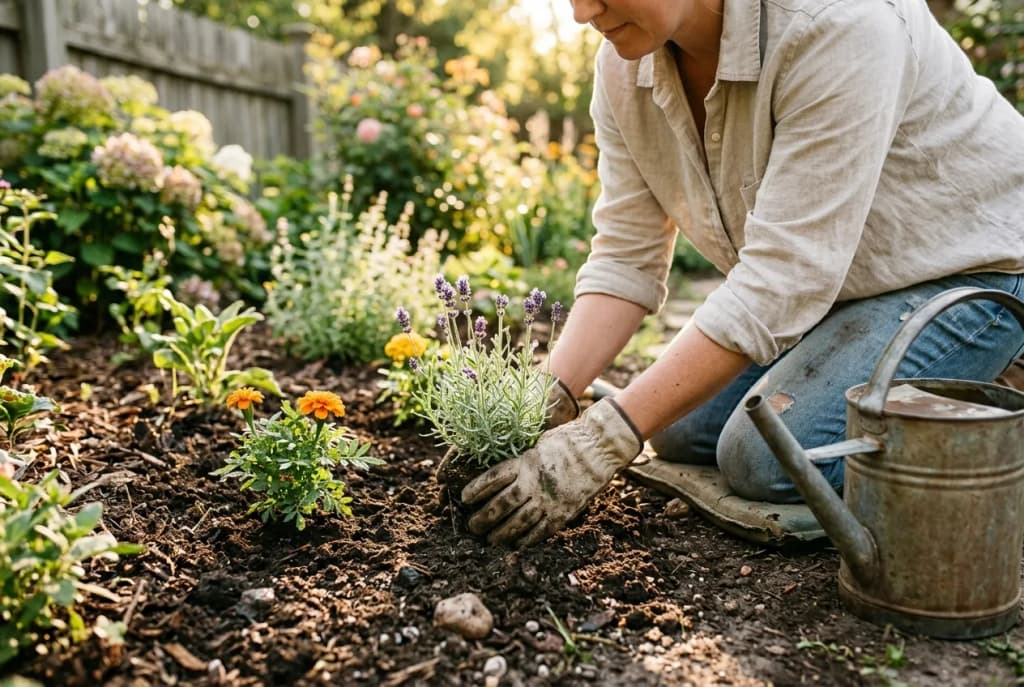
- Clear the area—remove existing weeds, grass, or debris. Get your hands in the dirt. Feel the cool soil under your nails. This is already therapeutic, even if it doesn't feel like it yet.
- Define the border—use stones, bricks, or a low wooden frame. The boundary matters psychologically. You're creating a container.
- Add a base layer—pea gravel, mulch, or decomposed granite. Choose something with texture. Something that crunches underfoot or feels soft when you kneel.
Step 3: Choose Plants With Purpose
Don't just grab whatever's on sale at the nursery. Every plant in this space should mean something—either to you personally or to the sensory experience you're building.
Plants that work especially well for corgi memorial gardens:
| Plant | Why It Works | Sun Needs | Zone |
|---|---|---|---|
| Creeping thyme | Releases scent when stepped on; ground-level | Full sun | 4-9 |
| Forget-me-nots | Obvious symbolism; low-growing; self-seeding | Partial shade | 3-8 |
| Lavender | Calming scent; attracts butterflies; hardy | Full sun | 5-9 |
| Dwarf mondo grass | Evergreen; corgi-height; soft texture | Shade to partial sun | 6-11 |
| Rosemary | Traditionally symbolizes remembrance; aromatic | Full sun | 7-10 |
| Sweet alyssum | Honey-scented; low, spreading; delicate | Full sun to partial shade | 5-9 |
Pro tip from our team: Rosemary's association with remembrance goes back centuries—it was placed on graves in ancient Greece and used in memorial ceremonies across cultures. When you brush past it and that sharp, clean scent hits you, there's a reason it feels significant. Your brain is wired to associate strong scents with memory retrieval. The American Kennel Club's guide to pet-safe plants is worth checking before you plant anything, especially if you have other pets at home.
Step 4: Add a Focal Point (This Is Where It Gets Personal)
Every memorial space needs a center—something your eye goes to, something that anchors the meaning.
Options range from simple to elaborate:
- An engraved stone with your corgi's name and dates
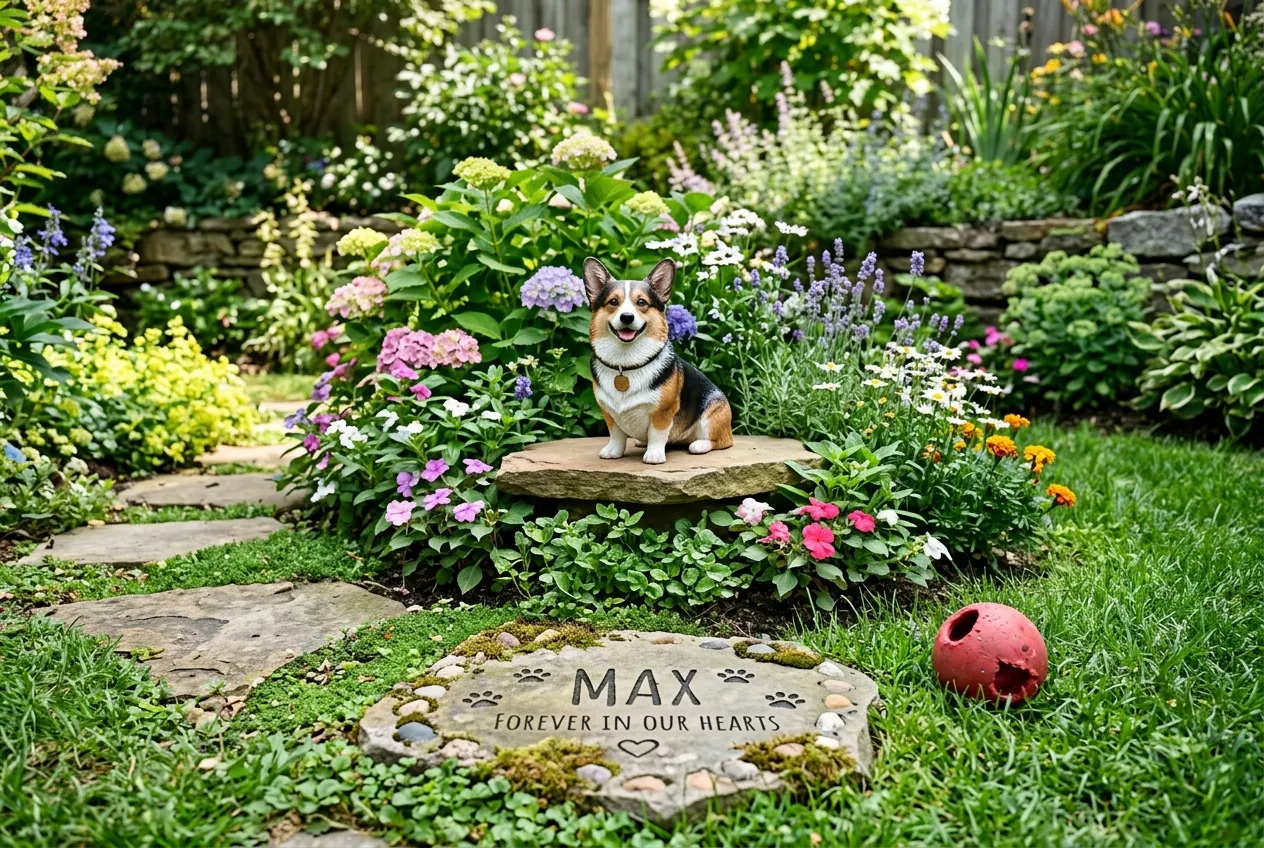
- A small statue or figurine that captures their specific look—not a generic corgi, but your corgi, with that one ear that never stood up straight or the sable markings that made everyone ask "what breed is that?"
- A weatherproof photo in a sealed frame
- A ceramic paw print from a vet impression
Here's where we'll be honest about what we do. At PawSculpt, we create custom pet figurines using full-color 3D printing technology—digitally sculpted by master 3D artists who work from your photos, then precision-printed in full-color resin where the color is embedded directly in the material, not painted on top. The result captures your specific corgi's markings, proportions, and personality in a way that generic figurines simply can't. Many families place their PawSculpt figurine as the centerpiece of their memorial garden, and the UV-resistant materials mean it holds up outdoors.
But we'll also say this: the focal point doesn't have to be purchased. A smooth stone from a beach your corgi loved, placed with intention, holds just as much meaning as anything you can buy. The point is that it's specific to your dog. Not a symbol of dogs in general. A representation of this one.
"Every corgi we sculpt digitally has a personality that comes through in the reference photos—the head tilt, the stance, the attitude. Our job is to make sure the figurine feels like a reunion, not a replica."
— The PawSculpt Team
Step 5: Create a Ritual (Small, Repeatable, Yours)
This is the part most memorial garden guides skip entirely, and it's arguably the most important.
A garden without a ritual is just landscaping. A garden with a ritual is a grief practice—and grief practices are what carry you through the long middle of loss, the part that comes after the funeral and the sympathy cards and the casseroles, when everyone else has moved on and you're still reaching for a dog who isn't there.
Your ritual doesn't need to be elaborate. It needs to be repeatable and specific:
- Morning coffee in the garden, sitting at ground level, for five minutes
- Brushing your hand across the lavender every time you walk past
- Placing a small treat or toy in the garden on anniversaries (yes, this is okay; no, it's not "crazy")
- Talking out loud to your corgi while you weed or water—your brain doesn't fully distinguish between talking to someone present and talking to someone remembered; the same neural pathways activate
One of our customers told us she places a fresh sprig of rosemary next to her corgi's PawSculpt figurine every Sunday morning. "It's not logical," she said. "But it's the most logical thing I do all week." We understood exactly what she meant.
What We Wish We Knew Sooner
A Candid Sidebar From the PawSculpt Team
We've worked with thousands of families navigating pet loss, and there are things we've learned that we wish someone had told us—and them—earlier:
- You don't have to wait until you're "done grieving" to build a memorial. There's no such thing as done. Start when you need somewhere to put your hands.
- The garden will make you cry at first. Then it'll make you cry less. Then it'll make you smile and cry at the same time. That's the progression, and it's healthy.
- Other people might not get it. You might hear "it's just a dog" or get a sideways look when you mention your memorial garden at dinner. The shame that follows—the feeling that your grief is too big, too much, too intense for "just a pet"—is one of the most isolating experiences of pet loss. Your grief is not too much. Their understanding is too small.
- Involve your kids if you have them. Children process grief through action, not conversation. Letting a child place a stone or plant a flower gives them agency in a situation where they feel powerless.
- Your other pets might visit the garden. We've heard this from dozens of families. The remaining dog or cat gravitates to the memorial space. We're not going to make claims about what animals understand, but we will say: it's not nothing.
- The garden will change over time, and that's okay. Plants will die. New ones will grow. The stones will shift. This isn't failure—it's a living memorial doing what living things do. The impermanence is part of the point.
Dog Memorial Outdoor Spaces: Weatherproofing and Long-Term Care
Let's get practical for a moment, because nothing undermines a memorial faster than watching it fall apart in the first winter.
Protecting Your Garden Elements
For plants: Choose perennials native to your USDA hardiness zone. Annuals are beautiful but require replanting every year, which some people love (it becomes part of the ritual) and others find exhausting. Know yourself.
For stones and engraved markers: Natural stone weathers beautifully and requires zero maintenance. Painted or printed markers may fade—look for UV-resistant options or plan to refresh them annually.
For figurines and decorative elements: This is where material matters enormously. Ceramic cracks in freeze-thaw cycles. Resin holds up better. The full-color resin we use at PawSculpt is finished with a protective clear coat specifically designed for UV resistance, but even so, we recommend placing figurines where they get some shelter from direct, all-day sun exposure. A spot under a tree canopy or near an overhang is ideal.
For the garden structure itself: Raised beds and borders made from rot-resistant wood (cedar, redwood) or natural stone will last years. Pressure-treated lumber is cheaper but can leach chemicals into soil—not ideal if you have other pets who might dig or eat plants from the area.
Seasonal Maintenance Schedule
| Season | Tasks | Time Needed | Emotional Note |
|---|---|---|---|
| Spring | Clean debris, divide perennials, refresh mulch | 1-2 hours | Often the hardest season—everything is coming back to life except them |
| Summer | Water consistently, deadhead flowers, check for pests | 15 min/week | The garden is fullest; enjoy it |
| Fall | Cut back perennials, plant spring bulbs, add leaf mulch | 1-2 hours | Planting bulbs is an act of faith—you're trusting the future |
| Winter | Protect tender plants, bring in non-weatherproof items, rest | Minimal | The garden sleeps. You can too. |
That spring note isn't throwaway. Multiple families have told us that the first spring after their corgi's passing was unexpectedly brutal—watching the garden come alive while still feeling so much absence. If that hits you, know that it's not a setback. It's your brain recalibrating. The contrast between external renewal and internal grief creates a specific kind of cognitive dissonance that's painful but ultimately productive. You're teaching your brain to hold both things: life continues, and this loss is real.
Pet Memorial Garden Ideas Beyond the Basics
You've got the foundation. Now let's talk about the details that elevate a memorial garden from "nice" to "this is the most meaningful square footage of my property."
Wind Chimes Tuned to a Specific Note
This sounds oddly specific, and it is. Wind chimes come in different musical keys. Choose one that resonates with you—literally. Hang it near the garden so that on breezy days, the sound drifts through. Over time, your brain will associate that specific tone with this space and this dog. Auditory anchoring is a well-documented phenomenon in psychology; it's the same reason certain songs immediately transport you to a specific memory.
A "Dig Zone"
Corgis dig. It's breed behavior—they were originally bred to herd cattle and work on farms, and many retain that instinct to excavate. Leaving a small patch of loose, soft soil in your memorial garden as an intentional "dig zone" is a playful, breed-specific tribute that'll make you laugh through tears the first time you see it. Some families bury a small time capsule there—a favorite toy, a collar tag, a note.
Nighttime Elements
Memorial gardens don't have to be daytime-only spaces. Solar-powered path lights, a small LED candle in a lantern, or glow-in-the-dark stones create an entirely different atmosphere after dark. Grief doesn't keep business hours. Sometimes you need your garden at 11 PM, and it should be ready for you.
A Visitor's Stone
Place a smooth, flat stone and a cup of permanent markers near the garden entrance. When friends or family visit, invite them to write a memory of your corgi on a stone and add it to the border. Over time, the garden accumulates stories. It becomes communal. Shared grief is lighter grief—not because the pain decreases, but because the weight is distributed.
The Fear of Forgetting (And Why a Garden Fights It)
There's a fear that lives underneath all the other grief emotions, and it's the one that wakes you up at 4 AM with your heart pounding.
You're afraid you'll forget.
Not the big things—you'll always remember that your corgi existed, what she looked like, her name. But the small things. The specific way she sneezed (three times, always three). The sound of her drinking water—that messy, enthusiastic lapping. The exact weight of her body when she fell asleep on your chest. The texture of the fur behind her ears versus the fur on her haunches. These micro-memories feel like they're already dissolving, and the terror of losing them can be worse than the grief itself.
Here's the neuroscience that might actually comfort you: your brain doesn't forget sensory memories the way it forgets facts. Episodic memories (events, timelines) are stored in the hippocampus and do fade over time. But sensory and emotional memories are encoded in the amygdala and sensory cortex, and they're triggered by environmental cues—a smell, a texture, a sound. They don't degrade the same way. They lie dormant until something activates them.
A memorial garden is a trigger garden. Every element you place there—the scent of rosemary, the texture of soft leaves, the sound of wind chimes, the visual of a figurine that captures your corgi's exact markings—is a sensory cue that reactivates those dormant memories. You're not just decorating a patch of ground. You're building a neurological retrieval system for the memories you're most afraid of losing.
This is why generic memorials don't work as well as specific ones. A generic dog angel statue doesn't trigger your specific memories. But a custom 3D-printed figurine that captures the exact tilt of your corgi's head, surrounded by plants you chose because of how they feel under your fingers? That's a sensory constellation designed—whether you intended it or not—to keep those neural pathways active.
"You don't build a memorial garden to remember. You build it so your body never forgets what your mind is afraid of losing."
When People Don't Understand Your Grief
We said we'd be honest in this article, so here it is.
Some people in your life are going to think this is excessive. A whole garden? For a dog? They'll smile politely or change the subject or say something about "getting another one," as if corgis are interchangeable. As if love works like a replacement policy.
The disenfranchised grief that pet owners experience—grief that society doesn't fully recognize or validate—is one of the most studied and least addressed phenomena in bereavement psychology. You don't get bereavement leave for a dog. You don't get a funeral that everyone attends. You get a quiet, private devastation and a world that expects you to be fine by Monday.
Building a memorial garden is, in part, an act of defiance against that minimization. It says: this mattered. This was real. This deserves space—physical, actual, measurable space—in my world.
If someone questions it, you don't owe them an explanation. But if you want one, here it is: the AVMA (American Veterinary Medical Association) recognizes pet loss as a significant bereavement event, and grief counselors increasingly specialize in it. You're not overreacting. You're responding proportionally to a genuine loss.
Closing: Back to the Beach
You're still standing there, aren't you? Feet in the sand. Tide coming back in. That phantom weight against your left ankle, the ghost of a corgi who chose that spot every single time, as if she was holding you to the earth.
You can't bring her back to this beach. But you can bring the beach to her.
A smooth stone from the shoreline. A handful of sand pressed into a small wooden box. A sprig of sea lavender, dried and tucked among the rosemary in a garden you build with your own two hands—soil under your nails, tears on your face, and not a single apology for any of it.
A corgi memorial garden isn't a grave. It's a conversation that keeps going. It's a place where your love lives now that it has no body to hold. And every time you kneel in the dirt and press your palm against the cool, smooth stone at its center, you're not just remembering. You're telling your brain, your body, and your stubborn, grieving heart: I was lucky enough to love something this much. And I'm not done yet.
Start small. Start messy. Start today.
Frequently Asked Questions
How do I build a memorial garden for my corgi?
Start by choosing a location you naturally pass each day—beside a back door or along a walkway works better than a hidden corner. Define borders with low stones or wood to create a contained space, plant sensory-rich ground cover like creeping thyme or lavender, and add a personal focal point that represents your specific dog. You don't need a large space; even a planter box on a balcony can serve as a meaningful memorial.
What plants are safe for a pet memorial garden if I have other animals?
Lavender, rosemary, creeping thyme, forget-me-nots, and sweet alyssum are popular and generally pet-safe options. However, always cross-reference with the ASPCA's toxic plant database or the AKC's poisonous plant guide before planting, especially if dogs or cats will have unsupervised access to the garden area. When in doubt, consult your veterinarian.
Is it normal to feel guilty after euthanizing my corgi?
Extremely normal—and extremely common with corgis specifically, because they tend to remain cheerful and food-motivated even when their bodies are failing. This cognitive dissonance between "they still seemed happy" and "the vet said it was time" can be agonizing. The guilt doesn't mean you made the wrong decision. It means you loved them enough to carry the weight of that choice. If the guilt becomes overwhelming, pet loss support groups and grief counselors who specialize in animal bereavement can help.
How long does grief last after losing a pet?
There's no expiration date. The acute, all-consuming phase often softens over several weeks to months, but grief doesn't follow a straight line. You might feel fine for a week and then fall apart because you found a stray fur clump behind the couch. These waves are normal and can continue for years. They don't mean you're "stuck"—they mean the love was real and your brain is still integrating the loss.
Can a memorial garden actually help with grief, or is it just symbolic?
It's both—and the symbolic part has real neurological effects. Environmental psychology research shows that creating a physical space tied to emotional meaning activates the brain's reward and attachment circuits. The tactile, sensory nature of gardening (hands in soil, textures, scents) also engages both the sympathetic and parasympathetic nervous systems simultaneously, which helps regulate the stress response that accompanies grief.
What weather-resistant items work best in an outdoor dog memorial?
Natural stone weathers beautifully without maintenance. UV-resistant resin figurines (like those produced through full-color 3D printing) hold up well with a protective clear coat, especially if placed under partial shelter. Cedar or redwood borders resist rot naturally. Avoid painted ceramics in freeze-thaw climates, as they tend to crack. Solar-powered lights and stainless steel wind chimes are durable additions that add sensory dimension year-round.
Ready to Honor Your Corgi's Memory?
Some memories deserve more than a photo on your phone. If you're building a corgi memorial garden and want a centerpiece that captures your dog exactly as they were—the markings, the stance, the personality that made them irreplaceable—a custom PawSculpt figurine is digitally sculpted from your photos and precision-printed in full-color resin that's built to last outdoors and in your heart.
Visit pawsculpt.com to see how it works, explore examples, and learn about our process and guarantees