
In the First Hour: How Grief Circles Help Families Bargain With Losing a Chihuahua
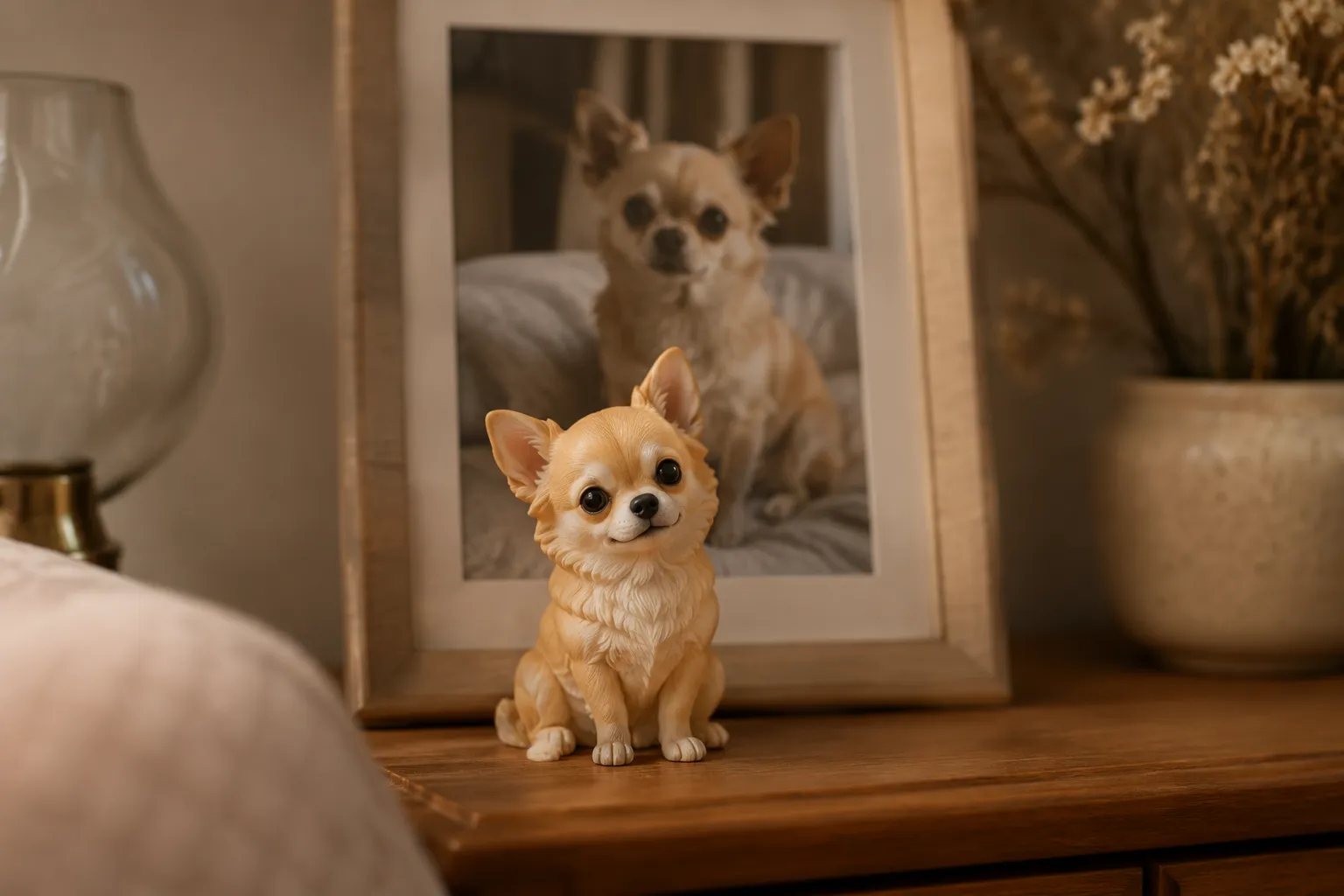
You're halfway down the porch steps with the little sweater still warm from the dryer when it hits you: no one is left to wear it. Chihuahua loss arrives like that, hidden in small, ordinary things.
In the first hour after a chihuahua's death, a grief circle gathers everyone who loved the dog to speak, cry, and share memories together. This shared space helps families move through shock and bargaining, and early communal acknowledgment appears to reduce isolation and the risk of prolonged grief.
Quick Takeaways
- Gather everyone in the first hour — a short spoken ritual keeps grief from splintering the household
- Name the bargaining out loud — "if only" thoughts lose power when someone else hears them
- Let kids lead their own goodbye — forced calm teaches them grief is shameful
- Anchor the memory in something you can hold — many families choose memorial keepsakes once the first wave passes
Why a Chihuahua Leaves a Hole Bigger Than Its Body
Here's the thing nobody prepares you for: the smallest dogs cast the longest shadows in a home.
A chihuahua isn't a pet you keep at arm's length. She rides in your hoodie. She sleeps under the covers, pressed against the back of your knees. She learns the sound of your car three blocks away. Fifteen, sometimes seventeen years of that kind of closeness rewires a household around one four-pound presence.
So when she's gone, the loss isn't proportional to her size. It's proportional to how deeply she was woven into your daily rhythm. That's why chihuahua loss so often blindsides people who thought they were "ready."
The bond with a toy breed tends to be unusually physical. You carried her. You warmed her when she shivered. Your body remembers her weight. And bodies grieve on their own timeline, long after the mind has accepted the facts.
"Her spot on the couch still holds the shape of her. Nobody sits there. It's become a small, sacred space by accident."
We've worked with thousands of pet families at PawSculpt, and the chihuahua parents tell us the same thing again and again. It's the smell that undoes them. That warm, faintly corn-chip scent of her paws. The blanket in the laundry basket they can't bring themselves to wash. The pillow that still carries her.
Scent is the sense wired most directly to memory and emotion. That's not sentiment, it's neurology. Which is also why the fear of forgetting cuts so deep. You're not afraid you'll forget she existed. You're afraid you'll forget exactly how she smelled when she burrowed into your neck. That fear is real, and it's one of the most common things pet owners carry in silence.
The First Hour: What a Grief Circle Actually Is
The first hour after a loss is a strange, suspended thing. The house goes still. Everyone orbits the same grief but nobody knows where to stand.
A grief circle is simply a decision not to scatter.
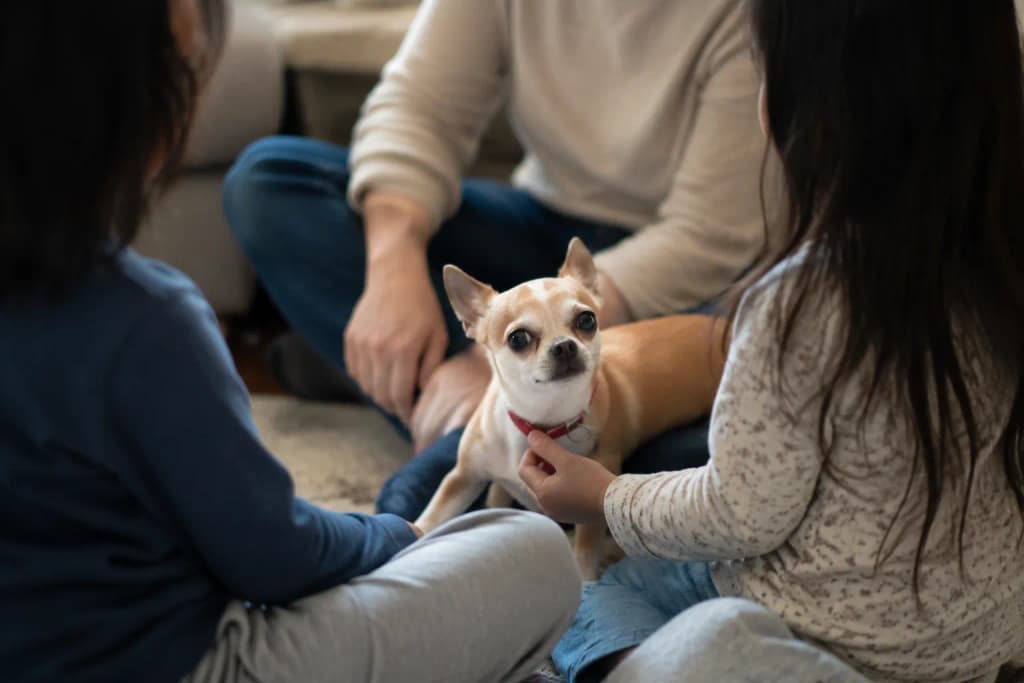
Instead of each family member retreating to a separate room to cry alone, you gather. In the living room, on the porch, wherever she loved to be. You sit together, and one at a time, anyone who wants to speaks. A memory. A thank-you. An apology. Whatever's true in that moment.
It sounds almost too simple to matter. It isn't.
The Association for Pet Loss and Bereavement has long emphasized that shared, verbal acknowledgment early in grief helps prevent the isolation that turns ordinary mourning into something heavier and longer. When grief stays locked inside individual people, it calcifies. When it's spoken into a room full of people who understand, it starts to move.
How to hold one, in plain terms
You don't need a script or a ceremony. You need about twenty minutes and a willingness to be awkward.
- Gather everyone who lived with the dog, including kids, within the first hours if you can.
- Put her collar, blanket, or bowl in the center. A physical object gives the grief somewhere to land.
- Go around once. Each person says one memory and one thing they'll miss. No cross-talk, no fixing.
- End with a small ritual — lighting a candle, saying her name together, opening a window. Something that marks the passage.
The point isn't closure. There's no such thing in the first hour. The point is presence. You're telling each other, without saying it directly, we felt this together and we won't carry it alone.
"We've seen families heal by holding something tangible. Grief needs an anchor, and it needs witnesses."
— The PawSculpt Team
Here's a rough map of how those first days tend to unfold. Every family moves through it differently, but knowing the shape ahead of time can steady you.
| Timeframe | What Usually Happens | What Helps |
|---|---|---|
| First hour | Shock, numbness, disbelief | Gather; don't isolate |
| First 72 hours | Waves of grief, guilt surfaces, sleep disrupted | Talk, eat, keep her scent nearby |
| First 2 weeks | Bargaining and "if only" loops intensify | Say the guilt out loud to someone |
| First 2 months | Grief softens into ache; routines rebuild | Consider a lasting memorial |
The Bargaining Nobody Warns You About
Grief has a stage most people skip when they talk about it politely. Bargaining.
It doesn't sound like grief. It sounds like math. If only I'd noticed the limp sooner. If only I hadn't waited that extra week. If only we'd tried the other vet, the other diet, the other surgery. The mind runs the numbers over and over, trying to solve a problem that has no solution.
And here's what almost no one says aloud: for families who chose euthanasia, the bargaining can be brutal.
You may find yourself second-guessing the timing at three in the morning. Did we do it too soon and steal weeks we could have had? Did we wait too long and let her suffer for our own sake? Both questions can haunt the same person on the same night. This is one of grief's cruelest tricks, and it is completely normal.
Let me say this plainly, because you may need to hear it from someone outside your own head. Choosing to end suffering is not a failure of love. It's the final, hardest form of it. You made a decision no one wanted, using the information you had, in the middle of a fear that clouds everyone's thinking. The version of you making that call was acting out of devotion, not haste.
The guilt that trails behind that choice isn't evidence you did something wrong. It's evidence of how much you cared. People who didn't love deeply don't lie awake auditing their own compassion.
Why saying it out loud works
There's a reason the grief circle matters so much for bargaining specifically. The "if only" runs on secrecy. In your head, unspoken, it grows teeth. Said aloud to someone who loved the same dog, it usually softens into something you can survive.
We remember one family, three generations under one roof, who'd lost their chihuahua after a long decline. The grandmother had been carrying private guilt about a missed vet appointment for weeks. She said it out loud during their circle, almost by accident. Her granddaughter, twelve years old, said, "Grandma, she slept on your chest every single day. She knew." That was the moment the whole room finally cried together.
That's the mechanism. Not advice. Witness.
Helping Kids Grieve Without Rushing Them
The instinct to protect children from grief is loving and almost always backfires.
When we soften the truth — "she ran away," "she's sleeping," "we had to give her away" — we don't spare kids pain. We teach them that this loss is too dangerous to name, and that their feelings need to be hidden. Helping kids grieve starts with honesty they can hold.
Use real words. Died. Death. Gone. Vague language leaves children imagining their dog is lost and afraid somewhere, which is far more frightening than the truth.
Then let them grieve in their own idiom, which rarely looks like adult grief. A child might sob for ten minutes and then ask to play video games. That's not coldness. Kids grieve in short bursts because their systems can only hold so much at once. Let them come and go from the feeling.
Different ages need different things. This is a rough guide, not a rulebook.
| Age | How They Understand It | What They Need |
|---|---|---|
| 2–5 | Death seems reversible; they may keep asking | Simple, repeated honesty; routine |
| 6–9 | Grasp permanence; may feel responsible | Reassurance it wasn't their fault |
| 10–12 | Understand fully; may hide feelings | Permission to grieve openly |
| Teens | Adult comprehension; may grieve privately | Space, plus quiet availability |
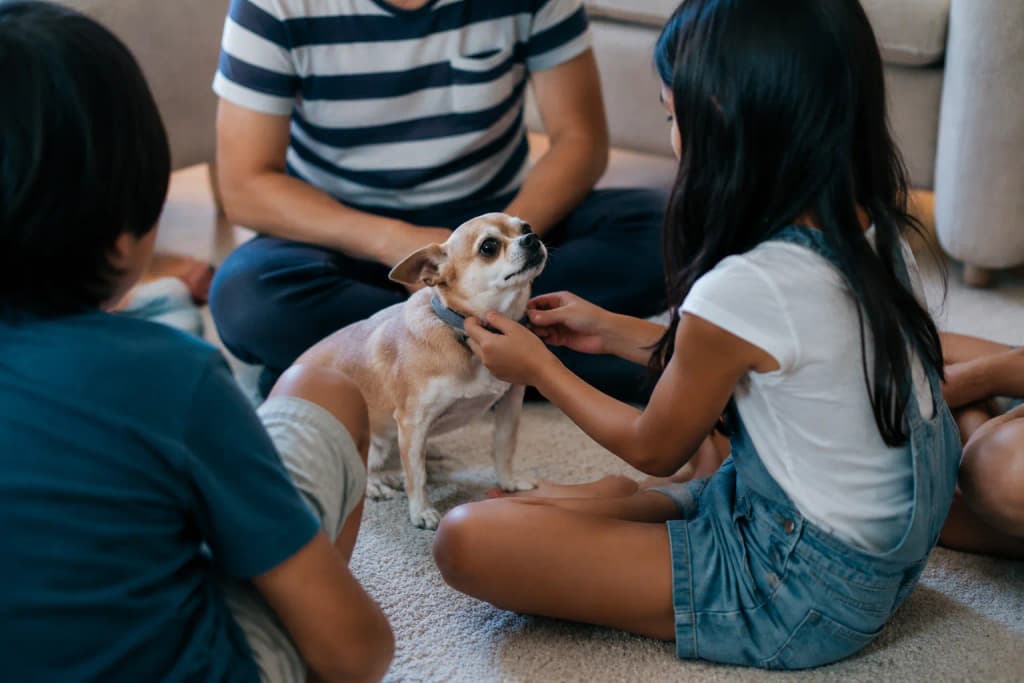
Give children a role in the grief circle. Let them choose which of her toys goes in the center. Let them draw her a picture to keep. Kids who participate in the ritual, rather than being sent to another room, carry less confusion and less of the sense that something shameful just happened.
"Let a child pick the toy that goes in the circle. Handing them a job hands them a way through the grief."
One more thing, and it surprises a lot of parents. It's okay for your kids to see you cry. A child watching a parent grieve honestly learns that love and loss belong together, and that big feelings don't destroy the people they depend on. You're not failing to be strong. You're teaching them how to survive being human.
Finding a Pet Grief Support Group That Fits
The grief circle handles the first hour. But grief doesn't clock out after a day, and this is where a pet grief support group earns its keep.
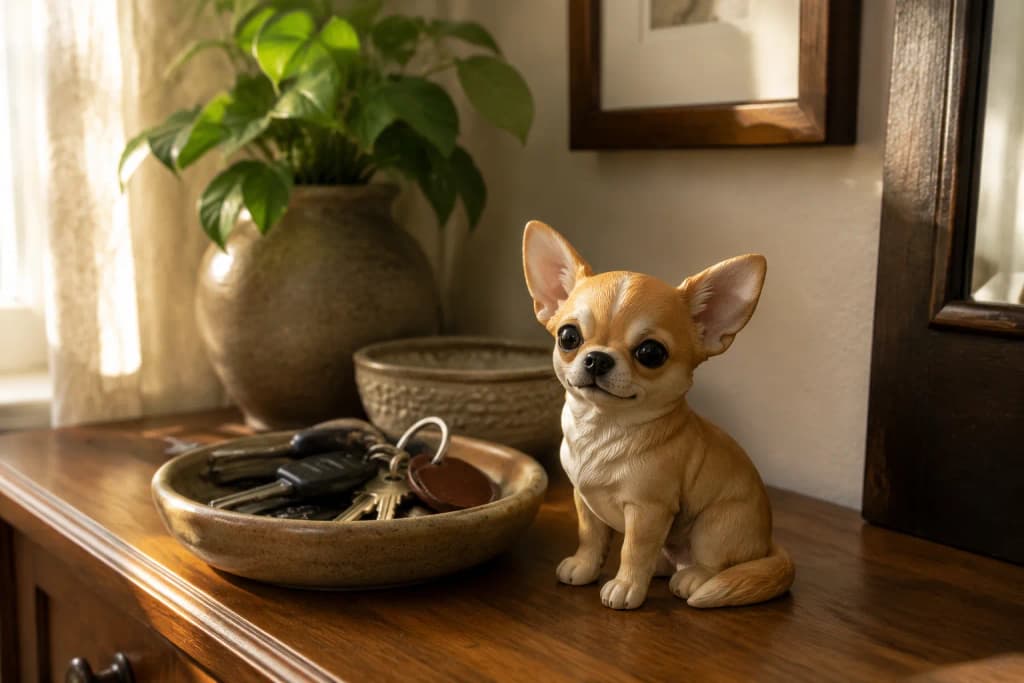
There's a particular loneliness to mourning a chihuahua. You go back to work and the world expects you to be fine, because "it was just a small dog." That casual dismissal is its own wound. Which brings up an emotion people rarely admit: feeling judged for grieving "too much" over an animal. If you've felt that flush of shame when someone raised an eyebrow at your tears, know that the size of your grief simply matches the size of your love. Nobody else gets a vote on that.
A good support group, online or in person, is a room where nobody raises that eyebrow.
What We Wish We Knew Sooner
Candid notes from our team, gathered from years of talking with grieving pet families:
- Grief has no expiration date, and that's not a problem to fix. The families who did best weren't the ones who "moved on" fastest. They were the ones who stopped apologizing for still missing their dog a year later.
- The empty routine hurts longer than the empty room. People brace for the quiet house. What ambushes them is reaching for the leash at 6 p.m. out of pure habit, weeks later.
- Don't wash the blanket yet. Several families told us they regretted rushing to erase her scent. There's no deadline. Keep it in a sealed bag if you need to save it.
- Getting another dog isn't betrayal. The anxiety about loving again is real, but a new dog doesn't replace the last one any more than a second child replaces the first.
When you're looking for a group, look for one that's moderated, that welcomes the ugly emotions and not just the tender ones, and that doesn't rush anyone toward "acceptance" on a schedule. The best ones treat your dog's death as a genuine bereavement, because that's exactly what it is.
If a full group feels like too much, start smaller. One friend who gets it. A single online thread. The goal is simply to not be the only person holding this.
Giving Grief an Anchor
At some point, usually after the first raw weeks, families start reaching for something to keep. Not to move on. To carry her forward.
This is where the spiritual dimension of the bond becomes something you can almost touch. The relationship didn't end; it changed form. The rituals we build afterward are how we honor a soul contract that outlasts the body. Some families plant a small tree over her ashes. Some frame a paw print. Some keep her collar on a hook by the door where the leash used to hang.
And increasingly, families choose a keepsake with more presence than a flat photo. At PawSculpt, we create custom pet sculptures that are digitally sculpted by 3D artists and then precision 3D printed in full-color resin, so her markings, her posture, that particular tilt of her head all come through in something you can hold in your palm.
We're honest about what this is: a portrait, not a photocopy. A sculpted interpretation that captures her character, not a clone of her. The color is printed into the resin itself and sealed with a protective clear coat, so it holds that vibrant, slightly textured, real-material look rather than a plastic sheen.
For families who want that kind of tangible memorial, our pet memorial figurines give grief somewhere to rest its hands. You can see a free instant preview on the website before deciding anything, and an artist's 3D preview follows within seven days of a deposit, so nothing is a guess.
Whatever anchor you choose, the purpose is the same. To turn the ache of absence into the steadiness of legacy. To keep her spirit present in the room without pretending she's still in it.
Closing: The Sweater by the Door
Go back to that porch. The sweater, warm from the dryer, no one left to wear it.
Here's what changes with time. One evening, months out, you'll fold that little sweater and you won't fall apart. You'll smile at the corn-chip memory of her paws, at the shape she left in the couch cushion, at the specific weight of her against the back of your knees. The absence won't vanish. It'll just stop being an open wound and become something more like a scar you're oddly grateful for, proof of a bond worth this much grief.
Your next step is small and immediate: gather your people. If the loss is fresh, hold the circle tonight, even a clumsy one. If it's been a while, do the thing you've been avoiding, whether that's finding a pet grief support group or finally choosing a keepsake that lets you hold her again.
Chihuahua loss teaches the same hard lesson every deep love eventually teaches. The price of loving something that won't live as long as you do is grief. And every pet parent, in the end, decides that price was always, always worth paying.
She was small. She was never small in your life. Let the ritual say so.
Frequently Asked Questions
How long does grief last after losing a chihuahua?
There's no set timeline, and anyone who gives you one is guessing. The first 72 hours are usually the most disorienting, and the sharpest pain tends to ease over the following weeks and months. But grief can return in waves for a year or longer, often triggered by a smell or a familiar time of day. That's not a setback. That's love with nowhere to go for a moment.
Is it normal to feel guilty after choosing euthanasia?
Completely normal. Many pet owners lie awake second-guessing the timing, wondering if they acted too soon or waited too long. Choosing to end a beloved dog's suffering is the hardest form of love, not a failure of it. The guilt that follows is a measure of how much you cared, not evidence you did anything wrong.
How do I help my child grieve the loss of our dog?
Start with honest, age-appropriate words. Say "died," not "went away." Let them grieve in short bursts, since children can only hold so much feeling at once, and give them a concrete role in the goodbye. And let them see you cry. It teaches them that big feelings are survivable and that love and loss belong together.
What if people think I'm grieving too much over a small dog?
That judgment says everything about them and nothing about your bond. The intensity of your grief simply matches the depth of your love, and no one else gets a vote. A moderated pet grief support group can be a genuine relief here, because it's a space where no one raises an eyebrow at your tears.
When is the right time to get another pet?
There's no universal answer, and the anxiety you feel about it is normal. A new dog never replaces the one you lost, the way a second child never replaces the first. When you feel ready to open your heart to a different personality, rather than to find a copy of your chihuahua, you'll know.
Ready to Celebrate Your Pet?
Every pet has a story worth preserving. Whether you're honoring a beloved companion who's crossed the rainbow bridge or working through the raw days of chihuahua loss, a custom PawSculpt figurine — a sculpted portrait, not a photocopy — captures the character, posture, and markings that made your dog one-of-a-kind.
Start with a free instant preview, then review your artist's 3D preview before anything is finalized. Every order ships insured, tracked, and carefully packed.