
Turning Attachment Into Art: A Teen's First Week Without Their Maine Coon's Bed
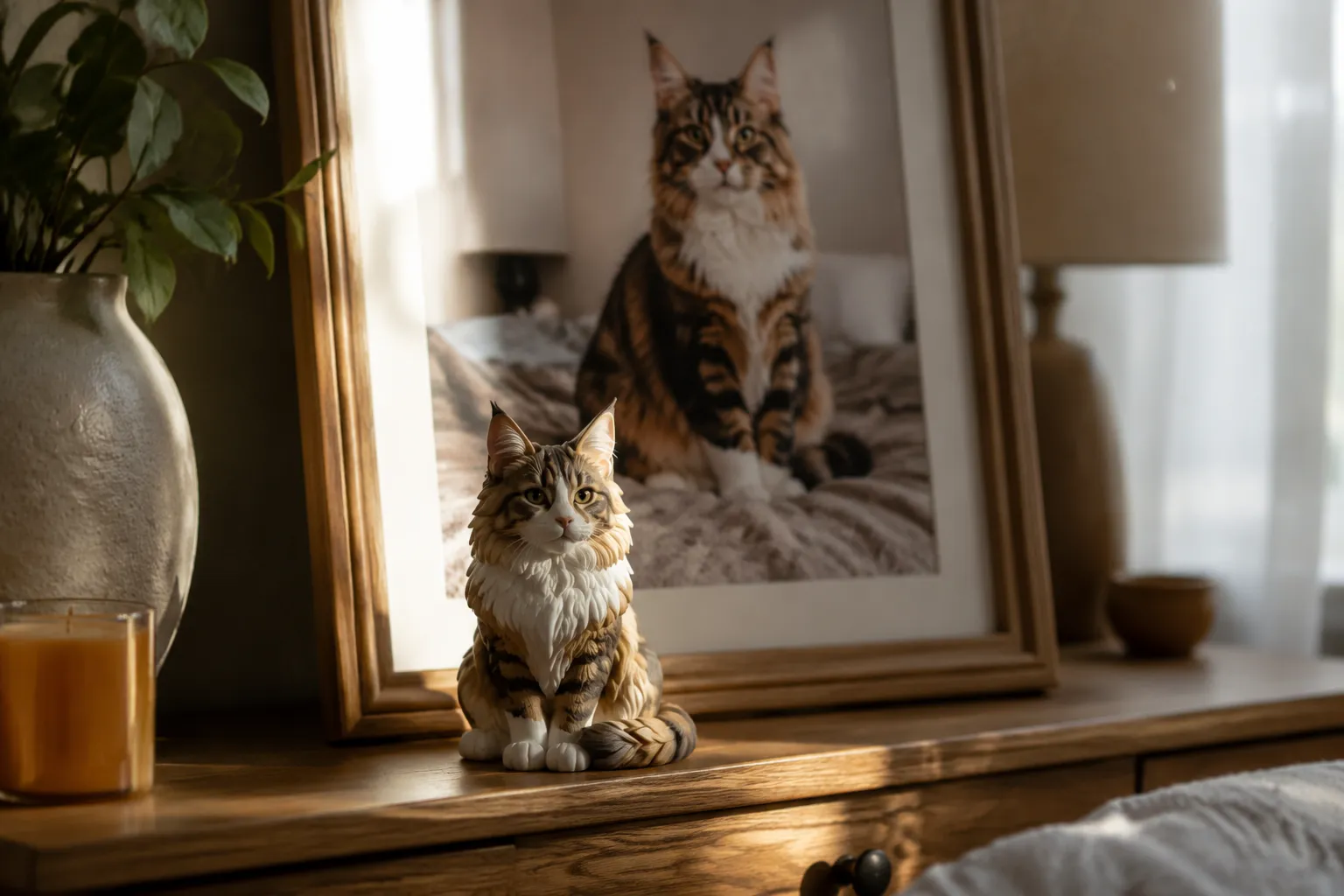
A Maine Coon can weigh eighteen pounds and greet you with a chirping trill that carries through a whole house like a small engine warming up. For one teenager building a maine coon memorial in her attic last winter, it was that trill she missed most. The stairs no longer answered back.
A maine coon memorial helps most in the first week because grief needs somewhere physical to land. Turning attachment into a creative act, whether a memory box, a written letter, or a sculpted keepsake, gives the mind a place to put love that suddenly has no recipient. Research on the human-animal bond shows this redirection eases acute loss.
Quick Takeaways
- The first 72 hours are the loudest — the absence of routine sounds hits harder than the big moments.
- Attachment doesn't disappear, it redirects — creative grief expression gives that energy a destination.
- Guilt and relief can coexist — feeling both does not mean you loved your pet any less.
- Tangible keepsakes anchor memory — many families find comfort in pet memorial figurines that hold a pet's character in the room.
- Teens grieve differently than adults — they often process through making, not talking.
Why the First Week Is Mostly About Sound
Here's something most grief guides skip entirely. When a pet dies, the sharpest ache in the early days often isn't visual. It's auditory. It's the sound that stops.
A Maine Coon is a vocal breed. They trill, they chirp, they carry on half-conversations from the top of the stairs. The American Kennel Club and feline behaviorists both note that Maine Coons are unusually "talkative" for cats, which means their households are tuned, without realizing it, to a specific soundtrack.
Then the soundtrack ends. And the silence that follows isn't peaceful. It's a presence. You notice the refrigerator hum you never heard before. You notice your own footsteps on the stairs, unanswered.
We worked with a family last year whose teenage daughter kept setting two alarms out of habit. One to wake herself. One that used to signal the morning feeding trill she'd wake up to anyway. She told us she didn't cry when she found the collar. She cried when she realized the house had gotten quiet enough to hear the clock.
"The collar didn't break me. The quiet clock did. I never knew how much noise love makes until it stopped."
That's the strange arithmetic of loss. The objects hurt, sure. But the missing sound rearranges the whole architecture of a home.
What the science says about that ache
Studies on attachment suggest that our brains encode pets into our sensory routines the same way they encode people. The National Institutes of Health has published research on the human-animal bond describing how companion animals become woven into our daily regulation of stress and rhythm.
So when the trill stops, your nervous system keeps reaching for a signal that no longer comes. That reaching has a name in psychology. It's called the "searching" phase of grief, and it's why you'll swear you heard your cat for weeks.
The Psychology of Pet Attachment (And Why Teens Grieve Sideways)
Adults tend to grieve out loud. We talk, we post, we gather. Teenagers often do the opposite. They grieve sideways, through their hands.
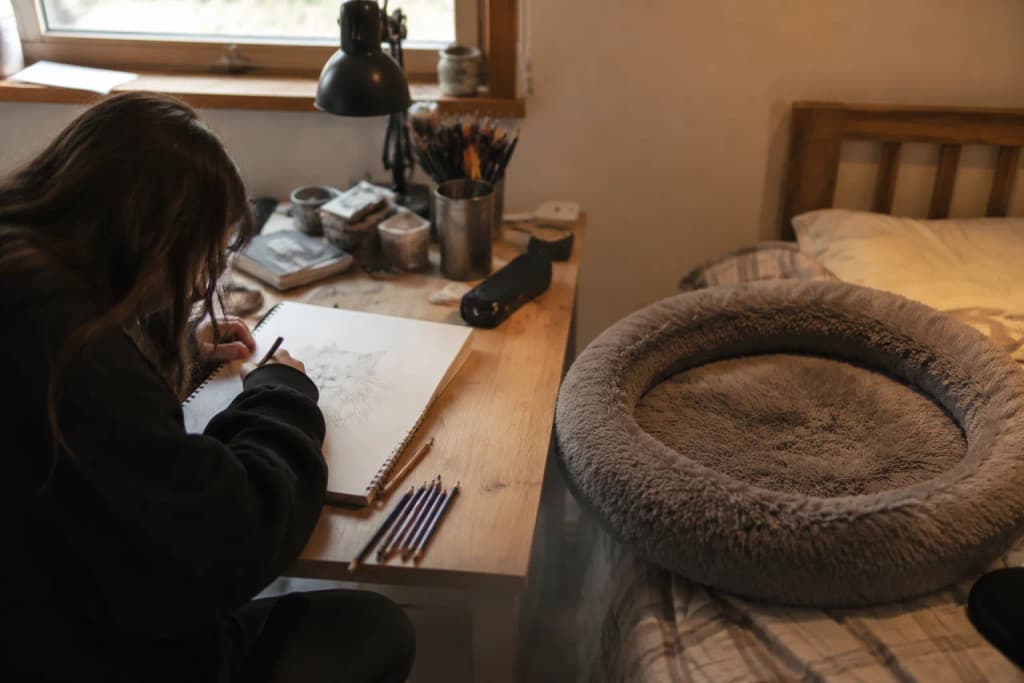
The teen in the attic wasn't journaling her feelings. She was sorting. She pulled her Maine Coon's bed, the frayed cat tree, the tuft of shed fur still clinging to a blanket, and she started arranging them like an exhibit. She was building something before she had words for why.
This is worth understanding if there's a young person in your home. Adolescents frequently process loss through making rather than speaking. Pushing a teen to "talk about their feelings" can backfire. What actually helps more is handing them a project.
The mistake most families make is treating a grieving teenager like a smaller adult who just needs the right conversation. What they often need instead is a task with their hands and permission to be quiet about it.
The attic as a grief studio
There's a reason so much mourning happens in attics and garages. These are the spaces where we store the things we can't throw away but can't look at daily. An attic is a paused room. It holds the past in suspension.
When that teenager carried the cat bed up the attic stairs instead of into the trash, she was making a decision most adults understand instinctively. Some objects can't be discarded and can't stay in the living room. They need a middle place. A place to become memory instead of clutter.
The artistic instinct here is real. She was doing what curators do. Choosing what to preserve, deciding how to arrange it, and giving texture and color a home. Grief and craft share a border, and teenagers cross it more naturally than we do.
Turning Attachment Into Art: Creative Grief Expression That Actually Works
Not all creative grief expression is equal. Some rituals help you move through the loss. Others quietly trap you inside it. After years of talking with families in the rawest weeks, we've noticed a pattern worth sharing.
The projects that heal tend to have a beginning, a middle, and a finished object. The ones that don't heal tend to loop forever with no completion. Endlessly scrolling old photos, for instance, keeps the wound open without giving it a container.
Here's a comparison of common approaches, what they cost emotionally, and who they tend to serve best.
| Creative Approach | Effort | Emotional Payoff | Best For |
|---|---|---|---|
| Memory box of objects | Low | Immediate, tactile comfort | Kids and teens who process by touch |
| Written letter to your pet | Low | Deep, cathartic release | Adults who process verbally |
| Photo book or album | Medium | Warm but can loop | Families with lots of images |
| Memorial garden or planting | Medium | Slow, seasonal healing | Those who need a living ritual |
| Sculpted portrait keepsake | Medium | Lasting, spatial presence | Anyone who misses their pet's physical form |
Notice that the sculpted portrait sits in a different category from the photo book. A photograph is flat. It captures light on a surface. A three-dimensional keepsake occupies actual space in a room, which is closer to how you experienced your pet in life.
That distinction matters more than people expect. When you miss a pet, you often miss their volume. The weight on the bed. The shape in the doorway. The eighteen pounds of Maine Coon that used to press against your legs.
A note on the cat bed
The teenager in our story eventually did something we've seen bring quiet relief to many young people. She didn't throw the bed away, and she didn't leave it in the doorway to ambush her every morning. She placed it in her attic arrangement and set a small sculpted figurine of her Maine Coon beside it.
The bed became a monument instead of a wound. That's the difference a finished object can make.
The Feelings Nobody Warns You About
Let's name the thing that sits under a lot of pet loss and rarely gets said aloud. Fear of forgetting.
Within days of losing a pet, people start to panic that they're already losing the details. The exact pitch of the trill. The specific way the fur curled behind the ears. This fear is more common than you might think, and it's not morbid. It's love trying to protect itself.
That fear is exactly why physical keepsakes exist. Not to replace memory, but to give it a hook to hang on. When you can no longer perfectly recall the shape of your cat, having something in the room that holds their posture and markings gives your mind a reference point to return to.
The guilt that comes with relief
And there's another feeling that deserves honesty, especially for families whose Maine Coon was old or sick at the end.
That flicker of relief you felt when the labored breathing finally stopped? When the house wasn't organized around medications and vet visits anymore? It does not make you cruel. It makes you someone who was carrying a heavy load and finally set it down. The guilt that chases that relief is one of grief's meanest tricks, and it lies to you.
For teenagers, this guilt can be even sharper. They may feel guilty for being at school when it happened, or for the times they were annoyed by the 5 a.m. trilling. If there's a young person in your house replaying those moments, the most useful thing you can say isn't "don't feel guilty." It's "the cat knew you loved it, even on the mornings you groaned at the noise."
The Association for Pet Loss and Bereavement offers resources that specifically address these tangled emotions, and they're worth pointing a struggling family member toward.
"We've learned that grief doesn't want to be talked out of existence. It wants somewhere to live. Our job is to give it a shape you can hold."
— The PawSculpt Team
What We Wish We Knew Sooner
A candid sidebar from our team, drawn from thousands of conversations with grieving pet families. These are the things we didn't understand at first.
- Don't move the objects too fast. Families who rushed to clear everything within 48 hours often regretted it. Give it a week before deciding what stays.
- The finished keepsake matters more than the perfect keepsake. People who waited for the "right time" to memorialize often never started. Beginning is the healing part.
- Teens want the project, not the pep talk. The most healing thing we've seen for young people is handing them a role in the memorial.
- Photos aren't enough for everyone. Some people need to miss the physical form, and a flat image can't answer that. This surprised us early on.
- Grief has a soundtrack. More people mention missing the sound of their pet than almost any other detail. We didn't expect that.
How Memory Becomes an Object: The Sculpted Portrait Approach
When families ask us how a keepsake gets made, we walk them through it honestly, because the process itself can be part of the closure.
At PawSculpt, we're a sculpted portrait studio. Our master 3D artists digitally sculpt your pet by hand on the screen, studying the posture, the expression, the markings that made your companion unmistakably them. That digital sculpture is then precision 3D printed in full color, where the color is printed directly into the resin, not layered on top. The only manual finishing step is a protective clear coat that adds durability and a soft sheen.
The result has a natural, authentic texture. This is our whole philosophy, and it's why our line is "a portrait, not a photocopy." We aren't trying to trick your eye into thinking it's a photograph. We're capturing character, the tilt of the head, the set of the eyes, the specific dignity of a big Maine Coon at rest.
Here's a rough map of what to expect, so you're never left guessing.
| Stage | What Happens | Timing |
|---|---|---|
| Free AI preview | Instant digital preview on our website | Immediate |
| Artist's 3D preview | A master sculptor's rendering after your deposit | Within 7 days of deposit |
| Full-color 3D printing | Your pet is printed in full-color resin | After you approve |
| Delivery (US) | Insured, tracked, carefully packed | Typically 27-40 days after final payment |
| Delivery (international) | Insured, tracked, carefully packed | Typically 33-47 days after final payment |
For the finer points of the process, it's best to explore the custom pet sculptures options directly, since details evolve and we'd rather you see the current specifics than take our word from an old blog post.
What photos work best
If you're considering this route, a few practical tips from experience. Natural daylight beats flash every time. Aim for a photo at your pet's eye level rather than shooting down at them. Include a couple of angles if you can, and pick images that show their typical expression, not just a posed one. The character lives in the ordinary moments.
We'll gently add the honest caveat we give everyone. We're a portrait studio, not veterinarians or grief counselors. A keepsake is one meaningful part of healing, not a substitute for support when grief turns heavy.
Closing the Attic Door, Softly
That teenager finished her arrangement over about a week. The Maine Coon's bed, the collar, a photo, and a small full-color figurine of her cat mid-trill, mouth slightly open like it was about to answer the stairs one more time.
She told us the house is still quiet. That hasn't changed. But now the quiet has a center. When the silence gets too loud, she goes up to the attic, sits with the arrangement, and the missing sound feels less like an absence and more like a memory she chose to keep.
That's what turning attachment into art actually does. It doesn't fill the silence back up. It gives the silence something to hold.
If you're in your own first week right now, here's your one specific next step. Don't organize a whole memorial today. Just choose one object. The bed, the bowl, the collar. Move it from the doorway to a shelf, and let that small act be the beginning. A maine coon memorial doesn't start with a grand gesture. It starts with deciding that this love gets a place to live.
The trill is gone. What you keep is up to you.
Frequently Asked Questions
Is it normal to feel relief after my pet dies?
Yes, and it's far more common than people admit. If your pet was sick or elderly, relief that their suffering ended is a sign of your compassion, not a failure of love. The guilt that follows is grief playing tricks. You prioritized their comfort over your own need to keep them near.
How long does the hardest part of pet grief last?
For most people the first 72 hours through the first week are the sharpest, particularly the disappearance of daily routines and familiar sounds. Acute grief tends to soften over the following weeks, though everyone moves at their own pace. If it deepens rather than eases over months, consider reaching out to a pet loss support resource.
How can I help my teenager grieve the loss of a pet?
Resist the urge to sit them down for a big talk. Many teens process loss through their hands, not their words. Offer them a concrete role instead, like assembling a memory box, choosing photos, or building a small memorial arrangement. The making is often where the healing happens for them.
What is the best way to memorialize a Maine Coon?
The most comforting memorials tend to have a finished object at the end rather than an open-ended ritual. A memory box, a memorial planting, or a sculpted portrait keepsake all work well. Because Maine Coons have such a distinct physical presence, many families find a three-dimensional keepsake captures what a flat photo can't.
What photos work best for a custom pet figurine?
Natural daylight is your friend, and photographing at your pet's eye level beats shooting down at them. Include two or three angles if you can, and choose images that show their everyday expression rather than a posed one. Character lives in the ordinary moments.
Ready to Celebrate Your Pet?
Every pet has a story worth preserving. Whether you're honoring a beloved companion who's crossed the rainbow bridge or building your own maine coon memorial to hold on to the character you miss most, a custom PawSculpt figurine, a sculpted portrait, not a photocopy, captures the posture, expression, and markings that made your pet one-of-a-kind.
Start with a free instant AI preview, then see your artist's 3D preview within 7 days of your deposit. Every keepsake ships insured, tracked, and carefully packed. Visit pawsculpt.com to learn more about our sculpting process.