
Don't Pack Away That Collar Yet: How a French Bulldog's Collar Became the Anchor for One Woman's Delayed Grief
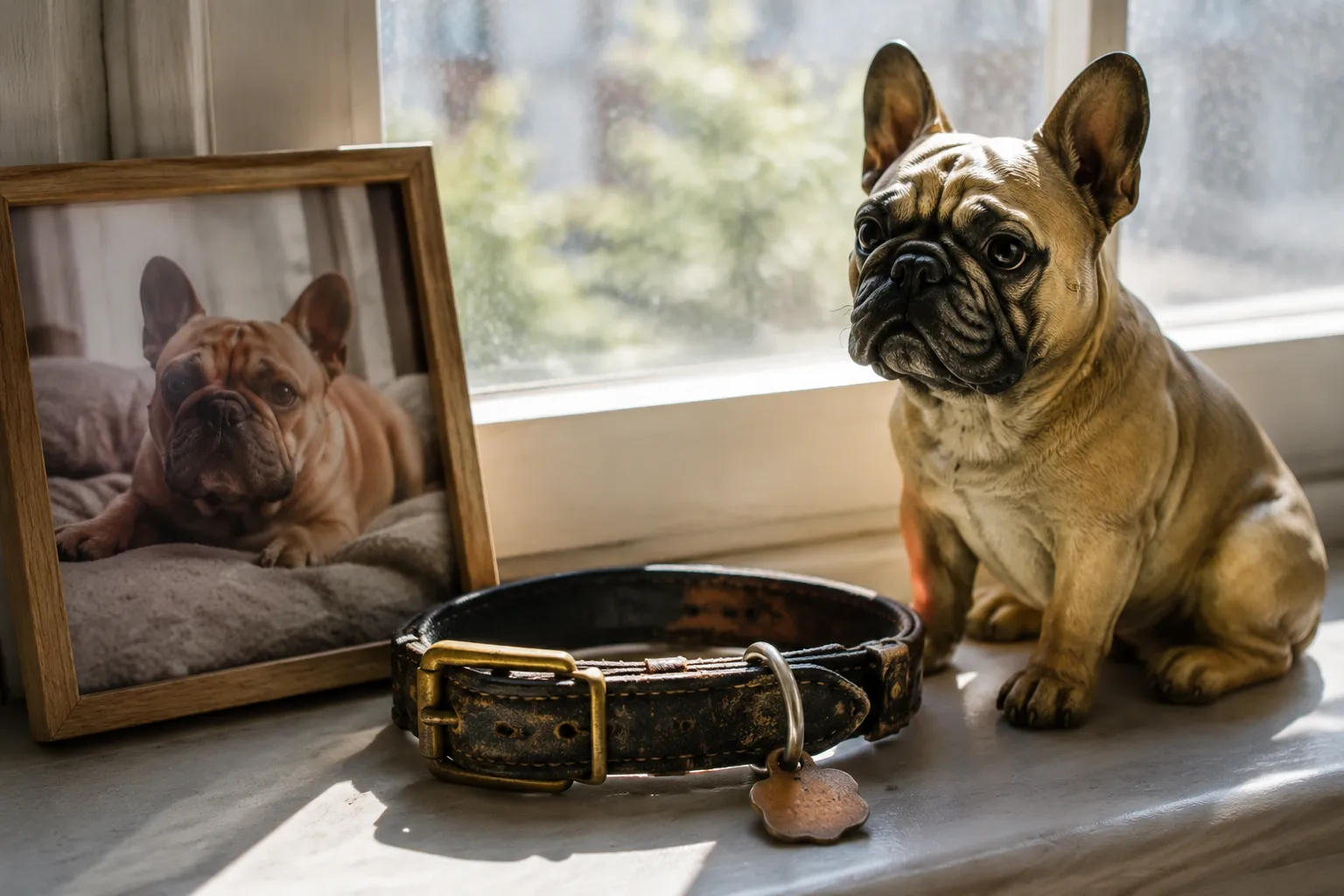
She pressed the worn leather collar against her face at 2 a.m., breathing in what remained—kible dust, city rain, the faint musk of French Bulldog skin folds—and realized she hadn't cried once in the six weeks since Hugo died. The pet collar memorial she didn't know she was creating had just cracked something open.
Quick Takeaways
- Delayed grief after pet loss is not denial — it's your nervous system protecting you until you're ready to feel
- A single physical object can become a grief anchor — collars, leashes, and tags hold scent memory longer than we expect
- The "I should be over this" timeline doesn't exist — sudden pet illness grief operates on its own clock
- Tangible memorials help when words fail — options like custom 3D-printed figurines give grief a physical home
- Relief after loss doesn't cancel love — it's one of the most common and least discussed emotions in pet bereavement
Why We're Not Talking About Delayed Grief in Pet Loss
Most pet grief resources assume linear path: loss happens, sadness follows, healing begins. Neat. Tidy. And for a significant number of pet owners—completely wrong.
Here's what we've observed working with thousands of families memorializing their pets: delayed grief is far more common than immediate, dramatic mourning. Especially with sudden pet illness—the kind where a French Bulldog is snoring on your pilow Tuesday night and gone by Thursday afternoon. The speed of it short-circuits the emotional response.
You function. You clean out the crate. You cancel the auto-ship on their food. People say you're "handling it so well." And you believe them. Until a collar falls out of a coat pocket three months later and you can't breathe.
"Grief doesn't always arrive when you expect it. Sometimes it waits until you find the object that holds the memory."
The counterintuitive insight here—the one you won't find in standard bereavement articles—is this: the delay isn't a malfunction. It's a feature. Your brain triages emotional overwhelm the same way anER triages patients. When loss is sudden and disorienting, your system prioritizes stability. The grief gets filed away, waiting for a moment when you have the bandwidth to process it. That moment often arrives through a physical object.
A collar. A leash clip. The indent on a dog bed that still holds their shape.

The Science of Scent and Memorial Objects in Pet Loss
Let's talk about why that collar matters more than a photograph ever could.
Theolfactory bulb connects directly to the amygdala and hippocampus—the brain regions governing emotion and memory. No other sense has this direct neural pathway. When you press Hugo's collar to your face and catch that particular cocktail of skin oil and driedool, you're not just remembering your dog. You're re-experiencing them at a neurological level.
| Memorial Type | Sensory Engagement | Longevity | Emotional Trigger Strength |
|---|---|---|---|
| Photographs | Visual only | Permanent | Moderate — fades with repeated viewing |
| Collar/Leash | Smell + Touch | 3-12 months (scent fades) | Very High — diminishes over time |
| Paw print cast | Touch + Visual | Permanent | Moderate |
| Custom 3D figurine | Visual + Touch | Permanent | High — captures personality, not just form |
| Fur clipping | Touch + Smell | 6-18 months | High initially, fades |
The problem with scent-based memorials is obvious: they're temporary. That collar will eventually smell like your dreser drawer, not your dog. This is why many families we work with describe a second wave of grief—the day they realize the scent is gone. It's losing them again, smaller but sharper.
What actually helps more than preserving the collar alone is pairing it with a permanent memorial that captures what the scent evokes: the personality, the posture, the specific way your Frenchie tilted their head when confused. The collar becomes the emotional key; the permanent memorial becomes the door it opens.
A Morning Six Months After
Picture this: You wake up, and for three seconds, you listen for the snuffling. The wet, congested breathing of a brachycephalic dog that used to be your alarm clock. Your hand reaches toward the nightstand where collar sits, loped around a small figurine that captures Hugo mid-headtilt, bat ears at full attention. You touch both. The leather, the smooth resin. You breathe. You get up. The grief is there, but it has a home now. It doesn't ambush you in the cereal aisle anymore.
The Emotions Nobody Warns You About After Sudden French Bulldog Loss
French Bulldogs are particularly cruel in how they leave us. The breed's predisposition to respiratory issues, spinal problems, and heat sensitivity means that sudden pet illness grief is disproportionately common among Frenchie owners. One day they're doing their ridiculous frog-leg sprawl on the cool kitchen tile. The next, you're in an emergencyvet's office making decisions no one prepared you for.
And then comes the emotion that makes you feel like a monster.
The Relief You're Not Supposed to Feel
We'll be real: many Frenchie owners carry a specific guilt that other breed owners don't. Because French Bulldogs often struggle—with breathing, with overheating, with the structural consequences of their breeding—there's frequently a thread of worry woven through the entire relationship. You loved Hugo and you worried about Hugo. Constantly.
So when he's gone, mixed into the devastation is something that feels like... relief. Not relief that he's dead. Relief that the vigilance is over. Relief that you won't wake up at 3 a.m. to check if those breathing sounds are normal or an emergency. Relief that the $400 vet visits every few months have stopped.
That relief doesn't make you a bad person. It makes you someone who carried an invisible weight for years and just set it down. The guilt that chases that relief—the voice that says how dare you feel lighter—is one of grief's cruelest tricks. It conflates relief from suffering with relief from love. They're not the same thing.
According to the Association for Pet Loss and Bereavement, this mixture of relief and grief is among the most commonly reported—and least commonly discussed—emotional experiences in pet loss. It thrives in silence. It shrinks when named.
Second-Guessing Every Decision
Here's another one that lives in the dark: regret about decisions made during the crisis. Should you have tried the surgery? Should you have said no to the surgery? Did you wait too long? Did you not wait long enough? Was there a sign last week you missed because you were busy with work?
This spiral is especially vicious with sudden illness because the timeline is compressed. You didn't have months to research and prepare. You had hours. Sometimes minutes. And now your brain—freed from the urgency—replays those hours on an infinite loop, editing the script, inserting choices you didn't make.
The truth that helps (though it doesn't fix): you made decisions with the information you had, under pressure, out of love. Hindsight isn't wisdom. It's a haunting dressed up as clarity.
"You didn't fail your pet in their final hours. You showed up for the hardest shift love ever asks of us."
The Fear of Forgetting
This one creps in later. Weeks or months after loss, when the acute pain has duled to a background hum, a new anxiety surfaces: What if I forget what they looked like? What if I forget the sound? What if their face gets blurry?
This fear is why memorial objects matter so much. Not as decoration. As evidence. Proof that this creature existed, that they looked exactly like this, that their markings fell in this specific pattern and no other.
"Every family we work with says the same thing: 'I'm afraid I'll forget the details.' That fear is love refusing to let go. Our job is to make sure it doesn't have to."
— The PawSculpt Team
It's why a generic bulldog figurine from a gift shop doesn't land the same way. Hugo wasn't generic. He had that one brown patch above his left eye. The slightly croked underbite. The scar on his ear from that incident with the neighbor's cat. The details are the dog.
How a Collar Becomes a Grief Anchor (And Why That's Healthy)
Let's define what we mean by memorial object pet loss anchoring. In grief psychology, anchor object is any physical item that serves as a transitional tool—something that helps you move between the world where your pet existed and the world where they don't. It's not about clinging. It's about having a bridge.
The collar works so well as an anchor because it occupied the liminal space between you and your pet. It touched their body. It touched your hands. It was the point of connection on every walk, everyvet visit, every moment you clipped it on and they knew something was about to happen.
Why "Don't Pack Away That Collar Yet" Is Real Advice
Well-meaning friends and family often encourage tidying away pet belongings quickly. "It'll help you move on," they say. "Out of sight, out of mind."
This is wrong. Or at least, it's wrong for many people, and the timing matters enormously.
Packing away belongings before you've processed the loss doesn't accelerate healing—it buries the grief alive. It removes the anchors before you've used them to cross the bridge. The grief doesn't disappear. It just loses its landmarks and becomes disorienting, formless, harder to navigate.
Here's what we'd suggest instead:
- Keep the collar accessible for as long as you need it — nightstand, hook by the door, wherever feels right
- Notice when you reach for it — these moments are your grief asking to be acknowledged
- When the scent fades, consider what comes next — this is often when families transition to a permanent memorial
- Let the collar's role evolve — it might move from nightstand to memory box to wrapped around a figurine's base over months or years
| Timeline After Loss | Common Collar Behavior | What It Signals |
|---|---|---|
| Week 1-2 | Carrying it, sleeping with it, smelling it frequently | Acute grief seeking sensory connection |
| Month 1-3 | Keeping it visible, touching it daily | Active processing, using anchor regularly |
| Month 3-6 | Reaching for it less, but keeping it accessible | Integration beginning, grief becoming portable |
| Month 6-12 | Finding a "permanent home" for it | Ready for transition to lasting memorial |
| Year 1+ | Paired with other memorial objects or stored with intention | Grief integrated into life narrative |
The key word in that table is intention. There's a difference between a collar shoved in a junk drawer because looking at it hurts and a collar placed deliberately in a memory box or loped around a memorial figurine. One is avoidance. The other is curation.
Building a Memorial That Holds What the Collar Can't
Here's where we get practical. The collar is temporary as a sensory memorial. The scent fades. The leather dries. Eventually, it becomes a symbol rather than a portal. That's natural and okay. But many families tell us they want something that captures what the collar evoked—the living, breathing, snorting, ridiculous reality of their specific dog.
Options Worth Considering
Photo books and framed prints — Accessible, affordable, and immediate. Best for people who process visually. The limitation: they're flat. They capture a moment but not a presence.
Paw print casts or nose print jewelry — Beautiful for what they are. A literal impression. But they capture a body part, not a personality. Hugo's paw print looks like every other Frenchie's paw print.
Memorial garden stones or plantings — Lovely if you have outdoor space and plan to stay in your home. Less portable. Weather-dependent.
Custom 3D-printed figurines — This is where we'll mention what we do at PawSculpt, because it's genuinely relevant here. Our process uses advanced full-color 3D printing technology to reproduce your pet's exact markings, coloring, and personality in resin. The color is printed directly into the material—voxel by voxel—so Hugo's brown patch, his brindle pattern, his specific shade of cream are all captured permanently in the medium itself. A clear coat protects the surface and gives it a subtle sheen. What you get isn't a generic French Bulldog. It's your French Bulldog, in three dimensions, holding space on your shelf the way they held space in your life.
Commissioned paintings or illustrations — Can be stunning. Dependent on finding the right artist. Longer timelines. Higher variability in outcome.
Charity donations in their name — Meaningful but intangible. Works best paired with something physical.
What Makes a Memorial "Work" Psychologically
Not all memorials serve the same function. The ones that help most with delayed grief share three qualities:
- Specificity — They capture what made YOUR pet unique, not the breed in general
- Permanence — They won't fade, degrade, or lose their power over time
- Accessibility — You can see and touch them daily without effort
The collar scores high on accessibility but low on permanence. A garden stone scores high on permanence but low on accessibility (especially in winter, or if you move). A custom figurine—particularly one that captures personality and posture, not just physical form—tends to score high across all three.
The Isolation Problem: When Nobody Gets It
Let's talk about the loneliness.
You lost Hugo six weeks ago. Your coworker lost their grandmother last month. Both losses are real. Both deserve compassion. But when your coworker gets bereavement leave and sympathy cards and caseroles, and you get "So are you going to get another one?"—the isolation compounds the grief.
Feeling judged for the intensity of your grief is one of the most damaging secondary emotions in pet loss. It doesn't just hurt. It teaches you to hide. To perform being fine. To save your tears for 2 a.m. collar-pressing sessions because at least the bedroom doesn't judge you.
This is why community matters. Online forums for pet loss. Breed-specific groups where other Frenchie owners understand the particular cocktail of love and worry that defines the relationship. Even just one friend who gets it—who doesn't say "it was just a dog" or "at least it wasn't a child."
"Grief that has to hide doesn't heal. It hardens."
If you don't have that person in your life, consider:
- Pet loss support hotlines — The ASPCA Pet Loss Hotline and similar resources exist specifically for this
- Online communities — Reddit's r/petloss, breed-specific Facebook groups, and forums where your grief won't be minimized
- Pet loss counselors — Yes, they exist. No, it's not "too much." Therapists who specialize in animal bereavement understand the bond in ways general therapists sometimes don't
The "Just Get Another One" Problem
While we're here: the anxiety about getting another pet deserves its own acknowledgment. People suggest it like it's replacing a phone. "The new one will help you move on!" But you know it's not that simple. The guilt of "replacing" Hugo. The fear of betraying his memory. The terror of loving something that fragile again.
All of it is normal. All of it is common. And none of it needs to be resolved on anyone else's timeline.
A Framework for Moving Through (Not Past) Delayed Grief
We've curated this from what we've observed across years of working with grieving pet families. It's not a prescription. It's a pattern that seems to help.
Phase 1: Let the Anchor Do Its Work (Weeks 1-8)
Keep the collar. Smell it. Hold it. Don't let anyone tell you it's morbid. Your nervous system is using sensory memory to process what your conscious mind isn't ready to face yet. This is healthy. This is the bridge.
Phase 2: Name What You're Actually Feeling (Weeks 4-12)
When the delayed grief finally arrives—and it will, often triggered by the anchor object—resist the urge to categorize it as simple sadness. Get specific. Is it guilt? Relief? Anger at the vet? Anger at the breed's genetics? Fear of forgetting? Jealousy when you see someone else's Frenchie at the park?
Name it. Write it down if that helps. The naming takes away its power to ambush you.
Phase 3: Transition from Temporary to Permanent (Months 3-12)
This is when many families begin thinking about lasting memorials. The collar's scent is fading. The acute grief has shifted into something more like a deepache. You're ready to create something that will hold the memory permanently—not because you're "moving on" but because you're building a lasting home for the love.
This might be when you explore options like a custom pet figurine from PawSculpt—something digitally sculpted by artists who study your photos and capture the specific posture, expression, and markings that made Hugo Hugo. The full-color resin holds those details permanently, in three dimensions, in a way that a flat photograph or a generic breed figurine never could.
Or it might be a different memorial entirely. The point isn't what you choose. It's that you choose it intentionally, when you're ready, as an act of love rather than an act of erasure.
Phase 4: Integration (Ongoing)
Grief doesn't end. It integrates. Hugo becomes part of your story rather than the crisis at the center of it. The collar finds its permanent place—maybe in a shadow box, maybe wrapped around the base of a figurine, maybe in a memory chest with his favorite toy and that ridiculous sweater he hated.
You still miss him. You always will. But the missing has a shape now. It has landmarks. It has a home.
| Phase | Primary Need | Helpful Actions | What to Avoid |
|---|---|---|---|
| 1: Anchor | Sensory connection | Keep collar accessible, allow scent-seeking | Packing everything away prematurely |
| 2: Naming | Emotional honesty | Journal, talk to someone who gets it, be specific | Performing "fine" for others |
| 3: Transition | Permanence | Research lasting memorials, choose intentionally | Rushing into decisions or avoiding them entirely |
| 4: Integration | Meaning-making | Create rituals, share stories, let joy coexist with grief | Believing you should be "over it" |
What Hugo's Owner Did Next
We worked with a woman—let's call her Mara—who came to us eight months after losing her French Bulldog to a sudden respiratory crisis. She'd kept his collar on her nightstand the entire time. She told us she'd been "fine" for the first six weeks. Functional. Busy. Then one night she picked up the collar and realized she could barely smell him anymore, and everything she'd been holding back arrived at once.
"It was like the collar was the dam," she said. "And when the scent started going, the dam broke."
By the time she reached out to us, she was in Phase 3. Ready for something permanent. She sent photos of Hugo—mid-yawn, ears back, that specific Frenchie expression that's somehow both dignified and absurd. Our digital sculptors worked from those images to capture him in full-color resin, every brindle stripe and wrinkle rendered directly in the material through our3D printing process.
When the figurine arrived, she placed it on the nightstand. Loped the collar around its base. Sent us a photo with a note that said: "He has a home now. And so does my grief."
That's what a memorial object does at its best. Not replace. Not fix. Not erase. Just... hold.
The Counterintuitive Truth About Pet Collar Memorials
Here's the thing nobody tells you, the insight buried beneath all the well-meaning advice about "letting go" and "finding closure": You don't need closure. You need a container.
Closure implies an ending. A door shut. A chapter finished. But love doesn't close. It transforms. What you need isn't an ending—it's a vessel. Something that holds the love in a form you can live alongside. The collar is the first vessel. Temporary, scent-based, intimate. The permanent memorial—whatever form it takes—is the vessel that lasts.
The woman in the bedroom at 2 a.m., pressing leather to her face, isn't stuck. She's beginning. The collar is doing exactly what it's supposed to do: anchoring her grief in something real, something she can touch, something that smells like the creature she loved. When that scent fades, she'll be ready for what comes next. Not because the grief is over. Because it finally has somewhere to live.
And that—honestly—is enough.
Frequently Asked Questions
How long does delayed grief after pet loss typically last?
There's no universal timeline, which is both frustrating and freing. Delayed grief can surface anywhere from a few weeks to over a year after loss. The trigger is usually sensory—a scent, a sound, a found object. Once it arrives, the active processing period varies enormously based on your support system, the circumstances of the loss, and whether you allow yourself to feel it or push it back down. The grief itself doesn't "end" so much as it integrates into your life at a manageable volume.
Is it normal to feel relief after a French Bulldog passes away?
Completely normal, and far more common than people admit. French Bulldogs often require intensive health monitoring—breathing checks, temperature management, frequent vet visits. The relief you feel isn't about wanting them gone. It's your nervous system releasing years of accumulated vigilance. That relief and deep love coexist. They're not contradictions.
What should I do with my pet's collar after they die?
Keep it wherever feels right for as long as it serves you. Nightstand, coat hook, wrapped around your wrist—there's no wrong answer. The collar functions as a grief anchor, providing sensory connection during early mourning. As the scent naturally fades (typically 3-12 months), many people transition the collar into a permanent memorial display—a shadow box, a memory shelf, or paired with a lasting kepsake like a figurine.
How do I memorialize my pet when photos don't feel like enough?
Photos capture moments but not presence. If you're craving something more dimensional, consider options that occupy physical space: custom figurines that capture their specific posture and markings, shadow boxes combining their collar and favorite toy, memorial garden stones, or commissioned artwork. The key is choosing something that captures their personality—not just their appearance.
Why did my pet grief hit me weeks or months after the loss?
Your brain has a built-in triage system. When loss is sudden—especially with acute illness—your nervous system prioritizes survival and functioning over emotional processing. The grief gets qued. It surfaces later, often when triggered by a physical object or sensory memory, because your system has determined you now have the capacity to handle it. This isn't denial. It's neurological self-protection.
Is it too much to see a therapist for pet loss?
Not even slightly. Pet loss counselors exist because this grief is real, significant, and often unsuported by social networks that minimize animal bonds. If your grief is affecting your sleep, work, relationships, or daily functioning—or if you simply need a space where no one will say "it was just a dog"—professional support is entirely appropriate.
Ready to Honor Hugo's Memory?
Some grief needs a permanent home. If you've been holding onto a collar, a leash, a worn blanket—waiting for the right way to preserve what those objects represent—a custom figurine might be the vessel your love has been looking for. PawSculpt's full-color 3D printing captures the exact markings, posture, and personality of your pet in lasting resin, creating a pet collar memorial companion that holds space on your shelf the way they held space in your heart.
Visit pawsculpt.com to explore the process, see examples, and learn how our team brings your pet's likeness to life