
Walk Their Route This Season: A Stoic Framework for Families Accepting a Border Collie's Unexplained Loss
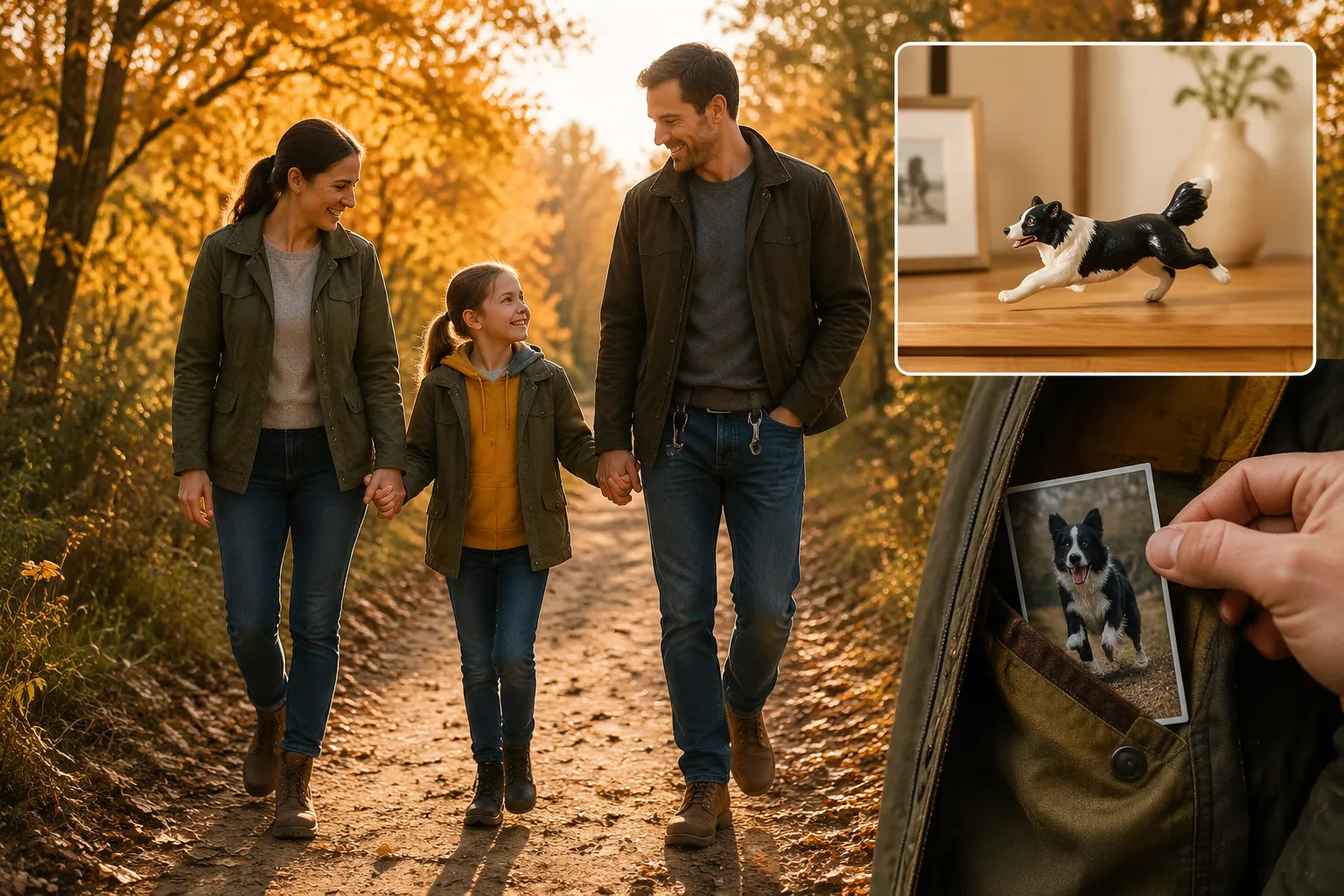
"He who has a why to live can bear almost any how." — Friedrich Nietzsche
The smell of wet grass hit her before anything else. Standing in the garden where her Border Collie used to herd the children in wide, joyful arcs, she realized the route they walked every morning still existed—even though he didn't. Border Colie loss without explanation is a particular kind of devastation, because the mind keeps circling back to a question that has no answer.
Quick Takeaways
- Walking your pet's familiar route is a Stoic practice — it transforms avoidance into active acceptance within days
- Unexplained pet death grief hits differently — the absence of a "why" creates a loop that specific frameworks can interrupt
- Families grieve as a system, not as individuals — one person's coping can accidentally silence another's pain
- A tangible anchor accelerates acceptance — physical objects like custom pet figurines give grief somewhere to land
- Stoic grief isn't about suppressing emotion — it's about choosing which thoughts you feed and which you release
The Angle Nobody Talks About: Grief Without a Diagnosis
Here's what most pet loss articles won't tell you: unexplained death is its own category of grief. It doesn't follow the same trajectory as losing a pet to cancer, old age, or an accident. When Border Collie—a breed known for intelligence, vitality, and almost supernatural awareness—dies without clear cause, the family doesn't just grieve the dog. They grieve the story they'll never get to tell.
We've worked with hundreds of families at PawSculpt who lost pets suddenly. The ones who struggle longest aren't always those who lost pets to prolonged illness. It's the ones who say, "We don't even know what happened." That uncertainty becomes a splinter under the skin.
Most grief resources assume you know what took your pet. They offer timelines based on anticipated loss versus sudden loss. But unexplained pet death grief sits in a third space—sudden, yes, but also permanently unresolved. You can't process what you can't name.
"Grief without answers isn't weaker grief. It's grief doing double duty—mourning the loss and the mystery simultaneously."
This article isn't about the five stages. It's about a specific framework—roted in Stoic philosophy—that gives families a physical, repeatable practice for moving through the particular hell of not knowing why.

Why Border Collies Leave a Specific Shape of Absence
Let's be direct about something. Border Collies don't just live in your house. They organize it. They manage the rhythm of your mornings, the pace of your walks, the emotional temperature of your rooms. When a Golden Retriever dies, you lose a companion. When a Border Collie dies, you lose the conductor of your daily orchestra.
This isn't breed snobbery. It's behavioral reality. The American Kennel Club notes that Border Collies are among the most intelligent and work-driven breeds, forming intense bonds with their families and often self-assigning roles within the household. That intelligence means they're woven into your routines at a level most breeds aren't.
So when they're gone—especially without warning—the absence has texture. It smells like the spot on the couch where their fur collected. It sounds like the click of nails that doesn't come at6 AM. It feels like the phantom weight against your leg while you're cooking.
The Specific Grief of "No Reason"
Here's the counterintuitive insight most people miss: having a reason for your pet's death is actually a grief resource. It gives your brain a narrative endpoint. "She had cancer. We did everything we could. It was her time." That's a complete sentence your mind can file away.
Without that sentence, your brain keeps the file open. Indefinitely. You replay the last48 hours. You Google symptoms at 2 AM. You wonder if the food was wrong, the yard was toxic, the vet missed something. This isn't neurosis—it's your brain doing exactly what it's designed to do: seek cause and effect.
| Grief Type | Brain's Response | Common Duration of "Searching" Phase | What Helps |
|---|---|---|---|
| Anticipated loss (illness) | Narrative closure available | 2-4 weeks | Remembering care given |
| Sudden explained loss (accident) | Cause identified, anger possible | 4-8 weeks | Processing the shock |
| Unexplained loss | No closure available, loop continues | 8-16+ weeks | Framework + physical anchors |
| Euthanasia decision | Closure mixed with guilt | 6-12 weeks | Validating the choice |
That third row is where most families reading this live. And it's where Stoic philosophy becomes not just comforting—but genuinely functional.
The Stoic Grief Framework: What It Actually Is (and Isn't)
Let's bust some myths first, because "Stoic" gets misused constantly.
Myth vs. Reality
Myth 1: Stoicism means suppressing your emotions.
Reality: The Stoics wrote extensively about grief, tears, and love. Marcus Aurelius wept for his children. Seneca wrote entire letters about the pain of loss. Stoicism isn't about feeling nothing—it's about choosing your relationship to what you feel. You can hold grief without letting grief hold you hostage.
Myth 2: "Just accept it" means giving up.
Reality: Stoic acceptance is active, not passive. It's the difference between collapsing in a doorway and walking through it. Acceptance in this framework means: "I acknowledge this happened. I cannot change it. I choose where to direct my energy now." That's not resignation. That's the hardest kind of strength.
Myth 3: A framework means following steps in order.
Reality: This isn't a recipe. It's a set of tools you pick up when you need them. Some days you'll use all of them. Some days you'll only manage one. The framework holds space for both.
The Three Pillars Applied to Pet Loss
The Stoic framework for grief rests on three principles, and each one maps directly onto the experience of losing a Border Collie without explanation:
1. The Dichotomy of Control
What you can control: how you honor them, what you do with your mornings now, how you support your family.
What you cannot control: why they died, whether vet could have caught something, whether you "should have known."
2. Amor Fati (Love of Fate)
This doesn't mean loving that your dog died. It means accepting that your life—including this loss—is yours. The walks you took, the years you had, the mystery of their leaving. All of it is the fabric of your story. You don't have to love the thread to accept the tapestry.
3. Memento Mori (Remember Death)
Not as morbidity, but as gratitude. Every morning your Border Collie woke you up was borrowed time. Not because something was wrong—but because all time with anyone we love is borrowed. This reframe doesn't erase pain. But it can transform "why was it taken from me?" into "how extraordinary that it was given at all."
"The route still exists. The morning still comes. You get to decide what you carry on the walk."
Walking Their Route: The Physical Practice
Here's where philosophy meets pavement. Walking meditation grief isn't a metaphor in this framework. It's literal. And it works for reasons that are both Stoic and neurological.
Why the Same Route Matters
Your Border Colie's walk wasn't just exercise. It was ritual. It was the smell of the neighbor's jasmine at the corner, the spot where they always paused to investigate, the stretch of sidewalk where they'd look back at you as if to say, "Keep up."
When you walk that route without them, your brain does something remarkable: it expects them. And in that expectation—that gap between what your nervous system anticipates and what actually exists—there's a space for integration. Psychologists call this "updating the internal model." Stoics would call it practicing the truth.
The Practice, Week by Week
Week 1-2: Walk with intention, not avoidance.
Most families avoid the route. It hurts too much. But avoidance tells your brain the route is dangerous—that the memories there are threats. Walking it deliberately, even for five minutes, tells your brain: "This is sad, but I can survive it."
Bring something that smells like them if you can. A bandana. A collar. The scent anchors you in reality rather than abstraction.
Week 3-4: Walk with attention.
Notice what's still there. The tree they marked. The garden where they'd freeze in a herding stance at the neighbor's cat. Let yourself smile at these. Stoic practice isn't about eliminating joy from memory—it's about holding joy and sorrow in the same hand.
Week 5-6: Walk with someone.
Invite a family member. Walk in silence or talk—either works. The point is shared presence on the route. Grief in families often becomes isolated because everyone's protecting everyone else. Walking together breaks that pattern without requiring anyone to perform vulnerability.
Week 7+: Walk with purpose.
By now, the route has shifted from "their walk" to "our walk that includes their memory." This is where some families begin to notice they're not just surviving the walk—they're choosing it. That's acceptance. Not the absence of pain, but the presence of choice.
"We've noticed that families who create a physical ritual—walking a route, placing a figurine in a specific spot, tending a garden—move through unexplained loss with more steadiness than those who try to think their way through it alone."
— The PawSculpt Team
What to Do When the Walk Breaks You
Some days, you'll round the corner where they used to sprint ahead, and the smell of rain on warm concrete will hit you, and you'll lose it completely. That's not failure. That's the practice working.
The Stoic response isn't to push through. It's to pause. Acknowledge: "This is grief. It is here. It will move." Then decide—continue or turn back. Both are valid. The only wrong choice is never walking the route again.
The Emotions Nobody Warns You About
Here's where we get honest about something the pet loss community often glosses over.
The Guilt of Not Knowing
When a Border Collie dies without explanation, guilt doesn't just show up—it moves in. It unpacks its bags. It sets up camp in every quiet moment.
"Did I miss something? Was there a sign I ignored? Should I have taken them to the vet that Tuesday when they seemed slightly off?"
This guilt is almost universal among families we've worked with. And here's what makes it particularly cruel: there's no way to resolve it. With a diagnosed illness, you can trace the timeline. You can say, "We caught it as early as possible" or "The treatment gave us three more months." Without a diagnosis, the guilt has infinite room to grow because it's feeding on imagination, not facts.
The Stoic reframe: You made decisions with the information you had. Not the information you wish you'd had. Not the information that exists somewhere in a parallel universe where you're omniscient. The information that was actually available to you, a human being who loved their dog and was doing their best.
That's not a platitude. It's a logical truth. And sometimes logic is the only thing that can interrupt a guilt spiral.
The Relief You're Ashamed Of
We'll be real about this one because almost nobody else will.
Some Border Collies—especially aging ones or those with behavioral challenges—required enormous energy. The constant mental stimulation. The anxiety management. The 5 AM demands. If your Border Collie was struggling in ways you couldn't fix, you might have felt a flicker of relief when they passed. And then immediate, crushing shame.
That relief doesn't mean you didn't love them. It means you were exhausted. It means caregiving was hard. It means you're human. The guilt that follows that relief is one of grief's cruelest tricks—it takes your compassion (relief that their struggle ended) and repackages it as evidence of your failure (you must not have loved them enough).
Name it. Say it out loud to someone safe. "I feel relieved and I feel terrible about feeling relieved." Watch how the shame loses power when it's spoken.
The Fear of Forgetting
This one creps in later—usually around month two or three. You realize you can't quite remember the exact pitch of their bark. The specific weight of their head on your knee. The particular smell of their ears after a nap (that warm, slightly corn-chip scent that every dog owner knows but nobody talks about).
The fear of forgetting is why tangible memorials matter so much. Not as commercial products—as cognitive anchors. A photo on your phone is abstract. Something you can hold, something with dimension and weight presence in a room—that's different. It occupies physical space the way your dog occupied physical space.
This is where families often turn to memorial objects. Some plant a tree. Some keep the collar on a hook by the door. Some commission a custom 3D-printed figurine that captures their Border Collie's specific markings—the particular tilt of the head, the one ear that never quite stood straight. The point isn't what you choose. The point is choosing something that exists in three dimensions, something your hands can find when your memory starts to blur.
| Memorial Type | Sensory Engagement | Longevity | Best For |
|---|---|---|---|
| Photo album/digital | Visual only | Decades (if backed up) | Preserving specific moments |
| Planted tree/garden | Visual, smell, touch | Lifetime+ | Families who need living growth |
| Paw print casting | Touch, visual | Decades | Immediate post-loss (done atvet) |
| Custom figurine (3D printed) | Visual, touch, spatial presence | Decades (UV-resistant resin) | Capturing personality + physical likeness |
| Jewelry/wearable | Touch, constant presence | Years | Those who need daily connection |
| Commissioned art | Visual | Decades | Artistic families, wall display |
Families Grieve as a System: The Part Everyone Gets Wrong
Here's something that surprised us after years of working with grieving families: the family member who seems "fine" is often the one struggling most.
In a household that's lost a Border Collie, grief doesn't distribute evenly. One person cries openly. Another goes quiet. A child might act out. A teenager might seem indifferent. And the family—without meaning to—assigns roles. The crier becomes the "designated griever." The quiet one becomes the "strong one." The child gets told they'll "understand when they're older."
This is where the Stoic framework for families becomes essential. Because Stoicism isn't about individual endurance—it was always communal philosophy. Marcus Aurelius wrote his meditations while leading an empire full of grieving people. The practice was never meant to be done alone.
A Framework for Family Grief
Step 1: Name the absence together.
Sit down—at the kitchen table, in the garden, wherever feels right—and let each person say one thing they miss. Not a eulogy. One specific thing. "I miss the sound of her drinking water at night." "I miss how she'd herd me away from the stove." Specificity prevents performance. It keeps grief honest.
Step 2: Assign no roles.
Nobody has to be strong. Nobody has to be the one who "handles it." If Dad cries at dinner, that's not a crisis—it's a Tuesday. Normalize the randomness of grief waves. They don't follow schedules.
Step 3: Create one shared ritual.
The walk is ideal for this. But it could also be lighting a candle at dinner. Saying the dog's name before a meal. Placing a figurine on the mantle and letting it be a conversation starter rather than a conversationender. The ritual gives grief a container so it doesn't flood every moment.
Step 4: Allow different timelines.
Your eight-year-old might seem "over it" in two weeks and then collapse at month three when they realize the dog won't be at their birthday. Your partner might grieve silently for a year. The Stoic principle here: you cannot control another person's grief timeline. You can only control your response to it—which should be patience, not judgment.
When Children Ask "Why Did They Die?"
With unexplained loss, this question has no satisfying answer. And children—especially those who grew up with a Border Collie's constant, organizing presence—deserve honesty.
"We don't know why. Sometimes that happens, and it's okay to feel frustrated about not knowing. What we do know is that [dog's name] had a good life with us, and we're allowed to be sad and happy about that at the same time."
That's Stoic parenting in one paragraph. Acknowledge the unknown. Validate the emotion Offer the dual truth.
The Counterintuitive Power of Routine After Loss
Here's what most grief guides get backwards: they tell you to "be gentle with yourself" and "take time off from normal life." And look, sometimes you need a day in bed. But for family pet loss acceptance, especially with a breed as routine-driven as a Border Collie, the fastest path through isn't away from routine—it's through a modified version of it.
Your Border Collie structured your mornings. Without them, the morning becomes a void. And voids get filled—usually with scrolling, avoidance, or that particular brand of restless anxiety that comes from a body expecting movement it isn't getting.
The Stoic approach: keep the container, change the contents.
- Same wake-up time. Different first activity.
- Same walk route. Different pace (slower, more deliberate).
- Same feeding time... but now it's your breakfast, eaten mindfully at the table instead of standing at the counter while filling a bowl.
This isn't about "replacing" the dog. It's about honoring the architecture they built in your life by not letting it collapse entirely. The structure was a gift. Keep it.
The 6 AM Problem
Every Border Collie owner knows 6 AM. That's when the staring begins. The nose in your face. The "we have places to be" energy that no alarm clock can match.
After they're gone, 6 AM becomes the loneliest minute of the day. Your body wakes expecting that weight on the bed, that insistent presence. And instead: nothing. The smell of empty sheets where fur used to gather.
The practice: get up anyway. Not because you have to. Because choosing to rise at the time they taught you to rise is an act of love, not obligation. Make coffee. Step into the garden. Feel the cold air they used to charge into with such ridiculous enthusiasm. Stand there for sixty seconds and breathe.
That's the walk before the walk. That's Stoic grief in its simplest form: showing up for the life that remains.
What "Acceptance" Actually Looks Like (It's Not What You Think)
Acceptance isn't a destination. It's not the moment you stop crying. It's not the day you can say their name without your throatightening. It's not "moving on."
Acceptance is the first morning you walk their route and notice something new. A flower that wasn't bloming last week. A neighbor's new puppy. The way the light hits the fence differently in this season. Acceptance is your attention expanding beyond the absence to include the present again.
It doesn't mean the absence shrinks. It means the present grows large enough to hold both.
For families dealing with unexplained pet death grief, acceptance has an additional layer: accepting that you will never know why. This is perhaps the hardest Stoic practice of all—releasing the need for answer that doesn't exist. Not because the question doesn't matter, but because the question has become a cage.
You can honor your Border Collie's memory without solving the mystery of their death. Those are two separate things, and grief often welds them together until you can't tell which one you're actually pursuing at2 AM on Google.
Signs You're Moving Toward Acceptance
- You tell a funny story about them without immediately feeling guilty for laughing
- You notice their absence without it ruining the next three hours
- You can look at photos and feel warmth before (or alongside) sadness
- You stop rehearsing what you "should have done"
- You consider—even briefly—that your life will contain joy again
- You walk the route because you want to, not because you're forcing yourself
None of these mean you're "over it." They mean you're integrating the loss into a life that continues. That's all acceptance ever is.
Creating Anchors: Why Physical Objects Matter in Stoic Grief
The Stoics weren't minimalists in the way people assume. They valued objects that served purpose. A soldier's sword. A philosopher's journal. A family's hearth. The key was intentionality—owning things that meant something, not accumulating things that meant nothing.
A memorial object for your Border Collie serves a Stoic purpose: it gives grief a location. Instead of grief being everywhere—in every room, every routine, every silence—it has a home. You can visit it deliberately. You can hold it when you need to. And you can set it down when you need to do something else.
This is why flat memorials (photos, digital tributes) work differently than dimensional ones. A photo lives behind glass. A figurine—something that captures the specific tilt of your Border Collie's head, the way their fur pattern broke across their chest, the particular stance they took when they were about to bolt after squirrel—that occupies space the way they occupied space.
We've seen families place a memorial pet figurine on the windowsill where their dog used to watch the street. Not as a replacement. As a marker. A way of saying: "You were here. You mattered. This spot is still yours."
The full-color resin captures details that paintings often miss—the exact gradient of a merle coat, the specific brown of those intense Border Collie eyes. Because the color is printed directly into the material (not painted on top), it doesn't fade or chip the way traditional memorials can. It just... stays Quietly present. Like the memory itself.
The Season Matters: Why Walking Now Is Different
There's a reason this article says "this season." Grief is not season-agnostic. The smell of autumn—decomposing leaves, wood smoke, that particular crispness—triggers different memories than summer's cut grass or spring's mud.
Walking your Border Collie's route in the current season means encountering the version of that route they knew at this time of year. The garden they investigated October smells different than it did in June. The light falls at different angle. The neighbors are doing different things in their yards.
This specificity matters because grief lives in sensory details, not abstractions. You don't grieve "your dog" in general. You grieve the specific dog who rolled in that specific pile of leaves on that specific corner last November. Walking the route now—in this season, with this weather, at this temperature—is the most precise form of remembering available to you.
And precision, in Stoic practice, is everything. Vague grief is unmanageable. Specific grief can be held.
Frequently Asked Questions
How long does grief last after an unexplained pet death?
There's no universal timeline, but we'll be honest: unexplained loss tends to extend the acute grief phase compared to losses where the cause is known. Most families describe the intense, daily-disruption phase lasting 8-16 weeks, with grief waves continuing at decreasing frequency for months or even years. The "searching" phase—where your brain keeps trying to find the reason—is what extends things. The Stoic framework helps interrupt that loop, but it doesn't eliminate it overnight.
Is it normal to feel guilty when your pet dies suddenly without explanation?
Completely normal. Nearly every family we've worked with reports guilt as their dominant emotion in the first weeks. Your brain is wired to find cause and effect—when it can't find an external cause, it turns inward and asks, "What did I miss?" This isn't evidence that you failed. It's evidence that your brain is working exactly as designed, just without the data it needs.
How do I help my child cope with our Border Collie's sudden death?
Honesty is the foundation. Tell them you don't know why it happened, and that not knowing is frustrating for everyone. Include them in whatever memorial rituals you create—the walk, the candle, the figurine placement. Let them lead sometimes. And expect their grief to surface in unexpected moments, weeks or months later, often triggered by seasonal changes or milestones the dog would have been present for.
What is a Stoic approach to pet loss?
It's not about being emotionless. A Stoic grief framework focuses on three things: distinguishing what you can control from what you can't, accepting reality as it is (not as you wish it were), and directing your energy toward meaningful action rather than circular thinking. In practice, this looks like walking the route instead of avoiding it, creating rituals instead of waiting for grief to "pass," and allowing yourself to feel everything without letting any single feeling become your identity.
Should I walk my deceased pet's route or avoid it?
Walk it. Avoidance feels protective but actually reinforces your brain's belief that the memories are dangerous. Walking meditation grief works because it gives your nervous system real-time evidence that you can encounter the absence and survive it. Start small—even five minutes. Bring something that smells like them. And give yourself permission to turn back on days when it's too much.
How can a memorial figurine help with pet grief?
Three-dimensional objects serve a specific psychological function: they give grief a physical location. Instead of the loss being everywhere, it has a home—a shelf, a windowsill, a garden spot. Holding something that captures your pet's likeness provides sensory grounding during acute grief waves. It's not about replacement. It's about having something your hands can find when your memory starts to feel unreliable.
Ready to Honor Your Border Collie's Memory?
Some losses don't come with explanations. But they all deserve to be honored with intention. Whether your Border Collie left last week or last year, their presence shaped your family in ways that deserve more than a photo on your phone. A custom PawSculpt figurine captures the details that made them irreplaceable—the specific markings, the characteristic stance, the personality that no generic memorial could hold.
For families navigating Border Collie loss and unexplained pet death grief, having something tangible to anchor your Stoic grief framework makes the practice real. Something to hold on the hard mornings. Something to place on the windowsill where they used to watch the world.
Visit pawsculpt.com to learn more about our process and guarantees