
Don't Let Tonight Pass Without Sitting in Your Labrador's Spot: A Stoic Practice for Delayed Grief During Crisis
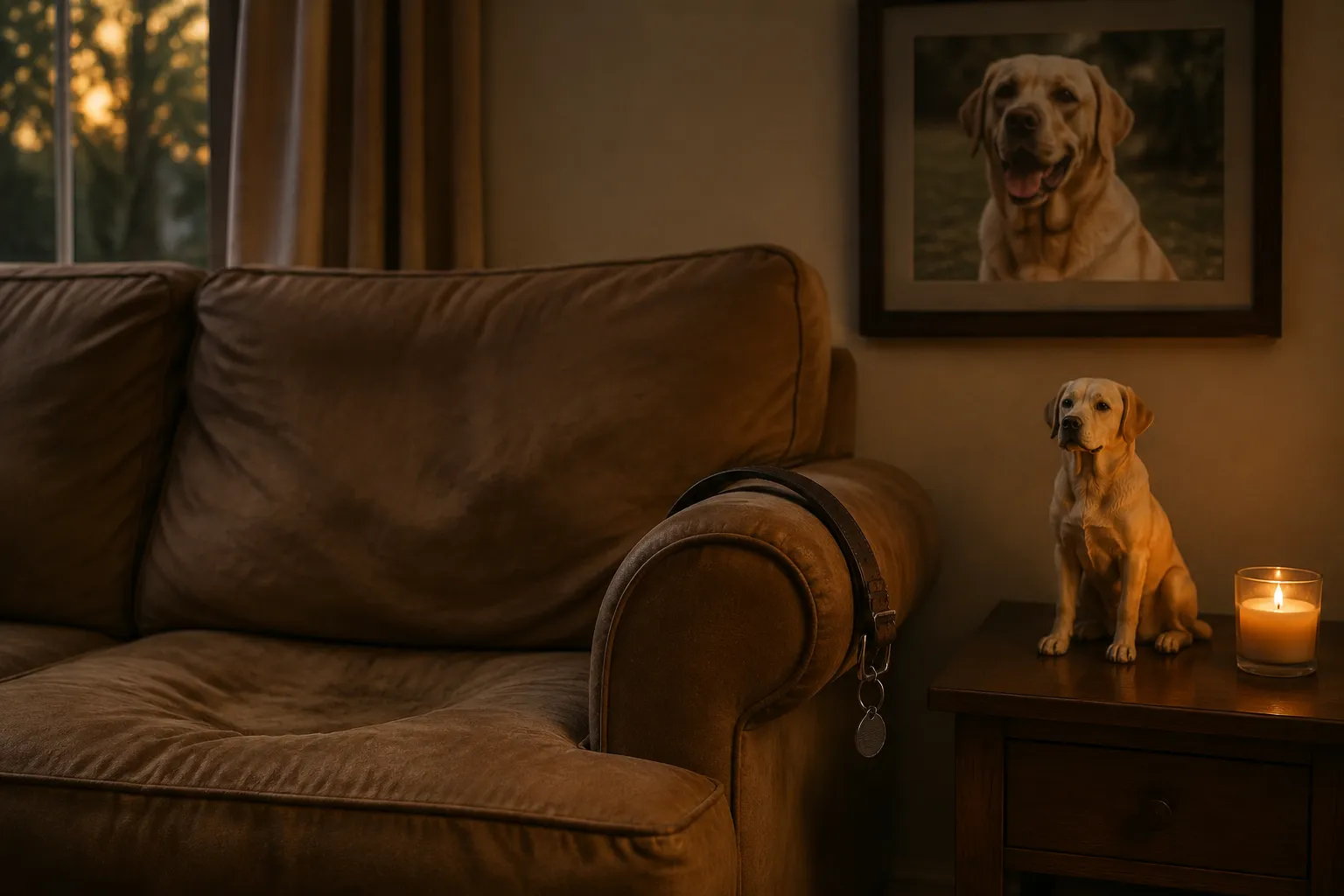
You're sitting on the couch, and the cushion beside you still holds the faint depression where seventy pounds of Labrador used to settle each evening—that warm, corn-chip smell of paw pads lingering in the fabric like a question you haven't answered yet. Delayed pet grief doesn't announce itself. It waits, sometimes months, until a crisis passes and your body finally has bandwidth to feel what it deferred.
Quick Takeaways
- Delayed grief is a neurological strategy, not avoidance — your brain triages survival over mourning during crisis periods
- The Stoic "premeditatio" practice adapts powerfully for pet loss — sitting deliberately in their space reactivates stalled grief processing
- Physical anchors outperform mental ones — smell and texture trigger memory consolidation faster than photographs alone
- A tangible memorial like a custom pet figurine can serve as a grief anchor — giving delayed emotions a fixed point of return
- Tonight matters more than "someday" — the 72-hour window after grief recognition is when ritual has the most neurological impact
The Neuroscience of Grief That Arrives Late
Here's what most pet loss resources won't tell you: delayed grief after losing a Labrador isn't a failure of emotional processing. It's your nervous system making a calculated trade.
When you lose a pet during a life crisis—a job loss, a move, a family emergency, a global pandemic—your prefrontal cortex essentially puts grief in a queue. The amygdala flags the loss as significant, but cortisol flooding from the active crisis suppresses the full mourning response. Your body choses function over feeling.
The problem? That queue doesn't empty itself.
Research from the American Veterinary Medical Association confirms that pet bereavement can mirror the intensity of human loss, yet society rarely grants it the same timeline or legitimacy. When you add delay to that equation, you get something uniquely disorienting: grief that surfaces when everything else in your life has supposedly "gotten better."
| Grief Type | Onset | Duration | Common Trigger | Misdiagnosed As |
|---|---|---|---|---|
| Acute grief | Immediate | 2-8 weeks intense | The loss itself | Depression |
| Delayed grief | Weeks to months later | Variable, often longer | Crisis resolution | Anxiety, burnout |
| Anticipatory grief | Before death | Days to months | Terminal diagnosis | Emotional withdrawal |
| Complicated grief | 6+ months, no integration | Indefinite without intervention | Traumatic circumstances | Clinical depression |
Most Labrador owners we've worked with at PawSculpt who order memorials months or even years after their dog's passing describe the same pattern: they were "fine" until they weren't. The crisis ended. The adrenaline dropped. And suddenly, reaching for a leash that isn't there anymore became unbearable.
Why Labradors Specifically Trigger Delayed Patterns
This isn't breed favoritism—it's behavioral architecture. Labradors embed themselves into daily routines more thoroughly than most breeds. They're retrievers by nature, which means they're participators. They don't observe your life from a dog bed in the corner. They carry your slippers. They press against your leg while you cook. They position themselves as connective tissue between your morning and your evening.
When that connective tissue disappears during a crisis, you don't notice the absence because the crisis fills the structural gap. Your mornings are chaotic for different reasons. Your evenings are consumed by different urgencies.
Then the crisis resolves. And the architecture of your day reveals its missing load-bearing wall.
"Grief doesn't expire. It waits in the body until the body is safe enough to feel it."

The Stoic Framework You Haven't Considered
Marcus Aurelius didn't have a Labrador (as far as we know). But the Stoic practice of premeditatio malorum—the deliberate contemplation of loss—contains a mechanism that maps almost perfectly onto delayed grief processing.
The original practice works like this: you sit quietly and imagine losing something precious before it happens, not to create anxiety, but to metabolize the emotional weight in manageable doses. It's inoculation through imagination.
Here's the counterintuitive adaptation for delayed pet grief: you reverse the timeline. Instead of imagining future loss, you deliberately sit with past loss that your body never fully processed. You don't imagine what it would feel like. You finally let yourself feel what it did feel like.
And the most effective physical anchor for this practice? Your Labrador's spot.
The Protocol: What "Sitting in Their Spot" Actually Means
This isn't metaphorical. This is a concrete, timed practice:
- Choose the spot deliberately. Not their bed (too obvious, too prepared-for). Choose the couch indent, the kitchen floor tile where they waited for scraps, the patch of carpet by the front door where they watched you leave.
- Sit there for exactly seven minutes. Not five (too easy to dismiss), not twenty (too easy to dissociate). Seven minutes is the threshold where your nervous system shifts from resistance to reception.
- Breathe through your nose. This matters more than you'd think. Olfactory processing is the fastest pathway to the hippocampus, where episodic memories live. If the spot still carries any trace of their scent—that particular Labrador musk of lake water and warm grain—your nose will find it before your conscious mind does.
- Don't narate. Don't tell yourself a story about what you're feeling. Don't journal Don't explain it to anyone. Just sit in the architecture of their absence and let your body do what it's been waiting to do.
- When the seven minutes end, stand up and do one physical task. Wash a dish. Fold a towel. This grounds you back in the present without dismissing what just surfaced.
Personal Aside: Our team debated whether to include specific timing in this protocol. Some of us felt prescriptive. But honestly? Every grieving pet owner we've spoken to says the same thing—they needed permission AND structure. "Just sit with your feelings" is useless advice. "Sit in this spot for seven minutes tonight" is something you can actually do.
Why Tonight, Not "Someday"
The title of this piece isn't hyperbole. There's a neurological window that matters here.
When delayed grief finally surfaces—when you first recognize that theightness in your chest isn't stress but mourning—your brain enters a brief state of reconsolidation readiness. The memory network associated with your Labrador becomes temporarily malleable. This is the same mechanism that makes EMDR therapy effective for trauma: you access the memory during a window of plasticity, and the emotional charge can finally integrate rather than loop.
That window is roughly 48-72 hours from the moment of recognition.
If you read this article and felt something shift—a tightening, a prickle behind your eyes, a sudden vivid image of golden fur—your window may be open right now. Tonight matters because tomorrow you might re-armor. The crisis-brain that protected you for months knows how to reassert itself.
The Emotions Nobody Warns You About
Let's talk about what actually surfaces when you sit in that spot. Because it won't be clean sadness. It won't be the photogenic grief you see in pet loss forums.
The Relief You're Ashamed Of
Here's the one that keeps people up at night: you felt relieved when they died.
Maybe your Lab was old. Maybe the last months involved carrying them outside, cleaning up accidents, administering medications they hated. Maybe the financial strain of veterinary care during an already-difficult period made you feel trapped between love and logistics.
That wave of relief when their suffering ended—and yours—doesn't make you a monster. It makes you someone who was carrying an unsustainable weight and whose body registered the lifting of it before your heart could catch up.
The guilt that follows relief is one of grief's cruelest mechanisms. It creates a loop: you feel relief, then guilt about the relief, then shame about the guilt, then numbness to escape the shame. And numbness looks a lot like "being fine." Which is how grief gets delayed in the first place.
The Stoic reframe: Relief and love are not opposites. You can be relieved that suffering ended because you loved them. The relief is evidence of compassion, not its absence.
The Anger That Has No Target
Delayed grief often surfaces as irritability first. You snap at your partner. You're impatient in traffic. You feel a low-grade rage that doesn't attach to anything specific.
Then one evening you realize: you're angry at your Labrador for dying during the worst possible time. For not waiting until you could properly fall apart. For leaving you to grieve in installments between crises.
This is normal. This is so normal it's almost universal among people processing delayed pet loss. Anger at the dead is one of grief's most taboo emotions, and it's also one of its most necessary ones. Anger means you haven't yet accepted the loss as final. It means some part of you still believes the situation is negotiable.
The seven-minute practice gives anger a container. You sit in their spot, and if rage comes, you let it exist for seven minutes. It won't destroy you. It won't make you a bad person. It will pass through, and something softer will be underneath it.
"The emotions you won't name are the ones that run your life from the basement."
Second-Guessing the Timeline
Did you wait too long? Did you not wait long enough? Should you have tried that one more treatment? Should you have let go soner?
Second-guessing euthanasia timing is perhaps the most isolating form of pet grief guilt, because you can't talk about it without someone either reassuring you too quickly ("You did the right thing!") or accidentally confirming your fear ("Well, some people do wait too long...").
Here's what we'll say plainly: you made the best decision you could with the information and emotional capacity you had at that moment. You were likely in crisis. You were likely exhausted. You were likely making that decision while simultaneously managing other emergencies that demanded your attention.
The Stoic practice here isn't about resolving the question. It's about sitting with the uncertainty without needing to resolve it. Some questions don't have answers. They have acceptance.
| Emotion | What It Feels Like | What It Actually Means | What Helps |
|---|---|---|---|
| Relief | Lightness, then immediate guilt | You were carrying unsustainable weight | Name it without judgment |
| Anger | Irritability, restlessness | You haven't accepted the finality | Give it a container (the 7-min practice) |
| Second-guessing | Obsessive replaying of decisions | You're seeking control over the uncontrollable | Accept uncertainty as its own answer |
| Fear of forgetting | Panic when you can't recall details | Memory is shifting from active to archival | Create physical anchors |
| Guilt about moving on | Resistance to joy | You equate suffering with loyalty | Redefine loyalty as living well |
Physical Anchors: Why Objects Outperform Memories
Here's the counterintuitive insight that most grief resources miss entirely: your memory of your Labrador will degrade, and that's not a failure—it's biology.
Episodic memory (the kind that stores specific moments) naturally consolidates and compresses over time. The vivid, sensory-rich memory of your Lab's wet nose pressing against your palm at 6 AM will, within18-24 months, flatten into a general sense of "morning routine with dog." The specific smell, the exact pressure, the temperature of their breath—these details fade not because you loved them less, but because your hippocampus is doing its job of archiving.
This is why physical anchors matter more than people realize. Not as sentimental objects, but as neurological tools.
The Hierarchy of Grief Anchors
Not all memorial objects function equally for delayed grief processing. Here's what actually works, ranked by neurological effectiveness:
Tier 1: Olfactory anchors (highest impact)
- Their collar (unwashed)
- A blanket they slept on
- The spot itself (carpet, couch fabric)
Tier 2: Tactile anchors
- A cast of their paw print
- Their favorite toy (the texture matters more than the visual)
- A three-dimensional representation that you can hold—something with weight and dimension that your hands can map
Tier 3: Visual anchors
- Photographs
- Videos
- Flat artwork or illustrations
The reason Tier 1 outperforms everything else is anatomical: olfactory signals bypass the thalamus and route directly to the amygdala and hippocampus. Smell doesn't get filtered through rational processing. It arrives raw.
But smell fades. Collars air out. Blankets get washed or stored. The spot on the couch eventually loses its scent signature.
This is where Tier 2 becomes critical for long-term grief integration. A three-dimensional object—something with mass, with texture, with the specific proportions of your dog—gives your hands something to return to when smell is gone and photographs feel flat.
"We've watched families pick up their figurine and immediately run their thumb along the ears. The hands remember what the eyes forget."
— The PawSculpt Team
At PawSculpt, we've noticed that orders placed months or years after a pet's passing often come with the most detailed photo submissions and the most specific revision requests. These aren't impulse purchases. They're grief finally finding its anchor point. The full-color 3D printing process captures details—the exact brindle pattern, the one ear that always flopped differently, the specific way their tail curled—that photographs flatten but your hands remember in three dimensions.
Building Your Anchor Kit
You don't need to choose one object. In fact, a multi-sensory anchor kit works better for delayed grief because different senses activate on different days:
- Seal their collar in a ziplock bag tonight. The scent will preserve for months this way. Open it only during your seven-minute practice.
- Photograph their spot before you rearrange furniture or clean the cushion. You'll want the visual reference later.
- Choose or commission one three-dimensional object that captures their specific physical presence. Not a generic Labrador. Your Labrador, with their particular markings and posture.
- Save one voicemail or video where you can hear yourself talking to them. Your voice changes when you speak to your dog. That vocal register is its own anchor.
The Crisis-Grief Intersection: A Timeline Nobody Gives You
Most grief timelines assume a clean starting point: pet dies, grief begins. But delayed grief during crisis follows a completely different trajectory. Here's what actually happens:
Weeks 1-4 after loss (during active crisis):
- Minimal grief symptoms
- Occasional sharp pangs, quickly suppressed
- Functional numbness that feels like "handling it well"
- Others may comment on how "strong" you're being
Months 1-6 (crisis ongoing or resolving):
- Grief surfaces as physical symptoms: insomnia, appetite changes, unexplained fatigue
- You attribute these to the crisis, not the loss
- Avoidance behaviors develop (not walking past the pet store, changing your route)
- You may feel disconnected from other pet owners or avoid conversations about animals
The Recognition Moment (variable timing):
- A trigger breaks through: a similar-looking dog, a seasonal smell, finding a toy behind furniture
- Sudden, disproportionate emotional response
- Confusion: "Why am I crying about this NOW?"
- This is your window. This is when the seven-minute practice matters most.
Weeks 1-8 after recognition:
- Grief arrives with full intensity, often feeling "fresh"
- Others may not understand why you're grieving "so late"
- Feeling judged by others becomes a significant secondary stressor
- Integration begins if you allow the process rather than re-suppressing
The Judgment Problem
Let's address this directly: people will not understand why you're falling apart over a dog that died eight months ago. They'll say things like "I thought you were over that" or "It's been a while, hasn't it?" or—worst of all—"It was just a dog."
This isolation is one of the most damaging aspects of delayed pet grief. You're not only mourning your Labrador. You're mourning alone, out of sync with anyone else's timeline of when grief is "appropriate."
The Stoic response isn't to seek validation. It's to recognize that your grief operates on its own clock, and that clock is correct. You don't owe anyone an explanation for why tonight—months after the fact—you need to sit in your dog's spot on the couch and let yourself feel what you deferred.
Practical Architecture: Building the Nightly Practice
Enough theory. Here's how to build this into your actual life, starting tonight.
The Minimum Viable Ritual
You need three things:
- A location (their spot—not yours, theirs)
- A timer (set for seven minutes, use a gentle alarm tone)
- A transition object (something to hold: their collar, a toy, a figurine, even a photograph if that's all you have)
That's it. No candles. No music. No guided meditation. The Stoic tradition is deliberately spare. You're not creating an experience. You're removing the barriers between yourself and an emotion that's been waiting.
Frequency and Duration
| Week | Frequency | What to Expect |
|---|---|---|
| Week 1 | Every night | Resistance, then breakthrough. Possibly tears, possibly anger, possibly nothing. All valid. |
| Week 2 | Every night | Emotions become more specific. Less "sad" and more "I miss the sound of their nails on the kitchen floor." |
| Weeks 3-4 | 4-5 nights per week | Integration begins. The practice feels less like opening a wound and more like visiting a familiar place. |
| Month 2+ | 2-3 times per week, then as needed | The practice becomes a choice rather than a necessity. You'll know when you don't need it nightly anymore. |
What "Done" Looks Like
You're not trying to stop grieving. You're trying to move grief from the basement to the living room—from a force that operates on you unconsciously to something you can sit with deliberately.
You'll know the practice is working when:
- You can think about your Labrador without your chest tightening
- You can tell a story about them without your voice breaking (or you can let it break without shame)
- You can encounter another Lab on the street and feel warmth instead of only pain
- The spot on the couch becomes a place of connection rather than avoidance
This doesn't mean you stop missing them. It means the missing becomes integrated into your life rather than interrupting it.
Beyond the Spot: Extending the Practice
Once nightly ritual establishes itself, you can extend the Stoic framework into other areas of delayed grief processing.
The Morning Acknowledgment
Before your feet hit the floor each morning, take three seconds to acknowledge: They're not here. I notice that. I'm continuing anyway. This isn't wallowing. It's the Stoic practice of seeing reality clearly rather than constructing elaborate avoidance architectures around it.
The Object Rotation
If you've built anchor kit, rotate which object you hold during the seven-minute practice. Different objects activate different memory networks:
- The collar brings back walks—the pull of the leash, the smell of rain on wet fur, the particular rhythm of their gait
- A toy brings back play—the sound of squeaking, the weight of a retrieved ball dropped in your lap
- A custom figurine brings back presence—the specific way they held their body, the tilt of their head, the proportions that made them uniquely themselves rather than generically "Labrador"
Each rotation prevents habituation. Your nervous system stops responding to repeated identical stimuli, so varying the sensory input keeps the practice effective over weeks and months.
The Conversation Practice
This one feels strange, but it works: during your seven minutes, talk to them. Out loud. Not in your head—out loud.
Say what you didn't get to say. Say what you've been carrying. Say "I'm sorry I couldn't fall apart when you left because everything else was falling apart too." Say "I'm here now."
The Stoics wrote letters to the dead. Marcus Aurelius addressed his deceased teachers in his Meditations. There's nothing mystical about this. You're giving language to emotions that have been stored as body sensations, and language is how the prefrontal cortex integrates what the amygdala has been holding.
When Delayed Grief Becomes Complicated Grief
A necessary distinction: delayed grief that surfaces and processes—even painfully—is healthy. It's your system catching up. But sometimes delayed grief calcifies into something that doesn't move.
Signs that you may need professional support:
- The seven-minute practice consistently triggers dissociation (going blank, losing time) rather than emotion
- Six months after recognition, the grief hasn't shifted in quality or intensity at all
- You're unable to function in daily life (missing work, unable to eat, unable to sleep for weeks)
- You're experiencing intrusive thoughts about harming yourself
- The grief has attached to a belief that you're fundamentally bad or undeserving of love
If any of these resonate, a therapist specializing in grief—particularly one familiar with pet bereavement—can help. The Association for Pet Loss and Bereavement maintains a directory of qualified professionals. This isn't weakness. It's the same logic as seeing a doctor for a bone that didn't set properly: delayed grief that calcifies needs professional intervention to re-break and heal correctly.
"A memorial isn't about the past. It's about giving your future self permission to remember."
The Labrador-Shaped Hole in Your Evening
Here's what nobody tells you about Labradors specifically: they don't just occupy space. They occupy transitions.
They greet you at the door—that's the transition from outside-world-self to home-self. They settle beside you on the couch—that's the transition from doing to resting. They follow you to bed—that's the transition from day to night. They're there when you wake—that's the transition from sleep to waking life.
When a Labrador dies, you don't just lose a companion. You lose your transitional object. Every threshold in your day becomes unmarked, unwitnessed. You walk through doors that nobody celebrates you for opening.
The Stoic grief practice of sitting in their spot addresses this directly. It re-marks one transition—the evening one, the settling-in—with deliberate attention. You're not replacing them. You're acknowledging the threshold they used to guard.
And over time, you become your own witness. You learn to mark your own transitions. Not because you've "moved on" (a phrase that deserves to be retired permanently) but because you've integrated their absence into the architecture of your days rather than building around it.
Tonight, when the house settles and the evening stretches ahead of you, don't sit in your usual spot. Sit in theirs. Set the timer. Hold something that carries their weight or their scent or their shape.
Seven minutes. That's all. Your Labrador gave you years of unquestioning presence. You can give their memory seven minutes of yours.
The grief that's been waiting in your body—deferred by crisis, suppressed by necessity, delayed by the sheer logistics of surviving—it's ready when you are. And the spot is still warm enough, if you sit in it tonight, to feel like something close to coming home.
The smell of them—corn chips and lake water and sun-warmed fur—it's fading from that cushion a little more each day. Don't let tonight pass without breathing it in one more time. Your delayed pet grief deserves this specific, deliberate, Stoic act of attention. Not someday. Tonight.
Frequently Asked Questions
What is delayed pet grief and why does it happen?
Delayed pet grief occurs when your nervous system suppresses the full mourning response because you're simultaneously managing another crisis—a job loss, health emergency, move, or family upheaval. Your brain prioritizes survival over processing, queuing the grief for later. It surfaces when the crisis resolves and your body finally has the capacity to feel what it deferred. This isn't avoidance or emotional failure. It's a protective mechanism.
Is it normal to suddenly start grieving my Labrador months after they passed?
Completely normal, and more common than most people realize. The recognition moment—when grief finally breaks through—often feels confusing because it seems "too late." But grief doesn't operate on social timelines. Your nervous system processes loss on its own schedule, and that schedule is valid regardless of what the calendar says.
How does sitting in my pet's spot actually help with grief?
The practice works on multiple levels. Physically, you're placing your body in a space saturated with sensory memories (scent, texture, spatial orientation). Neurologically, you're accessing the memory network during a window of reconsolidation readiness, allowing emotional integration. Psychologically, you're giving yourself structured permission to feel what you've been deferring—with a clear beginning and end point that prevents overwhelm.
Why do I feel guilty about feeling relieved when my pet died?
Relief after witnessing suffering end is a compassion response. Your body registered the lifting of an unsustainable caregiving weight before your conscious mind could process it. The guilt that follows is grief's cruelest trick—it makes you believe that relief and love are opposites. They're not. You felt relieved because you loved them enough to be pained by their suffering.
What physical objects help most with processing delayed pet grief?
Olfactory anchors (unwashed collars, blankets) have the highest neurological impact because smell bypasses rational processing and routes directly to memory centers. However, scent fades. Three-dimensional tactile objects—paw casts, custom figurines that capture your specific pet's proportions and markings—provide lasting anchors that your hands can return to long after scent has dissipated. The key is having objects that engage multiple senses, not just sight.
When should I seek professional help for pet grief?
If your grief consistently triggers dissociation rather than emotion during processing attempts, if it hasn't shifted in quality or intensity after six months of active work, if you're unable to maintain daily functioning, or if you're experiencing thoughts of self-harm, professional support is warranted. The Association for Pet Loss and Bereavement maintains directories of qualified grief therapists who specialize in human-animal bond loss.
Ready to Honor Your Labrador's Memory?
Some grief needs anchor—something tangible that holds space for a love that outlasts presence. Whether your Labrador crossed the rainbow bridge last month or last year, a custom PawSculpt figurine captures the specific details that made them irreplaceable: the exact tilt of their head, the pattern of their coat, the posture that was theirs alone. For those navigating Stoic grief practice and Labrador loss, having a three-dimensional anchor to hold during those seven-minute sessions transforms abstract mourning into embodied remembrance.
Visit pawsculpt.com to explore the process, see examples, and learn how our team brings your pet's likeness to life through full-color 3D printing