
Capturing the 'Head Tilt': How to Trigger Your Pug's Most Iconic Expression
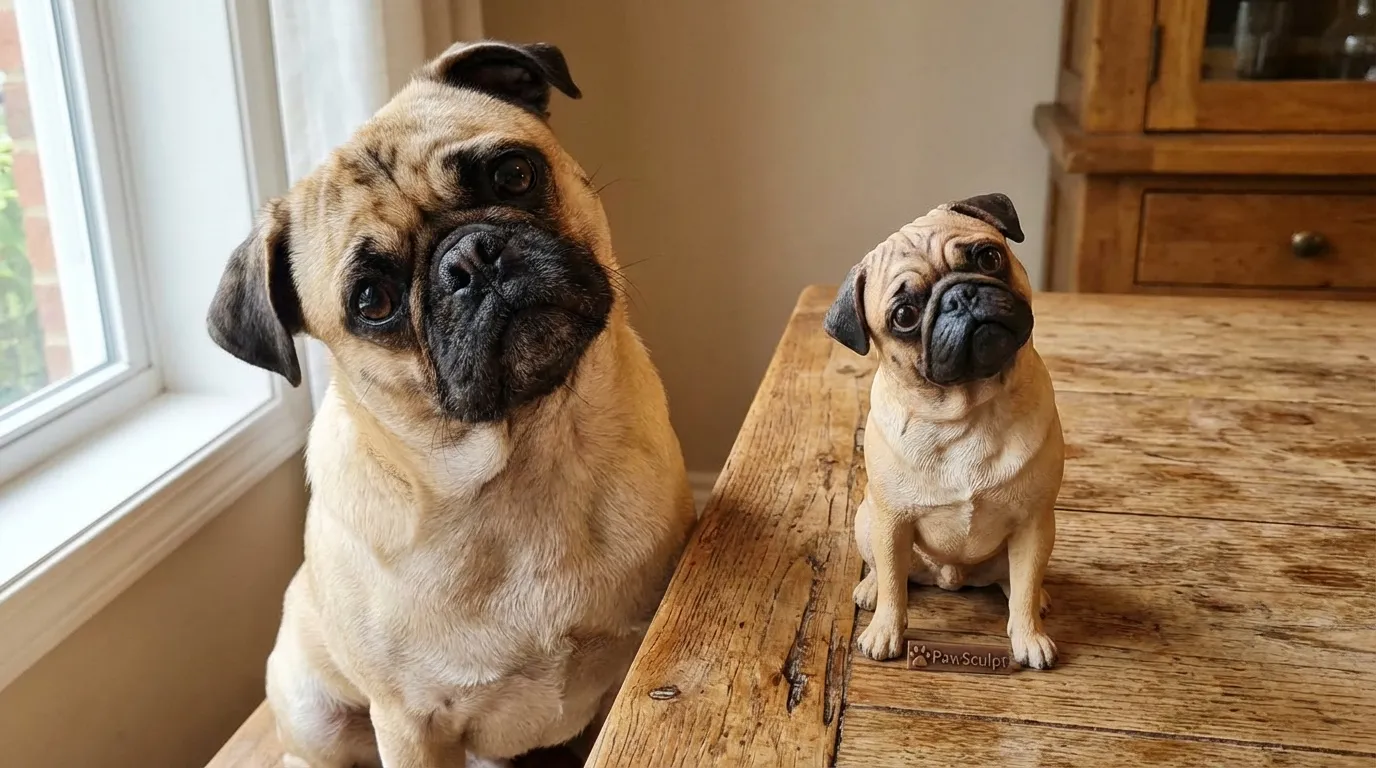
The squeak of a rubber chicken echoes strangely against the concrete walls of my basement, followed immediately by the click-click-click of nails on the floorboards above. I’m holding a bag of crinkly treats in one hand and a camera in the other, frozen like a statue, waiting for that split-second mechanical adjustment of a Pug’s neck that signals total confusion.
Quick Takeaways
- Sound novelty fades fast — you have about three attempts before a noise loses its "head tilt" potency.
- Elevation changes perspective — photographing from your Pug's eye level (or lower) exaggerates the tilt.
- The "High-Pitch/Low-Pitch" combo — alternating vocal tones triggers curiosity better than a single sound.
- Preserve the moment forever — once you capture the perfect photo, turn it into a custom 3D figurine to keep that expression on your desk permanently.
The Mechanics of the Tilt
Let’s get straight to the biology because understanding why your Pug tilts their head is the key to triggering it on command. It’s not just them trying to be cute for Instagram.
Pugs have brachycephalic (flat) faces. While this gives them their signature look, it also obstructs their vision. That muzzle, however short, still blocks the lower part of their visual field. When you make a weird noise or speak to them, they tilt their head to adjust their ears for better sound localization, but more importantly, to move their muzzle out of the way so they can clearly see your mouth.
They are trying to read your facial expressions.
Here is the practical application of this fact: If you want a massive head tilt, you need to be a visual puzzle, not just an auditory one. Standing still and making a noise works okay. But crouching down, widening your eyes, and making a noise while slightly obscuring your mouth? That forces the dog to tilt to get a better look at the source of the communication.
"A head tilt isn't just a pose; it's your dog saying, 'I am listening with my entire body.'"
The Auditory Trigger List (Ranked by Effectiveness)
Most people fail to capture the tilt because they use the same sound too often. Pugs are smart; once they identify a sound as "neutral" or "irrelevant," they stop reacting. You need a rotation of novel sounds.
I’ve tested dozens of audio triggers. Here is what actually works, ranked by reliability:
| Trigger Type | Specific Sound | Why It Works | Success Rate |
|---|---|---|---|
| The Synthetic | Crumpling a plastic water bottle | High-frequency crackle mimics small prey | 9/10 |
| The Digital | YouTube video of other dogs whining | Triggers intense social curiosity | 8/10 |
| The Vocal | A sharp, rising "Huuuh?" whistle | Mimics excited human speech patterns | 7/10 |
| The Mechanical | Doorbell recording on phone | conditioned response to visitors | 6/10 |
| The Physical | Scratching a textured wall/carpet | mimicking movement behind a barrier | 5/10 |
The Counterintuitive Insight: The word "Treat" is actually a bad trigger for a head tilt. Why? Because "Treat" usually triggers excitement and forward motion. The dog runs toward you. You don't want motion; you want stationary curiosity. You want the dog to think, "What is that?" not "Gimme that!"
Setting the Stage: The 3-Step Setup
You cannot chase a Pug around the living room expecting a studio-quality shot. You need to control the environment. If you want the shot that captures their personality perfectly—perhaps to use as a reference for a custom figurine—you need to prep the space first.
1. The Lighting Trap
Do not use flash. Flash flattens the image and causes "green eye" in dogs. Position your Pug facing a large window. You should be between the window and the dog, but slightly to the side so you don't block the light. The catchlights (white reflection) in their eyes are what make the expression look alive.2. The Elevation Hack
Get off your feet. I cannot stress this enough. If you shoot from a standing position, you get a picture of the top of your dog's head. You need to be belly-down on the floor.Pro Tip: If your knees can't handle the floor, put the Pug up on a table or sofa (with a handler nearby for safety). The lens of the camera must be exactly parallel to the dog's eyes.
3. The "bait and Switch"
Hold a high-value treat near the camera lens to get their focus, but do not give it to them yet. Pull the treat back toward your forehead. This draws their eyes up. As soon as their gaze locks, hide the treat and immediately make your novel sound.The "Soundboard" Method
If you are shooting alone, you don't have enough hands to hold the camera, the treats, and make the noises. This is where technology helps.
Download a simple soundboard app on your phone. Load it with:
- Squeaky toy sounds
- Cat meows
- Doorbell chimes
- Ducks quacking
Set your phone on the floor right next to the camera lens. This ensures the dog looks directly at the camera when the sound plays. If you make the noise with your mouth, they look at your face. If you hold a squeaker in your left hand, they look to the left. You want them looking down the barrel of the lens.
Troubleshooting the "Bored Pug"
Pugs have a notoriously short attention span. If you have tried for 5 minutes and haven't gotten the shot, stop.
The Mistake: Repeating the noise louder.
The Fix: Change the context entirely.
If the dog is bored, pick them up, spin them around gently, or run to a different room. Reset their brain. A Pug that is bored looks sad in photos, not inquisitive. The head tilt requires a state of "alert processing."
"You can't manufacture curiosity. You have to surprise it out of them."
Capturing the Moment for Posterity
Once you have that perfect photo—the one where the tilt is almost 90 degrees, the wrinkles are bunched up, and the eyes are wide—you have a decision to make. It can live in your camera roll, buried under screenshots and food pics, or it can become something tangible.
We see thousands of pet photos at PawSculpt. The ones that translate best into physical art are the ones with strong silhouettes. A Pug sitting straight up is a rectangle. A Pug with a deep head tilt has dynamic geometry.
When our digital artists sculpt a model for 3D printing, that tilt changes everything. It adds movement to a static object. Because we use full-color 3D printing technology, we can replicate the specific shading of your Pug's mask and the way the light hits those forehead wrinkles during the tilt. It’s not just a generic dog statue; it’s your dog's specific reaction to a specific moment.
Frequently Asked Questions
Why do Pugs tilt their heads more than other breeds?
It is largely physical. Because Pugs have flat faces (brachycephalic), their muzzle—short as it is—still obstructs the lower part of their vision. When they look at you, tilting their head moves that muzzle out of the way so they can clearly see your mouth and read your expression.At what age do Pugs start tilting their heads?
You will typically see the first tilts around 8 to 10 weeks of age. This coincides with the development of their distance hearing and their increasing interest in social interaction. The behavior often peaks in young adulthood when their energy and curiosity are at their highest levels.Does a head tilt ever indicate a medical problem?
Yes, and this is important. A "cute" head tilt is a reaction to a sound or sight. A "medical" head tilt is persistent. If your Pug holds their head to the side constantly, walks in circles, stumbles, or has eyes that dart back and forth (nystagmus), this is not a photo op. It could be an ear infection or vestibular disease. Consult a veterinarian immediately.How can I get my Pug to hold the pose longer?
You generally cannot, and you shouldn't try. The head tilt is a micro-expression of curiosity. Once they figure out what the sound is, the tilt stops. Use "burst mode" or "Live Photo" on your phone to capture the split second it happens.Ready to Celebrate Your Pet?
Every pet has a story worth preserving. Whether you're honoring a beloved companion who's crossed the rainbow bridge or celebrating your furry friend's unique personality, a custom PawSculpt figurine captures those details that make your pet one-of-a-kind.
Free instant AI preview • 3D artist preview within 7 days • 5 free revisions