The Ultimate Guide to Sizing a Great Dane Figurine: 5 Pitfalls, 3 Details Worth It
'Just make him life-size,' the email said. In the photo, her Great Dane stood knee-deep in surf, ears pinned flat by the wind. That one line kicks off the trickiest conversation in great dane figurine sizing, and it's the one nobody warns you about.
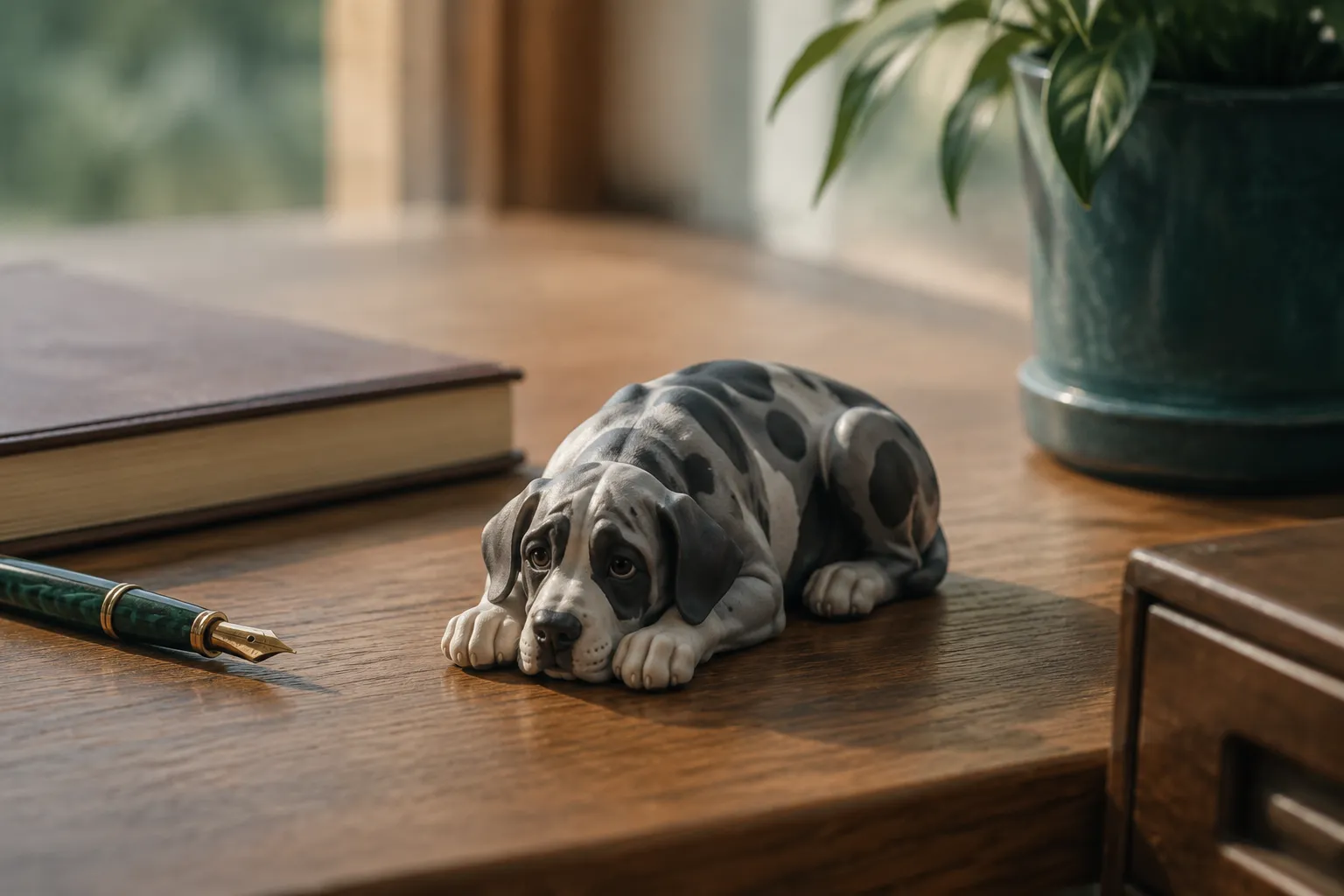
When sizing a Great Dane figurine, a 6-to-9-inch model in true breed proportion beats a scaled-down "life-size" copy every time. At that height, a full-color resin 3D print holds fine detail, survives a knock off a shelf, and reads instantly as your dog. Bigger scale means thinner legs, higher fragility, and steeper cost with little gain in likeness.
Quick Takeaways
- Don't chase life-size — a 6–9 inch figurine reads as your Dane and survives real shelves.
- Legs and tail are the weak points — big breeds need engineered thickness, not literal scaling.
- A three-quarter angle photo beats ten random shots for capturing that giant-breed posture.
- Full-color 3D printing bakes color into the resin — no fading paint layer to chip off later.
- Match the piece to your pet's character with a custom pet sculpture, not a shrunken photocopy.
Why "Life-Size" Is the First Trap in Great Dane Figurine Sizing
Here's the thing about giant breeds: our brains already store them at maximum volume. You don't need a two-foot figurine to feel the weight of a Great Dane. You need proportion.
We've had this exact back-and-forth dozens of times. A family sends a photo of a 140-pound gentle giant and asks for something "that really shows how big he was." Totally understandable. But scale and impact aren't the same thing.
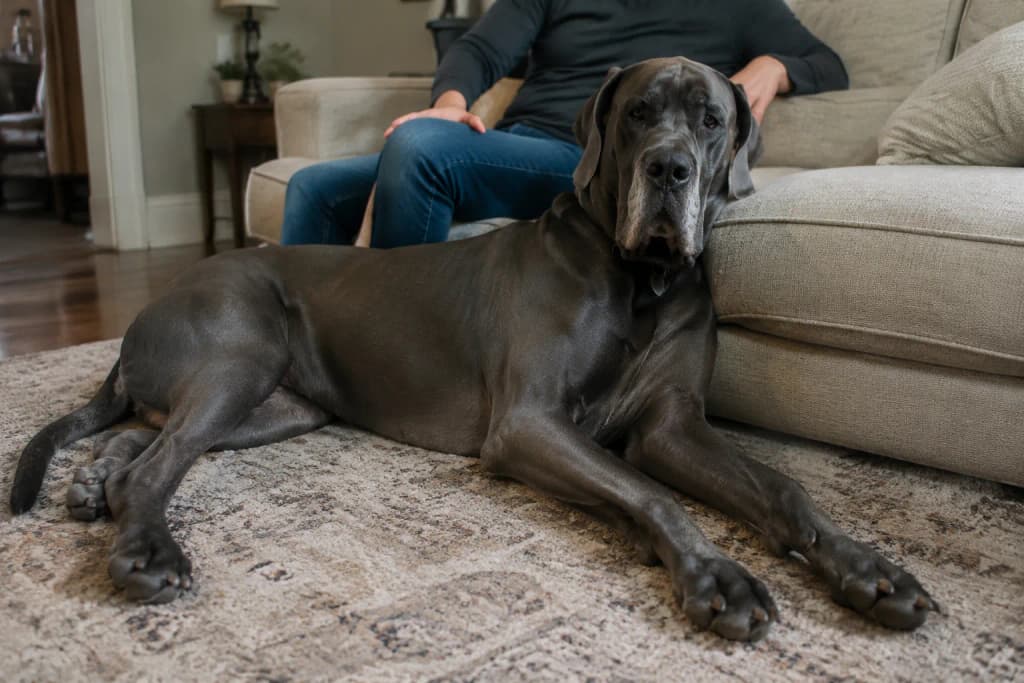
A Great Dane's whole visual signature lives in ratios. The long, slightly bowed neck. The deep chest that drops well below the elbow. Those legs that look almost too thin for the frame (the AKC breed standard describes a squarish, powerful build with real elegance up top). Nail the ratios at 7 inches and people gasp. Miss them at 18 inches and it just looks like a big, generic dog.
So the counterintuitive part: shrinking a dog "to scale" often makes it look less like itself. The features that say "Dane" get muddy when everything scales down uniformly. A good sculpt exaggerates the read-at-a-glance cues instead of copying millimeters.
"A Great Dane isn't big because of its size. It's big because of its proportions. Get the neck-to-chest ratio right and a 7-inch figure feels enormous."
The scale most people actually end up loving
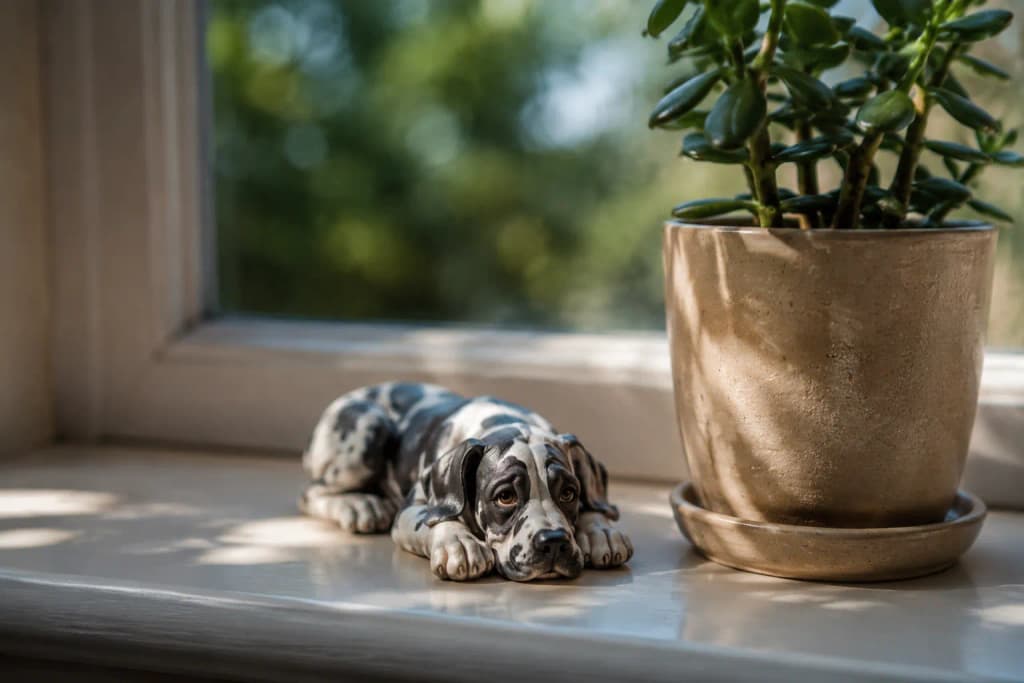
If we look at where large-breed orders land after the preview stage, the sweet spot is consistently in the 6-to-10-inch range for a standing pose. It's tall enough to command a shelf, small enough to keep the legs sturdy, and it fits the places people actually display these: a mantel, a desk, a windowsill next to the leash hook.
Sighthound and giant-breed owners tend to overshoot on their first guess, then walk it back once they hold a printed sample. That's normal. You're not alone if your gut says "bigger." Most of us start there.
The 5 Pitfalls of Large Breed Custom Figurine Sizing
These are the mistakes we see most often, roughly in order of how much they'll bite you.
Pitfall 1: Scaling the legs literally
A Great Dane's legs are proportionally slim on the real animal. Scale that down to figurine size and you get spindly resin sticks that snap the first time the piece tips over. UV-cured photopolymer resin is strong but brittle — it doesn't bend, it cracks.
A practitioner doesn't copy the leg thickness. We quietly beef up the ankles and pastern (the "wrist" area above the paw) by a fraction of a millimeter so the silhouette still reads correct but the load path can survive a bump. You won't notice the change. Your floor will.
So what? This single decision is the difference between a keepsake that lasts years and one that arrives with a hairline fracture near the paw.
Pitfall 2: The floating tail
That long whip tail is pure Great Dane. It's also a cantilever — a thin arm sticking out into space with nothing under it. On a 3D printed dog sculpture, an unsupported tail held straight out is the most common breakage point after the legs.
Two fixes, both invisible when done right: sculpt the tail curving toward the body or a hind leg so it has an anchor, or thicken the base where it meets the rump. We usually nudge the pose so the tail relates to the body instead of daring gravity to win.
Pitfall 3: Ignoring how print orientation leaves marks
This one's insider baseball, but it matters for a big dog. In resin printing (SLA/MSLA/DLP, all variations of curing liquid resin layer by layer, often in the 25–50 micron range per layer), the model is grown at an angle and held up by temporary supports — little scaffolding points that leave tiny scars when removed.
Orientation is a tradeoff. Point the supports at the face or the smooth chest and you get pitting where it shows most. A veteran orients the print so support contact lands on the belly, inner legs, and base, where nobody looks. On a large piece with lots of surface, that planning is the whole ballgame.
Pitfall 4: Solid vs. hollow (and the suction-cup surprise)
Print a big Dane fully solid and you get three problems: it's heavy, it uses a ton of resin (read: costs more), and thick resin can over-cure and grow brittle at the core. So large pieces get hollowed — printed as a shell.
But hollow parts need drain holes. Skip them and uncured resin gets trapped inside, or a sealed cavity acts like a suction cup during printing and warps the shell. It's the kind of failure mode you only learn by ruining a few prints. A discreet drain hole tucked under the base solves it.
Pitfall 5: Buying by height instead of by footprint
People fixate on the height number. But a Great Dane in a sitting or lying pose has a wide footprint — it eats horizontal shelf space. We've had folks order a tall standing pose, then realize the only open spot is a narrow bookshelf ledge.
Measure your display spot first. Depth and width, not just height. Then pick the pose. A reclining Dane at 5 inches tall might need 9 inches of shelf run.
Here's a quick reality check on what different sizes actually do in a room:
| Figurine height | Best for | Watch out for |
|---|---|---|
| 4–5 in | Desks, floating shelves, gifts | Fine detail on face gets tight |
| 6–8 in | Mantels, main display piece | The proportion sweet spot |
| 9–12 in | Statement piece, open shelving | Legs/tail need engineering, heavier |
| 13 in+ | Floor stands, rare commissions | Cost climbs fast, fragility rises |
3 Details That Are Genuinely Worth It
Not everything costs more. But a few things are worth caring about, and they're rarely the things buyers ask about first.
Detail 1: The head-to-body posture, captured from a photo
The magic of a Great Dane is in the carriage — how that big head sits on the long neck. This is a photo-to-sculpt problem before it's a printing problem. Our 3D artists work from your reference photos, checking proportion against the breed's natural stance and the flow of the coat.
The best reference is a three-quarter angle shot at the dog's eye level, not shot down from above. Down-angle photos foreshorten the neck and shorten the muzzle, and the sculpt inherits whatever the camera lied about. One clear side profile plus one three-quarter beats fifteen phone snaps taken from standing height.
Detail 2: Full-color printing that captures the coat, not a paint job
This is where the technology earns its keep. PawSculpt uses full-color resin 3D printing — the kind of process where color is laid down voxel by voxel (think of a voxel as a 3D pixel) right inside the material as it prints. The pigment is part of the resin, not a coat brushed on afterward.
Why you should care: a Dane's coat carries subtle stuff. The brindle striping, the blue-gray sheen, the black mask fading into fawn, the white blaze on a mantle coat. Because the color is embedded in the print, there's no thin surface layer to chip off at the ear tips or scuff on the nose. A clear coat goes on at the end for protection and a soft sheen. That's the only hand step — no brushes, no acrylics, no waiting for coats to dry.
The look is honest: vibrant color with a faint natural grain from the layer lines, sealed under that clear coat. Not plastic-perfect, not a photo shrink-wrapped onto plastic. A portrait, not a photocopy.
"On a giant breed, we're not copying every hair. We're capturing the way he carried that big head like he owned the beach."
— The PawSculpt Team
Detail 3: The base
Underrated, honestly. A slightly wider, weighted base changes everything for a tall dog. It lowers the tip risk, gives the legs a stable anchor, and stops the whole piece from feeling top-heavy. If you're going above 8 inches, a solid base isn't optional — it's the thing keeping your Dane upright when the cat walks by.
What We Wish We Knew Sooner
A candid list from our production side. The stuff that took a few hundred orders to really internalize.
- The first sculpt almost never nails the ears. Dane ears vary wildly — natural, folded, cropped — and they're the fastest way to make a piece look "off." This is exactly why the preview step exists. Speak up on the ears.
- Warping is real on big flat surfaces. That broad chest and back can pull slightly during curing. We over-cure conservatively and inspect under raking light (a low sidelight that throws shadows across the surface so tiny waves show up) before anything ships.
- Heavier isn't better. Early on, people equated weight with quality. A well-hollowed shell that survives a fall beats a solid brick that shatters. Weight is a feel, not a virtue.
- Symmetry checks matter more on large heads. A 2mm asymmetry in a small dog's skull hides. On a Dane's big head, your eye catches it instantly. We do dimensional and symmetry checks before final approval.
Is a Custom Dog Figurine Worth It for a Great Dane?
Fair question, and the honest answer depends on what you want out of it.
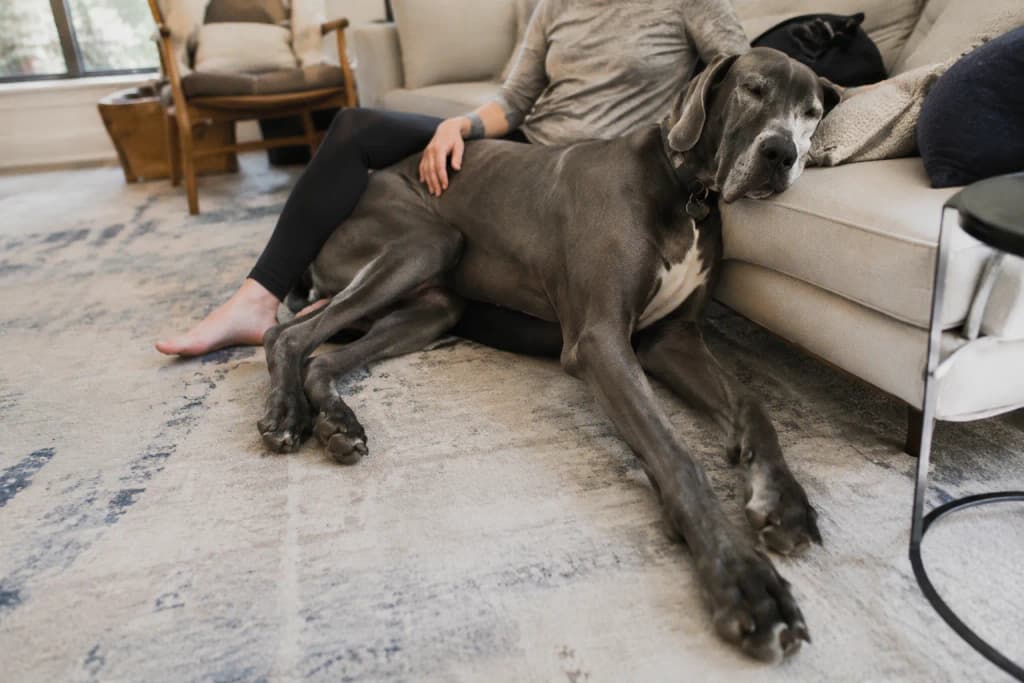
If you want a literal, forensic copy of your dog, no keepsake will fully satisfy you — that's just not what a sculpted portrait is. If you want the character preserved (the posture, the goofy lean, the specific way your Dane took up half the couch), then yes, it holds up well against the alternatives.
We're not the only option, and we'll say so. Here's an honest comparison for a large breed specifically:
| Option | Typical strength | Tradeoff for giant breeds |
|---|---|---|
| Full-color 3D printed sculpture | 3D form, coat color, posture | Needs good reference photos |
| Flat framed portrait | Affordable, wall-friendly | No dimensionality, no "presence" |
| Photo book / canvas | Cheap, many images | Doesn't capture physical scale |
| Mass-produced breed statue | Low cost | Not your dog, generic face |
For most families we work with, the value isn't the object. It's walking past the shelf and catching that head carriage out of the corner of your eye. If you're weighing cost against longevity, comparing a few custom pet portrait options side by side is smarter than guessing.
What to Expect From the Process
No product-manual energy here, just the shape of it so there are no surprises.
- Free AI preview. You can get a free instant AI preview right on the website to see the general idea before committing.
- Photo submission. Send that three-quarter shot and a profile. Eye-level, good light, no heavy shadow on the face.
- Artist's 3D preview. After a deposit, a master 3D artist digitally sculpts your Dane and sends a 3D preview, typically within 7 days. This is your moment to fix the ears, the tail curve, the stance.
- Full-color 3D printing and finishing. Once approved, it's printed in full-color resin, cleaned, cured, supports removed and sanded, then clear-coated.
- Delivery. Usually 27–40 days in the US after final payment (33–47 days international). Everything ships insured, tracked, and carefully packed.
For anything specific about your Dane's pose or markings, the custom dog figurine details on the site cover more than we can here, and the process changes often enough that the website is always the current source.
"You measure the shelf twice and forget to look at the depth. Then a 12-inch dog shows up for a 6-inch ledge."
Frequently Asked Questions
What size Great Dane figurine should I get?
For a standing pose, 6 to 9 inches is the sweet spot. It's tall enough to have real presence on a mantel, but small enough that the legs stay sturdy and the detail on the face holds. Measure your display spot's depth, not just height, before you decide.
Why do Great Dane figurines break at the legs?
Because a Dane's legs are proportionally thin, and resin is strong but brittle. If you scale the legs down literally, you get fragile sticks. A good sculpt quietly thickens the ankle area so the silhouette reads correct while the piece survives a knock.
Is a custom dog figurine worth it for a Great Dane?
If you want the character preserved — the head carriage, the goofy lean, the specific posture — it holds up well against flat portraits and photo books, which can't capture 3D presence. If you're after a literal hair-by-hair copy, adjust your expectations, since it's a sculpted interpretation.
What photos should I send for the best result?
One three-quarter angle shot at your dog's eye level and one clean side profile. Good, even light. Skip photos taken looking down from standing height, because they foreshorten the neck and shorten the muzzle, and the sculpt inherits those distortions.
Are the figurines painted?
No. The color comes from full-color resin 3D printing, where pigment is embedded in the material as it prints layer by layer. A clear coat is applied at the end for protection and sheen. That clear coat is the only manual finishing step.
Ready to Celebrate Your Pet?
Every pet has a story worth preserving. Whether you're honoring a gentle giant who's crossed the rainbow bridge or celebrating your Dane's here-and-now goofiness, getting great dane figurine sizing right means a keepsake that lasts and actually looks like your dog — a sculpted portrait, not a photocopy, with the coat color printed right into the resin.
Start with a free AI preview, refine the artist's 3D preview before anything prints, and know every order ships insured, tracked, and carefully packed.