
Displaying Your Calico Sculpt: A Side-by-Side Look at Capturing Her Patchwork Face
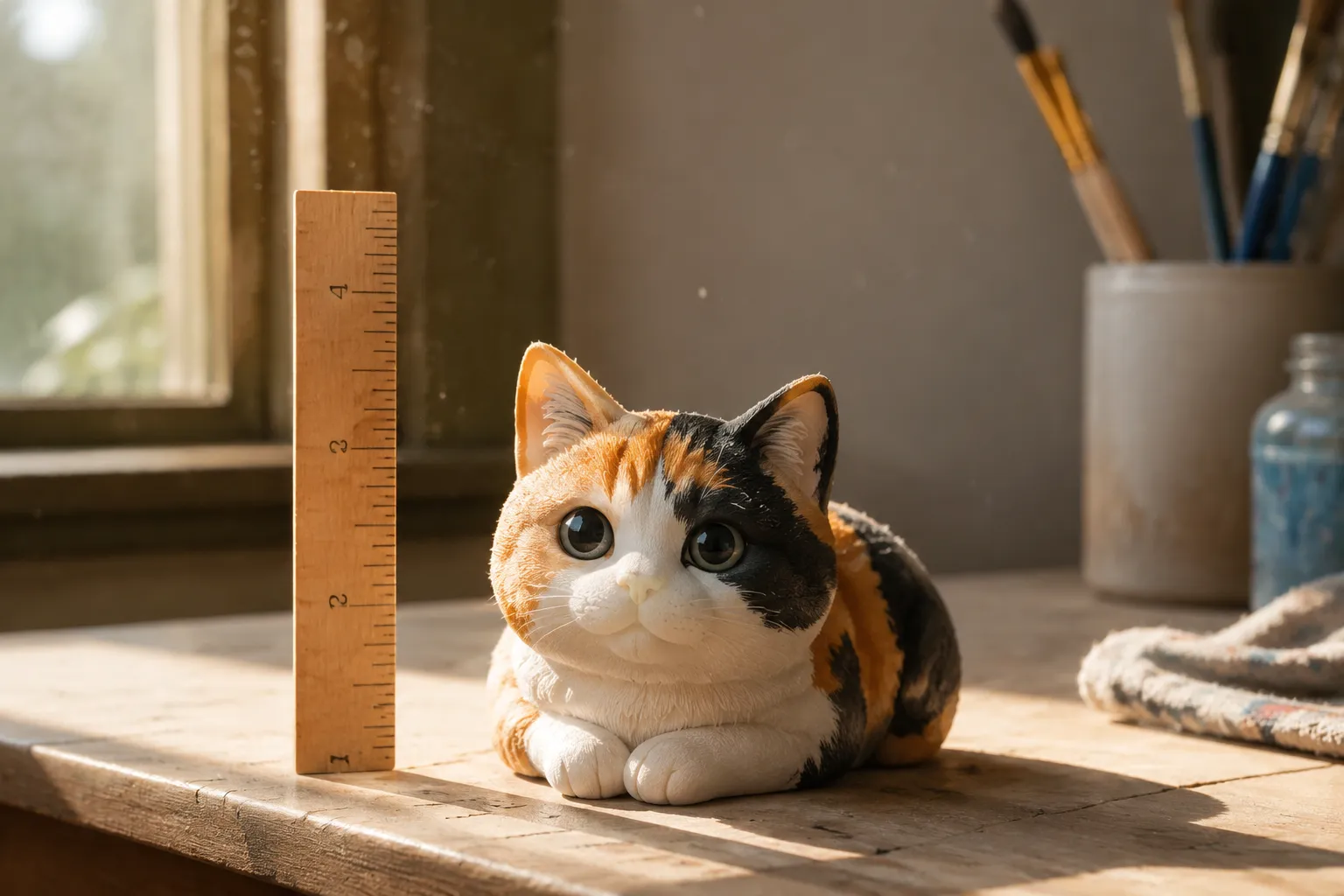
Late afternoon light hits the front porch, and there she is on the sill of your calico cat figurine shelf, that patchwork face frozen mid-yawn. One orange cheek. One black. The little white bib she always kept clean. You catch the scent of the old cushion she claimed as hers.
To display a calico cat figurine well, place it at eye level in soft, angled light that reveals the asymmetry of her tri-color face, and orient it so her "signature side" faces the room. Calico markings are never symmetrical, so lighting and angle matter more than for solid-colored pets when showing off her one-of-a-kind patchwork.
Quick Takeaways
- Asymmetry is the point — never "correct" a lopsided face; that randomness is her identity.
- Raking light reveals detail — angle a lamp low to make the color borders pop.
- Photograph the split — the best reference shows exactly where orange meets black.
- Full-color 3D printing embeds the pattern — explore how custom pet sculptures reproduce tri-color coats directly in resin.
- Rotate her every few months — even UV-resistant resin ages best out of direct sun.
Why a Calico Face Breaks the Usual Display Rules
Here is something most display guides will not tell you: the advice that works for a solid black Lab or a cream Persian actively works against a calico.
With a single-color pet, symmetry is your friend. You center the figure, light it evenly, and the eye reads it as balanced and calm. Do that with a calico and you flatten the very thing that made her her. That off-kilter blaze running down her nose. The orange patch that swallows one eye while the other sits in a field of white.
Calico coloring isn't a pattern in the tidy sense. It's the result of a genetic quirk called X-inactivation, where cells randomly "switch off" one of two X chromosomes early in development. That's why nearly all calicos are female, and why no two are ever alike. Even cloned calicos come out with different splotches. The ASPCA's overview of feline genetics touches on how coat color works, and the short version is this: your cat's face was a one-time roll of the dice.
So when you display her sculpt, you're not showing off a paint job. You're showing off a genetic fingerprint that will never repeat. That changes everything about how you angle, light, and place her.
"A calico's face isn't decorated. It's authored once, by chance, and never printed again."
The One Reference Photo That Makes or Breaks the Sculpt
We've worked with thousands of pet families, and calicos generate more back-and-forth during the preview stage than almost any other coat type. Not because they're hard to love. Because owners send us the wrong photo.
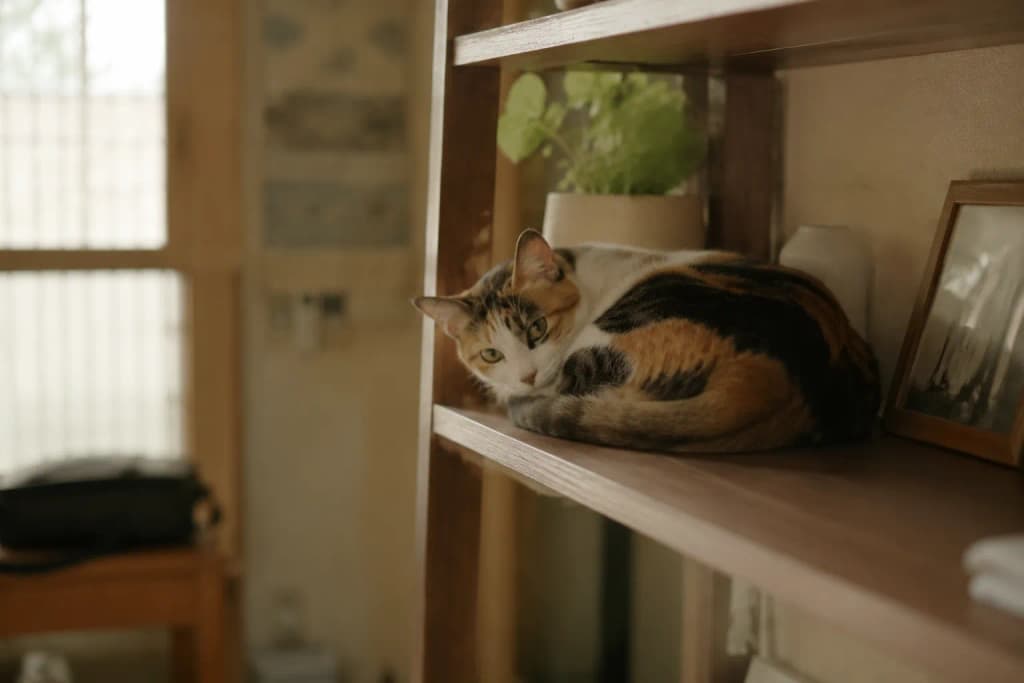
Here's the pattern we see constantly. Someone sends a gorgeous, soft-focus portrait shot from three-quarters above, cat looking up adoringly. Beautiful for a frame. Nearly useless for capturing where the black patch actually ends and the orange begins.
What our sculptors actually need to see
For a calico specifically, the color boundaries carry the likeness. A sculptor modeling a solid tabby can fudge a border by a few millimeters and nobody notices. On a calico, moving the edge of a facial patch even slightly can turn "that's her" into "that's a cat."
- A straight-on face shot in flat, even daylight (a shaded porch at midday is ideal, no harsh sun).
- A clear profile of each side — calicos are asymmetrical, so both cheeks tell different stories.
- One photo showing the top of the head where patches often meet in unpredictable swirls.
- A neutral expression, not a yawn or squint, so the patch edges aren't distorted by stretched skin.
The so what: color boundary accuracy is the difference between a figurine that stops you in the hallway and one that sits in a drawer. Spend ten minutes getting these four shots and you save yourself a revision cycle later.
One order stuck with us. A family sent us a single photo, but it happened to be a flatlay taken from directly above their cat napping on a quilt. Every patch edge crisp, both sides visible, the white bib clearly defined. Our sculptor said it was the easiest calico preview she'd built all year. Sometimes the "bad" candid beats the studio portrait.
How Full-Color 3D Printing Handles a Patchwork Coat
This is where I get to talk shop, because the technology behind a modern calico cat figurine is genuinely different from what most people picture.
When people imagine a custom figurine, they picture someone at a bench with tiny brushes, dabbing orange and black onto a little white cat. That's not how this works at PawSculpt, and honestly, that old method is exactly why cheap calico figures look wrong.
The actual process, start to finish
- Digital sculpting. A master 3D artist hand-models your cat in software like ZBrush or Blender, building the geometry, the posture, the set of the ears, the coat flow. This is where the artistry lives.
- Full-color printing. The finished model goes to a full-color resin 3D printer (PolyJet/MJF-style technology). The machine deposits color voxel by voxel — think of a voxel as a 3D pixel, a tiny cube of material. The orange, black, and white are printed directly into the resin as it builds.
- Post-processing. We clean, cure, and remove supports, then apply a protective clear coat for sheen and durability. That clear coat is the only manual finishing step. No color is added by hand.
Read that second step again, because it's the whole game for calicos. The color is part of the material, not a layer on top. A patch border that would take a painter a steady hand and a prayer is, for the printer, just a boundary in the digital file. Wherever the sculptor placed the edge of that black cheek patch, that's exactly where the color changes in the physical resin.
"With a calico, the machine never flinches at a color border. It prints the patchwork exactly where the artist placed it, down to the voxel."
— The PawSculpt Team
Why this matters for the "impossible" markings
Calicos often have those tiny freckle-like flecks, a spray of black over an orange muzzle, a single white toe in a dark paw. Full-color printing renders those transitions as smooth gradients or crisp edges depending on how the artist models them. There's no "bleeding" the way wet color bleeds, and no visible boundary line where two colors were laid down separately.
That said, be a smart consumer here. Our line is "a portrait, not a photocopy." The sculpt is an artist's interpretation of your cat's character and markings, not a molecule-for-molecule clone. It captures her patchwork, her posture, her expression. It won't reproduce every individual hair, and any studio promising that is selling you a fantasy.
Here's a quick reality check on the tradeoffs we actually weigh in production:
| Production Factor | What It Means | The Real Tradeoff |
|---|---|---|
| Layer height | Often 25–50 microns (a micron is 1/1000 mm) | Finer layers = smoother coat, longer print time |
| Print orientation | Angle the model sits at during printing | Affects where faint support marks land; we hide them under the belly |
| Hollowing & drain holes | Interior cavities to save resin | Lighter figure, but must be vented to cure evenly |
| Clear coat sheen | Matte vs. satin vs. gloss | Gloss pops color; matte reads more natural for fur |
None of these are numbers we invented for marketing. They're the ordinary decisions a print shop makes every day, and reasonable studios land in similar ranges.
Myth vs. Reality: Calico Figurines
Three things we hear constantly, and the truth behind each.
Myth: "A good figurine should have a perfectly symmetrical face."
Reality: For a calico, symmetry is a red flag. If both cheeks match, the sculptor guessed instead of following your photos. Lopsided is correct.
Myth: "The colors are painted on afterward, so they'll chip."
Reality: The color is printed into the resin as a full-color material. There's no paint layer to chip off. The clear coat on top guards against scuffs and UV.
Myth: "3D printed means plasticky and perfect, like a toy."
Reality: Full-color resin prints carry a fine natural grain and faint layer texture under the clear coat. It reads as an authentic handmade-feeling object, not an injection-molded toy.
That middle one surprises people most. We're not huge fans of how the industry has let "hand-painted" become shorthand for "quality," because for a complex coat like a calico's, embedded color is more consistent and more durable than any brush could manage.
Displaying Her: Light, Angle, and the "Signature Side"
Now the fun part, and the reason you're really here. You've got the sculpt. Where does she go?
Find her signature side first
Every calico has a "better" side, the one that tells her story fastest. Maybe it's the cheek where orange, black, and white all meet in a three-way split. Hold the figurine, rotate it slowly under a lamp, and watch for the angle that makes a stranger say "oh, look at her face." That's the side you aim at the room.
Micro-story: a customer told us she kept her cat's sculpt facing the window for weeks and felt something was off. She turned it 30 degrees toward the sofa, and suddenly the split-face patch caught the evening light. "That's the side she always showed me when she wanted dinner," she said. The sculpt hadn't changed. The angle had.
Use raking light, not flat light
Raking light means light that hits from a low, sharp angle rather than straight on. Photographers and sculpture conservators use it to reveal surface texture and edges. A small lamp placed low and to one side will make the color borders and the coat's modeled flow read three-dimensionally instead of washing flat.
- Do: position a warm LED lamp at roughly 30–45 degrees to one side.
- Don't: park her under a single overhead downlight (it flattens the face and hides the patchwork).
- Do: keep her at or just below eye level on a shelf, so you meet her gaze naturally.
Protect the resin over the years
Our materials are UV-resistant, but no material is UV-proof. Direct, all-day sun will eventually dull any pigment on earth.
| Display Choice | Why It Helps | Simple Action |
|---|---|---|
| Out of direct sun | Slows any long-term color fade | Keep off south-facing windowsills |
| Eye-level shelf | Shows the face as she showed it to you | Avoid high shelves that hide markings |
| Rotate quarterly | Even light exposure on all sides | Turn 90 degrees every few months |
| Dust with soft brush | Clear coat scratches with abrasives | Never use paper towels or cleaners |
The dusting one matters more than people expect. A dry makeup brush or a soft artist's brush lifts dust from the crevices around ears and paws without dragging grit across the clear coat. Skip the household spray cleaners entirely.
What to Expect From the Creative Process
If you're considering a sculpt of your own calico, here's the honest shape of it without any invented promises.
You can start with a free instant AI preview right on the website to get a rough feel for the concept at no cost. Once you place a deposit, an artist builds a proper 3D preview within about 7 days, and that's your window to nudge the patch placement, the pose, the expression. Use it. This is exactly when calico owners should point out "her orange patch sits higher over the left eye."
After final payment, delivery typically runs 27–40 days in the US and 33–47 days internationally. Sculpting a face well takes real time, and calicos take a touch more attention at the preview stage than solid coats. For anything about revisions, pricing, or specifics, the full service details live on the site and stay more current than any blog can.
Families choose different ways to keep a pet close. Some plant a garden. Some make a photo book. Others want something with weight in the hand, a small sculpted portrait on the shelf, and for a calico especially, a custom cat figurine captures the patchwork that a flat photo can flatten out.
"The sculpt sits where her sunbeam used to land. Same spot on the sill, same little face turned toward the door."
The Detail Owners Overlook Most
Here's the commonly missed thing, the one that reframes this whole topic.
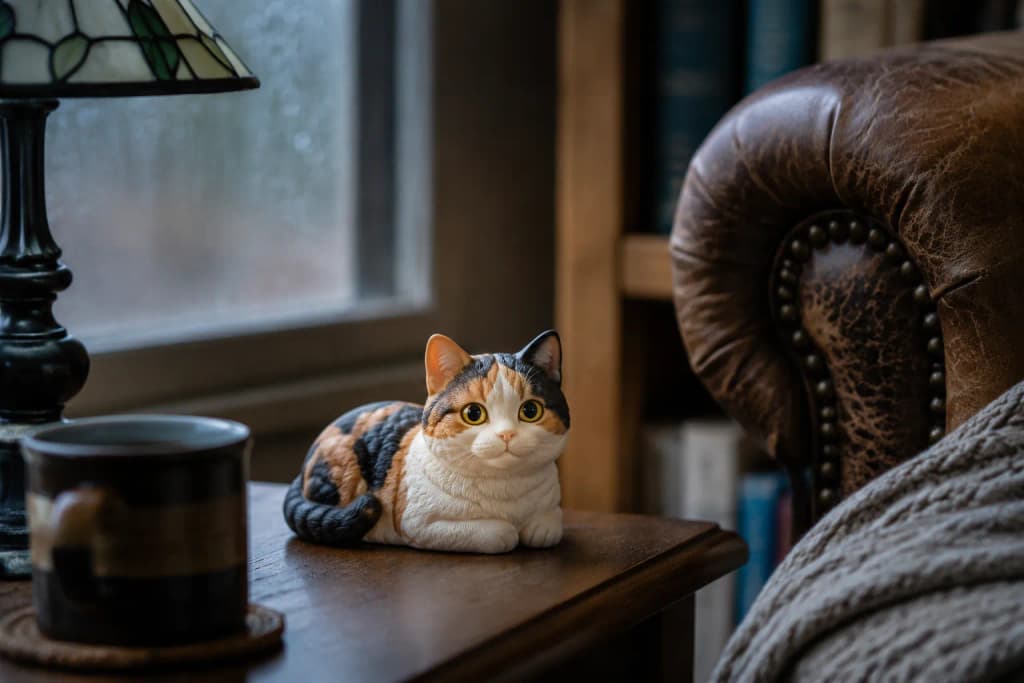
Owners obsess over getting the colors right and forget about the expression the colors sit on. A calico's markings are dramatic, sure. But you loved her face, not her color chart. The slight tilt of the head. The way one ear cocked. Whether her eyes read curious or sleepy or mildly unimpressed with you.
When you review your preview, spend half your attention on the geometry underneath the color. Does the head tilt feel like her? Because the most accurate patchwork in the world means nothing sitting on a face that isn't hers. That's the difference between a cat and your cat.
Frequently Asked Questions
What photos work best for a calico cat figurine?
Shoot in flat, even daylight, like a shaded porch at midday. You want a straight-on face shot, a clear profile of each side, and one from above where patches meet. Calicos are asymmetrical, so both cheeks carry different information the sculptor genuinely needs.
Are the colors painted on by hand?
No. This is full-color 3D printing, so the orange, black, and white are printed directly into the resin as the model builds, voxel by voxel. There's no brushwork and no paint layer. The only manual finishing step is a protective clear coat that adds sheen and guards against scuffs and UV.
Why does my calico sculpt look lopsided?
Because your cat was. Calico markings come from random X-inactivation, which is why the pattern never repeats and never matches side to side. A symmetrical calico face is the inaccurate one. That lopsided charm is her actual genetic signature.
How do I keep the colors from fading?
Keep her out of direct, all-day sun and rotate her a quarter turn every few months for even light exposure. Dust with a soft dry brush, never paper towels or household cleaners, which can scratch the clear coat over time.
Is a custom figurine better than a framed photo?
Different, not better. A photo captures a moment flat on a wall. A sculpted portrait gives you her face in three dimensions, something with weight you can hold. For a calico, the 3D form shows how the patches wrap around a real head in a way a photo can't.
Ready to Celebrate Your Pet?
Every pet has a story worth preserving. Whether you're honoring a beloved companion who's crossed the rainbow bridge or celebrating your calico's gloriously lopsided, one-of-a-kind patchwork face, a custom PawSculpt calico cat figurine — a sculpted portrait, not a photocopy — captures the character that makes her unmistakably herself.
Start with a free instant AI preview, refine the artist's 3D preview before anything is printed, and receive your finished sculpt carefully packed, insured, and tracked to your door.